Optical archives · Tech
A useful archive needs more than dense glass
Separate the specimen, the writing station and the future retrieval service.
- Keep the two glass regimes together with their numbersThe lower-cost material trades capacity for simpler optics. Combining the strongest figures from each creates a system the evidence does not describe.
- Count both plates and writing stationsA small shelf footprint can coexist with a substantial ingest job. Parallel equipment changes the arithmetic.
- Treat longevity as a bounded research resultThermal stability is one part of preservation. An archive must also keep its data retrievable.
The striking object in Microsoft’s glass-storage research is a thin square with no plug. Its potential comes from moving information inside a durable material, then leaving the written object on a shelf. The engineering question is how much machinery that apparently simple archive needs around it.
Microsoft’s February 2026 research update describes an important shift from high-purity fused silica to lower-cost borosilicate, familiar from heat-resistant cookware. The material change also simplifies the optical equipment. A record-capacity headline can obscure that trade.
The featured image is an AI-generated editorial illustration based on official specimen and laboratory references. It is not a photograph of a shipping product.
Two kinds of glass lead to two different results
The 2026 Nature paper by the Microsoft Research Project Silica Team reports the following usable capacities for a 120 × 120 × 2 mm platter.
Keep the material beside the capacity
| Material | Encoding regime | Usable capacity |
|---|---|---|
| Fused silica | Birefringent voxels | 4.84 TB |
| Borosilicate | Phase voxels | 2.02 TB |
The general Project Silica page also discusses raw capacity above 7 TB. Raw and usable capacity answer different questions, and a project overview can describe a different configuration. A smaller number in a later paper is therefore insufficient evidence that the whole project has gone backwards.
The useful comparison holds its definition steady. Ask which material, which encoding method and which allowances produced the number. Only then can capacity become an input to a planning exercise.
Simpler optics are the less obvious breakthrough
Microsoft’s author explanation describes single-pulse phase-voxel writing and a reader that needs one camera, compared with three or four in earlier arrangements. Fewer components also make writing equipment easier to manufacture and calibrate. The illustration below uses a three-camera example to show that simplification; it is not a complete optical schematic.
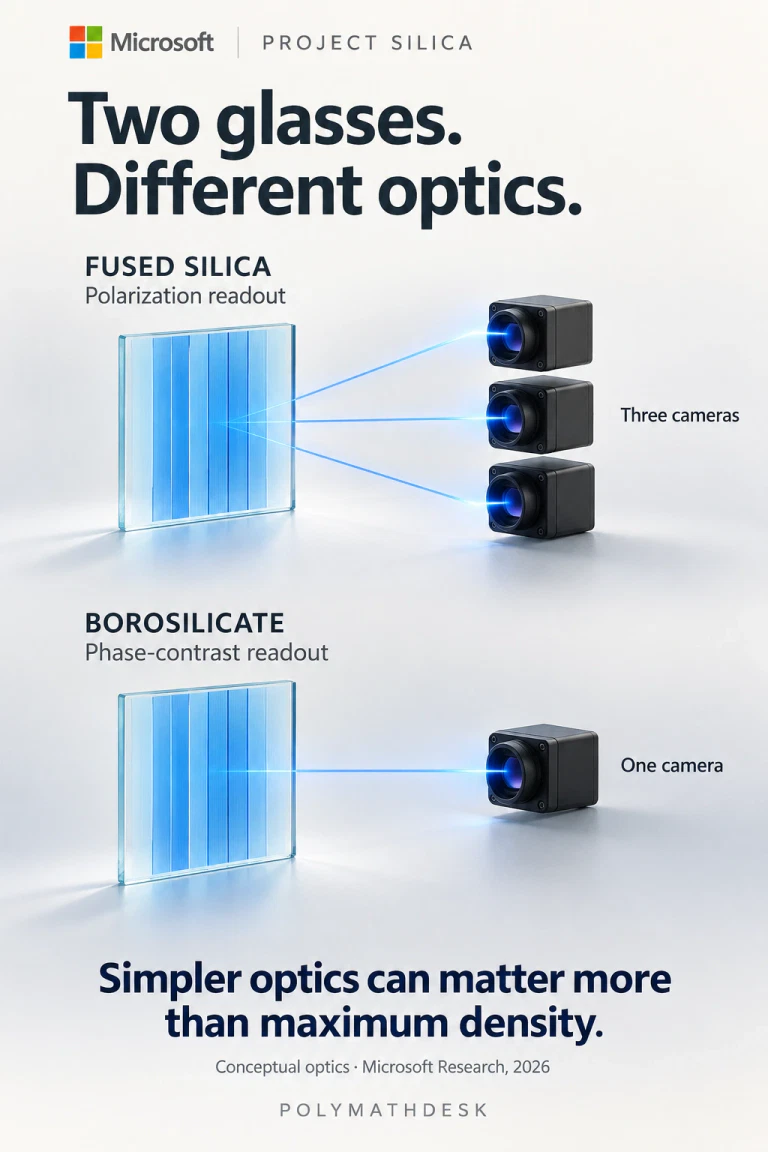
That gives an archive designer two competing opportunities. Denser media reduces the number of physical objects to house and handle. Simpler equipment may make it easier to build and operate more stations. Neither opportunity alone establishes the least expensive system: that requires actual equipment prices, reliability and a workload.
A 100 TB collection changes the shelf arithmetic
Consider a hypothetical collection containing exactly 100 decimal TB. Assume complete packing and no extra copies or cross-platter redundancy. Dividing the payload by each usable capacity and rounding upward gives 21 fused-silica platters or 50 borosilicate platters. These are our calculations, not a reported deployment.
The rounding matters. Twenty fused-silica platters would leave 3.2 TB without a home; forty-nine borosilicate platters would leave 1.02 TB. The next plate is necessary even when much of its space remains unused.
The resulting 50-plate minimum is a useful physical intuition. It is not the final bill of materials. A preservation policy can require separate copies, geographic separation, spares and reserve capacity. Those choices would increase the count, and they should remain visible rather than being smuggled into a “capacity” label.
The writing station sets another clock
The paper demonstrates 65.9 Mbit/s peak writing with four beams in borosilicate. Using that rate as a continuous idealization, our 100 TB payload requires approximately 140.5 station-days.
Days = payload in bytes × 8 ÷ bits per second ÷ 86,400. For this example, the numerator is 100 × 1012 × 8. The rate is 65.9 × 10⁶. This keeps bits and bytes separate.
More stations divide an idealized ingest job
| Four-beam stations | Ideal elapsed time |
|---|---|
| 1 | 140.5 days |
| 10 | 14.1 days |
| 100 | 1.4 days |
Each row describes a different equipment commitment. Ten stations do not make an individual plate ten times denser. A hundred stations do not prove that the required facility is affordable. They move the constraint from elapsed time toward equipment count, space, utilization and orchestration.
This is why a very long retention horizon can coexist with demanding short-term operations. An institution moving one completed collection has a different scheduling problem from a service accepting another large batch every day. The thought experiment makes that distinction explicit without inventing a commercial price or a promised delivery date.
Passive shelves still belong to an active system
The team’s 2023 system account separates writing, reading and storage racks. Shuttles transport platters from power-free shelves to the equipment that needs them. Its workload analysis also finds that small requests dominate operation counts, while a relatively small share of requests accounts for most bytes. Retrieval therefore involves request patterns and physical movement as well as read speed.
An archive evaluation should specify a retrieval exercise: select a collection, request it, verify the recovered files and record completion time. That exercise asks a different question from whether a specimen retains its optical changes. A storage medium can be an excellent foundation while the service around it remains the harder part to demonstrate.
Conditions also shape familiar media: our analysis of enterprise SSD offline retention explains why a product class cannot substitute for a storage specification. For a different long-horizon approach, the DNA storage primer follows information into molecular sequences.
A more distant but revealing comparison is ICARDA’s recovery from the Svalbard seed backup. The preserved material supplied a starting point; restoring a working collection required further work. Glass archives deserve the same concrete question: what must still function when someone wants the preserved information back?
Questions about an archive written in glass
Can I buy this as a replacement for an external drive?
Microsoft’s current presentation describes specialized writing and reading equipment for large-scale archival and cloud use. The cited research does not establish a consumer product or a purchasable service specification.
Does the arithmetic prove that borosilicate is cheaper overall?
No. The example counts media and ideal writing time. It lacks equipment prices, staffing, utilization, service reliability and retrieval costs. Those are necessary before judging total cost.
Primary research and official project accounts
- Microsoft Research Project Silica Team — Laser writing in glass for dense, fast and efficient archival data storage (Nature, 18 February 2026)
- Richard Black — Project Silica’s advances in glass storage technology (18 February 2026)
- Microsoft Research — Project Silica Sustainable cloud archival storage in glass (26 October 2023)
- Microsoft Research — Project Silica project overview
- Microsoft Unlocked — Sealed in glass (updated 17 March 2026)
Sources checked 12 September 2026. Calculations are original illustrative arithmetic, not experiments or purchasing estimates.