
Key takeaways from the DNA Data Storage analysis
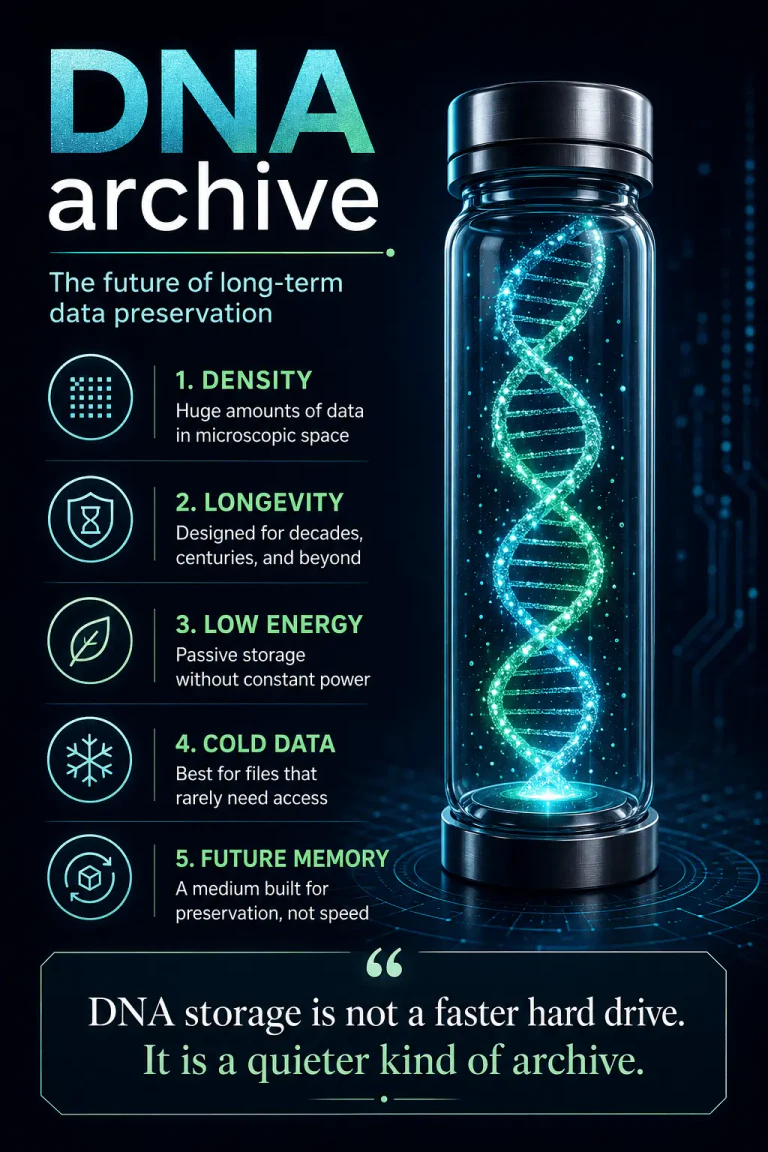
DNA data storage is not a futuristic replacement for everyday drives or cloud platforms. Its real promise lies in something narrower and more radical: preserving rarely accessed, high-value data for decades, centuries, or even longer.
- 1. DNA is an archival medium, not a faster hard drive DNA data storage should not be understood as a better SSD, a quicker hard drive, or a direct replacement for cloud storage. Its most realistic function is ultra-long-term preservation: storing information that does not need constant access, but must remain readable far into the future.
- 2. Its value comes from density, stability, and passive storage The appeal of DNA storage lies in three properties that conventional media struggle to combine: extreme physical density, long molecular stability, and almost no energy demand while the data remains passively stored. That makes it especially attractive for cold archives, not active computing.
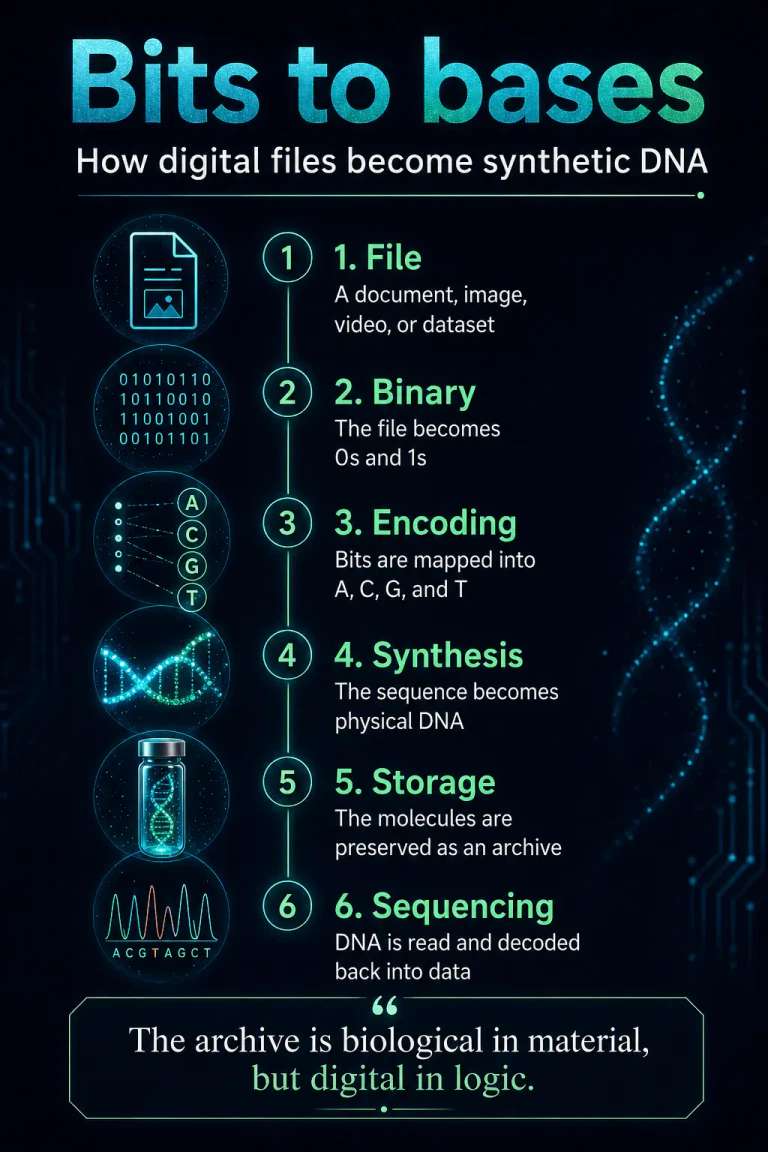
- 3. Digital files become molecular sequences The basic mechanism is simple in concept. Binary data is converted into sequences using the four DNA bases: A, C, G, and T. These sequences are then synthesized as physical DNA molecules, preserved, and later read back through sequencing before being decoded into the original digital file.
- 4. The technology works, but it is not yet mass-market storage DNA storage has already been demonstrated in laboratory settings, but several barriers still limit broader deployment. The most important challenges are synthesis cost, write speed, read speed, automation, error correction, and integration with existing digital infrastructure.
- 5. The most realistic future is cold archival storage The strongest use cases are not everyday files, apps, or active databases. DNA is better suited for cultural records, scientific datasets, government archives, legal documents, medical research, AI model snapshots, and other information that must survive for decades or centuries with minimal passive energy use.
Humanity is producing data faster than it can comfortably preserve it.
Photos, videos, medical scans, satellite imagery, financial records, scientific instruments, AI training datasets, public archives and private communication all feed the same expanding digital ocean. A widely cited IDC projection estimated that the global datasphere would rise from 33 zettabytes in 2018 to 175 zettabytes by 2025. Even if individual forecasts vary, the direction is obvious: our capacity to create data is growing faster than our ability to store all valuable information responsibly1.
The problem is not only volume. It is time.
Hard drives fail. SSDs have retention limits. Magnetic tape remains useful for enterprise archiving, but it still requires controlled conditions, periodic migration and specialized infrastructure. Optical media can degrade. File formats become obsolete. Hardware readers disappear. Data preservation is not a single act of saving a file; it is a continuous process of migration, verification, replacement and energy use.
This is why DNA data storage has become one of the most fascinating ideas in long-term information technology. Instead of storing bits in magnetic domains or electronic charge states, DNA storage encodes digital information into synthetic DNA molecules. It uses the same molecular alphabet that life has used for billions of years: adenine, cytosine, guanine and thymine.
The appeal is almost poetic. The future of digital memory may depend on the oldest information medium on Earth.
But the real story is more interesting than the slogan. DNA data storage is not magic. It is not ready to replace data centers. It is slow, expensive and technically demanding. Its future depends on whether researchers and industry can turn laboratory demonstrations into reliable, automated and economically sensible archival systems.
If that happens, DNA may become one of the most important cold-storage technologies of the next era.
Why conventional storage is under pressure
Modern storage technologies are excellent for active data. SSDs are fast. Hard drives remain cost-effective. Magnetic tape is still widely used for backup and archival purposes. Cloud infrastructure makes data available globally. These systems are not going away.
The issue is that most of them were not designed for civilization-scale preservation over centuries.
Long-term archives face a different problem from everyday computing. A company may need to keep legal records for decades. A research institution may need to preserve genomic or astronomical data for future analysis. A museum may want digital cultural artifacts to remain readable long after current hardware disappears. A government may need durable records that survive institutional and technological change.
Traditional media require ongoing maintenance. Data must be checked, copied, refreshed and migrated. Storage hardware needs power, cooling, space and operational oversight. Even when data is rarely accessed, the infrastructure around it still consumes resources.
A review of DNA data storage research notes that current magnetic, optical and solid-state storage technologies face issues of cost, space, energy use and limited durability when considered from the perspective of very long-term preservation2.
This is where DNA enters the conversation. Its value is not speed. Its value is density, stability and endurance.
What DNA data storage actually is
DNA data storage begins with a translation problem.
Computers store information as binary: 0s and 1s. DNA stores biological information through sequences of four bases: A, C, G and T. A DNA storage system needs a codec, meaning a software layer that converts digital data into DNA-compatible sequences and later converts those sequences back into digital files.
The SNIA DNA Data Storage Alliance describes this codec as the layer that translates source files from 1s and 0s into DNA bases and back again. In practice, this process is more complex than a simple substitution table, because the encoded DNA must avoid patterns that are difficult to synthesize, store or sequence reliably3.
A simplified workflow looks like this:
- A digital file is converted into binary data.
- The binary data is encoded into DNA base sequences.
- Error correction and indexing information are added.
- Synthetic DNA strands are chemically manufactured.
- The DNA is stored in a stable physical form.
- When retrieval is needed, the DNA is sequenced.
- The sequence is decoded back into the original digital file.
This means DNA data storage is not “putting files into living cells” in the usual commercial vision. Most serious archival concepts use synthetic DNA stored outside organisms, often dried, encapsulated or preserved in chemically stable environments.
The archive is biological in material, but digital in logic.
Why density matters
DNA’s storage density is the feature that first captures attention.
A famous 2017 DNA Fountain study demonstrated an encoding approach that approached the information capacity of DNA storage. Commentary around that work reported a theoretical density of about 215 petabytes per gram of DNA. That figure should be treated carefully because practical systems include redundancy, indexing, error correction and physical handling constraints. Still, it illustrates why the field is so compelling4.
Even if real-world usable density is far lower than theoretical density, DNA remains extraordinary compared with conventional storage media. A tiny physical sample can potentially hold enormous quantities of information.
That matters because data has a physical footprint. Data centers occupy land, consume energy and require cooling. Tape libraries and archival systems require buildings, climate control and logistics. If large volumes of cold data could be compressed into DNA archives, the physical space required for long-term preservation could shrink dramatically.
This is not mainly about storing your laptop backup in DNA. It is about archives so large that conventional preservation becomes increasingly expensive and environmentally demanding.
Why longevity matters even more
Density is impressive, but longevity may be the more important property.
DNA can degrade, but under the right conditions it can remain readable for very long periods. Ancient DNA recovered from fossils and preserved biological material shows that genetic molecules can survive far beyond the lifespan of modern electronic storage media. Reviews of DNA storage often note that dehydrated DNA stored under optimal conditions could potentially endure for extremely long periods, making it attractive for archival preservation.
This does not mean any vial of DNA will last forever. Storage conditions matter. Moisture, heat, radiation and chemical contamination can damage DNA. The future of the field depends not only on encoding and synthesis, but also on containment systems: glass, silica, polymers, capsules or other materials that protect the molecules over time.
Still, the principle is powerful. A well-designed DNA archive could reduce the need for constant migration from one medium to the next. Instead of copying data every few years or decades because the medium is aging or the hardware is obsolete, DNA could function as a write-once, preserve-long-term medium for data that rarely needs to be accessed.
SNIA’s 2025 technology review frames DNA storage as a complementary capability, not a replacement for existing storage technologies, and specifically points toward archival use cases as the likely early commercial direction.
That distinction is crucial.
DNA storage is not competing with RAM, SSDs or hard drives for speed. It is competing with the long-term burden of keeping cold data alive.
How writing data into DNA works
Writing data into DNA is the hardest and most expensive part of the process.
After software converts the file into DNA sequences, those sequences must be synthesized. DNA synthesis is a chemical manufacturing process. It builds physical strands nucleotide by nucleotide according to the designed sequence.
This is very different from writing to an SSD. Electronic writing is fast because it changes physical states in existing hardware. DNA writing has to manufacture molecules. That is why current DNA storage is slow and costly compared with electronic storage.
The DNA Data Storage Alliance has emphasized that reductions in synthesis and sequencing costs are essential for adoption. Its introductory paper cites ambitious cost targets connected to the IARPA MIST program, including a long-term goal of dramatically reducing synthesis cost per terabyte.
This is the economic bottleneck. The idea works. The question is whether it can become cheap and automated enough to matter outside specialized contexts.
How reading data from DNA works
Reading DNA-stored data requires sequencing.
The stored DNA is retrieved, prepared and passed through a sequencing process that determines the order of A, C, G and T bases. The resulting sequence data is then decoded by software back into the original binary file.
This process can be accurate, but it is not instant. DNA sequencing has become far cheaper and faster over the past two decades, largely because of biotechnology and medical research. DNA data storage benefits from those improvements, even though data archiving is not the main driver of the sequencing industry.
There is another important issue: random access.
An archive is not very useful if retrieving one file requires sequencing everything. Researchers have therefore developed methods to tag, index and selectively retrieve particular files. In 2018, University of Washington and Microsoft researchers reported random access in a large-scale DNA data storage system, encoding more than 200 MB of data into over 13 million DNA oligonucleotides and recovering individual files5.
This was not a commercial product, but it demonstrated a key requirement: DNA archives need file-level retrieval, not just bulk recovery.
Error correction is not optional
DNA storage sounds elegant, but molecular systems are noisy.
Errors can occur during synthesis, storage, amplification, sequencing and decoding. Bases can be inserted, deleted or substituted. Some strands may be damaged or lost. Sequencing may produce imperfect reads. A practical DNA archive must assume that errors will happen.
That is why error correction is central to the field.
Just as conventional digital storage uses redundancy and error correction codes, DNA storage systems add extra information so that corrupted or missing pieces can be detected and repaired computationally. The codec must balance density with reliability. More redundancy improves recovery, but reduces usable storage efficiency.
This is one reason simple claims like “one gram of DNA can store X petabytes” can be misleading. A real archive needs metadata, indexing, primers, redundancy, error correction and physical handling design. The theoretical capacity is astonishing, but commercial usefulness depends on the full system.
DNA storage is best understood as cold storage
The most common misunderstanding is to imagine DNA as a general-purpose hard drive.
It is not.
DNA storage is not suitable for data that must be rewritten constantly or accessed instantly. It is not appropriate for operating systems, active databases, gaming, video editing or real-time cloud services. Writing is too slow. Reading is too involved. Costs remain too high.
Its natural use case is cold data: information written once or rarely, preserved for a long time, and accessed infrequently.
Examples include:
- national archives,
- scientific datasets,
- cultural heritage collections,
- historical records,
- legal and compliance archives,
- medical research repositories,
- satellite and climate data,
- AI model checkpoints,
- institutional memory,
- deep backup systems.
In these cases, speed is less important than durability. A file that may not be opened for 50 years does not need SSD-like access time. It needs to survive.
That is the real niche where DNA storage could become transformative.
The environmental argument
Data storage has an environmental cost.
Active data centers require electricity, cooling, hardware replacement and physical infrastructure. Even archival systems consume resources through maintenance, migration and climate control. As data volumes grow, the sustainability of storage becomes more important.
DNA’s passive storage profile is attractive because dried, protected DNA does not need continuous power to preserve information. Energy is required during synthesis, processing and sequencing, but a stable DNA archive can sit inertly without the constant power demands of active electronic storage.
This does not automatically make DNA storage “green.” The full environmental impact depends on synthesis chemistry, manufacturing scale, materials, logistics and retrieval frequency. But for cold archival storage, the possibility of very low passive energy demand is one of the technology’s strongest arguments.
The promise is not that DNA eliminates the environmental cost of data. The promise is that it may reduce the long-term cost of preserving data that does not need to remain constantly online.
Future-proofing and technological obsolescence
Every archive faces a strange problem: the data may survive, but the reader may not.
We already know this from floppy disks, magnetic tapes, old file formats and obsolete storage systems. Preserving information requires preserving the ability to interpret it.
DNA offers an unusual advantage here. DNA is not tied to one company’s hardware format. It is a universal molecule, and sequencing DNA will likely remain scientifically important for as long as biotechnology exists. A future civilization may not have a working Blu-ray drive or today’s cloud APIs, but it is likely to understand DNA if it has advanced biology.
That does not remove the need for metadata. A DNA archive still needs clear instructions, encoding standards and information about how to reconstruct the files. This is why standardization matters. SNIA’s DNA Data Storage Alliance explicitly works on education, specifications and standards for an interoperable ecosystem.
The molecule may be ancient, but the archive still needs documentation.
The biggest barriers
DNA data storage is promising, but several barriers remain.
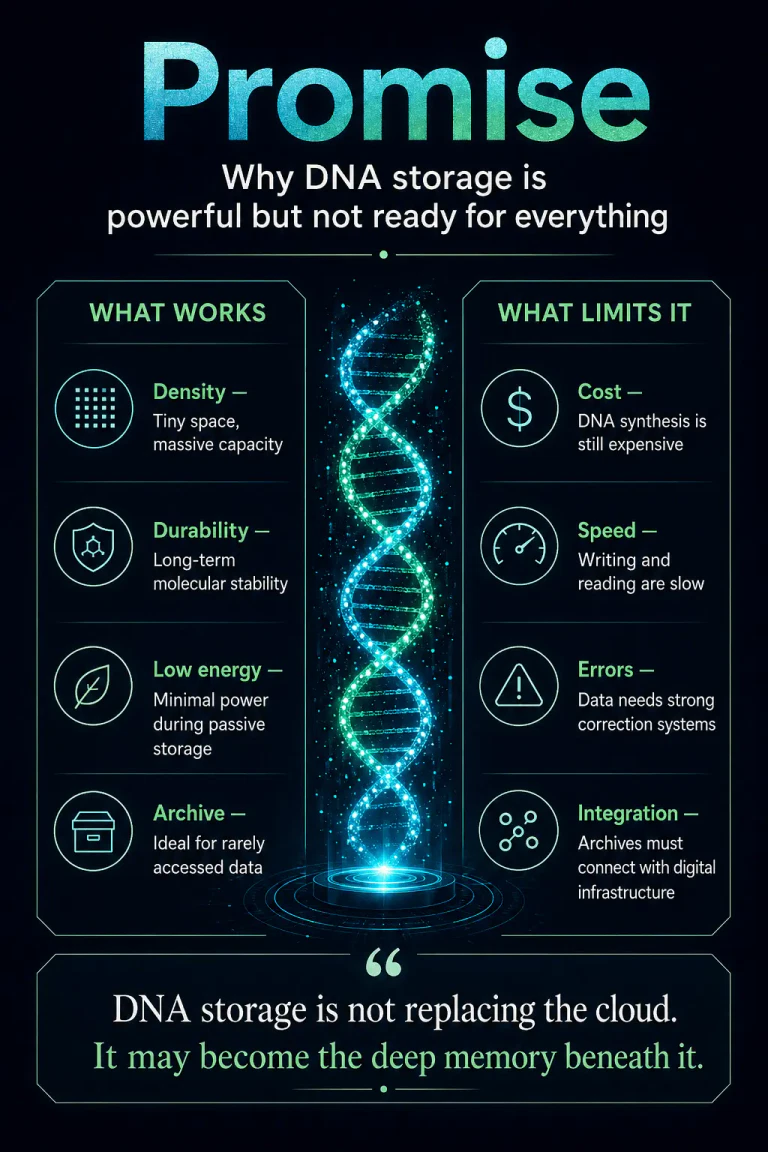
The first is cost. DNA synthesis is still too expensive for broad archival deployment. Sequencing costs have fallen dramatically, but writing data into DNA remains the larger challenge.
The second is speed. Chemical synthesis and sequencing are much slower than electronic read/write operations. This is acceptable for some cold storage, but not for active data.
The third is automation. Laboratory workflows must become industrial workflows. A commercial DNA archive cannot depend on fragile, manual, research-scale procedures.
The fourth is reliability. Error correction, preservation methods and retrieval protocols must work predictably at scale.
The fifth is integration. Data centers and archive systems need interfaces that allow DNA storage to fit into existing data management workflows. Administrators should not have to think like molecular biologists to use it.
The sixth is standardization and governance. Codecs, metadata, physical containment, biosecurity and long-term readability all require shared norms.
A 2022 review of emerging DNA storage approaches summarized the field as promising but still constrained by low writing and reading speeds and high cost per byte stored. SNIA’s 2025 review similarly describes the technology as nascent, while noting that the foundations of writing, storing, retrieving and reading data using DNA have been demonstrated on scalable technology platforms.
That is the balanced view: real progress, real barriers.
Why the hype should be corrected, not dismissed
DNA data storage attracts big claims.
All the world’s data in a shoebox. Archives lasting millions of years. Biological hard drives. The ultimate storage solution.
Some of these phrases contain a kernel of truth, but they can also distort the actual technology. DNA storage will not make conventional storage obsolete. It will not replace fast electronic media. It will not solve every data problem. It will not remove the need for curation, metadata, security or format preservation.
But dismissing the field because of hype would also be a mistake.
The core idea is technically sound. Researchers have stored and retrieved digital files in DNA. Random access has been demonstrated. Error correction is an active field. Preservation materials are improving. Standards groups are forming. Biotech cost curves may continue to help.
The mature version of DNA storage will probably look less dramatic than the headlines, but more useful than skeptics assume: a specialized archival layer in a broader storage hierarchy.
Hot data stays on fast systems.
Warm data stays in conventional infrastructure.
Cold, high-value, rarely accessed data may eventually move into molecular archives.
A realistic future for DNA archives
The most plausible future is hybrid.
DNA storage becomes one layer of a larger ecosystem. It is used when the cost of losing data is high, the expected retention period is long, and access frequency is low. Institutions do not replace their storage systems with DNA. They add DNA as a preservation tier.
Imagine a national archive preserving constitutional records, census data, cultural artifacts and historical media in DNA capsules designed to last centuries. Imagine scientific institutions storing raw observational datasets that future researchers may reinterpret with better tools. Imagine AI laboratories preserving major model versions as long-term records. Imagine museums storing digital scans of fragile works whose physical forms may be lost.
In all of these cases, the value of DNA is not convenience. It is endurance.
SNIA’s 2025 review suggests that DNA archival storage use cases may emerge over the next three to five years, while broader and more flexible capabilities will depend on continued investment and technical progress.
That is not a guarantee. It is a reasonable horizon for early archival adoption if costs, automation and standards continue to improve.
- https://www.forbes.com/sites/tomcoughlin/2018/11/27/175-zettabytes-by-2025/ ↩︎
- https://pmc.ncbi.nlm.nih.gov/articles/PMC10296570/ ↩︎
- https://www.snia.org/sites/default/files/DNA/SNIA-DNA-Data-Storage-Technology-Review-v1.0.pdf ↩︎
- https://pubmed.ncbi.nlm.nih.gov/28254941/ ↩︎
- https://news.cs.washington.edu/2018/02/19/uw-and-microsoft-researchers-achieve-random-access-in-large-scale-dna-data-storage/ ↩︎


