Understanding Wet-Bulb globe temperature technology
WBGT differs fundamentally from simple air temperature or heat index measurements by incorporating four critical environmental factors: air temperature, humidity, radiant heat from solar exposure, and wind movement. This comprehensive approach provides a more accurate assessment of heat stress on the human body than traditional weather metrics.
The calculation uses the formula: WBGT = 0.7Tw + 0.2Tg + 0.1Td for outdoor environments, where Tw represents natural wet-bulb temperature, Tg indicates globe thermometer readings capturing radiant heat, and Td measures dry-bulb air temperature. This weighted formula emphasizes humidity's dominant role in heat stress, accounting for 70% of the final calculation.
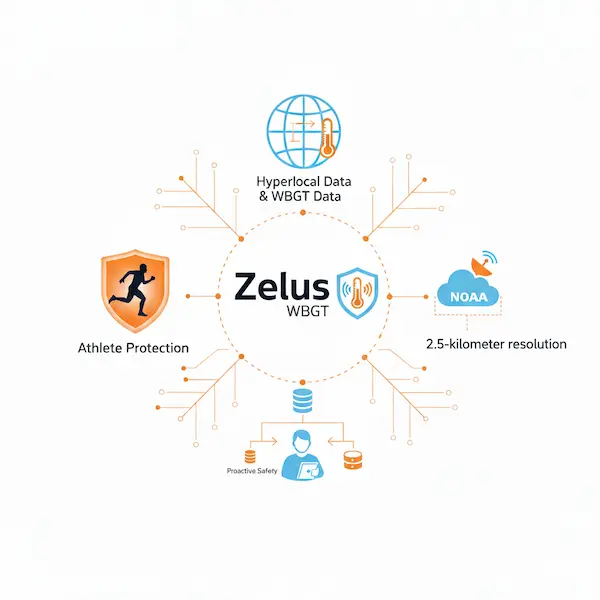
Traditional WBGT monitoring required expensive hardware costing thousands of dollars, including black globe thermometers, natural wet-bulb sensors, and data loggers. The Zelus system eliminates this barrier by leveraging hyperlocal weather data from multiple sources including NASA satellite imagery, precipitation radar, and weather station networks to provide accurate WBGT calculations through smartphone technology.
Hyperlocal weather resolution advantages
The 2.5-kilometer resolution represents a significant advancement in weather safety monitoring. Weather conditions can vary dramatically over short distances, particularly in areas with varied terrain, urban heat islands, or coastal influences. Generic city-wide forecasts often fail to capture microclimatic variations that significantly impact athlete safety.
Zelus integrates data from the world's most advanced weather datasets, including NASA MODIS satellite data, multi-sensor precipitation systems, MERRA2 and ERA5 reanalyses, and the Vaisala lightning network. This comprehensive data fusion enables the app to account for solar irradiance, sun angle, cloud cover, atmospheric pressure, and wind speed at specific geographic coordinates.
The hyperlocal approach proves especially critical for outdoor sporting venues where surface conditions, elevation changes, and surrounding structures create unique thermal environments. A football field surrounded by asphalt parking lots experiences different heat loads than one bordered by trees and grass, even when separated by less than a mile.
Sports Industry Risk Management Applications
Athletic organizations increasingly recognize WBGT as the gold standard for heat safety protocols. The American College of Sports Medicine bases its practice intensity guidelines on WBGT readings rather than simple temperature measurements. States like Georgia have mandated WBGT monitoring for all high school outdoor athletic programs, while Texas's University Interscholastic League recommends transitioning from heat index to WBGT-based safety protocols.
The Zelus system provides automated activity modification recommendations based on configurable thresholds. When WBGT levels indicate elevated risk, the app suggests specific interventions: increased hydration breaks, modified practice duration, equipment adjustments, or complete activity suspension. These evidence-based recommendations help coaches make consistent safety decisions rather than relying on subjective assessments.
Professional sports organizations, including Fortune 500 companies and elite athletic teams, rely on Zelus for compliance and liability protection. The app's automatic data logging with secure timestamps provides defensible documentation for insurance claims, regulatory audits, and legal proceedings. This electronic record-keeping eliminates disputes about whether safety protocols were followed.
Player safety versus performance optimization balance
The tension between athlete safety and competitive performance presents ongoing challenges for coaches and athletic administrators. Traditional approaches often err toward either excessive caution, limiting training opportunities, or inadequate protection, risking heat-related illnesses. WBGT monitoring enables evidence-based decision-making that optimizes both safety and performance outcomes.
Research demonstrates that heat-related illnesses are entirely preventable with proper monitoring and intervention protocols. Exertional heat stroke, the leading cause of preventable death in athletics, typically occurs when environmental heat stress exceeds the body's cooling capacity. WBGT readings provide early warning indicators that enable proactive cooling strategies before dangerous core temperature elevations occur.
The Zelus app facilitates graduated responses to increasing heat stress rather than binary practice/no-practice decisions. At moderate WBGT levels (82-87°F), teams might implement additional water breaks and remove non-essential equipment. Higher readings (87-90°F) could trigger shortened practice duration and mandatory rest periods. Extreme conditions (>90°F) necessitate activity modification or cancellation.
Technological innovation and accuracy validation
Independent research validates the Zelus system's accuracy against traditional hardware-based WBGT measurement. In a dataset of over 20,000 unique readings from May through November, WBGT calculations from weather parameters consistently measured within 1 degree Celsius of gold-standard WBGT sensors. This accuracy level meets or exceeds regulatory requirements while providing real-time accessibility.
However, comparative studies highlight important limitations of app-based WBGT systems. University of Georgia research involving 1,056 paired readings across 26 high schools found that smartphone WBGT apps can underestimate actual conditions by up to 4°F during high-risk periods. This discrepancy potentially places athletic activities in incorrect safety categories when heat stress is most dangerous.
The accuracy challenges stem from reliance on modeled weather data rather than on-site measurements. Local factors like artificial surface heating, stadium wind patterns, and equipment-generated radiant heat create microenvironments that differ from regional weather model predictions. Professional installations increasingly combine app-based monitoring with on-site sensor verification for critical safety applications.
Implementation best practices and limitations
Effective WBGT monitoring requires understanding system limitations and implementation best practices. The Zelus app performs optimally when using saved location coordinates rather than real-time GPS positioning, which may reflect outdated or inaccurate location data. Indoor venues, enclosed courts, and large asphalt surfaces can produce erroneous readings due to modeling assumptions about standard outdoor environments.
Athletic trainers should establish clear protocols for WBGT monitoring frequency, typically every 30 minutes during high-risk periods. The app's alert notification system can automate this process, but manual verification remains important during rapidly changing conditions. Staff training ensures consistent interpretation of WBGT readings and appropriate implementation of activity modifications.
Integration with broader safety protocols enhances WBGT monitoring effectiveness. Emergency action plans should specify responses to different WBGT thresholds, including cooling station placement, medical personnel availability, and evacuation procedures. Regular equipment maintenance, including backup measurement systems, ensures continuous monitoring capability during critical periods.