Key takeaways from the Quantum Computing Business analysis
Quantum computing is unlikely to transform every business at once, but it may create a narrow and powerful advantage in industries built around molecular simulation, optimization, risk modeling, logistics and cybersecurity. The real question is not whether every company needs a quantum computer, but whether it understands where quantum disruption could touch its business model:
- 1. Quantum advantage will arrive unevenly Quantum computing will not replace classical computing or transform every sector by 2030. Its first serious business value will appear in specific problem areas where classical systems struggle: drug discovery, materials science, portfolio optimization, risk modeling, supply chain planning and complex simulation. The early winners will be companies that can identify where quantum methods solve a real bottleneck, not those that treat the technology as a general-purpose IT upgrade.
- 2. Cybersecurity may feel the impact before most industries see performance gains The most urgent quantum issue for many organizations is not faster computation, but cryptographic risk. Sensitive data collected today may become vulnerable later if powerful quantum computers can break widely used public-key encryption. This makes post-quantum cryptography, cryptographic inventories and crypto-agility practical business priorities long before fault-tolerant quantum machines become common.
- 3. Quantum readiness matters more than quantum ownership Most companies do not need to buy or build quantum hardware. They need enough internal literacy to map use cases, test hybrid workflows, evaluate vendors, prepare security systems and separate serious opportunities from inflated claims. Quantum readiness means understanding which business problems could benefit from quantum computing, which risks require action now and which experiments are worth running before the market becomes obvious.
Quantum computing has spent years in a strange position. It is one of the most serious fields in modern technology, built on hard physics, difficult engineering and billions of dollars in research, yet it is also surrounded by some of the most careless language in the tech industry. Every few months, another headline suggests that quantum computers will cure disease, break encryption, redesign finance or unlock new materials almost overnight. The promise is real, but the timeline is often blurred.
For business leaders, the question is no longer whether quantum computing is interesting. That debate is over. The better question is whether it will become commercially useful soon enough to affect strategy before 2030.
The honest answer is uncomfortable because it sits between hype and dismissal. Quantum computing will probably not revolutionize every business by 2030. It will not replace classical computing. It will not put quantum laptops on office desks. It will not make today’s data centers obsolete in one dramatic leap. Most companies will still run on cloud infrastructure, AI systems, classical optimization engines and ordinary enterprise software.
But that does not mean nothing important will happen.
By the end of this decade, quantum computing is likely to begin changing the competitive landscape in a narrower but more meaningful way. The first business impact will appear where the problems are too complex, too probabilistic or too combinatorial for classical systems to handle efficiently. Drug discovery, materials science, portfolio optimization, risk modeling, logistics, energy systems and cybersecurity are the most obvious candidates.
The shift will not look like a universal revolution. It will look like an uneven advantage. A few companies will learn how to use quantum systems, quantum-inspired methods and hybrid workflows earlier than competitors. They will not necessarily own quantum hardware. They may access it through cloud platforms, research partnerships or specialized vendors. Their advantage will come from knowing which problems are worth testing, how to translate them into quantum-compatible forms and how to integrate early results into business decisions.
In that sense, the quantum revolution may begin quietly. Not as a replacement for classical computing, but as a new layer of computational strategy.
What quantum computing actually changes
Classical computers process information using bits. A bit is either 0 or 1. Every digital system, from a smartphone to a supercomputer, ultimately depends on this binary foundation. Quantum computers use qubits, which behave according to quantum mechanics. A qubit can exist in a combination of states through superposition, and multiple qubits can become linked through entanglement. These properties allow quantum systems to represent and manipulate certain kinds of complexity differently from classical machines.
That does not mean a quantum computer is simply a faster computer. This is one of the most common misunderstandings. A quantum computer is not designed to speed up every task. It will not open spreadsheets faster, train every AI model more cheaply or run ordinary business software more efficiently. Its value appears in specific problem classes where the structure of the problem matches the strengths of quantum computation.
The practical promise lies in problems where the number of possible states becomes impossibly large. Molecular simulation is one example. Optimization is another. Some cryptographic problems are especially exposed because known quantum algorithms could, at sufficient scale, attack mathematical assumptions used in today’s encryption systems. The reason quantum computing matters is not that it is universally superior. It matters because it may be radically better for a limited set of problems that are extremely valuable.
This distinction is crucial for business strategy. Companies that treat quantum as a general-purpose IT upgrade will waste money. Companies that treat it as a specialized computational tool may begin to see where it belongs.
Quantum advantage is not the same as business value
The phrase quantum advantage is often used as if it marks one clean moment when quantum computers suddenly become useful. In reality, it is more complicated.
In the strict technical sense, quantum advantage refers to a quantum computer performing a task that a classical computer cannot match efficiently. But a task can be technically impressive and still commercially irrelevant. A quantum processor may outperform classical machines on a benchmark designed to prove a physics point, while still being far from solving a practical business problem in pharmaceuticals, finance or logistics.
For companies, the more important milestone is not abstract quantum advantage. It is business-relevant quantum advantage. That means a quantum or hybrid quantum-classical system produces a result that is better, faster, cheaper or more decision-relevant than the classical alternatives for a real use case.
This is a higher bar.
A bank does not need a quantum demonstration. It needs better risk analysis, portfolio construction or fraud detection. A pharmaceutical company does not need a beautiful quantum circuit. It needs a way to reduce failed experiments, identify promising molecules or simulate interactions that classical methods approximate poorly. A logistics company does not need to prove quantum theory. It needs fewer empty miles, better routing, lower fuel costs and more resilient planning.
The gap between laboratory success and business value is where many quantum claims become inflated. The technology is advancing, but the business case still has to be earned use case by use case.
Why the road to 2030 is different from earlier hype cycles
Quantum computing has already survived several hype waves. What makes the current phase more serious is that hardware progress, cloud access, error correction research and enterprise experimentation are beginning to converge.
Large technology companies are publishing roadmaps instead of vague promises. Quantum processors are becoming more accessible through cloud platforms. Startups are specializing in hardware, software, error mitigation, quantum algorithms, sensing, security and industry-specific use cases. Governments are treating quantum as strategic infrastructure rather than a niche research field. At the same time, post-quantum cryptography has moved from academic preparation into standardization and migration planning.
This does not remove the uncertainty. Quantum computers remain fragile. Error rates remain a major obstacle. Useful fault-tolerant systems require a large gap between physical qubits and logical qubits, because many physical qubits may be needed to create one reliable logical qubit. The software ecosystem is still young. There are not enough quantum engineers, quantum algorithm developers or business translators who can connect real industry problems to quantum methods.
Still, the field has moved beyond pure speculation. Companies no longer need to build their own quantum computers to start learning. They can access early systems through cloud services, partner with vendors, test hybrid algorithms and identify where quantum may eventually matter. That changes the strategic question.
The question is no longer: should we buy a quantum computer?
The question is: which parts of our business could become exposed to quantum advantage, quantum threat or quantum-enabled competition?
Pharmaceuticals and chemistry
The most intuitive business case for quantum computing is molecular simulation. Chemistry is quantum mechanical at its foundation. Molecules, electrons and chemical bonds do not behave like simple mechanical objects. Classical computers can model them, but many simulations require approximations because the underlying complexity grows extremely fast.
This is why pharmaceuticals and advanced chemistry are often placed at the center of the quantum story. If quantum computers become capable of simulating molecular behavior more accurately, the impact could be substantial. Drug discovery is expensive, slow and failure-prone. Many compounds that look promising fail later because biological systems are more complex than early models suggested. Even modest improvements in simulation, screening or target identification could change the economics of research and development.
The strongest early use cases are unlikely to mean that quantum computers instantly “cure cancer” or fully automate drug discovery. That language is misleading. The more realistic impact is narrower: better modeling of molecular interactions, improved understanding of binding affinities, more efficient candidate screening, support for protein-ligand analysis, and eventually more accurate work in areas where classical approximation is especially costly.
The same logic applies to materials science. Batteries, catalysts, semiconductors, fertilizers, carbon capture systems and industrial chemicals all depend on complex physical and chemical processes. A company that can model better materials faster may gain an advantage long before quantum computing becomes mainstream.
For business, this means the first serious quantum value may arrive not through consumer products, but through hidden improvements in research pipelines, lab productivity and material performance.
Finance and risk modeling
Finance is another sector where quantum computing could matter early because the industry is full of optimization, probability and uncertainty.
Portfolio optimization, derivative pricing, capital allocation and risk modeling all involve large numbers of variables. Classical systems already handle these tasks at enormous scale, but the complexity of modern markets continues to grow. Financial institutions must evaluate correlated risks, stress scenarios, liquidity constraints, regulatory requirements and nonlinear market behavior. The value of even a small improvement can be large if it affects capital efficiency, hedging accuracy or risk visibility.
This is why major banks have been experimenting with quantum algorithms for years. The short-term value may come less from replacing classical models and more from hybrid exploration. Quantum methods may help test new approaches to optimization or sampling, while quantum-inspired algorithms may generate value even before fault-tolerant quantum hardware is available.
This part is often overlooked. Quantum computing can influence business before mature quantum computers dominate production systems. The attempt to think quantum mechanically can lead to new algorithmic approaches on classical hardware. In finance, where the search for marginal advantage is relentless, that alone can justify experimentation.
But finance also shows the limits. A model that works in a controlled setting must survive regulation, auditability, risk governance and operational constraints. A bank cannot deploy a black-box quantum process simply because it is elegant. It needs explainability, repeatability, security and integration with existing systems.
By 2030, quantum computing may not transform all financial modeling. But it is plausible that leading institutions will use quantum and quantum-inspired tools in selected high-value workflows, especially where uncertainty and optimization collide.
Logistics, manufacturing and supply chains
Supply chains are made of combinatorial problems. Routes, warehouses, inventory, fuel costs, delivery windows, demand shocks, labor constraints, geopolitical risk and weather events all interact. The number of possible configurations becomes enormous very quickly.
This makes logistics one of the most commercially appealing areas for quantum optimization. A delivery network does not need philosophical novelty. It needs better decisions under constraints. If quantum methods can improve routing, fleet use, inventory placement or disruption planning, the value can be immediate and measurable.
The same applies to manufacturing. Factory scheduling, resource allocation, materials planning and quality control often depend on complex optimization. In advanced manufacturing, even small efficiency gains can matter because margins, energy use and production timing are tightly connected. Quantum optimization could eventually help firms test many more configurations than classical systems can explore within practical time limits.
However, the near-term reality will likely be hybrid. Quantum processors will not run entire supply chains by themselves. They may be used for specific subproblems, while classical systems handle data ingestion, simulation, user interfaces and business rules. The companies that benefit first will probably be those that know how to isolate the right optimization problem rather than those that simply announce a quantum initiative.
This distinction matters. “Quantum for logistics” is too broad. A serious use case needs boundaries: which route problem, which constraints, which objective function, which benchmark, which classical alternative, which business metric.
Without that discipline, quantum projects become theatre.
Cybersecurity may be the first unavoidable business impact
The most immediate quantum business issue may not be quantum computing as a performance tool. It may be quantum computing as a security threat.
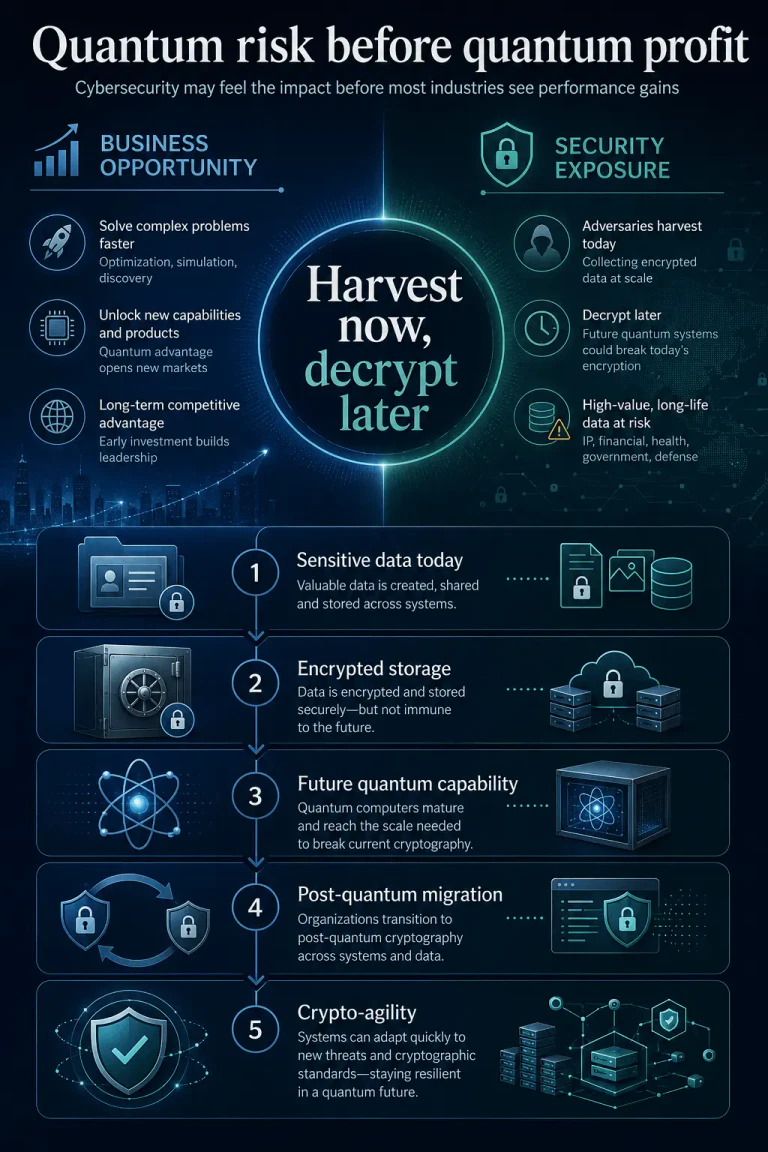
A sufficiently powerful fault-tolerant quantum computer could undermine widely used public-key cryptography, including systems based on RSA and elliptic curve cryptography. The danger is not only future decryption. It is also the harvest now, decrypt later problem. Sensitive encrypted data can be collected today and decrypted later if quantum capabilities become strong enough. For governments, banks, healthcare organizations, telecoms and critical infrastructure, this changes the risk timeline.
This is why post-quantum cryptography is already a business issue, even before large-scale cryptographically relevant quantum computers exist. Companies with long-lived sensitive data cannot wait until the threat becomes operational. Migration to quantum-resistant cryptography can take years because encryption is embedded deeply into applications, certificates, protocols, devices, cloud services, identity systems, code signing, VPNs and legacy infrastructure.
For many organizations, the first quantum project should not be a quantum algorithm experiment. It should be a cryptographic inventory.
Which systems use vulnerable public-key cryptography?
Which data must remain confidential for ten, twenty or thirty years?
Which vendors control critical cryptographic components?
Which certificates, protocols and devices can be upgraded?
Where is crypto-agility missing?
This is less glamorous than drug discovery or portfolio optimization, but it may be more urgent. The companies that ignore quantum risk until the last moment will face a migration problem under pressure. The companies that begin now can turn quantum readiness into a broader modernization of security architecture.
Why hardware remains the bottleneck
Despite progress, quantum hardware remains the central constraint. Qubits are extremely sensitive to their environment. Noise, temperature, electromagnetic interference and control imperfections can disrupt quantum states. This leads to errors, and errors are the main reason useful large-scale quantum computing is difficult.
Several hardware approaches are competing: superconducting qubits, trapped ions, photonic systems, neutral atoms, spin qubits and topological approaches. Each has strengths and weaknesses. Some aim for faster gates, some for better coherence, some for easier scaling, some for manufacturability, and some for more stable error-resistant qubits.
This diversity is healthy, but it also signals uncertainty. The industry has not yet converged on one inevitable hardware architecture. Business leaders should therefore avoid treating any single roadmap as guaranteed. The strategic lesson is not to bet the company on one hardware platform. It is to build enough understanding to evaluate progress without being captured by vendor marketing.
The most important transition will be from noisy intermediate-scale devices to fault-tolerant machines. Current systems can support experimentation and algorithm development, but many practical use cases require error correction at a scale that remains difficult. Until then, the business value of quantum computing will depend heavily on hybrid approaches, error mitigation and careful selection of problems where early hardware can contribute.
This is why 2030 is both close and far. It is close enough that companies should prepare. It is far enough that many promises remain uncertain.
The talent gap
Quantum computing does not only require hardware. It requires people who can translate between physics, computer science, mathematics and business.
This is a serious bottleneck. A quantum physicist may understand the machine but not the business process. A business executive may understand the problem but not the computational structure. A software engineer may understand deployment but not quantum algorithms. A consultant may understand the vocabulary but not the limits.
The most valuable people in the next phase will be translators. They will not necessarily be Nobel-level physicists. They will be able to identify business problems that fit quantum methods, frame them mathematically, compare them with classical alternatives and decide whether a quantum experiment is worth running.
Companies that want to become quantum-ready should not begin by hiring a large quantum department. For most, that would be premature. A more realistic approach is to build a small internal capability: one or two technical leads, partnerships with vendors or universities, a use-case inventory, and enough executive literacy to separate serious opportunities from inflated claims.
Quantum readiness is not mainly about owning machines. It is about knowing what to do when the machines become useful.
Cloud access changes the adoption curve
One reason quantum computing may enter business earlier than previous deep technologies is cloud access. Companies do not need to build cryogenic laboratories to experiment. Quantum hardware can be accessed through cloud platforms, and many providers offer software development kits, simulators and hybrid workflows.
This lowers the barrier to entry. It also changes the economics of experimentation. A company can test a use case, build internal knowledge and compare approaches without committing to massive capital expenditure. That does not make quantum easy, but it makes it more accessible.
The cloud model will likely shape the first business wave. Quantum computing may be consumed more like specialized high-performance infrastructure than like owned hardware. Companies will access different quantum systems through platforms, depending on the problem, hardware availability and vendor ecosystem. This is similar to how many firms use cloud AI infrastructure without owning the underlying chips.
The risk is that cloud access can also create superficial experimentation. Running a toy problem on a quantum machine is not the same as building a quantum strategy. The difference lies in whether the project connects to a real business bottleneck and whether the result is benchmarked against strong classical methods.
A useful quantum experiment should always answer a hard question: why would quantum help here?
If the answer is unclear, the project is probably branding, not strategy.
The sectors most likely to see early advantage
The first business impacts will probably appear in sectors with three characteristics: high-value problems, mathematical complexity and the ability to absorb experimental technology.
Pharmaceuticals and chemistry fit this profile because molecular simulation is naturally connected to quantum mechanics and the economic value of better discovery pipelines is high. Finance fits because optimization and probabilistic modeling are central to the business. Logistics and manufacturing fit because even small improvements in routing, scheduling or resource allocation can create measurable savings. Energy and materials science fit because catalysts, batteries, grids and industrial systems involve complex physical processes.
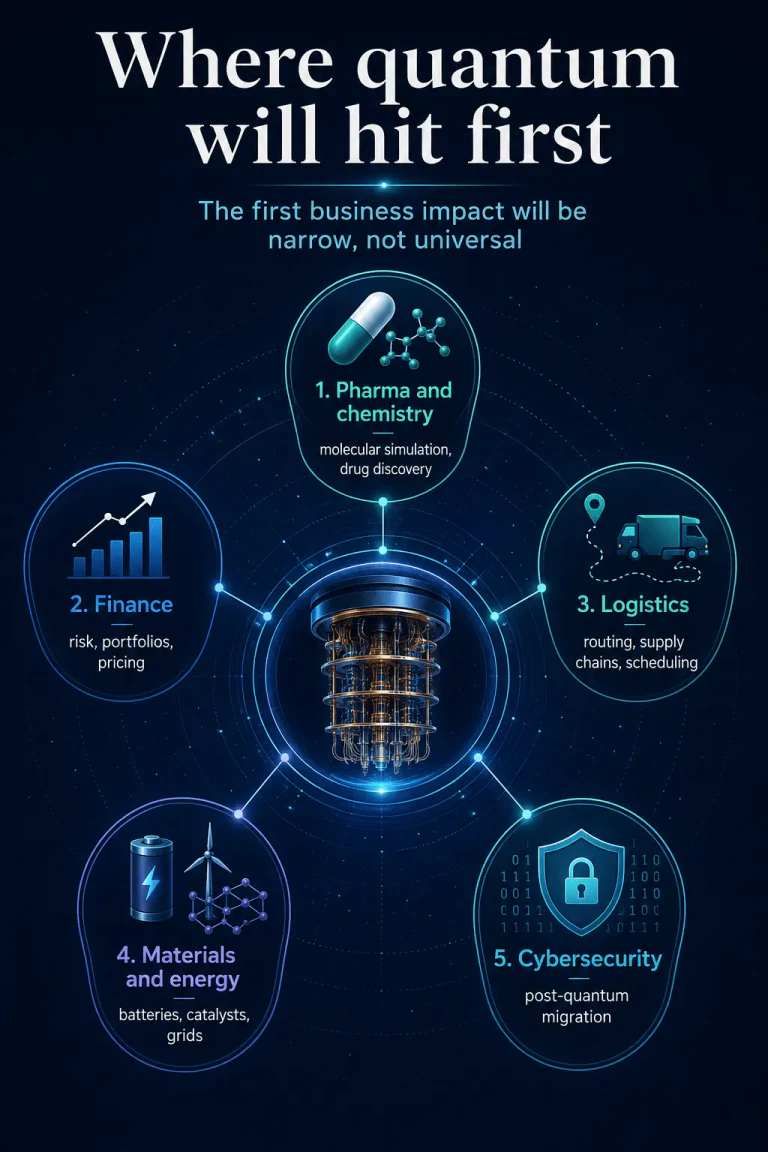
Cybersecurity is different. It is not a sector-specific opportunity but a cross-sector obligation. Every organization with long-lived sensitive data will eventually need to think about post-quantum migration.
Other industries will follow more slowly. Retail, media, education, hospitality and many service businesses may be affected indirectly through better logistics, security, pricing models or supplier innovation, but they are unlikely to be transformed by quantum computing directly before 2030.
This unevenness is important. A company should not ask whether quantum computing will transform “business” in general. It should ask whether quantum computing affects the specific constraints that limit its industry.
What business leaders should do now
The most practical response to quantum computing is neither panic nor indifference. It is structured readiness.
The first step is education at the executive level. Leadership teams do not need to understand every detail of quantum mechanics, but they should understand the difference between quantum advantage, quantum utility, post-quantum cryptography, quantum-inspired algorithms and fault-tolerant computing. Without that vocabulary, they will either overbuy the hype or ignore a strategic shift.
The second step is use-case mapping. Companies should identify problems that are expensive, computationally difficult and strategically important. These may include optimization, simulation, risk modeling, materials discovery or cryptographic exposure. The goal is not to launch twenty experiments. The goal is to find two or three serious candidates.
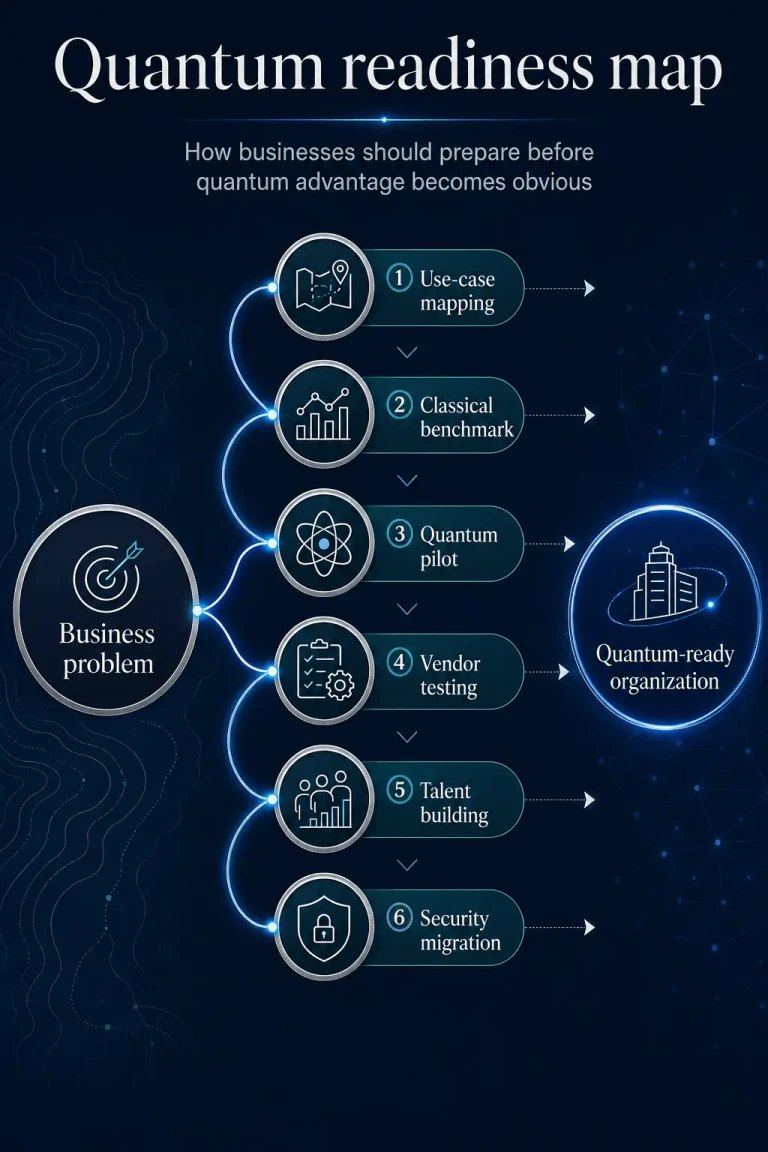
The third step is partnership. Most companies should not build quantum capabilities alone. Cloud providers, universities, startups and consulting partners can help test feasibility. The key is to keep the experiments connected to business metrics, not only technical curiosity.
The fourth step is cybersecurity preparation. Organizations should begin cryptographic inventories, evaluate exposure to post-quantum risk and design a migration path toward quantum-resistant standards. This work is operationally difficult, so waiting for the threat to become urgent is a poor strategy.
The fifth step is talent development. A small quantum readiness team can track the field, run pilots, evaluate vendors and educate internal stakeholders. The team does not need to be large. It needs to be credible.
The companies that benefit first from quantum computing will probably not be those that spend the most on announcements. They will be those that prepare patiently, test intelligently and avoid confusing experimentation with adoption.
What will probably not happen by 2030
A realistic forecast should also say what is unlikely.
Most businesses will not run daily operations on quantum systems by 2030. Quantum computing will not replace classical cloud computing. It will not make AI infrastructure irrelevant. It will not automatically produce superior results for every optimization problem. It will not remove the need for domain expertise. It will not eliminate the hard work of data quality, model validation, integration and governance.
Many early quantum projects will fail to outperform classical alternatives. Some will fail because the hardware is not ready. Some will fail because the problem was poorly chosen. Some will fail because the business did not have the data, talent or patience to evaluate the result properly. This is normal. The same happened with AI, cloud and many other technologies before they became mature enough for broad adoption.
The danger is not failure itself. The danger is learning nothing from it.
A failed quantum pilot can still be useful if it teaches the company which problem classes are unsuitable, which vendors are credible, which internal skills are missing and which classical methods are stronger than expected. A superficial pilot that produces a press release but no knowledge is less useful, even if it sounds successful.
The quiet business revolution
The quantum business revolution, if it begins before 2030, will not look like science fiction. It will look like a pharmaceutical team narrowing a search space faster. A bank testing a new risk model. A logistics company improving a difficult routing problem. A manufacturer exploring better materials. A cybersecurity team migrating systems before quantum attacks become practical. A cloud platform quietly adding quantum services to a larger computational workflow.
That is how deep technologies usually enter business. Not as magic, but as infrastructure.
The companies that wait for quantum computing to become obvious may discover that the strategic advantage formed earlier, during the uncertain phase. In that phase, leaders learned the vocabulary, tested use cases, built partnerships, trained people and prepared security systems. They did not assume quantum would solve everything. They simply refused to be surprised by it.
So will quantum computing revolutionize business by 2030?
Not broadly. Not evenly. Not in the exaggerated way many headlines suggest.
But in selected industries, for selected problems, the first serious advantages may arrive sooner than cautious observers expect. The more important revolution may be organizational rather than technological: the shift from asking whether quantum is real to asking which problems inside the business are worth preparing for now.
The companies that understand that difference will not need to predict the exact date of the quantum revolution.
They will already be positioned for it.