The surprising part is how the wheels become free to move. The installation briefly carries the vehicle’s weight itself. That makes it possible to unlock the running gear, guide the wheels into their new positions and secure them before they resume carrying the load.
Spain’s main conventional gauge is 1,668 mm, while its high-speed network uses the 1,435 mm standard gauge. Gauge is the distance between the rails, not the width of the carriage. Adif’s 2024 network statement describes the changing installations as a means of extending high-speed services across those networks. A train can use the fast section and continue beyond it, rather than making the gauge boundary the passenger’s destination.
The track takes the weight while the wheels move
A wheel that could slide freely during an ordinary journey would be a serious problem. Variable-gauge equipment therefore has to do two opposite jobs: hold a fixed position on the running railway, then permit controlled movement in a particular installation. The changer provides the conditions under which that second job is allowed.
Adif’s technical catalogue explains the sequence. Additional support rails receive pads or rollers carrying the weight transmitted from the vehicle body. The wheels are released from their locked positions. Guides move them laterally to match the outgoing gauge, after which they are secured again and take back the vehicle’s weight.
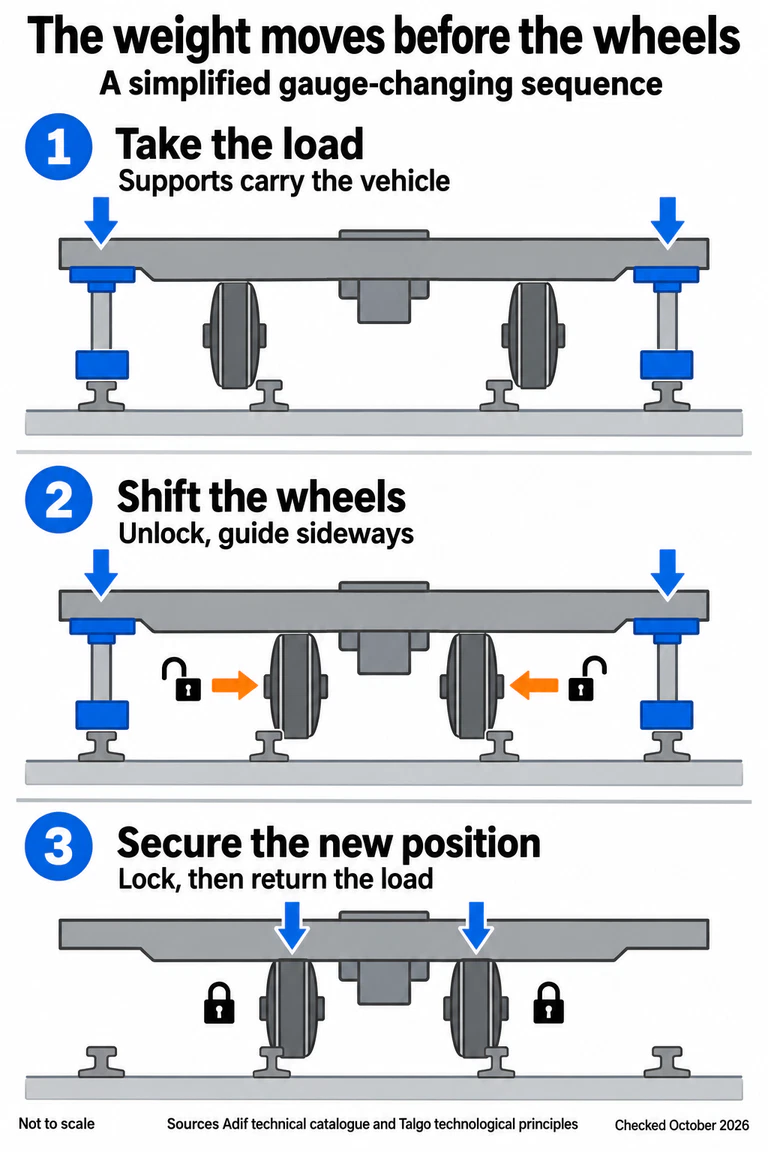
The rails do more than point the train towards its next line. There are separate functions for supporting the vehicle, releasing the locks and controlling lateral movement. The choreography matters: the wheels need to be secured at their new spacing before ordinary running resumes. Thinking of the system as a set of rails that simply squeezes a heavy train narrower misses the temporary change in where its weight is carried.
Talgo describes its own system operating at approximately 15 km/h without stopping. Its technical explanation also makes clear that the process is reversible: the installation can move the wheels to the other gauge in either direction. That is a description of Talgo’s system, not a universal speed for every gauge changer. A high-speed train crosses this particular piece of infrastructure slowly.
The train and the installation have to fit each other
There is another compatibility problem inside the apparent solution. Spain has variable-gauge technologies from both Talgo and CAF. They achieve the same broad result, but their support and locking arrangements differ. An ordinary fixed-gauge train does not acquire adjustable wheels merely by being routed through a changer.
Ineco, which worked with Adif on the facilities, describes the response in its 2011 engineering publication, pages 78–79. Earlier installations were specific to Talgo. When trains using CAF’s Brava bogies entered the picture, the designers developed a dual installation capable of accommodating the two technologies within one pit. Shared space still required equipment matched to the train.
That distinction helps explain why a map showing two connected lines is not enough to establish that any train can run through. The vehicle needs the appropriate running gear, and the boundary needs a compatible facility. Adif’s 2024 statement lists installations by technology, including sites supporting both Talgo and CAF, rather than treating gauge change as one interchangeable appliance.
The payoff is a journey beyond the high-speed line
Renfe’s Alvia S-730 is a useful example of the wider engineering task. The operator’s 2022 description of the fleet identifies variable gauge alongside electric and diesel traction. The two capabilities address different interruptions: a change in rail spacing and the end of an electrified section. It also names the signalling systems fitted to the trains.
These features have to work together to make a continuous journey possible. Moving the wheels cannot supply traction on a line without the required power source. It cannot interpret a different signalling system either. The S-730 example shows why a through-running train is a combination of capabilities, rather than a clever wheel mechanism attached to an otherwise universal vehicle.
There is a geographical reason to invest in that combination. A new high-speed section can improve a longer trip even while its remaining sections keep their existing infrastructure. The same passenger vehicle crosses the gauge boundary and carries on. That extends the useful reach of the new line without requiring every destination to sit on it.
The price of that continuity is specialised rolling stock and an additional installation to operate and maintain. Gauge changing does not erase the two networks’ differences; it lets a suitably equipped train traverse a specific connection between them. For the passenger, the visible event may be a brief slow passage. Under the carriage, the railway has temporarily taken the load, repositioned the wheels and returned it.