Fundamentals of osmotic power technology
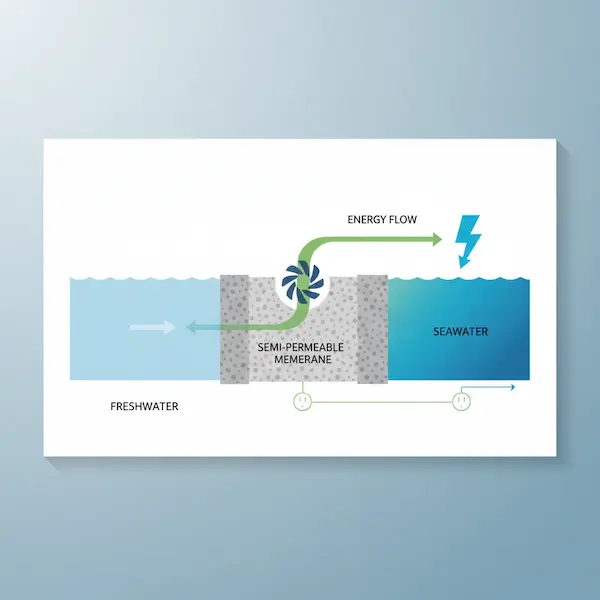
At its core, osmotic power generation relies on the principle that when two water bodies with different salt concentrations—typically freshwater and seawater—are separated by a semipermeable membrane, freshwater naturally moves through the membrane to the saltier side due to osmotic pressure. This movement generates a flow of water that can be converted into mechanical energy, and subsequently electricity, via turbines or pressure retarded osmosis systems.
Technological advancements, such as the Ionic Nano Osmotic Diffusion (INOD) technology developed by Sweetech Energy, employ nanotechnology to create highly efficient membranes that maximize the osmotic flow. These membranes overcome key challenges like fouling and durability while increasing energy output. Osmotic power plants can function continuously, offering a stable baseload power source, unlike intermittent renewables.
Advantages of osmotic power systems
- Renewable and sustainable energy - osmotic power uses a naturally occurring gradient and produces no greenhouse gases or pollution.
- Constant availability - unlike solar or wind power, osmotic energy is available 24/7, offering a predictable and stable electricity supply.
- Low environmental impact - osmotic systems typically have minimal effects on aquatic ecosystems and do not require large land areas.
- Scalable technology - osmotic plants can be implemented in varying sizes, from small-scale remote installations powering sensors or IoT devices to larger grid-supporting plants located at river mouths or estuaries.
Applications and real-world examples
Osmotic power technology is perfect for deployment in areas where rivers discharge freshwater into seas or oceans, providing a readily available salinity gradient. It is particularly attractive for coastal communities, islands, and remote locations seeking dependable and green energy.
Besides power generation, osmotic systems can be used for providing energy autonomy to Internet of Things (IoT) devices and underwater sensors, creating self-powered networks in marine environments. Research efforts continue to focus on optimizing membranes and system designs to improve commercial viability and reduce maintenance costs.
Current market status and future prospects
While still an emerging technology, osmotic power has reached important milestones. Sweetech Energy aims to launch the first commercial-scale osmotic power plant, signaling a leap from experimental setups to practical implementations. Globally, interest is rising as governments worldwide pursue diversification of renewable energy sources, especially those offering base-load stability.
Challenges remain, largely in scaling production of advanced membrane materials and ensuring long-term system reliability under variable aquatic conditions. However, ongoing R&D and investment are gradually overcoming these barriers. As cost-efficiency improves, osmotic power is expected to become a core part of sustainable energy portfolios by the 2030s.