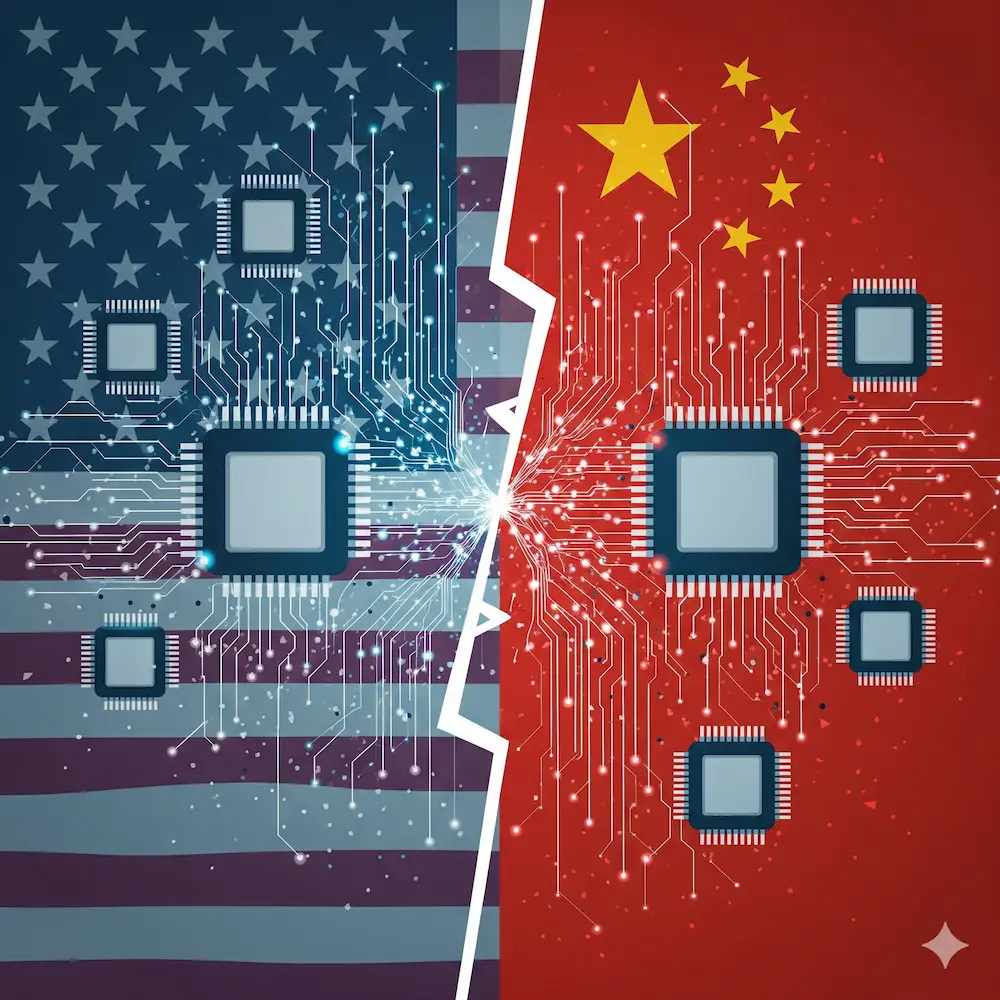
This new conflict revolves around a fundamental struggle for control over the infrastructure of our digital lives: the hardware, software, and data that power the global economy. At the center of this struggle are the United States and China, each championing its own ecosystem of technology and corporate titans. This isn't just about market competition; it's a deep-seated rivalry over who will write the rules for the 21st century.
The rise of digital empires
For decades, political power was the exclusive domain of nation-states. Corporations, however powerful, operated within the frameworks set by governments. That paradigm has shifted. Companies like Apple, Google (Alphabet), Meta, Amazon, and Microsoft in the West, and Alibaba, Tencent, and Huawei in the East, have grown into transnational empires with unprecedented influence.
Consider their scale:
- Economic clout - the market capitalization of a single company like Apple often exceeds the GDP of most countries. They command vast resources, drive innovation, and are critical to the economic health of their home nations.
- Control over information - Google and Meta effectively control the flow of information for billions of people. They shape public discourse, influence opinions, and hold vast repositories of personal data that represent an invaluable strategic asset.
- Infrastructure ownership - companies like Amazon Web Services (AWS) and Microsoft Azure own and operate the cloud infrastructure that underpins governments, financial institutions, and critical industries. They are the new landlords of the digital world.
This immense power has turned them into key players in international relations. When a government wants to curb misinformation or track a terrorist, it often needs the cooperation of a Silicon Valley firm. When a nation seeks to build out its 5G network, its choice between Sweden's Ericsson, Finland's Nokia, or China's Huawei is a major geopolitical decision. These companies are no longer just market participants; they are indispensable actors in the machinery of statecraft.
The heart of the conflict - The US-China tech war
The most visible front in this new cold war is the escalating US-China tech war. This is a direct confrontation aimed at achieving dominance in the foundational technologies of the future. The battle is being waged across several key domains. As former Google CEO Eric Schmidt warned, this rivalry is creating a profound global split.
"We’re heading toward a bipolar world, a U.S. world and a Chinese world," Schmidt noted. "The big question is, who’s in which camp?"
Semiconductors - The new oil
Microchips are the lifeblood of the modern economy, powering everything from smartphones to advanced military hardware. Recognizing its vulnerability, China has poured hundreds of billions of dollars into developing its own semiconductor industry. In response, the US has imposed strict export controls, aiming to cut off China's access to advanced chip technology. This "chip war" is a clear example of economic policy being used as a tool of geopolitical containment.
5G and Telecommunications
The rollout of 5G networks is about more than just faster downloads. It’s about building the backbone for the Internet of Things, autonomous vehicles, and smart cities. The battle over Huawei, the Chinese telecom giant, epitomizes this struggle. The US has aggressively campaigned to persuade its allies to ban Huawei from their 5G networks, citing national security risks and fears of cyber espionage. This has forced countries around the world to choose sides, effectively dividing the world into competing technological blocs.
Artificial Intelligence (AI)
AI is widely seen as the ultimate technological high ground. The nation that leads in AI will have a decisive advantage in both economic and military terms. Both the US and China have declared their ambitions for AI leadership. While the US currently leads in fundamental research, China has a massive advantage in data collection and implementation, fueled by its large population and state-led initiatives. The race for AI supremacy is a core element of the digital sovereignty struggle.
Cyber espionage and the battle for data
In the 20th century, espionage involved spies and secret agents. In the 21st, it involves hackers and state-sponsored cyberattacks. The new intelligence currency is data. State-backed hacking groups routinely target foreign governments, corporations, and critical infrastructure to steal intellectual property, gather political intelligence, and disrupt rivals.
The cases of TikTok and WeChat highlight this new reality. The US government's attempts to ban or force the sale of these Chinese-owned apps were driven by fears that the vast amounts of data they collect on American citizens could be accessed by the Chinese government. Whether these fears are overblown or not, they demonstrate a critical shift: a person's digital footprint is now a matter of national security. The line between corporate data collection and state intelligence gathering has become dangerously blurred.
This has given rise to the concept of digital sovereignty, where nations are increasingly seeking to control the data generated within their borders. Regulations like Europe's GDPR are not just about privacy; they are assertive declarations of regulatory power. This reflects a desire to forge an independent path, as articulated by European Commission EVP Margrethe Vestager:
We accept that there is a conflict between the US and China. But we will not accept being the battleground. We will be the players.
This trend toward a "splinternet," a fragmented internet divided along national or regional lines, is a direct consequence of the new cold war.
The power wielded by tech giants has fundamentally altered the landscape of global politics. They are simultaneously commercial enterprises, critical infrastructure providers, and instruments of national power. Their decisions about content moderation, data privacy, and market access have diplomatic and security consequences that ripple across the globe. As this conflict continues to unfold, governments and citizens alike must grapple with a new set of questions: How do we balance innovation with national security? Can we protect individual liberties in an age of mass data collection? And in a world shaped by digital empires, what does it truly mean to be sovereign? The answers will define the power dynamics of the 21st century.