Gravity is a tyrant. It interferes with everything we try to create down here. Crystals form with defects, metals separate by density, proteins grow all wonky. But up there? In that beautiful, weightless void? Materials behave like they're supposed to.
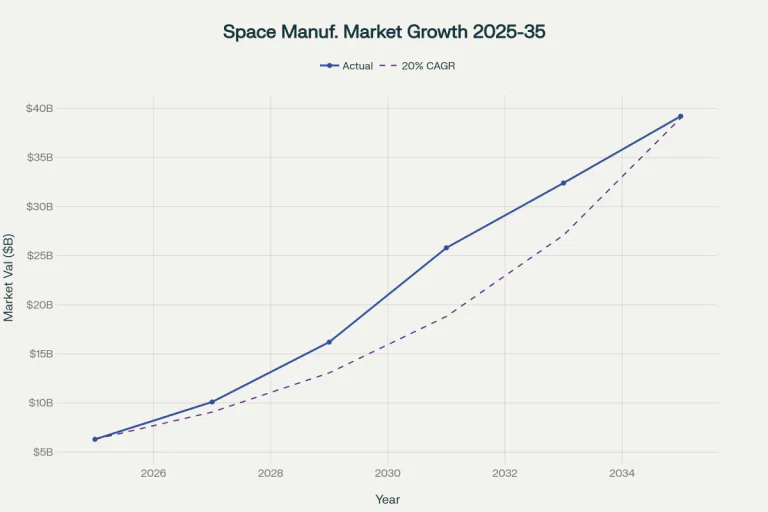
The numbers are bonkers. We're looking at a market worth $6.3 billion this year that's projected to hit $39.2 billion by 2035. That's not hype, that's companies like Flawless Photonics pulling 11.9 kilometers of perfect fiber optics out of the International Space Station and proving this isn't science fiction anymore.
Perfect crystals that don't exist on earth
Let's talk about ZBLAN fiber optics first, because this stuff is absolutely mind-blowing.
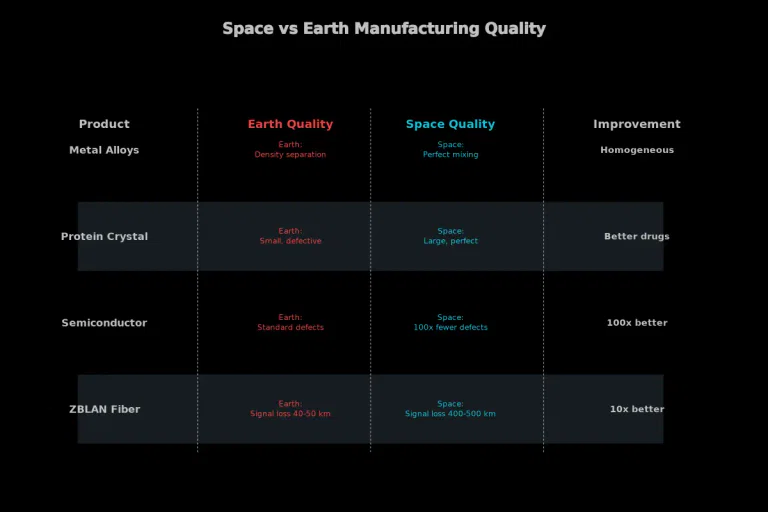
On Earth, these fluoride glass fibers are basically junk. They crystallize during production, get cloudy, break easily. Useless. But take that same material up to orbit, and suddenly you've got fiber optics that can carry signals 10 times farther than anything we can make down here.
Think about submarine internet cables. Right now, they need signal boosters every 40-50 kilometers because the signal degrades. With space-made ZBLAN? You could put those boosters 400-500 kilometers apart. That's not just better—it's a complete game-changer that could revolutionize global internet infrastructure.
Flawless Photonics just proved this isn't theoretical anymore. They manufactured over 5 kilometers of ZBLAN on the ISS in just two weeks—something that eluded other companies for years. The University of Adelaide supplied the glass rods, the European Space Agency provided funding, and NASA gave them space on the station. When those samples come back to Earth, independent analysis will determine if they're really as perfect as the preliminary results suggest.
But here's the kicker: one kilogram of ZBLAN preform can produce 2-3 kilometers of fiber. Sell that at $150-1000 per meter, and you're looking at $300,000 to $3 million per kilogram of space-manufactured product. No wonder Varda Space Industries is building reusable capsules specifically designed to bring ZBLAN back from orbit.
Semiconductors with 100x fewer defects
The semiconductor story is even crazier.
Space Forge, this UK startup that launched their ForgeStar-1 satellite in June, claims they can manufacture semiconductors with 100 times fewer defects than Earth-based production. One hundred times! That's not an incremental improvement—that's a complete transformation of how we make computer chips.
The physics makes sense when you think about it. Semiconductor fabrication requires ultra-clean environments, precise crystal growth, and uniform material distribution. On Earth, we spend billions building cleanrooms that can never be as clean as the natural vacuum of space. We fight convection currents and gravitational settling that create defects in crystal structures.
In Low Earth Orbit, you get vacuum conditions of about 10^-9 torr—essentially impossible and economically unfeasible to maintain in terrestrial facilities. No atmospheric contamination, no gravity-induced defects, no convection to mess up crystal growth.
Arizona State University researchers developed a method for inkjet printing advanced semiconductor chips in zero gravity. Their process provides better trench filling, less voiding, and can replace conventional cleanroom processes. NASA's partnering with Intel, NAU, Fujifilm, and others to test high-precision inkjet printing on the ISS in 2024-2025.
Made in Space (now part of Redwire) got NASA funding to develop autonomous semiconductor manufacturing capabilities specifically for space production. They're not just talking about research—they're building systems for actual commercial production.
Protein crystals for impossible drugs
The pharmaceutical applications might be the most important of all.
For over two decades, researchers have been growing protein crystals on the International Space Station. They've conducted more than 500 protein crystal growth experiments, the largest single category of research on the orbiting laboratory.
Why? Because protein crystals grown in microgravity are larger, more uniform, and have fewer defects than anything we can produce on Earth. When you're trying to understand protein structure to develop new drugs, these improvements aren't just nice to have, they're the difference between success and failure.
Here's how it works: when we take medications, they bind to specific proteins in our bodies. The drug protein has to fit into the target protein like a key in a lock. Better crystal structure means better understanding of that lock, which means better drugs with fewer side effects.
Merck Research Laboratories developed experiments that produced simple hardware allowing scientists from other disciplines to conduct microgravity research. JAXA created technology for membrane protein crystallization and developed processes for growing high-quality crystals aboard the space station.
The University of Toledo is crystallizing proteins involved in Salmonella contamination, heart attack and liver disease, and DNA repair. Their goal is producing crystals large enough for neutron diffraction analysis, which provides greater structural detail than traditional X-ray diffraction because it reveals hydrogen atom positions.
Dover Lifesciences is working on crystallizing large protein complexes that could lead to drugs for obesity and rare genetic disorders like Cori disease, Pompe disease, and Lafora disease. MicroQuin is using space crystallization to enhance breast cancer therapeutics and create a pipeline for other cancer treatments.
The applications go way beyond just better drugs. PCG 5 research sponsored by the ISS National Lab focused on monoclonal antibodies—treatments that typically require hours of intravenous delivery in clinical settings. High-quality crystalline suspensions produced in space could enable delivery by simple injection, making treatment more convenient and significantly cheaper.
Metal alloys that shouldn't exist
Gravity ruins everything when you're trying to mix metals of different densities.
Try making an alloy of lead and aluminum on Earth. The lead, being much denser, will settle to the bottom during the cooling process. You end up with separated layers instead of a uniform mixture. Same problem happens with dozens of potentially useful metal combinations.
In microgravity? Perfect mixing. No settling. No separation. Just homogeneous alloys with properties that are impossible to achieve terrestrially.
Space Forge is betting big on this. They claim microgravity manufacturing allows creation of materials "impossible to create on Earth" with "significant increases in purity, structure and size of crystals". Their ForgeStar satellites orbit for one to six months manufacturing materials before returning to Earth with precision-engineered recovery systems.
The UK company raised £7.6 million ($10.2 million) based on the premise that "Earth is a wonderful place to live on but terrible for manufacturing so many things". They're not wrong. You fight gravity, atmospheric contamination, and pollution constraints. In space, you get pure vacuum, no gravitational interference, and the ability to heat or cool rapidly by turning toward or away from the Sun.
The economics are getting real
Let's be honest about the costs and challenges for a minute.
Launch services still cost around $2,000 per kilogram to Low Earth Orbit, even with SpaceX's dramatic cost reductions. Deploying heavy manufacturing equipment into space remains a logistical nightmare. Regulatory frameworks are complex, covering space operations, safety standards, and intellectual property.
But the unit economics work for high-value products.
ZBLAN fiber selling at $150-1000 per meter means you can justify expensive launches. Semiconductors with 100x fewer defects command premium pricing in markets where performance matters more than cost. Protein crystals that enable breakthrough drugs represent enormous pharmaceutical market opportunities.
Varda Space Industries raised significant funding specifically to build reusable re-entry capsules optimized for cost and repeatability. Their business model depends on manufacturing products in orbit and bringing them back to Earth economically. They're not alone—multiple companies are working on similar approaches.
The supply chain is becoming real too. Thorlabs, the industry leader in ZBLAN preforms and terrestrial production, partnered with Redwire to rapidly industrialize space-based optical fiber production. This isn't research anymore—it's commercial development with established supply chains and customer relationships.
Companies racing to space factories
Flawless Photonics proved large-scale space manufacturing works with their 11.9-kilometer ZBLAN production run. They're now working on making preforms in space, the next step toward complete orbital manufacturing.
Space Forge launched ForgeStar-1 to demonstrate in-orbit semiconductor manufacturing while testing their innovative heat shield technology. They're positioning themselves as the primary commercial platform for space semiconductor production at scales suitable for telecoms, electric vehicles, data centers, and renewable energy systems.
Varda Space Industries is building what they call "the world's first commercial zero-gravity industrial park at scale". Their focus is manufacturing things in space that are highly valued on Earth, starting with ZBLAN fibers but expanding to other high-value materials.
Redwire (formerly Made in Space) has been producing fiber optics on the ISS since 2017, with multiple successful missions demonstrating commercial viability. They've privately funded multi-year R&D work and partnered with Thorlabs to industrialize production.
Axiom Space is working with NASA, Flawless Photonics, University of Adelaide, and Visioneering Space on preform manufacturing experiments. They're building the infrastructure for commercial space stations that could host manufacturing facilities.
Why this matters beyond cool tech
The implications go way beyond just making stuff in space.
Internet infrastructure could be revolutionized by ZBLAN fiber optics that carry signals 10 times farther with less signal loss. Those submarine cables that carry most international internet traffic could operate with far fewer repeaters, reducing both cost and energy consumption.
Pharmaceutical development could accelerate dramatically with perfect protein crystals enabling better drug design. Diseases that currently have no treatments because we can't understand the protein structures involved might become treatable.
Semiconductor performance improvements of 100x fewer defects could enable new computing capabilities, better solar panels, more efficient electric vehicle electronics. When chips work better, everything works better.
Materials science advances through perfect alloys could lead to stronger, lighter materials for aerospace, automotive, and construction applications. Imagine building materials that are both stronger than steel and lighter than aluminum.
The chaotic reality of space business
Here's what nobody mentions in the glossy space manufacturing coverage: this stuff is hard as hell to actually do.
Supply chains are nightmare fuel. When Spectrum AMT missed shipment targets in 2024 due to supply chain bottlenecks, it highlighted how vulnerable the space industry is to single-source suppliers and long approval processes. Government contracts require components from approved U.S. manufacturers, severely limiting supplier options.
Quality control requirements are insane. "When you talk about spaceflight, satellite, and deep space, it's one shot, never fail," explains industry expert Gilbert. "High-reliability electronics require rigorous tracking, testing, and documentation. Each component must be traceable from its manufacturing date through its lifecycle".
Space debris and orbital congestion create new risks nobody fully understands yet. More satellites and manufacturing platforms mean more potential collisions and debris cascades.
Regulatory frameworks lag behind technology development. Export controls, frequency allocation, environmental regulation, it's a maze that can delay missions and increase costs dramatically.
But companies are pushing through anyway because the potential rewards are too big to ignore.
What happens next
The timeline is getting compressed fast.
Flawless Photonics samples return to Earth in 2025 for independent analysis that will determine if space-manufactured ZBLAN really delivers the promised performance improvements. If those results confirm the preliminary findings, expect massive investment in orbital fiber optic production.
Space Forge's ForgeStar-1 results should demonstrate whether space-manufactured semiconductors really have 100x fewer defects. Success could trigger a rush to build orbital semiconductor facilities.
Varda Space Industries continues developing their reusable re-entry capsules with plans for regular manufacturing missions. Their success or failure could determine whether the "space factory" business model works economically.
Multiple commercial space stations are in development, potentially providing dedicated manufacturing facilities instead of sharing space on the ISS. This could dramatically increase orbital manufacturing capacity.
The market projections suggest explosive growth: from $6.3 billion in 2025 to $39.2 billion by 2035. That's a 20% compound annual growth rate driven by companies proving that microgravity manufacturing delivers impossible-to-replicate improvements in material quality.
But here's the thing about exponential markets: they either explode or collapse spectacularly. Space manufacturing is betting that the physics advantages of microgravity, vacuum, and temperature control will overcome the cost and complexity challenges of orbital operations.
The next few years will determine whether we're witnessing the birth of a revolutionary new industry or an expensive tech demo that never scales. Either way, it's going to be absolutely fascinating to watch.
Because when you can make materials that literally cannot exist on Earth, you're not just manufacturing products, you're manufacturing possibilities that could change everything.