Key takeaways from the Hardware Ownership analysis
The traditional concept of ownership is being replaced by "digital feudalism." Corporations are weaponizing software, firmware, and complex licensing agreements to turn physical hardware into vehicles for endless, mandatory subscriptions and extortion:
- 1. The Trojan Horse of hardware extortion From HP printers utilizing "Dynamic Security" to brick devices using generic ink, to automakers like BMW and Tesla hiding physically installed hardware (like heated seats or battery capacity) behind remote software paywalls, manufacturers maintain perpetual control over hardware they have already sold.
- 2. Cryptographic monopolies and repair barriers Tech giants employ "parts pairing" algorithms that artificially degrade functionality if unauthorized, independent components are installed. This anti-competitive strategy crippled vital medical ventilator repair during the pandemic and costs the US agricultural sector an estimated $4.2 billion annually via digital tractor locks.
- 3. The legislative fight to reclaim ownership Governments are finally responding to this crisis. The sweeping EU Right to Repair Directive mandates a 10-year repair window and strictly outlaws software obstruction, while expanding US state laws (like in Oregon) are explicitly banning the deceptive practice of parts pairing to restore consumer autonomy.
The fundamental nature of property has been quietly and ruthlessly rewritten over the past decade by major technology conglomerates. Buying a physical object no longer guarantees absolute control over its mechanical or digital functions, stripping consumers of basic autonomy. Instead, buyers are increasingly purchasing a highly conditional license to operate. This paradigm shift represents a massive, calculated wealth transfer from individuals to corporations, permanently tethering buyers to the manufacturer's server architecture.
Corporations have systematically transformed tangible goods into mere delivery mechanisms for recurring, inescapable revenue. Physical hardware is frequently sold at a loss or at exceptionally narrow margins to aggressively capture market share and trap the unsuspecting user. Once trapped, the consumer is subjected to a relentless rent-seeking ecosystem. This phenomenon extends far beyond paying a monthly fee for cloud storage or streaming media; it is about paying a continuous ransom to utilize hardware components that are already physically sitting on your desk or installed in your garage.
The trojan horse hardware
The economic theory defining this aggressive corporate shift is widely known among academic researchers as the rise of digital feudalism. In this regressive economic model, traditional free markets are entirely replaced by highly controlled digital fiefdoms where manufacturers extract endless cloud rent from their users. The physical item essentially becomes a deceptive trojan horse device. It seamlessly infiltrates the home, the hospital, or the business environment, demanding ongoing financial tribute simply to maintain its basic, originally advertised utility.
This process of systematic service degradation has been formalized by researchers as the inevitable enshittification of the modern global economy. Platforms and hardware ecosystems first attract users with high value and remarkably low initial upfront costs. Eventually, they manipulate the rules to trap those users in a hostile forced subscription loop. Product quality actively declines, yet switching costs become deliberately too high for the average consumer to reasonably escape the ecosystem.
We are currently witnessing the absolute death of ownership through a thousand mandatory, invisible over-the-air software updates. When the manufacturer retains absolute remote control over a device's functionality, the purchaser is legally and functionally reduced to a mere tenant. This creates a deeply imbalanced macroeconomic battlefield. The fierce conflict over who physically controls infrastructure now spans consumer electronics, heavy agriculture, and critical healthcare systems, dictating the future of modern property rights.
Feudalism in modern tech
The sheer audacity of this model is predicated on an intricate web of digital locks and aggressive end-user license agreements. By prioritizing recurring revenue streams, tech giants ensure that the hardware itself is inherently disposable, acting only as a gateway to monetization. This calculated dynamic eliminates the traditional buyer-seller relationship, replacing it with an unequal perpetual servitude contract. The user assumes all the physical risks of maintenance and depreciation, while the corporation absorbs all the recurring financial upside.
Furthermore, this artificial dependency effectively neutralizes any genuine market competition once the initial hardware purchase is complete. Consumers are essentially held hostage by the software architecture, unable to seek competitive alternatives for repairs, upgrades, or operational consumables. This creates a rigid anti-competitive moat. By leveraging copyright law and cryptographic verification, manufacturers ensure that stepping outside their authorized walled garden results in the immediate, catastrophic failure of the device.
Printers and digital ransom
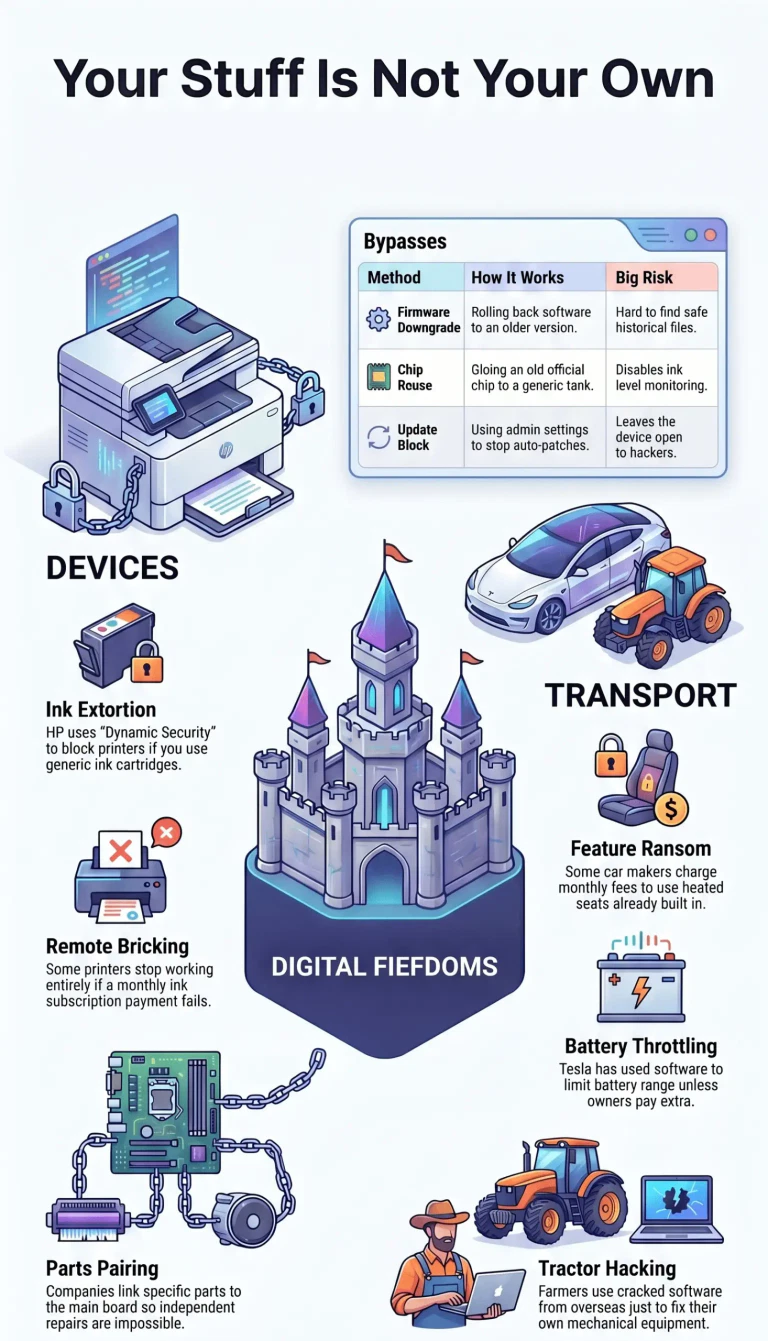
The most notorious and widely recognized pioneer of hardware extortion is the modern consumer printer industry, led aggressively by Hewlett-Packard. For years, HP has deployed mandatory firmware updates designed specifically to disable devices attempting to use third-party or refilled ink cartridges. This deliberate, destructive practice effectively turns a perfectly functional piece of office equipment into a bricked plastic paperweight. The consumer is given a stark, unavoidable ultimatum: pay exorbitantly for premium branded ink or permanently lose the ability to print entirely.
This extortion model was perfectly illustrated by a widely shared incident in 2022 involving a frustrated Reddit user known as u/I_am_not_a_moth. The user received a terrifying message on their HP printer stating the device was locked and could not be used until an account issue was resolved. The underlying issue was simply an expired credit card linked to their wife's separate Instant Ink subscription. Despite owning the physical printer outright, the manufacturer held the hardware entirely hostage over a declined digital payment, showcasing the absurdity of the connected ecosystem1.
Hewlett-Packard utilizes a controversial mechanism they openly and proudly refer to as Dynamic Security. This system relies on intricate cryptographic algorithms embedded deep within the printer's firmware to detect the presence of non-HP microchips. When a generic or refilled cartridge is installed, the software triggers a ruthless planned obsolescence protocol. The screen flashes a "Non-HP Chip Detected" error message, immediately halting all mechanical printing functions until an authentic, highly-priced factory cartridge is physically inserted into the carriage.
The dynamic security trap
These restrictive firmware updates are pushed to consumers through automated Wi-Fi networks under the deceptive guise of enhancing security or fixing routine system bugs. Users generally accept these updates without hesitation, conditioned by years of standard mobile phone and computer maintenance hygiene. However, the true objective is to quietly install a restrictive digital killswitch. This aggressive tactic has impacted a vast array of models, specifically targeting the popular HP DeskJet, OfficeJet, ENVY, and All-in-One lines utilizing 902XL, 952XL, and 148A series cartridges.
The sheer scale of this corporate extortion has sparked significant legal and regulatory backlash across multiple continents over the past several years. In Australia, the national competition commission forced HP to financially compensate over 220,000 customers who purchased printers without realizing they contained dynamic security failure technology. This blatant deceptive trade practice cost the company thousands in settlements, offering affected users a meager $50 each, yet the financial penalty barely dented their incredibly profitable global strategy.
More recently, in early 2025, a massive wave of consumer complaints revealed that HP's automated updates were suddenly disabling even their own genuine, factory-sealed cartridges. Frustrated users took to online forums reporting that authentic ink, purchased directly from reputable retailers, triggered immediate "Cartridge cannot be used" errors. By artificially expiring these expensive authentic ink products, the manufacturer crossed the legal line from aggressive brand protection to outright digital vandalism, prompting law firms like Javitch Law Office to explore renewed class-action litigation.
To circumvent these arbitrary restrictions, frustrated users must resort to highly technical and risky workarounds just to restore basic functionality to their property. Solutions include attempting complex firmware rollbacks, physically harvesting original equipment manufacturer chips to graft onto generic cartridges, or buying expensive chip-upgrade rewriting machines. These elaborate technical bypass procedures place an absurd operational burden on the average consumer who is simply trying to print a basic, everyday document without being financially exploited.
| Workaround method | Technical mechanism | Primary limitation |
|---|---|---|
| Firmware Downgrade | Rolling back the printer's internal operating system to an older version. | Extremely difficult to source clean, historical firmware files safely. |
| OEM Chip Reuse | Physically removing a genuine HP chip and gluing it to a generic cartridge. | Disables ink level monitoring; printer cannot accurately warn of low toner. |
| Chip Upgrade Machine | Using industrial hardware to rewrite the coding on third-party chips. | Prohibitively expensive; machines are generally restricted to large distributors. |
| Disable Auto-Updates | Accessing hidden administrator settings via IP address to block future patches. | Leaves the device completely vulnerable to actual cybersecurity threats. |
Environmental compliance
The primary justification provided by printer manufacturers usually revolves around protecting intellectual property, reducing counterfeiting, and ensuring pristine print quality. However, this corporate defense is increasingly clashing with vital global environmental sustainability standards designed to reduce mounting electronic waste. The General Electronics Council recently updated its rigorous sustainability certification framework, known globally as EPEAT 2.0, explicitly forbidding printer vendors from utilizing software to block remanufactured cartridges if they wish to receive eco-certification.
Despite these incoming environmental regulations, HP aggressively released firmware version 2602A/B in early 2026, which further expanded their dynamic security blocking tactics. This update affected millions of devices globally, demonstrating a blatant disregard for the new environmental compliance standards. Out of tens of thousands of registered electronic products on the market, zero printers have managed to successfully transition to the strict EPEAT 2.0 registry, highlighting the industry's massive, intentional e-waste problem.
Consumer advocacy groups, including the UK-based organization Which?, note that this behavior is generating massive amounts of unnecessary plastic waste as half-full generic cartridges are thrown away in frustration. A study involving 9,000 consumers revealed deep dissatisfaction with these tactics, noting that the cost of branded ink is astronomical. Independent analyses show OEM ink costing over £2.04 per single milliliter, proving that hardware lock-in is a highly deliberate profit maximization tool masquerading as a quality control measure.
Automotive paywall systems
The hardware extortion model has seamlessly migrated from cheap office peripherals directly into the luxurious cabins of modern automobiles. The car industry has collectively realized that while steel and glass represent fixed manufacturing costs, digital software unlocks an infinite stream of recurring revenue. Manufacturers are now pre-installing physical components on the assembly line and holding them hostage behind a sophisticated digital automotive paywall. The consumer pays for the weight, the fuel to carry it, and the initial manufacturing cost, but is aggressively denied its actual use.
Subscribing to your seats
BMW became the infamous, globally mocked poster child for this dystopian business model when they introduced a mandatory subscription for heated seats in 2020. Offered in select markets like South Korea and the United Kingdom, the company demanded roughly $18 a month to activate heating coils that were already physically wired into the car's upholstery. This blatant feature hostage situation triggered intense global backlash as consumers immediately recognized they were simply being charged an arbitrary toll to unlock their own physical property.
The resulting public relations disaster was so severe that it eventually forced BMW to completely backtrack on the heated seat subscriptions by late 2023. BMW board member Pieter Nota publicly admitted that the initiative failed specifically because customers rightfully felt they were paying double for the exact same feature, acknowledging that public perception is reality. However, the company remains deeply committed to expanding their broader connected vehicle ecosystem. They have simply pivoted their subscription efforts toward features deemed highly "software-related," such as advanced parking assistance, traffic camera information, and 360-degree environmental cameras.
The underlying philosophy remains entirely unchanged despite the temporary, highly publicized retreat on seating hardware. Buyers can theoretically order these features prior to delivery, but BMW will actively fit the requisite hardware powering them into every single car that rolls off the production line. This strategy allows the manufacturer to seamlessly unlock the features via remote software later, creating a perpetual post-purchase monetization pipeline. The vehicle is no longer a static product, but an evolving storefront where the manufacturer acts as the eternal gatekeeper of your driving experience.
Remote battery throttling
Tesla has employed incredibly similar strategies, manipulating core vehicle performance metrics through remote software commands issued directly from corporate headquarters. In one highly publicized legal case, a 2013 Model S owner discovered their 90-kWh battery pack had been artificially software-locked down to a 60-kWh capacity. Tesla demanded a staggering $4,500 ransom to restore the missing 80 miles of range, proving that capacity artificial scarcity is a deliberate and highly lucrative corporate strategy utilized to extract post-sale revenue.
This mechanism of battery locking is achieved by utilizing 100 percent of the physical lithium-ion cells but capping their maximum charge threshold at a much lower percentage via arbitrary code. A California lawsuit alleged that unprompted software updates suddenly slashed range and battery availability in lieu of performing actual hardware repairs under warranty. When range, horsepower, and charging speeds can be throttled over the air at a whim, the driver no longer commands an independent vehicle; they operate a tethered wheeled subscription terminal.
The implications for the used car market are particularly devastating under this new paradigm of software-defined vehicles. When a vehicle changes hands, manufacturers like Tesla have previously stripped software-unlocked features, forcing the second owner to repurchase the exact same digital upgrades. This aggressive practice completely divorces the intrinsic value of the physical hardware from the vehicle's resale value, creating a depreciation acceleration mechanism. The automaker effectively double-dips on the same physical components, destroying the foundational economic principles of secondary market ownership.
Agricultural repair locks
The high-stakes battle for hardware autonomy is arguably most critical and economically disruptive in the vital agricultural sector. Modern farming relies heavily on highly complex, half-million-dollar machinery controlled by dense, proprietary networks of electronic control units. John Deere has spent years explicitly exploiting copyright laws and embedded software locks to aggressively maintain a total repair monopoly ecosystem. If a single emissions sensor malfunctions during a critical harvest window, the entire combine halts, and the farmer is legally forbidden from fixing it.
The class action outcome
The financial toll of this monopoly on American agriculture is absolutely staggering, costing operators an estimated $4.2 billion annually across the industry. Farmers were routinely forced to pay exorbitant emergency fees and wait days for authorized technicians just to perform simple software resets to clear basic error codes. This systemic abuse ultimately culminated in a massive multi-district class action lawsuit, leading to a historic $99 million right to repair settlement finalized in April 2026.
Under the strict terms of this 2026 settlement agreement, John Deere must deposit the massive funds to directly compensate farmers negatively affected by their restrictive practices since early 2018. More importantly, the massive manufacturing company is now legally required to provide comprehensive diagnostic tools to independent repair shops for at least the next decade. These newly liberated tools will allow farmers to read trouble codes, diagnose mechanical issues, and recalibrate replacement equipment without begging an exclusive authorized dealership network for permission.
Despite agreeing to this landmark financial settlement, John Deere explicitly admitted no legal wrongdoing, and a separate 2025 antitrust lawsuit initiated by the Federal Trade Commission remains aggressively ongoing. Legal experts and consumer advocates note that the company's highly restrictive policies severely inflated baseline repair costs while actively depriving farmers of timely maintenance options. This ongoing federal litigation highlights that absolute corporate aftermarket dominance is fundamentally anti-competitive, economically destructive, and a direct threat to the stability of the food supply chain.
Hacking the harvest
Long before the federal courts finally intervened, desperate farmers took matters into their own hands out of pure operational survival necessity. Unable to wait weeks for official service trucks while seasonal crops literally rotted in the fields, operators turned to the digital black market. They began secretly importing cracked, reverse-engineered software from Eastern Europe, specifically Poland and Ukraine, to bypass the manufacturer's restrictive digital diagnostic locks. This illicit software allowed them to connect standard laptops via USB to reset immobilizer systems and adjust engine control modules themselves.
The sheer absurdity of Middle American farmers relying heavily on Ukrainian hackers just to fix their own mechanical tractors perfectly illustrates the absolute failure of the modern ownership model. John Deere once boldly argued to the US Copyright Office that farmers do not legally own their physical tractors, but merely hold an implied software license to operate the vehicle for its lifespan. This stunning legal posturing proves that the ultimate goal of the agricultural manufacturer is absolute, unbroken hardware subjugation.
The desperation was palpable in stories like that of Nebraska farmer Kyle Schwarting, whose John Deere combine malfunctioned due to a software lock only an authorized technician could access. Facing the loss of his livelihood as the harvest window rapidly closed, Schwarting was forced to hack his own half-million-dollar machine just to keep it running. As fifth-generation farmer Tom Schwarz aptly noted, farmers pay personal property taxes on their equipment; the idea that they do not own it is a deeply offensive corporate legal fiction.
The political maneuvering surrounding this issue is equally fraught with corporate influence and backroom deals. The California Farm Bureau, representing millions of agricultural jobs, controversially signed a memorandum giving up the right of farmers to access source code or bypass security measures in exchange for basic diagnostic access. Critics slammed this as a massive capitulation, effectively legally binding farmers to the manufacturer's software limitation parameters. They are barred from retrofitting old equipment or tweaking engines for environmental efficiency, cementing the manufacturer's control over agricultural innovation.
Medical infrastructure risk
While agricultural repair restrictions severely threaten rural livelihoods, medical equipment monopolies directly and immediately threaten human lives. The global COVID-19 pandemic brutally exposed the absolute fragility of centralized, manufacturer-controlled biomedical repair networks in a time of crisis. Original Equipment Manufacturers deliberately restricted access to essential service manuals, administrative passwords, and specialized diagnostic tools to fiercely safeguard their lucrative service contracts. These exclusive maintenance contracts can cost desperate hospitals up to 15 percent of the original device price annually, draining vital public health budgets.
Pandemic hardware locks
During the terrifying height of the pandemic, critical lifesaving ventilators sat completely idle in hospital stockpiles simply because independent technicians were legally and technically barred from fixing them. Medical facilities were forced to wait agonizing weeks for overwhelmed, traveling OEM technicians to arrive on site to perform basic maintenance. The presence of impenetrable artificial software locks meant that even highly trained, in-house biomedical engineers were functionally reduced to mere shipping clerks, forced to pack broken equipment onto trucks instead of repairing it immediately.
This artificial, profit-driven bottleneck prompted civil society groups, including US PIRG and Repair.org, alongside front-line medical professionals, to demand immediate emergency legislative action. Activists like Nathan Proctor publicly argued that manufacturer restrictions were literally a matter of life and death, stating there was absolutely no time to be proprietary during a global crisis. The systemic failure of OEM maintenance networks proved that treating medical repair as a protected corporate profit center is incredibly dangerous when supply chains buckle under pressure.
| Medical repair barrier | Corporate mechanism | Impact on healthcare |
|---|---|---|
| Withheld Service Manuals | Manufacturers issue cease-and-desist letters to databases hosting PDF manuals. | Technicians cannot reference schematics, delaying basic component replacement. |
| Embedded Software Locks | Proprietary digital dongles or administrative passwords required to clear errors. | In-house engineers cannot reset devices even after physically fixing the hardware. |
| Patented Parts Control | Threatening litigation against entities attempting to 3D-print unavailable plastic valves. | Critical supply chain shortages cascade into immediate loss of patient care capabilities. |
| Service Technician Monopolies | Forcing hospitals into contracts that mandate only OEM employees can touch the machine. | Creates massive geographical bottlenecks as a handful of staff cover entire states. |
The legislative response
To combat this crisis, the Critical Medical Infrastructure Right-to-Repair Act was swiftly introduced by Senators Ron Wyden and Yvette Clarke. The legislation aimed to legally protect biomedical technicians from corporate liability when breaking digital locks or fabricating patented parts during the unprecedented global health crisis. Manufacturers, backed heavily by massive trade groups like AdvaMed, fought fiercely against these basic concessions, continuously citing nebulous patient safety, cybersecurity concerns, and intellectual property rights as reasons to maintain their monopolies.
The reality of independent medical repair contradicts the intense manufacturer fearmongering entirely, showcasing the competence of local engineers. When the state of California urgently needed a massive stockpile of idle ventilators refurbished rapidly, they bypassed the slow OEM pipeline entirely and enlisted Bloom Energy. Using a secured manual obtained directly, this independent engineering team safely fixed 170 ventilators in a single weekend. This proves definitively that in-house and third-party repairs possess superior operational crisis efficiency compared to bloated corporate service departments.
Despite the clear benefits of localized repair, the resistance from industry giants remains remarkably entrenched. While companies like Medtronic faced immense public pressure and eventually released some ventilator design specifications, they still held back comprehensive service manuals. Other major manufacturers, including Vyaire Medical and Dräger, aggressively maintained their tight restrictions. This stubborn refusal to share critical data forces independent technicians into a dangerous legal gray area, highlighting the extreme toxicity of the medical intellectual property landscape.
Cryptographic parts pairing
The most sophisticated, insidious, and invisible weapon in the corporate war against consumer ownership is the implementation of serialized component tracking. This practice, known technically within the industry as parts pairing, strictly links individual hardware components to a device's main logic board using proprietary software. If a broken screen or depleted battery is replaced with an identical, genuine part salvaged from another identical device, the system detects a serial mismatch and immediately triggers an artificial functionality downgrade.
The hardware root of trust
This absolute cryptographic lockdown is achieved through an incredibly complex silicon architecture known as the hardware root of trust. Embedded deep within the device's main processor, this secure computing enclave facilitates secure boot processes, cryptographic key management, and vital data encryption operations. While originally engineered to prevent malicious code execution and ensure basic system integrity, manufacturers have successfully weaponized it. It now serves as an insurmountable commercial barrier mechanism, harshly punishing any user who dares to seek third-party or independent repairs.
The mechanism is shockingly effective at enforcing market dominance over the lifespan of a device. Because the cryptographic keys are stored securely in hardware, bypassing the lock is nearly impossible without the manufacturer's proprietary calibration software. This means that even a perfectly executed physical repair is useless unless the corporation's servers issue a digital blessing. This architecture effectively transforms every independent repair shop into an unauthorized entity, centralizing the entire global repair economy directly into the hands of the original manufacturer.
These advanced digital locks are not limited to smartphones or computers; they are rapidly infiltrating essential home security infrastructure. Modern smart locks, such as the Lockin Veno series, utilize similar microcontrollers, memory chips, and firmware to interpret biometric scans and wireless signals. By deeply integrating semiconductor silicon-based fingerprint sensors with dedicated local encryption algorithms, these devices become incredibly secure but also deeply vulnerable to intentional manufacturer abandonment. If the company stops updating the firmware, the physical lock on a consumer's front door becomes entirely obsolete.
Biometrics and Apple
Apple has historically been the most aggressive and successful pioneer of parts pairing, strictly controlling its highly profitable global repair ecosystem. When independent shops seamlessly replace a broken iPhone screen, Apple's software intentionally disables core features like True Tone display balancing or Face ID unless explicitly validated by their proprietary cloud servers. Apple executives, including senior vice president of hardware engineering John Ternus, fiercely defend the practice by citing the absolute necessity of biometric security validation. They publicly argue that third-party components simply cannot be trusted with highly sensitive user data.
However, lawmakers and consumer advocates, including the repair website iFixit, are increasingly rejecting this strict security justification as a convenient smokescreen for monopolistic behavior. In 2024, the state of Oregon passed a landmark consumer protection law explicitly banning the use of parts pairing for any digital devices manufactured after January 1, 2025. Facing mounting regulatory pressure, terrible optics, and the threat of a fragmented US market, Apple was eventually forced to announce a significant expansion of its highly restrictive self-service repair program.
Starting in late 2024 and expanding through 2026, Apple committed to allowing the integration of used genuine parts, modifying their software to accommodate repairs. Instead of completely bricking the device or disabling features, the iOS software was updated to display a transparent "Parts and Service History" section, indicating if a non-genuine or used part was installed. While this is a step forward, it still relies on the manufacturer's overarching architecture to dictate the validity of the hardware, keeping the concept of absolute digital ownership just out of reach for the consumer.
The subscription economy
The relentless corporate drive toward mandatory subscriptions is fundamentally reshaping the global economy, generating unprecedented and highly stable revenue streams for tech giants. The Subscription Economy Index consistently outpaces traditional retail market growth by massive margins year over year. Wall Street actively rewards this transition, with technology companies employing these recurring models attracting valuation multiples roughly 59 percent higher than their traditional hardware peers. This undeniable financial reality guarantees the continued, aggressive proliferation of recurring revenue extraction across all product categories.
This economic transition is rapidly formalizing into the highly profitable Hardware-as-a-Service (HaaS) business model. Instead of making large, one-time capital expenditures (CapEx), businesses and everyday consumers pay predictable operational expenses (OpEx) to essentially rent their required equipment indefinitely. Providers seamlessly bundle the physical device, integrated software, and necessary consumables into one inescapable monthly package. While this occasionally offers theoretical benefits like proactive maintenance and lower upfront costs, it ultimately ensures absolute vendor lock-in dynamics.
The macroeconomic consequences of this subscription model are deeply concerning for long-term global wealth distribution. Academic research indicates a highly distinct statistical correlation between the rapid expansion of subscription economies and a rising Gini coefficient, which measures systemic financial inequality. Because mandatory subscription fees act essentially as a continuous, regressive lump-sum tax, they disproportionately drain disposable income from the working class. This constant, invisible financial bleed directly accelerates systemic wealth inequality by funneling capital upward to a handful of technology conglomerates.
The 2026 memory crisis
The immediate urgency of this economic issue is heavily compounded by the severe consumer electronics supply crisis currently unfolding in 2026. The explosive, unquenchable growth of artificial intelligence data centers has utterly consumed global memory production, creating a massive shortage of DRAM and solid-state NAND storage. Industry leaders, including Phison CEO Pua Khein-Seng, bluntly warn that numerous consumer electronics manufacturers will face imminent bankruptcy due to this unprecedented shortage. The immediate result is aggressive hardware price inflation and widespread, silent component shrinkflation across the entire retail market.
Because raw manufacturing costs are skyrocketing exponentially, consumer brands are desperately seeking alternative monetization strategies to survive. Smart televisions, for instance, are no longer sold as premium audio-visual equipment; they are heavily subsidized, interactive data-collection platforms. Companies like Roku, Samsung, and Vizio actively offset their hardware production losses by forcing intrusive advertisements and selling highly detailed user telemetry to data brokers. The television is no longer a passive product, but a massive surveillance advertising billboard permanently stationed inside the living room.
The severity of this hardware crisis means that consumers are paying significantly more for devices that are functionally inferior to models from previous years. Manufacturers like Dell, HP, and Lenovo are quietly reducing RAM capacities or display quality without altering the exterior chassis of the laptops. Upgrading memory post-purchase is becoming prohibitively expensive, and in many cases, physically impossible due to soldered components. The consumer is trapped in a vise: pay exorbitant upfront costs for crippled hardware, and then pay an ongoing software subscription toll just to unlock its basic potential.
Digital ownership demise
The utter fragility of modern digital ownership is perhaps most obvious and devastating in the realm of personal media libraries. In a highly controversial move in February 2025, Amazon quietly eliminated the ability for Kindle users to download their legally purchased e-books to a local computer hard drive via USB. This seemingly minor technical change effectively destroyed the permanence of personal digital libraries, leaving both independent authors and avid readers highly vulnerable to arbitrary platform censorship. The vast philosophical difference between unconditional physical ownership and mere conditional digital access has never been starker or more threatening to cultural preservation.
This suffocating corporate control extends far beyond simple media access directly into basic user autonomy and personal privacy. Sony recently implemented aggressive, mandatory age verification requirements for PlayStation 5 users, threatening to completely disable core communication features for unverified accounts. Utilizing third-party biometric systems like Yoti, the console manufacturer forces users to submit facial scans just to use their purchased hardware. These mandatory compliance checks represent a severe, terrifying erosion of digital privacy boundaries in the modern living room.
Even government infrastructure is not immune to the chaos of digital ownership disputes. In early 2026, the Indian state of Telangana faced a massive crisis when the private developer of their official T-Wallet application refused to hand over user data and source code after their contract expired. The private entity, TAIPL, audaciously claimed exclusive proprietary rights over the state-funded digital payment ecosystem, threatening the financial data of 1.6 million users. This incident proves that without absolute, legally defined ownership over source code and hardware, even sovereign governments can fall victim to technological hostage situations.
Global legislative action
The desperate fight against corporate hardware extortion has rapidly evolved from a niche hobbyist grievance into a massive, global legislative priority. Governments worldwide are finally recognizing that allowing private corporations to completely monopolize the aftermarket is a catastrophic antitrust failure. The ultimate goal is no longer just enabling users to fix broken smartphone screens; it is about reclaiming fundamental legal sovereignty over the physical infrastructure of society. The swift implementation of robust, legally binding anti-monopoly frameworks is absolutely essential to restoring market balance and protecting consumer wealth.
The European directive
The European Union has taken the absolute most aggressive legislative stance with its sweeping Right to Repair Directive, formally adopted in mid-2024. Member states are legally required to transpose these heavy regulations into enforceable national law by July 31, 2026. This directive fundamentally alters product lifecycle management by introducing a hard, inescapable legal obligation for manufacturers to repair defective goods. Devices like smartphones, household refrigerators, and washing machines must remain entirely serviceable at a reasonable economic price for up to a decade after their initial release into the market.
| EU directive provision | Operational details | Market impact |
|---|---|---|
| Obligation to Repair | Manufacturers must fix Annex II products (phones, fridges) for 7-10 years post-release. | Forces companies to maintain long-term spare part inventories and diagnostic tools. |
| Ban on Obstruction | Prohibits the use of contractual clauses or software locks to hinder independent repair. | Directly outlaws cryptographic parts pairing intended to maintain monopolies. |
| European Repair Platform | A pan-EU online portal launching in 2027 to connect consumers with local repairers. | Increases market visibility for independent technicians, driving down repair costs. |
| Legal Guarantee Extension | Grants an additional one-year warranty if the consumer chooses repair over replacement. | Actively incentivizes sustainable consumer behavior and reduces global e-waste. |
The European legislative mandate explicitly targets the artificial, software-based barriers erected by modern technology companies. Manufacturers operating within the bloc are strictly prohibited from using contractual clauses, obfuscated hardware designs, or malicious software locks to obstruct independent repair efforts. Furthermore, they absolutely cannot block the use of 3D-printed or fully compatible second-hand spare parts provided by third parties, severely undercutting the parts-pairing model. To actively nudge sustainable consumer behavior, the directive grants an automatic one-year legal guarantee extension to any user who consciously chooses repair over a full product replacement.
To further facilitate this massive market transition, the EU will launch a centralized European Repair Platform in 2027, hosted under the "Your Europe" portal. This digital platform will connect consumers directly with registered, oversight-compliant local repair shops, ensuring that finding a reliable technician is as easy as buying a new device. Additionally, repairers will utilize a standardized European Repair Information Form, providing clear, transparent quotes that remain valid for 30 days. This level of mandated transparency strikes directly at the heart of the opaque pricing models utilized by OEM service departments to discourage repairs.
Expanding American laws
Across the Atlantic, the United States is currently witnessing an unprecedented, rapid acceleration in state-level legislative action regarding ownership rights. As of early 2026, comprehensive right-to-repair laws are actively enforced in major states including California, Colorado, Minnesota, Oregon, and New York. These strict statutes mandate that manufacturers provide identical tools, schematics, documentation, and diagnostic software to independent repair providers and owners on fair, non-discriminatory terms. This rolling wave of state laws creates a highly fragmented regulatory compliance nightmare for corporations attempting to stubbornly maintain their national monopolies.
The newest, most aggressive wave of American legislation is specifically targeting the most pernicious and invisible technological barriers. Emerging bills in states like Texas and Connecticut feature vastly strengthened anti-parts-pairing provisions explicitly designed to outlaw component-level software locks entirely. Moreover, forward-thinking lawmakers are increasingly demanding that heavy diagnostic tools maintain full, uninterrupted offline functionality. This strict requirement ensures that critical mechanical repairs cannot be thwarted by a sudden lack of internet connectivity or a deliberately unreachable manufacturer authentication server, returning true control to the owner.
At the federal level, the push for agricultural autonomy gained immense traction with the introduction of the FARM ACT (H.R. 5857) in late 2025. This legislation specifically aims to tear down the software barriers surrounding heavy agricultural equipment, ensuring that farmers have guaranteed legal access to the parts, software, and tools needed to maintain their own machinery. While settlements like the John Deere case provide temporary financial relief, only permanent, sweeping federal legislation can dismantle the technofeudalist economic structure that has allowed corporations to hold physical property hostage for over a decade.
- https://www.newsweek.com/more-toxic-my-ex-hp-accused-holding-home-printers-ranson-viral-reddit-1728936 ↩︎