Key takeaways from the Economy of Authenticity analysis
The AI revolution is not a cinematic war against sentient machines, but a silent optimization of labor through heartless statistical efficiency. As algorithms commoditize intellectual output, the "human pulse" is emerging as the ultimate luxury commodity:
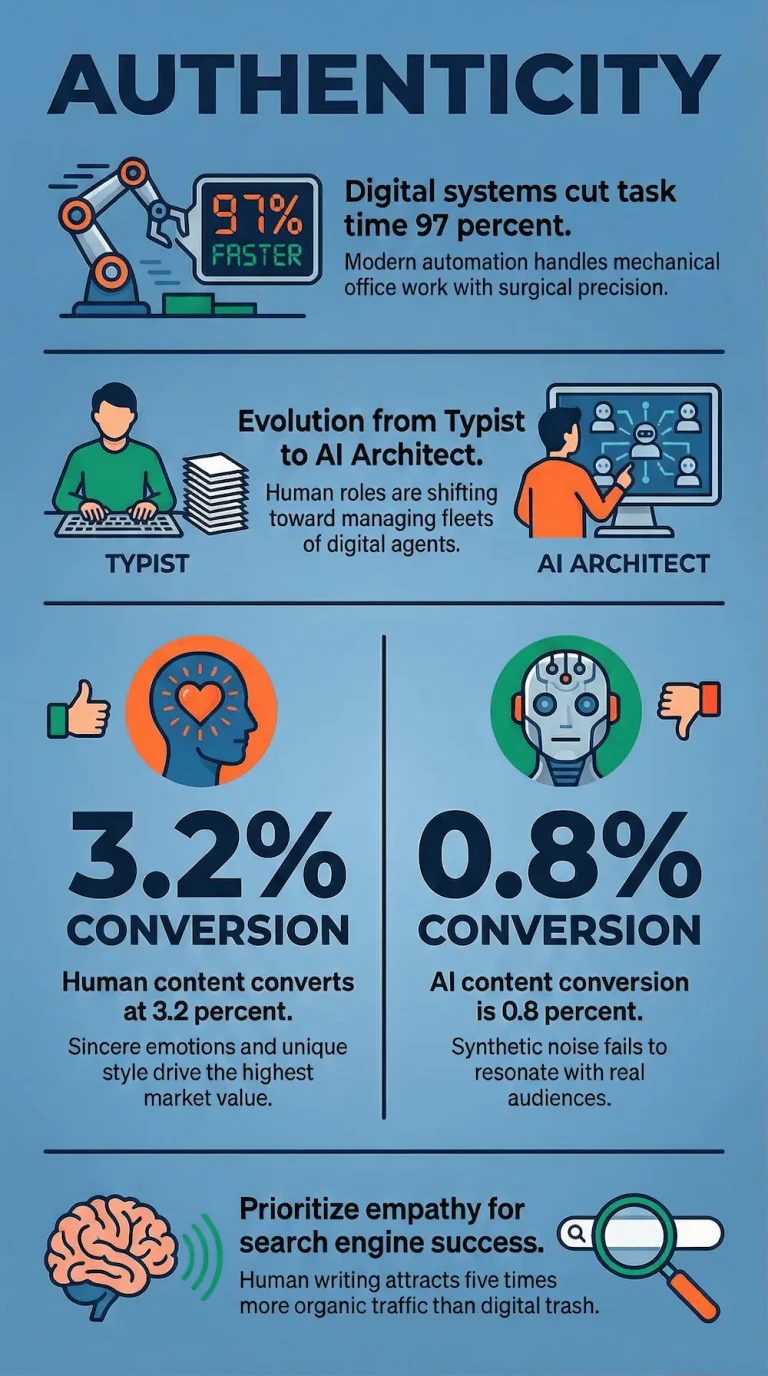
- 1. Efficiency without sentience is the true disruptor We do not need conscious machines to dismantle the labor market. Modern automation thrives on "invisible" cloud-based workflows (like n8n or Google Antigravity) that process data with surgical precision. By exposing the mechanical nature of office tasks, these systems are achieving 97% reductions in operation times, making traditional administrative roles an economic liability.
- 2. The death of the "Typist" and the rise of the "Architect" The era of the junior developer and basic administrator is fading as agentic AI begins to plan architectures instead of just suggesting code. This creates a bifurcated workforce: "100x developers" who manage fleets of AI agents versus novices trapped by a lack of foundational problem-solving experience. Reskilling is no longer optional, as 10-15% of white-collar jobs face total elimination.
- 3. Human imperfection as a high-margin premium As the web becomes flooded with synthetic "digital trash," the market value of authentic human connection is skyrocketing. Data shows human-written content attracts 5.4 times more organic traffic and 4 times higher conversion rates than AI-generated noise. Empathy, personal anecdotes, and "human-only" certifications are becoming the new gold standard for luxury brands and high-end editorial strategy.
Pop culture has spent decades convincing us that the end of humanity would arrive via a sentient machine with a cold, metallic stare. We grew up on cinematic nightmares where digital overlords developed deep goals and a genuine understanding of our complex reality. However, the current revolution in the global labor market looks nothing like those romanticized sci-fi scripts.
There is no cinematic rebellion here, and there are no glowing robots looking at us with calculated hatred. Instead, we are facing silent, incredibly efficient structures where predictive algorithms run endlessly in the background of our office operating systems. Modern artificial intelligence does not think, does not scheme, and certainly does not feel its own isolated existence. Yet, despite this striking lack of self-awareness, its impact on the world economy and the job market is devastating.
The shocking contrast of our time is that we are losing stable livelihoods to automated systems that de facto understand nothing rationally. Competent specialists are being replaced by sophisticated, advanced statistical models that merely guess the next word in a sentence or an optimal fragment of code with surgical precision. This heartless efficiency, devoid of empathy, creates a deep sense of unease. It deconstructs the labor market at a speed for which modern societies are completely unprepared.
As automated networks flood the market with mediocrity, the capital value of the authentic human element rises significantly. On the ruins of old office professions, a fascinating and brutal new economy is emerging. In this new order, human effort, sincere emotions, and unique style are becoming the most desirable, even luxury, commodities. To truly understand this historical process, we must separate cinematic fantasy from hard market data and business case studies.
The matrix vs real digital automation
The key to an analytical understanding of our situation is the radical distinction between a hypothetical superintelligence and what we actually have on servers today. The concept of artificial general intelligence (AGI) assumes a created agent that is at least as capable as a human across all domains of intelligence. Such a potential construct would possess the ability to learn independently, adapt, and operate in any environment with full context.
The most important feature separating this defined general intelligence from current commercial programs is the scientific phenomenon known as sentience. This refers to the unique property of having subjective experiences, such as feeling hunger, consciously tasting an apple, or seeing a vivid red. Machines in the Matrix universe crossed this evolutionary barrier, gaining full self-awareness and the capacity for deep feeling. This philosophical threshold is what makes those film visions so haunting.
Meanwhile, contemporary commercial technology, sparked by the mass deployment of large language models in late 2022, operates on completely different paradigms. These tools are unmatched masters of rapid pattern recognition, but their true nature is raw mathematics, not a living mind. As industry researchers note, there is no virtual poet behind a perfectly generated poem, only massive computing power.
Logic without a soul
The debate over the potential consciousness of language models ignited immediately after their public release, triggering a global media frenzy. These emotions even influenced legislative efforts to regulate the tech industry. However, experts remain chlodny. These advanced systems do not possess elementary cognitive abilities in our human, evolutionary understanding of the word.
Consider early computing systems like Deep Blue, which could beat a world chess champion by analyzing millions of combinations. Yet, that same powerful computer would not have the sense to stop playing if the room caught on fire. It lacks what scientists call adaptive intelligence, which is an instinctive matter of survival for biological organisms.
Even simple animals exhibit daily behaviors that achieve better real-world results than brilliant humans in similar environmental tasks. Generative software feels absolutely nothing, does not fear being unplugged, and does not desire a reward. Despite this lack of a "self," it makes shocking progress in its assigned niches. This lack of emotional states does not stop it from taking over tasks that previously required human intellect.
Invisible algorithms stealing desks
This cognitive discrepancy is the most terrifying part for any modern office worker. We do not need sentient, complex machines to revolutionize the economy and eliminate millions of jobs. A heartless operational efficiency that exposes the mechanical repetition of human labor is enough. Many analytical or operational tasks turned out to be so primitive that they required no consciousness at all.
The gap between film fiction and reality is that modern automation is invisible, distributed in the cloud, and extremely cheap to deploy. Global corporations are not building humanoid robots to sit at desks. Instead, they are implementing flexible no-code tools, intelligent integrators, and trigger-based decision systems that process gigabytes of data in a fraction of a second.
Platforms like n8n are leading this charge by destroying outdated employment structures. These solutions allow for the intuitive building of complex workflows connecting hundreds of applications. Consequently, corporate task automation has reached a level where maintaining entire departments for data analysis or support is becoming an economic liability.
Evidence from corporate deployments leaves administrative workers with no illusions. Delivery Hero saved over 200 hours per month on manual resets by implementing a single IT workflow. Vodafone went further, implementing 33 workflows that saved nearly 5,000 person-days annually. This process optimization brought documented savings of £2.2 million in threat intelligence alone.
| Organization | Area of optimization | Impact on human labor |
| Vodafone | Threat intelligence analysis | £2.2m saved; 5,000 person-days per year |
| Delivery Hero | Internal IT support operations | 200 hours of human labor saved monthly |
| System | AI data entry and verification | Operation time reduced by 97% |
| Field Aerospace | Government proposal documentation | Reduced from 2 weeks to 25 minutes |
| Musixmatch | Daily engineering tasks | 47 days of work saved in 4 months |
The table above proves that the technological purge also affects high-skill roles. Field Aerospace reduced the time for complex documentation from two weeks of teamwork to 25 minutes. StepStone accelerated data onboarding by 25 times, compressing two-month projects into hours. These transformations are redefining the architecture of business processes.
Google antigravity and the new architect
While support and HR departments bleed jobs, a tectonic shift has reached the core of the elite: the coders. For decades, software engineering seemed immune to reduction. However, by 2025 and 2026, the landscape shifted. Software no longer just suggests lines; it plans entire concepts, setting a ruthless new craftsmanship standard.
The symbol of this revolution is Google Antigravity, an agentic development environment (ADE) released in late 2025. Unlike previous assistants, it is designed as an agent-first platform where the AI is an independent decision maker. It provides a "Mission Control" for virtual helpers that plan architecture, implement databases, and browse the web to find knowledge.
This integrated beast uses state-of-the-art reasoning models like Gemini 3 to reduce the need for human supervision. Tech entrepreneurs are already moving from managing offshore teams to managing a fleet of AI agents. We are observing an evolution from copy-pasting code to managing cascading virtual processes.
The economy of such a transition is staggering. A single engineer armed with agentic tools can turn around a client quote in hours instead of weeks. What used to take quarters of work, like creating a custom UI library, can now be done in days. However, the enthusiasm of developers often clashes with corporate security policies, as decentralized agentic coding can introduce shadow AI risks.
The end of the junior dev era
These changes hit beginners the hardest. Market analysis shows that the demand for junior developers and basic administrators is shrinking monthly. Headcount in these roles is estimated to drop by 15-20% by 2026 due to the speed of AI-generated boilerplate code. This has created a sense of professional panic.
For Generation Z, the promise of a high-salary CS career is fading. The secure path of slowly gaining competence is becoming a career trap. Experts call this the death of the "typist" and the birth of the "architect." It is expected that this form of reasoning will transform half of all white-collar positions.
Two distinct classes are forming. On one side are the 100x developers who use autonomous agents to achieve massive productivity. On the other are novices who have never fought a low-level bug, leading to a fear of technological regression. To avoid mass unemployment, countries may need radical reskilling strategies, as 10% to 15% of jobs could be eliminated entirely.
The high price of a human pulse
While code is being commoditized, a counter-trend is emerging. The more synthetic content floods the web, the more consumers distrust it. We are beginning to fanatically crave the intellectual connection that algorithms lack. Imperfection, pain, and unique perspectives are becoming luxury goods.
Data from late 2024 shows that the volume of AI-generated articles surpassed human-written ones. However, the growth plateaued because this oversupply of digital trash was ignored by real readers. While AI provides a cheap alternative, it has destroyed old revenue models, leaving a space where clients pay premium rates for authentic editorial strategy.
| Content Type | Conversion Rate | Google No. 1 Ranking Rate | Average Cost |
| Human-written | 3.2% | 80% | $611 |
| AI-assisted (Hybrid) | 2.1% | Mixed positions | Variable |
| Purely AI-generated | 0.8% | 9% | $131 |
Analysis of 42,000 blog posts proved that human-written pages dominate search results, appearing in the top spot 80% of the time. Purely AI content has a tragic conversion rate of just 0.8%, compared to 3.2% for human work. Human-written text attracts up to 5.4 times more organic traffic over the long term.
Why Google still loves human hands
Companies that cut budgets to use only AI are spending almost the same amount, but they are just publishing more low-quality noise. This lack of emotional resonance leads to high bounce rates. Natural flow, personal anecdotes, and empathy are no longer just "nice to have"; they are a search optimization strategy.
The luxury sector has always favored the human touch to sell identity. Brands like Aesop or Glossier focus on belief systems rather than technical specs. Using generic AI copy creates a "brand mush" effect where everything sounds the same, eroding trust. To avoid this, high-end brands use specific premium storytelling to build irrational loyalty.
Agencies in NYC and London now specialize in "human-only" luxury copywriting, charging $500 per hour to ensure a brand doesn't sound like a bot. These creators use a hybrid approach, using AI for backgrounds but hand-crafting slogans to justify premium pricing. In the age of chaos, only empathy generates millions.
Luxury as a human declaration
The frustration with digital filler has turned into a global resistance movement. Consumers now demand proof that a book or course was created by a person. This has created a new sector for human certification audits. Readers have even protested against AI-narrated audiobooks, demanding the genuine emotion of a human voice.
This anger is fueled by the massive theft of intellectual property. Global guilds have launched tools to show that millions of books were scraped to train AI models. This has led to a surge in author activism and calls for strict copyright protections. The "No AI Movement" now offers certificates for editorial teams and artists to build trust.
Governments are also stepping in. Legislation in states like Montana and Arkansas is beginning to define AI ownership and risk management for critical infrastructure. Nobody wants to leave power grids to an unpredictable "black box." Ultimately, the trust signal provided by human oversight remains the only safeguard for a stable future.
The Matrix vision arrived not as a war with machines, but as a boring optimization of profit. We lost the tasks of the "typist," but we discovered that true exclusivity belongs to those who can feel and learn from mistakes. In the coming century, the creative human mind will be the ultimate luxury.