Key takeaways from the tech dematerialization illusion analysis
The tech industry’s cultivated narrative of boundless progress in a "boundless cloud" is a profound illusion. Digital reality possesses a heavy and brutally physical foundation that relies on resource extraction, corporate debt, and a dangerous new geopolitical rivalry:
1. The physical toll of "weightless" AIGenerative AI is not virtual; it is a thermodynamic phenomenon. Data centers Built for AI can require enough power for over 100,000 homes, and a mid-sized facility can consume up to 5 million gallons of water daily for cooling. Tech giants hide this immense drainage from local communities using non-disclosure agreements, effectively running an extractive industry disguised as progress.
2. SaaS has mutated into toxic corporate debtThe B2B software-as-a-service model has mutated from an optimization tool into uncontrollable fixed-cost debt. The average organization manages roughly 305 different SaaS applications, many purchased via shadow IT, with 70% of users abandoning the software within three months. This uncontrolled spending is now being strangled by AI-driven pricing structures.
3. The quantum cold war and cryptographic collapseThe rapid development of quantum computing is not an experimental curiosity; it is a national security crisis. The ultimate hidden cost is the death of modern security. The geopolitical strategy of "store now, decrypt later" means the arms race is already happening. Decades of state secrets are being archived by hostile regimes, awaiting retro-active decryption by 2030, threatening global informational sovereignty.
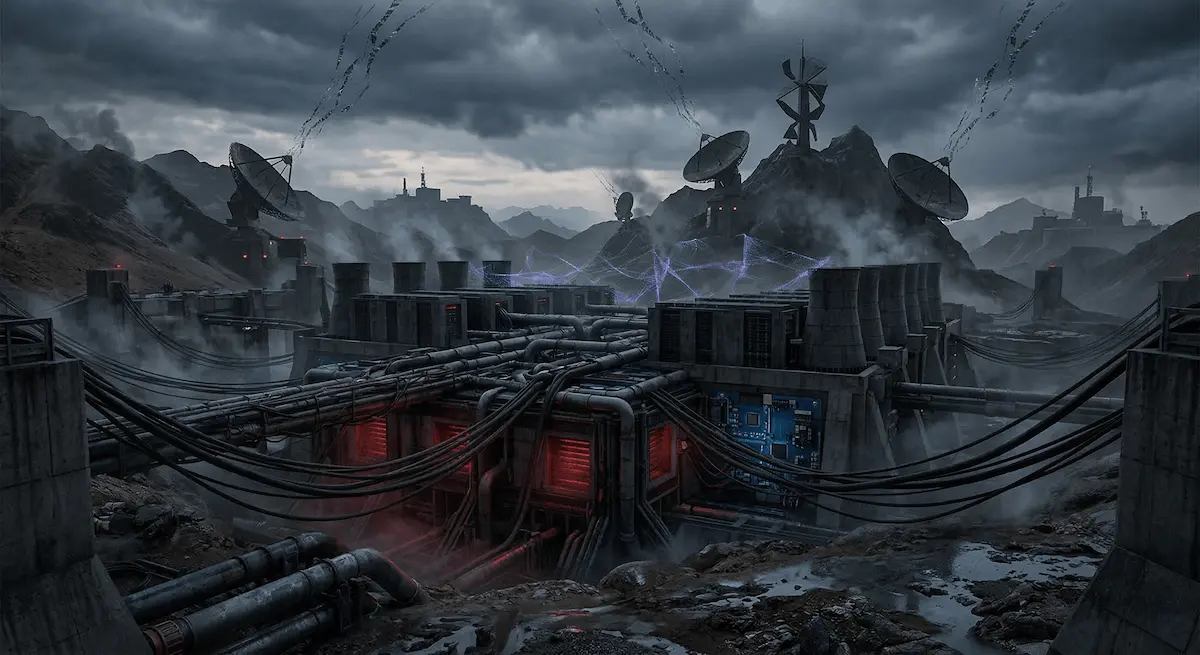
The contemporary technological discourse relies on a carefully cultivated narrative of dematerialization. Big tech corporations from Silicon Valley push the idea that progress happens in a boundless cloud. From generative artificial intelligence to software subscriptions and quantum computing promises, tech is sold as a weightless phenomenon. People generally believe digitalization frees humanity from physical constraints. They think it offers infinite scalability with marginal operational and environmental costs. This is a profound illusion. We must deconstruct the hidden mechanisms driving this industry. This is especially true given the ongoing semiconductor battles and the increasingly questioned return on investment in AI.
Digital reality possesses a heavy and brutally physical foundation. It relies on the massive extraction of natural resources. It creates addictive loops of corporate operational debt. It also stimulates an unprecedented geopolitical rivalry for survival in the post classical cryptography era. The water wars of artificial intelligence expose the thermodynamic costs of generating digital illusions and the corporate tactics used to hide this drainage from local communities. Meanwhile, corporate finance views the software as a service model not as an optimization tool but as toxic technological debt that chokes enterprise innovation. Finally, global powers invest billions in quantum computers for strategic national security reasons. This unstable technology already defines a new cold war and threatens a retroactive collapse of global information security. Understanding these connected vectors is absolutely crucial to diagnosing the true state and hidden costs of the tech economy.
The AI water wars and resource drainage
The rapid development of artificial intelligence has created an unprecedented demand shock for computing power. Large language models and multimodal generative AI require constant and massive matrix operations. This is vastly different from traditional cloud services that mostly handled simple data storage and light query processing. Graphic processing units and tensor processing units generate extreme heat when working under maximum load. The laws of thermodynamics are unforgiving here. This heat must be physically removed from the silicon to prevent system degradation and melting. This is exactly where virtual intelligence collides with hard local hydrology. Drinking water has effectively become the primary thermodynamic currency of the modern digital era.
From single query to city demand
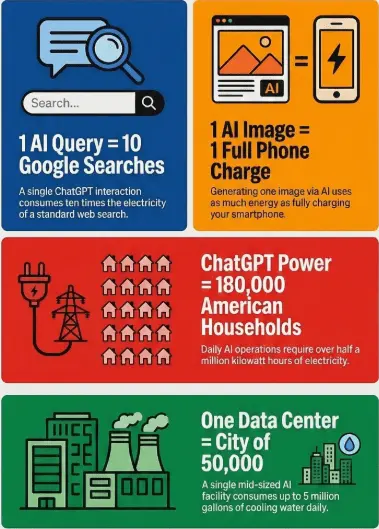
To fully understand the environmental impact of AI, we must translate abstract concepts into concrete consumption units. The computational complexity of AI drastically exceeds traditional web operations. A simple text query processed by a system like ChatGPT consumes nearly ten times more electricity than a standard Google search. Generating multimedia is even more demanding. Creating images through diffusion models is thousands of times more energy intensive than text queries. Generating just one image using an advanced AI model can consume as much electricity as fully charging a modern smartphone. Looking at the macro scale paints a grim picture. In 2024 alone, ChatGPT operations consumed over half a million kilowatt hours of electricity every single day. That is the equivalent of the daily power demand of 180,000 American households.
This massive energy demand translates directly into water consumption. The tech industry divides this into three main scopes.
Scope 1 covers direct water consumption. This includes water evaporated and used on site at data centers. Most modern facilities use evaporative cooling systems. These are highly energy efficient but extremely water intensive. A traditional data center consumes power equivalent to a town of up to 25,000 households. However, new hyperscale data centers built for AI can require enough power for over 100,000 homes. These requirements mean a mid sized data center consumes as much water as a small town. The largest flagship facilities absorb up to 5 million gallons of water every single day. This equals the daily water demand of a city with 50,000 residents.
Scope 2 involves indirect energy consumption. Every kilowatt hour drawn from the grid has its own water footprint. Power plants must be cooled and hydroelectric reservoirs lose water to evaporation. The weighted average for water evaporation during power generation in the United States is about 2.0 gallons per consumed kilowatt hour. Global energy consumption by data centers and AI servers is expected to double between 2022 and 2026. It will likely exceed 1000 terawatt hours. The demand from AI servers alone is projected to grow 150 times over a decade. Federal reports estimate the indirect water footprint of US data centers was roughly 211 billion gallons in 2023.
Scope 3 covers the semiconductor supply chain. Sustainability reports frequently ignore this aspect but it puts a massive burden on ecosystems. The physical production of processors requires enormous amounts of water. Cleaning and etching silicon wafers requires ultrapure water. Creating this substance is highly wasteful. Producing 1000 gallons of ultrapure water consumes 1500 gallons of regular tap water. An average microchip factory uses about 10 million gallons of ultrapure water daily. Producing a single microchip requires between 2.1 and 2.6 gallons of water just during fabrication. Considering an AI cluster can contain tens of thousands of connected processors, the initial water debt is astronomical.
Environmental impact vector
Mechanism and scale estimates
Single image generation
Requires energy equal to a full smartphone battery charge
Direct cooling scope 1
Up to 5 million gallons of water daily per hyperscale facility
Indirect water scope 2
211 billion gallons annually in the US alone
Microchip production scope 3
10 million gallons of ultrapure water daily per factory
AI related carbon emissions
Up to 79.7 million tons annually
Global data center demand
Around 560 billion liters of water consumed globally in 2023
The ecological trilemma of space and energy
The physical expansion of AI infrastructure has created an unsolvable spatial and energetic trilemma. Corporations must constantly choose between optimizing water use, preserving land surface, and minimizing carbon emissions. A deep analysis from Texas illustrates this perfectly. Using natural gas to power data centers requires 50 times more water than solar energy. It requires 1000 times more water than wind energy. Conversely, wind energy minimizes the water footprint but demands extreme amounts of physical space. It requires 42 times more land than gas plants and four times more than solar farms.
This trilemma hits local communities with unprecedented force. New data centers cover hundreds of acres in steel and concrete. They permanently remove this land from agricultural or residential use. They also force the construction of new transmission corridors. Tech giants are practically forcing regulators to return to fossil fuels. Regulators in Louisiana approved three new natural gas plants in August 2025 just to meet the energy demand of a single new Meta data center. Data centers are projected to emit three times more carbon dioxide annually by 2030 than they would have without the AI boom.
The hydrological dimension creates massive local infrastructure crises. Cooling demand peaks during the hottest and driest periods of the year. This puts maximum strain on water utilities exactly when reserves are at their lowest. Researchers warn that peak water demand for US data center cooling could spike by an additional 1.45 billion gallons daily by 2030. Meeting this extreme demand will require local governments to build new water infrastructure costing up to 58 billion dollars. Permit applications in Newton County alone include facilities that would use 6 million gallons daily. This would more than double the entire county's current consumption. There is a systemic risk that data center operators will get priority access to water reserves during droughts.
Information asymmetry and hidden costs
Big tech companies are fully aware of their destructive impact on local ecosystems. They have developed a sophisticated system of information asymmetry to pacify public resistance. The primary legal tool used for this purpose is the non disclosure agreement. Tech giants like Amazon and Microsoft often operate through shell companies. They sign strict agreements with local governments that categorically forbid disclosing key operational data. The identity of the operator, estimated power consumption, and water drainage remain hidden until the project is finalized.
This process allows corporations to negotiate unprecedented tax breaks in total secrecy. They effectively shift the financial burden of infrastructure development onto regular consumers. Electricity prices for citizens have skyrocketed by over 250 percent in regions with high data center density. Local authorities are lured by promises of new jobs and tax revenues. Tech companies saved about 130 million dollars annually through incentives in Virginia alone. However, the massive external costs like groundwater drainage and noise pollution are dispersed across the entire region.
Projects in Wisconsin serve as a perfect example. The Vantage facility in Port Washington has an estimated power demand of 3.5 gigawatts. If powered by conventional sources, its indirect water consumption will reach 54 million gallons daily. Similarly, Microsoft promotes its Fairwater project as the most powerful AI data center in the world but refuses to disclose its power generation estimates. These actions deliberately bypass investment risk evaluations by environmental organizations and local farmers. The AI boom has turned the tech industry into a deeply extractive sector. It heavily resembles the coal mining industry in its ruthless drainage of local resources. Corporations are also moving operations to the global south to find cheaper land and looser regulations.
Software subscriptions as corporate debt
A similarly destructive process is happening in corporate finance. It is hidden behind the popular software as a service model. The original promise of moving to the cloud seemed perfectly rational. Organizations wanted to replace massive capital expenditures with flexible monthly operational costs. They supposedly wanted to pay only for what they actually used. A decade later, reality has brutally verified these assumptions. B2B cloud software has mutated from an optimization tool into structural operational debt. It now generates massive and uncontrollable costs.
Tech stack sprawl and shadow IT
The mechanics of the SaaS model rely on decentralized purchasing. Modern enterprises no longer need long procurement cycles to deploy specialized applications. An employee simply links a corporate credit card to an account. This drastically lowered the barrier to entry but birthed the shadow IT phenomenon. Marketing, HR, and sales departments now build unapproved tech stacks entirely outside the control of central IT.
This has led to an unprecedented explosion of application portfolios. Industry benchmarks for 2026 show the average organization manages roughly 305 different SaaS applications. Many executives live in blissful ignorance of this scale. Management often estimates they use around 100 tools, while automated audits routinely discover up to 600. Maintaining this digital chaos is incredibly expensive. Average annual corporate spending on cloud software has hit 55.7 million dollars. The global SaaS market is projected to reach 1.22 trillion dollars by 2032.
Portfolio sprawl is tied directly to massive waste. Applications are bought during the initial excitement of new projects and quickly forgotten. Usage statistics are unforgiving. Nearly 70 percent of new users completely abandon purchased software within the first three months. A monthly churn rate of 3.5 percent clearly highlights the problem of user retention. However, complicated cancellation processes and auto renew clauses keep organizations paying for thousands of unused zombie seats.
The AI cost shock and price volatility
The arrival of generative AI complicated things further. It introduced a drastic shift in licensing models. Traditional SaaS relied on predictable per seat pricing. Language models forced vendors to integrate AI features and shift to consumption based pricing. Analysts predict 70 percent of top vendors will offer usage based pricing by 2027.
This marks the end of budget predictability for organizations. Companies are being hit by massive cost volatility. Enterprises report a staggering 108 percent year over year increase in spending on native AI applications. Surveys show 78 percent of IT leaders face unexpected charges tied directly to new AI features. The capital saved by automating human tasks is immediately consumed by soaring software license fees.
This uncontrollable spending spiral is damaging core business operations. Financial pressure is so intense that 61 percent of organizations have paused or canceled strategic projects just to cover unplanned cloud costs. The cloud has stopped being an accelerator for growth. It has become a parasitic fixed cost that suffocates the enterprise.
Stack optimization and management platforms
A powerful trend of tech stack rationalization has emerged in response. CFOs and CIOs have abandoned the growth at all costs mindset. They are moving toward rigorous control of operational risk and value. This is yielding historical results. For the first time, the number of applications in organizations dropped by 0.07 percent in 2026. Yet overall spending still grew by 8 percent. This proves that aggressive vendor pricing is the real engine of technological inflation today.
The market is rapidly adopting specialized SaaS management platforms. Over 70 percent of organizations will centralize their licensing through these platforms by 2028. These AI driven systems automatically scan identity providers and accounting software to monitor every aspect of software usage. They enable the crucial three R strategy.
First is rationalization. This involves eliminating duplicate tools and shadow IT. A third of organizations consolidated redundant apps in 2025 due to budget pressure. Second is rightsizing. Companies downgrade expensive premium licenses for users who only need basic features. Third is renewal management. Organizations consolidate purchasing power and negotiate using accurate market benchmark data.
The financial results of these actions are spectacular. Adobe reduced its portfolio to 400 preferred programs and saved 60 million dollars. Modernizing Medicine saved 1.4 million dollars simply by reclaiming 2800 unused licenses.
SaaS waste and optimization metrics
Market estimates 2025 to 2026
Average apps per organization
305 platforms per company
Shadow IT perception gap
Management underestimates stack size by up to 50 percent
Software user abandonment
70 percent drop off within three months
AI native software cost growth
Spending jumped 108 percent year over year
Management platform adoption
Expected to exceed 70 percent by 2028
The quantum arms race and cryptography
Environmental and financial costs pose direct operational threats to corporations. However, a much deeper threat looms over global security architectures. The rapid development of quantum computing is the ultimate hidden cost of the tech industry. Comparing the modern quantum arms race to the Manhattan Project is not journalistic hyperbole. This technology will permanently alter the cybernetic balance of power. It forces global superpowers to invest billions in immensely complex engineering systems.
Quantum physics and dual use potential
Classical computers rely on bits that hold a value of zero or one. Quantum computers use qubits to leverage superposition and quantum entanglement. Their power grows exponentially with every added qubit. They navigate complex probability spaces in ways classical supercomputers simply cannot. But this power requires unimaginable physical engineering. Superconducting quantum systems suffer from decoherence. Any interaction with the outside environment causes immediate operational failure. Quantum processors must be cryogenically cooled to near absolute zero. The infrastructure required rivals the energy needs of a small city.
Why do governments bear these massive costs? Quantum computing is a classic dual use technology. In the civilian sector, it will simulate chemical reactions with atomic precision. This will accelerate drug discovery by decades and optimize complex supply chains. However, it possesses absolutely devastating offensive potential in the military and cryptographic domains.
Shor algorithm and the death of RSA
Modern digital security relies heavily on asymmetric cryptography like RSA. These algorithms assume that factoring giant prime numbers would take supercomputers billions of years. Quantum computers flip this logic completely. A cryptographically relevant quantum computer running the Shor algorithm could break a 2048 bit RSA key in hours or minutes. This means state secrets, bank transfers, and private communications will be instantly exposed.
Store now and decrypt later strategy
Many people mistakenly believe our data is safe until a fully functional quantum computer is built. This is a dangerous cognitive bias. The threat is entirely contemporary due to a geopolitical tactic known as store now, decrypt later.
The architecture of this attack relies on three distinct phases. First is the harvest phase. Advanced hacker groups sponsored by hostile regimes infect telecommunication hardware and copy encrypted network traffic. Second is the storage phase. These exabytes of mathematical noise are archived in national data centers built by authoritarian states. Third is the decryption phase. When quantum technology matures around 2030, the Shor algorithm will be unleashed on these dormant archives. Classic infrastructure does not protect data retroactively. Decades of intelligence and industrial secrets will suddenly become readable.
Quantum geopolitical strategies
Impacts and current investments
Store now decrypt later threat
Capturing encrypted noise today to break it tomorrow
Chinese national strategy
$15 billion invested with focus on quantum satellite networks
United States defense response
$7.1 billion estimated cost to adapt federal agencies to PQC
European Union infrastructure
Over €11 billion for EuroQCI and IRIS2 satellite networks
The global race for quantum supremacy
The battle for quantum supremacy divides the world into three major research camps. China has emerged as an absolute pioneer. The state has directed at least 15 billion dollars specifically into public quantum research. While the US focuses on computing chips, China dominates quantum communication. They built a fully functional 12,000 kilometer terrestrial quantum network integrated with orbital satellites. Their Micius and Jinan-1 satellites facilitate quantum key distribution. This creates an unhackable command structure prepared for intense electronic warfare.
The United States struggles with a slow collapse of coordination despite bold claims of quantum supremacy. The American landscape suffers from a lack of a central federal agency. Crucially, the US relies heavily on Chinese supply chains for rare earth metals. American intelligence agencies forced the Office of Management and Budget to mandate a shift to post quantum cryptography. Just upgrading high priority federal systems will cost 7.1 billion dollars by 2035.
The European Union is making a massive, albeit delayed, attempt to save its informational sovereignty. They are pushing the European Quantum Act for 2026. Europe has poured over 11 billion euros into this field recently. The continent produces half of the world's quantum components but struggles to commercialize them. To fix this, the EU is building the EuroQCI project to create cross border quantum fiber networks. They are also launching the Eagle-1 satellite to secure space communications. Furthermore, strict foreign direct investment screening is blocking hostile nations from buying key European quantum firms.
Systemic implications and the real bill
Evaluating the modern tech environment reveals massive systemic distortions. Investing billions in AI without immediate returns masks a grim truth. The cloud is an extractive mechanism. Tech giants monetize innovations while local communities pay the brutal physical bill. They suffer through drained aquifers, lost farmland, and spiking energy tariffs. The push to automate cognitive functions drives structural energy poverty and unravels climate transition achievements.
Simultaneously, the corporate operational ecosystem is choking on subscription debt. The invisible cost of monthly licenses and AI driven pricing structures has created severe budget rigidity. Wasting billions on shadow IT forces massive project cuts.
Yet these environmental and financial crises pale in comparison to quantum geopolitics. The transition to post quantum standards is a desperate logistical necessity to save sovereign integrity. The store now, decrypt later strategy means the arms race is already happening. The tech industry has not invalidated the physical world. It merely shifted the load vectors. The true, material cost of the digital revolution is finally coming due.