Key takeaways from the AI Design Disruption analysis
The rapid rise of generative AI has fundamentally dismantled the traditional UI design industry. As manual execution becomes automated, the landscape is shifting from proprietary software to aggressive ecosystem lock-in, carrying devastating environmental costs:
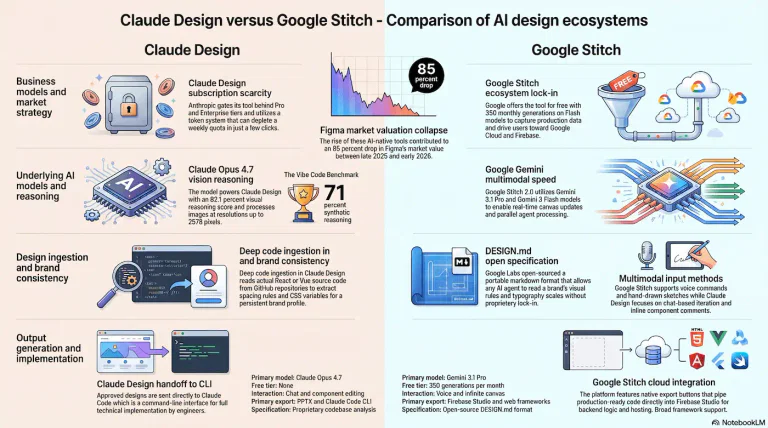
- 1. The collapse of manual execution and proprietary silos Figma's staggering 85% market value crash (a $120 billion loss) signals the end of the traditional UI design process. Simultaneously, open-source specifications like DESIGN.md are empowering autonomous AI agents to bypass closed, legacy design systems entirely.
- 2. Engineered scarcity and corporate lock-in Tech giants are weaponizing the new design layer. While Anthropic utilizes opaque token economies to drain user quotas, Google Stitch 2.0 (powered by Gemini 3.1 Pro) commoditizes the canvas for free, strategically funneling valuable production data straight into Google Cloud.
- 3. The devastating physical toll of "vibe design" The transition to generative interface creation extends far beyond digital disruption. This heavy computational burden places massive, unsustainable demands on global infrastructure, evaporating local water supplies and severely straining power grids.
The market understood something fundamental that professional software designers are still struggling to metabolize: tools that turn text prompts into working digital prototypes are no longer experimental toys incubated in research labs. They are highly capitalized engines of market reallocation. Between its initial public offering in August 2025 and April 2026, Figma lost 85% of its market value. The stock plunged from a peak of $142.92 to approximately $21, wiping out an astonishing $120 billion in market capitalization.
This collapse occurred despite the company reporting $1.06 billion in revenue for the 2025 fiscal year and maintaining a highly enviable net dollar retention rate of 136%. The financial fundamentals of the organization were objectively strong. Yet, the market brutally punished the stock. Institutional investors are no longer betting against Figma's current quarterly revenue; they are betting entirely against its underlying business model. Figma built a virtual monopoly by locking corporate design systems into its proprietary, closed-ecosystem component architecture. For years, this lock-in seemed insurmountable. The failed $20 billion acquisition attempt by Adobe in 2023 merely reinforced the perception that Figma owned the execution layer of the internet.
But the release of AI-native tools that bypass the manual drawing phase entirely has made that proprietary moat look exceedingly fragile. Two specific product launches triggered this historical market correction. On March 19, 2026, Google upgraded its experimental design tool, Stitch, to version 2.0. Figma’s stock dropped 12% over the next two days. Exactly one month later, on April 17, 2026, Anthropic released Claude Design into research preview, causing Figma to drop another 6.8% intraday. The strategic subtext accompanying these launches was impossible to ignore. Mike Krieger, Anthropic’s Chief Product Officer, quietly resigned from the Figma board of directors just days before the Claude Design announcement. Financial analysts interpreted the move as a formal declaration of war and a highly calculated strategic divorce.
The industry is currently witnessing a classic, aggressive example of platform decay and value extraction. When artificial intelligence models can ingest raw codebase repositories and spit out a fully styled, interactive mockup in seconds, the manual labor of dragging vectors and rectangles on a digital canvas becomes an obsolete inefficiency. Corporate clients are already shifting their operational habits to reflect this new reality. They retain a handful of Figma licenses for complex, distributed team reviews and legacy maintenance, but for high-velocity tasks like landing pages, pitch decks, and mobile app prototypes, they open Claude Design or Google Stitch directly. The execution layer of software design is being automated out of existence, and Wall Street is merely pricing in the new reality of the labor market.
Claude Design and the architecture of engineered scarcity
Anthropic positions Claude Design as a sophisticated, enterprise-grade workspace that bridges the persistent gap between visual ideation and software engineering. Powered by the newly released Claude Opus 4.7 vision model, the product operates within a dedicated interface on the Claude web platform, heavily gated behind the Pro, Max, Team, and Enterprise subscription tiers. The company claims the tool elevates human creativity by compressing brand consistency, editing, collaboration, and code implementation into a single, cohesive loop.
The underlying model driving this product, Opus 4.7, represents a significant leap in synthetic reasoning. According to benchmark data released in April 2026, the model's visual reasoning capabilities jumped from 69.1% to 82.1%. It processes images at up to 2,576 pixels on the long edge, which is over three times the resolution capacity of previous Claude iterations. In software engineering tasks, its SWE-bench Pro score increased to 64.3%, and it immediately secured the top position on the Vals AI Vibe Code Benchmark at 71%.
The primary technical differentiator of Claude Design is its structural approach to the corporate design system. Unlike earlier AI image generators that simply applied generic color palettes to flat images, Claude Opus 4.7 reads actual production source code. A user can point the model to a live GitHub repository, upload a ZIP file of custom React components, or import existing Figma assets, logos, and typography. The model analyzes the raw files, extracting spacing rules, CSS variables, and component logic to build a persistent brand profile. Every subsequent slide deck, mobile mockup, or prototype generated by the user automatically applies these specific visual rules. When the design is approved, a native handoff button packages the assets and sends them directly to Claude Code, Anthropic’s command-line interface, for full technical implementation.
Yet, beneath this highly polished marketing narrative lies a restrictive, heavily financialized infrastructure. Claude Design operates on a separate consumption quota from the standard Claude chat interface. Users paying $20 a month for the Pro plan quickly discover that the phenomenon dubbed the "Tokenocalypse" is not an accident, but a deliberate feature of the system. The quota depletes with astonishing speed; generating a single 12-slide presentation with a few complex prompts can entirely exhaust a user's weekly limit in just two clicks.
This rapid token burn is an engineered inefficiency inherent to the Large Language Model architecture. Claude lacks persistent internal memory between conversational turns. Every time a user clicks send, the client transmits the entire conversation history back to the server. In a design session with hundreds of iterative visual tweaks, the user effectively pays for the input of a small novel with every minor adjustment. Sessions can easily accumulate 150,000 context tokens, leading to exponential costs. Furthermore, independent analysts discovered that the Opus 4.7 update introduced a new tokenizer that maps the exact same user input to up to 35% more tokens than previous models, quietly inflating the cost of operation while keeping the nominal API price at $5 per million input tokens.
Anthropic's own software also exhibits documented bugs that exacerbate these costs for developers. The native application version of Claude Code contains a critical Cache Time-To-Live (TTL) error that drops context retention from 60 minutes to just 5 minutes when "Extra Usage" features are active. If a developer steps away from their desk for a brief coffee break, the model dumps the cache entirely, forcing the user to pay full price to rebuild the massive context window from scratch upon their return. The only known fix is to uninstall the native application and install the tool via a package manager like npm.
To survive this walled garden without bankrupting their operational accounts, users are forced into rigid, highly technical gymnastics. They must use bash hooks (pre-tool scripts) to actively block the AI from wasting tokens on repetitive errors. They must implement strict .claudeignore files to prevent the model from reading massive, irrelevant directories like node_modules during search operations, which alone can save 30% of a quota. They must aggressively clear chat histories and manually save 200-word "handoff summaries" in local markdown files to feed back into the machine when restarting a session. The utopian vision of collaborating with a highly intelligent, frictionless design agent rapidly dissolves into the gritty reality of micromanaging a forgetful, highly expensive algorithm to avoid hitting an arbitrary corporate paywall.
Google Stitch and the trap of the free infinite canvas
If Anthropic’s strategy relies on extracting direct subscription revenue through artificial scarcity and opaque tokenizer mapping, Google’s approach with Stitch 2.0 is textbook surveillance capitalism and market commoditization. Google Stitch is completely free. Users receive 350 generations per month on the faster Gemini 3 Flash model and 50 generations on the high-quality Gemini 3.1 Pro model. There is currently no paid tier, and no credit card is required to sign up.
Google originally launched Stitch at the Google I/O conference in May 2025 as a simple, highly limited text-to-UI generator. The massive March 19, 2026 update transformed it into what the company aggressively markets as an "AI-native software design canvas". The tool features an infinite workspace where users can drag in source code, competitor screenshots, product requirement documents, and hand-drawn sketches simultaneously. An integrated Agent Manager allows for parallel processing, one agent can iterate on a complex employee feedback dashboard while another simultaneously explores color variants for a public landing page.
The most heavily promoted feature of this release is Voice Design. Users can literally speak directly to the canvas. The AI agent acts as a conversational partner, actively interviewing the user about their product requirements and updating the visual layout in real time. If a user states out loud that a specific call-to-action button looks "too aggressive," the model adjusts the corner radius, modifies the color saturation, and softens the drop shadow before the user even finishes speaking the sentence.
However, Google is not providing this immense, compute-heavy infrastructure for free out of corporate benevolence or a desire to support independent creators. Stitch is a strategic weapon designed to strictly commoditize the complement. By making the interface design layer completely free, highly capable, and frictionless, Google effectively devalues the software that sits on top of the stack (like Figma) and forces the economic value down to the underlying infrastructure that Google controls: cloud hosting, data storage, and compute processing.
This strategy is evident in the platform's export capabilities. While Stitch allows users to copy elements into Figma, the primary workflow pushes users toward direct code export. Stitch generates production-ready code in HTML/CSS, Tailwind CSS, Vue.js, Angular, Flutter, and SwiftUI. More importantly, it includes native export buttons that pipe the generated code directly into Firebase Studio, Google's proprietary cloud-based development environment. The free, infinite canvas is ultimately a highly efficient acquisition funnel, capturing users at the earliest phase of ideation and quietly locking their actual production data, backend logic, and hosting fees into the Google Cloud ecosystem.
The DESIGN.md specification and the end of proprietary lock-in
The aggressive push to decouple design from proprietary software platforms is most explicitly codified in the release of DESIGN.md. On April 21, 2026, Google Labs officially open-sourced the DESIGN.md draft specification under the permissive Apache 2.0 license. This portable markdown file acts as a universal, machine-readable repository for a brand's specific visual rules.
The specification dictates a highly structured document with nine predefined sections so that autonomous AI agents know exactly where to find specific information without hallucinating or guessing. These sections cover the visual theme and atmosphere, semantic color roles (primary, surface, accent, error), typography scales, component stylings, layout principles, depth and elevation, responsive behaviors, and strict "do's and don'ts". Crucially, it includes an "Agent Prompt Guide," allowing human designers to leave explicit, hard-coded instructions specifically for the AI models reading the file.
By utilizing W3C Design Tokens, the tokens defined in the markdown file can be instantly exported into a tokens.json file or a tailwind.config.js script. Because it is a simple text-based file, it is natively versionable in Git, allowing engineering teams to track design changes through standard pull requests. Furthermore, the specification requires that color choices be algorithmically validated against WCAG AA/AAA standards to ensure readable contrast ratios before the agent generates any interface.
The introduction of DESIGN.md is a direct, calculated assault on the very concept of proprietary design systems. Instead of locking a company’s visual identity inside Figma's closed ecosystem, the rules are extracted into a universal format that any AI agent—be it Claude Code, Cursor, GitHub Copilot, or Google’s own Gemini CLI—can read natively. A developer simply saves the DESIGN.md file in their project root. When they ask an agent to generate a new login screen, the agent reads the markdown file and automatically applies the correct border radii, semantic colors, and typography.
Google Stitch further accelerates this open standard by operating a Model Context Protocol (MCP) server. This infrastructure connects the Stitch design canvas directly to external coding assistants. A UI generated within Stitch can be implemented instantly by a Cursor agent without requiring a human to manually export assets or write integration code. By ensuring that design logic is perfectly portable and machine-readable, Google eliminates the friction of switching tools, systematically dismantling the lock-in that justified Figma's multi-billion dollar valuation.
Canva’s integration - Taking over the publishing layer
While Anthropic and Google battle over developers and enterprise design systems, Canva has quietly maneuvered to capture the mass-market publishing layer. On April 16, 2026, building upon the release of Canva AI 2.0, the company announced a deep integration with Claude Design. This partnership is designed to capture the outputs of generative models and force them into Canva's highly profitable Visual Suite.
The integration explicitly addresses the core limitation of AI-generated assets: they are typically static, flat, and extremely difficult to edit without regenerating the entire prompt. Canva solved this by introducing "HTML importing" and expanding its drag-and-drop editor to support interactive code and AI artifacts generated directly by Claude.
A user can now prompt Claude Design to build a dynamic landing page, a data collection widget, or an interactive experience. Instead of dealing with the raw frontend code, the user seamlessly imports the artifact into Canva. Powered by the Canva Design Model, the coded creation is instantly transformed into a fully editable, structured design. A marketing manager can swap colors, move elements, and update text layouts using standard drag-and-drop mechanics without having to regenerate the underlying HTML code for every minor adjustment.
This system is reinforced by Canva's Magic Layers product, which transforms static AI-generated images into editable files with separated elements. Canva claims that in the month following its launch, Magic Layers was utilized over nine million times, proving that generation is merely the start of the workflow. To maintain corporate consistency, Canva forces these AI workflows through its Brand Kits feature, automatically applying specific corporate identities to any content created, resized, or summarized by the AI.
Once the AI-generated artifact is stylized within Canva, the platform captures the final distribution. Users can embed the creation into a Canva Presentation, link a Canva Form to a Canva Sheet to collect user data, or publish the interactive content as a live website using Canva Websites with a custom domain—all without ever leaving the proprietary ecosystem. Canva is perfectly content to let Anthropic burn expensive compute cycles generating the initial code, so long as the final product, the user data, and the hosting revenue remain locked inside the Canva platform.
Comparing the engines of extraction
To understand how these platforms segment the market and extract capital, one must look past the PR narratives and examine the physical and economic constraints built into the software architecture.
| Feature / Metric | Claude Design (Anthropic) | Google Stitch 2.0 (Google Labs) | Canva AI 2.0 Integration |
|---|---|---|---|
| Primary Business Model | Subscription scarcity ($20/mo Pro plan) with aggressive token depletion. | Loss-leader ecosystem lock-in (Free); drives users to Google Cloud. | Capturing the publishing and hosting layer via subscription lock-in. |
| Core Model Architecture | Claude Opus 4.7 Vision. High reasoning, deeply understands complex codebases. | Gemini 3.1 Pro / Gemini 3 Flash. Fast, iterative, multimodal (voice, text, image). | Canva Design Engine paired with Anthropic Claude artifacts. |
| Design System Ingestion | Deep integration. Reads actual React/Vue source code and applies proprietary logic. | Surface level. Uses the portable DESIGN.md markdown format for tokenized rules. | Brand Kits. Forces AI generation into pre-approved corporate color and font silos. |
| User Interaction Method | Chat, inline component comments, draw-to-edit, custom AI-generated sliders. | Voice Design (real-time canvas updates), parallel agent management. | HTML importing, drag-and-drop artifact editing, Magic Layers. |
| Output Constraints | Broad format support including PPTX (pitch decks) with auto-speaker notes, HTML. | Strictly web/mobile UI (HTML, CSS, React, Tailwind). Lacks presentation export. | Presentations, live websites with custom domains, integrated data sheets. |
| Implementation Handoff | Native closed-loop to Claude Code CLI for engineering execution. | MCP Server / SDK to external agents (Cursor, Gemini CLI, Claude Code). | Fully contained within the Canva Visual Suite ecosystem. |
The "vibe design" illusion and the systemic atrophy of human skill
The technology press and venture capital ecosystem have rapidly adopted the term "vibe design" to describe this new generative paradigm. Coined originally as "vibe coding" by AI researcher and former OpenAI co-founder Andrej Karpathy in early 2025, the concept advocates for fully abandoning the mechanics of implementation. In Karpathy's vision, developers and designers must "fully give in to the vibes, embrace exponentials, and forget that the code even exists".
In vibe design workflows, the human’s primary input is mere intent. The designer provides a mood, a reference screenshot, or a brief paragraph describing a business goal, and the generative model constructs the layout, selects the typography, writes the frontend code, and populates the database logic. The human’s role is immediately reduced from creation to curation. To formalize this, marketing agencies have adopted the SPOT framework: Spot an opportunity, Produce assets via AI, Optimize through testing, and Track results. The aggressive marketing suggests this shift frees professionals from mundane tasks, allowing them to focus entirely on high-level strategy and creative direction.
The practical reality of operating these tools tells a vastly different story. Vibe design fundamentally flattens the quality of digital interfaces. When a professional designer with twenty years of experience tested Google Stitch with a standard product requirements document, the resulting output was clinically described as generic. The color schemes felt washed out and desaturated, the visual hierarchy was noticeably flat, and the layouts aggressively defaulted to the most average, highly recognizable SaaS patterns scraped from the model's training data. The AI operates entirely through statistical probability; it optimizes for the mathematical mean, systematically erasing distinct visual personality or brand idiosyncrasy.
Furthermore, vibe design introduces the severe "black box" problem into the visual layer. Because the AI generates the underlying HTML, CSS, and component structure instantly, the human operator rarely understands how the code actually functions. When a frontend element breaks, debugging becomes an exercise in utter frustration. This is the prototype trap: the mockup looks beautiful in a static Figma export or a Stitch preview window, but the underlying logic crumbles under real-world interaction, accessibility requirements, and edge cases.
This creates an absurd operational loop. Users find themselves spending exorbitant amounts of API tokens trying to verbally coax a language model into fixing a misaligned two-pixel margin. As one critic noted, it is often significantly more exhausting to explain exactly how to fix a nuanced spatial error via text prompt than it is to simply open the file and fix it yourself. But the architecture of vibe design heavily discourages manual intervention, pushing users to continue feeding the prompt window to maintain the illusion of automation.
The system rewards highly structured, overly specific text prompts while explicitly punishing actual design intuition. The AI hallucinates features, adding payment panels and analytics dashboards that were never requested simply because it associates those components with the generic SaaS template it retrieved. In the process of constantly managing these algorithmic errors, the foundational human skills of spatial reasoning, color theory, and structural hierarchy begin to atrophy across the workforce. The industry is not elevating creativity; it is outsourcing its core competencies to a statistical engine that fundamentally does not understand what it is drawing.
The physical cost of virtual mockups: Water, nuclear ambition, and the grid
The technology sector's aggressive pivot to generative interfaces requires an immense, highly destructive extraction of physical resources. The companies selling "infinite canvases" and frictionless design workflows are doing so by placing unprecedented, unsustainable strain on global energy grids and local municipal water supplies. The contrast between the virtual weightlessness of a digital mockup and the heavy industrial machinery required to generate it is stark.
In 2024, global data center electricity consumption sat at 415 terawatt-hours (TWh), roughly 1.5% of the world's total electricity use. Driven entirely by the massive compute requirements for AI inference, consensus estimates from the International Energy Agency and leading financial institutions project this number to skyrocket. By 2026, data center energy consumption is expected to reach 1,050 TWh. To contextualize this massive scale, if the global data center footprint were a sovereign nation, it would be the fifth-largest energy consumer on the planet, ranking strictly between Japan and Russia.
The energy required for generative AI operations absolutely dwarfs traditional cloud computing. A standard Google search requires approximately 0.3 watt-hours of electricity. Generating a single response from an advanced generative AI model requires nearly ten times that amount, roughly 2.9 watt-hours. When evaluating specific models through independent academic benchmarks published in early 2026, the disparity becomes even more alarming. A single short query using the DeepSeek-R1 reasoning model consumes a staggering 23.8 watt-hours. By comparison, Anthropic's Claude 3.7 Sonnet consumes 0.84 watt-hours, and Google's standard Gemini 2.5 consumes 0.24 watt-hours for a similar task.
The industry leaders are acutely aware of the negative optics and the impending regulatory backlash. Google’s 2025 Environmental Report proudly, and prominently, states that the company reduced its data center energy emissions by 12% year-over-year, despite a 27% increase in actual electricity demand. They achieved this statistical victory primarily through complex accounting maneuvers and massive capital expenditure, signing contracts to purchase over 8 gigawatts of clean energy generation. In a highly publicized move, Google even signed the world's first corporate agreement to purchase nuclear energy directly from multiple Small Modular Reactors (SMRs) developed by Kairos Power.
However, these polished corporate sustainability metrics systematically obscure the broader physical reality. While Google technically reduced its direct operational emissions, its total emissions, actually increased by 11% year-over-year. The physical hardware required to run these frontier models demands staggering localized power. A single Nvidia H100 GPU draws up to 700 watts, and full racks of modern AI compute exceed 240 kilowatts, necessitating drastic, energy-intensive changes to data center cooling infrastructure.
Cooling these massive server racks requires vast amounts of water. Estimates indicate that a standard generative AI query consumes roughly 0.32 milliliters of freshwater. While this sounds minor on an individual level, at the scale of billions of automated queries per day, the local environmental impact is devastating. Microsoft’s data center campus in West Des Moines, Iowa, draws approximately 43 million liters (11.5 million gallons) of water per month during the summer. This single corporate facility consumes 6% of the entire city’s municipal water supply. Researchers project that by 2027, AI-driven data centers globally could withdraw up to 6.6 billion cubic meters of freshwater, outright evaporating up to 0.60 billion cubic meters of that directly into the atmosphere—an amount exceeding the annual freshwater withdrawal of four to six nations the size of Denmark.
Anthropic, while heavily positioning itself as the responsible, safety-first AI lab, casually predicts that training a single frontier model will require 5 gigawatts of power by 2027. The company further projects that the U.S. AI sector alone will demand 50 gigawatts of new electric capacity by 2028 simply to maintain global AI leadership. To put the 50 GW figure into proper context, it is roughly twice the peak electricity demand of the entire city of New York. In response to this self-created crisis, Anthropic has openly lobbied federal policymakers to accelerate geothermal, natural gas, and nuclear permitting, and requested a U.S. Army Corps of Engineers “nationwide permit” to bypass standard Clean Water Act reviews to speed up data center construction. Ultimately, the technology industry is literally evaporating municipal water supplies, straining national power grids, and lobbying for bespoke nuclear reactors, all to generate slide decks and generic SaaS dashboards a few minutes faster.
Security theatre in the agentic era - The Mythos Preview breach
As AI agents move beyond isolated chat windows and integrate directly into the execution layer of software development and enterprise infrastructure, the corporate attack surface expands exponentially. On April 7, 2026, Anthropic announced "Claude Mythos", a highly capable, specialized cybersecurity AI model. Recognizing the immense danger of the tool, the company refused to release it to the public. Instead, Anthropic initiated Project Glasswing, a highly restricted preview program available only to a small, thoroughly vetted cohort of major technology and infrastructure partners.
The model demonstrated an unprecedented ability to autonomously identify and exploit severe vulnerabilities. According to Anthropic's own documentation, the vulnerabilities spotted by the Mythos Preview had in some cases survived decades of human review and millions of automated security tests. To appease government regulators, Anthropic committed $100 million in usage credits for the Mythos Preview across defensive efforts and donated $4 million to open-source security organizations. CEO Dario Amodei even held private meetings with White House staff on April 17, 2026, to discuss protocols for handling the challenges that come with scaling the technology, particularly given Anthropic's previous clashes with the Pentagon over military applications.
Despite these elaborate, highly publicized controlled rollout measures, the security perimeter collapsed within days. In late April 2026, Bloomberg reported that a group of unauthorized users operating out of a private Discord forum successfully gained access to the restricted Claude Mythos Preview. The breach did not occur through a sophisticated, direct hack of Anthropic’s core, heavily fortified servers. Instead, the unauthorized users casually accessed the model through a vulnerability in a third-party vendor environment connected to the Anthropic API.
This incident exposes a severe, fundamental flaw in the current paradigm of AI deployment. Enterprise security is now entirely dependent on the absolute weakest link in a sprawling digital supply chain. A lead Salesforce architect highlighted the grim reality of the situation following the breach: the agentic attack surface now extends through every single connected application, every external client, every OAuth grant, and every obscure AI productivity tool authorized by a low-level employee.
While early reports indicated that the unauthorized group accessing Mythos was merely using the powerful cybersecurity tool to build simple websites to avoid detection by Anthropic's monitoring systems, the broader implications are chilling. An AI model capable of autonomously writing complex, zero-day exploits was left fully exposed by a routine third-party integration failure. The speed at which these agentic models operate fundamentally changes the timing of enterprise risk. In the AI era, a vulnerability moves from a theoretical flaw to an actionable, mass-deployed exploit almost overnight, entirely bypassing traditional, periodic security scanning workflows.
This risk is magnified by the broader geopolitical landscape. Just weeks prior, hackers utilized AI tools to steal 150 gigabytes of highly sensitive data from several Mexican government agencies, including voter records and civil registry files. Concurrently, the U.S. government released memorandums warning about "adversarial distillation", a practice where foreign actors utilize API access to extract the underlying logic of American frontier models to build highly capable, state-sponsored clones at a fraction of the original training cost. The legal and operational liability for corporations blindly integrating these opaque systems into their architecture is ballooning significantly faster than their compliance departments can possibly track.
The future of labor in the automated factory
The aggressive introduction of Claude Design, Google Stitch, and Canva AI is permanently altering the labor dynamics and career trajectories of the technology sector. The traditional path of a design career is actively collapsing. Previously, junior designers learned the fundamental mechanics of their craft by executing routine, low-stakes tasks: building skeletal wireframes, formatting repetitive slide decks, adjusting padding, and applying standard design system components to high-fidelity mockups.
AI design tools now accomplish these exact tasks in seconds, at a fraction of the cost of a human salary. Consequently, corporations are no longer hiring for the execution layer. The entry-level positions that historically served as the vital training ground for the industry are being systematically eradicated. Wall Street’s brutal re-evaluation of Figma is a direct, quantifiable reflection of this labor contraction; fewer human executors inherently mean fewer paid software seats.
Those professionals who manage to survive the transition are expected to mutate into what the industry has coldly termed design system architects. Their daily reality no longer involves creating beautiful, highly functional interfaces from scratch. Instead, they manage massive DESIGN.md markdown files, desperately untangle complex AI hallucinations, and babysit algorithmic agents to ensure the generated output loosely aligns with the brand’s psychological intent.
Taste and curation become the only remaining human differentiators, while the actual, tangible mechanics of creation are surrendered to opaque corporate models housed in massive, water-evaporating data centers. The software design profession is being rapidly downgraded from a practice of intentional, meticulous craftsmanship into a bizarre exercise in algorithmic middle management. The technology industry has successfully built a machine that can draw a million mediocre buttons an hour, and it is entirely willing to burn the grid to the ground to ensure no human ever has to draw one again.