🦠 Key takeaways on Bio-Concrete
As of 2026, self-healing infrastructure is transitioning from experimental tech to a $1.5 trillion industry. Here are the 3 critical factors driving this material revolution:
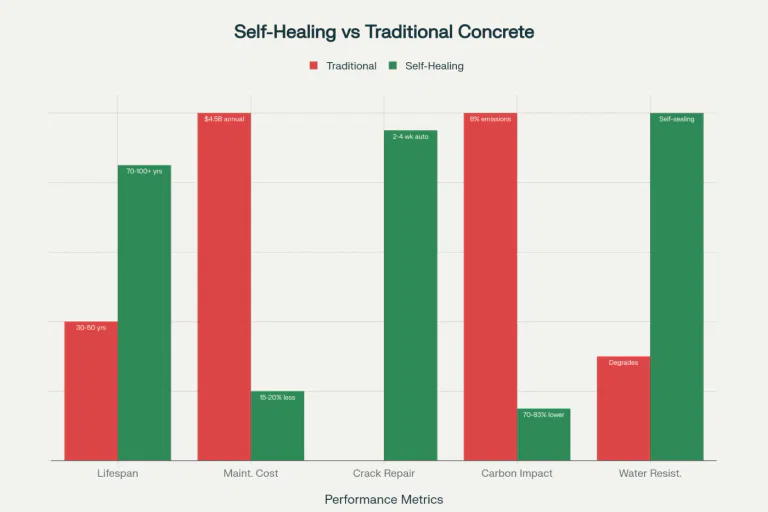
- 1. The 200-Year Lifespan Traditional concrete begins to crack and degrade within 20-30 years, costing the U.S. alone $4.5 billion annually in repairs. By embedding dormant Bacillus pseudofirmus bacteria that wake up to seal cracks with limestone, bio-concrete extends structural lifespans to 70-100+ years, fundamentally changing the economics of infrastructure maintenance.
- 2. Decarbonizing the Grey Giant Concrete production is responsible for ~8% of global CO₂ emissions. Self-healing concrete reduces this environmental load by up to 83% through two mechanisms: extending the life of existing structures (reducing replacement needs) and utilizing lower-temperature recycled materials that traditional concrete cannot support.
- 3. The Premium Pays Off While self-healing concrete costs ~50% more upfront than standard mix ($46 surcharge per cubic meter), the lifecycle cost analysis reveals massive savings. For critical infrastructure like bridges and tunnels, avoiding a single major repair cycle over 50 years more than covers the initial investment, driving adoption in major projects across Europe and Asia.
Picture this, concrete that literally comes alive when it gets damaged. Sounds like science fiction, right? Well, walk through the streets of Delft in the Netherlands, and you'll find bridges that have been quietly fixing their own cracks for over a decade. No construction crews, no road closures, no massive repair bills. Just bacteria doing what bacteria do best – making stuff.
The secret lies in tiny Bacillus pseudofirmus – hardy little microorganisms that can survive in the harsh, alkaline world of concrete for years, waiting patiently for their moment to shine. When a crack appears and water seeps in, these dormant bacterial spores wake up like construction workers getting a 6 AM call. They munch on calcium lactate (their favorite breakfast), and in return, they produce limestone – essentially concrete's natural Band-Aid.
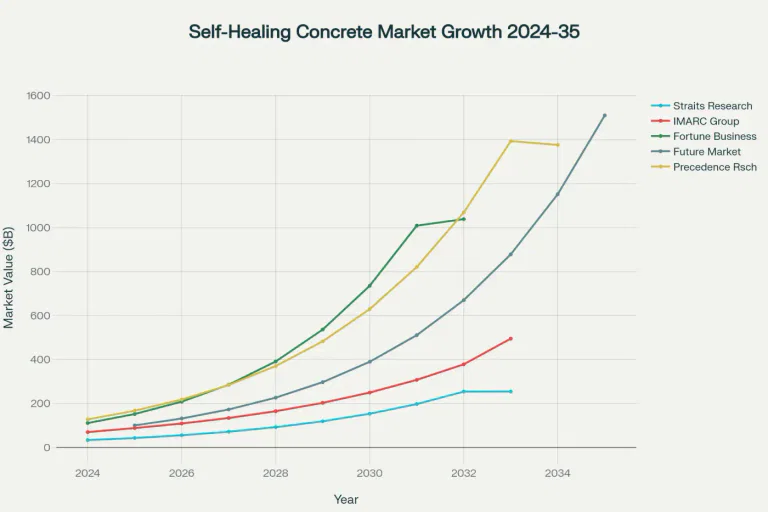
The numbers are staggering. We're looking at a market that exploded from around $86 billion in 2024 and could hit $1.5 trillion by 2035. That's not growth – that's a revolution happening in real-time as cities worldwide realize they're sitting on aging infrastructure that's bleeding money faster than a broken dam.
When concrete gets sick (and why that matters to your wallet)
Here's something that should keep city planners awake at night: concrete structures are designed to last 30-50 years, but many start showing serious problems within two decades. Every winter, water seeps into tiny cracks, freezes, expands, and turns those hairline fractures into major structural headaches. The result? $4.5 billion annually just in the United States for concrete repair and replacement.
But the real kicker? Traditional concrete is responsible for roughly 8% of global CO₂ emissions. When you're producing 30 billion metric tons of the stuff every year – equivalent to building six Pyramids of Giza annually – those emissions add up fast. Making cement requires heating limestone to extreme temperatures, and every pound of concrete produced spits out nearly a pound of carbon dioxide into the atmosphere.
Concrete rot – yeah, that's actually a thing construction folks call it, even though it's not technically biological decay. Water penetrates the structure, reaches the steel reinforcement inside, causes rust, and then the expanding rust literally bursts the concrete apart from the inside. It's infrastructure's version of a heart attack, and it's happening everywhere.
Dr. Ali Abbas from the University of East London puts it beautifully: "The idea of using bacteria to heal concrete cracks has always fascinated me. It brings a human feel to a material otherwise conceived as hard and lifeless"1.
The bacterial workforce that never sleeps
The breakthrough came from Delft University of Technology, where researcher Dr. Henk Jonkers had what can only be described as a brilliant "what if" moment. What if concrete could heal itself the same way biological systems do? What if instead of waiting for cracks to become catastrophic failures, we could catch them early and seal them automatically?
Bacillus pseudofirmus turned out to be the perfect candidate. These bacteria are tough as nails – they can survive in concrete's brutal alkaline environment (pH levels that would kill most living things), remain dormant for years, and spring into action the moment conditions are right.
The process is almost poetic in its simplicity. When a crack forms and water enters, it's like ringing a dinner bell for these microscopic construction workers. They wake up, start metabolizing their calcium lactate food source, and begin producing calcium carbonate – limestone that bonds chemically with the surrounding concrete.
Lithuanian researchers tested three different bacterial strains and found that B. pseudofirmus had the highest efficiency, with a healing coefficient of 0.497 after 56 days. That means it successfully sealed about half of all crack damage – pretty impressive for something you can't even see without a microscope.
The bacteria can handle cracks up to 0.8 millimeters wide within 2-4 weeks, depending on environmental conditions and crack size. Larger cracks still pose challenges, but researchers are working on hybrid systems that combine bacterial healing with other technologies.
Real-world success stories (and why they matter)
Green Basilisk, a spin-off from TU Delft, has been quietly revolutionizing infrastructure across Europe and Asia. CEO Bart van der Woerd explains their global expansion: "70 percent of the global concrete consumption takes place in Asia. Therefore this is a very important market for us". The company is building production facilities in South Korea and partnering with governments on major infrastructure projects.
Their self-healing additive can be mixed into new concrete or applied to existing structures. The bacteria remain dormant until cracks appear, then activate to produce limestone repairs. It's particularly valuable for water infrastructure – dams, sewage treatment plants, bridges – where traditional repairs are expensive and disruptive.
The Netherlands has become the testing ground for large-scale applications. A pedestrian bridge in Delft, constructed with bacterial concrete, has been self-repairing for over a decade without any manual intervention. Even more impressive, a lifeguard station built on the North Sea coast in 2011 has remained completely watertight despite constant exposure to salt spray, wind, and freeze-thaw cycles.
Highway trials in the UK compared self-healing concrete panels against traditional materials under identical traffic and weather conditions. The panels with bacterial systems healed cracks more completely and maintained higher impermeability than conventional concrete. For bridge engineers, this translates to fewer inspections, extended intervals between major rehabilitations, and significantly improved safety.
In Germany, researchers at Munich University of Applied Sciences developed methods for embedding bacteria into fiber reinforcements. These fibers act as both structural support and delivery mechanisms for healing agents, ensuring bacteria are positioned exactly where cracks are most likely to form.
The economics are getting serious
Let's talk money, because that's what ultimately drives adoption.
Green Basilisk sells regular concrete for $68-$91 per cubic meter, with a $46 surcharge for the self-healing feature. That might sound expensive until you consider the alternative: traditional concrete repairs often cost more than the original construction, especially for complex infrastructure like bridges or underwater structures.
JP Concrete in the UK partnered with the University of East London to develop bio-concrete that reduces maintenance costs by 15-20 percent for structures in harsh environments. That's a massive saving when you're talking about coastal defenses, tunnels, or marine infrastructure that face constant environmental assault.
The real game-changer is lifecycle cost analysis. A bridge built with self-healing concrete might cost 10-15% more initially, but it could operate for 70-100 years instead of the typical 30-50 year lifespan. Over decades, the maintenance savings dwarf the upfront investment.
SHIFT Invest, a Dutch venture capital fund, provided seed funding to Green Basilisk specifically because of the environmental impact potential. Investment partner Bram Ledeboer noted: "We are impressed by this highly innovative bio-based solution which has the potential to significantly reduce the carbon footprint of the construction sector".
The environmental angle (and why it's huge)
BioZEment research shows that bacterial concrete has 70-83% lower global warming potential than conventional concrete. That's not a typo – we're talking about massive reductions in environmental impact through a combination of factors.
First, the self-healing properties extend structure lifespans dramatically, reducing the need for replacement concrete production. Second, some bacterial concrete formulations use recycled powder from metal manufacturing instead of pure cement, lowering the high-temperature requirements that create most concrete-related emissions.
Corbion, a biotechnology leader, partnered with Green Basilisk to develop substrate systems that survive the concrete curing process. Their SENTIALL technology won the Bio-Based Product of the Year award for creating truly sustainable construction materials.
The University of East London's approach goes even further, combining bacterial healing with corrosion inhibitors that protect steel reinforcement. This creates a double benefit: self-repairing concrete that also prevents the rust-induced cracking that destroys most traditional structures.
Technical challenges (because nothing's perfect)
Let's be honest about the current limitations.
Bacterial survival remains tricky. Many bacterial spores die during the concrete mixing and curing process, when temperatures can exceed 80°C. Researchers found that encapsulating bacteria in calcium alginate microcapsules helps, but even then, survival rates vary significantly.
Crack size matters. The technology works great for cracks up to 0.8mm wide, but larger structural cracks still require traditional repair methods. For truly massive infrastructure damage, bacteria simply can't produce enough limestone fast enough to be effective.
Cost optimization continues to challenge commercial adoption. The calcium lactate nutrient that feeds the bacteria represents a significant portion of production costs. Dr. Jonkers and his team are exploring sugar-based alternatives that could dramatically reduce expenses while maintaining healing effectiveness.
Quality control in large-scale production presents another hurdle. Ensuring consistent bacterial distribution, viability, and activation across massive concrete pours requires sophisticated monitoring and process controls that many traditional concrete producers haven't implemented yet.
What happens next (and why you should care)
Smart cities worldwide are beginning to specify self-healing concrete for critical infrastructure projects. Tokyo and Paris are incorporating the technology into eco-friendly buildings, while Germany invests billions in smart infrastructure materials.
The integration with IoT technology creates fascinating possibilities. Imagine concrete structures equipped with sensors that monitor their own health, automatically triggering healing processes when problems are detected, and reporting status updates to city management systems. It's not just concrete anymore – it's intelligent infrastructure.
Space applications might sound far-fetched, but researchers are exploring bacterial concrete for lunar and Martian construction, where traditional repair methods would be impossible. The bacteria could potentially use locally available materials to create self-healing structures in environments where human maintenance is impractical.
Ocean infrastructure represents another huge opportunity. Seawalls, offshore platforms, and underwater tunnels face constant assault from saltwater corrosion. Self-healing concrete that automatically seals cracks could revolutionize marine construction and coastal defense strategies.
The human side of living concrete
There's something almost magical about materials that exhibit lifelike properties. Bart van der Woerd from Green Basilisk captures this perfectly: "Making 700 million m³ of concrete more sustainable is a realistic step forward". It's not just about technology – it's about fundamentally changing how we think about the built environment.
Workers in the construction industry are beginning to see bacterial concrete not as a threat to their jobs, but as a tool that lets them focus on more complex, creative work instead of repetitive crack repairs. Infrastructure that heals itself means fewer emergency repairs, less dangerous work in traffic, and more time for building new projects.
City residents benefit from reduced construction disruptions, fewer road closures for infrastructure repairs, and ultimately safer bridges and buildings that maintain their integrity longer. It's urban infrastructure that actually gets better with age instead of gradually deteriorating.
The next generation of engineers is growing up with biological thinking integrated into materials science. They're not just building structures – they're creating living systems that adapt, respond, and maintain themselves autonomously.
Beyond the hype: what's really happening
The timeline for widespread adoption looks realistic but gradual. Europe leads with practical implementations, Asia follows with massive market potential, and North America lags but shows growing interest.
Regulatory frameworks are slowly catching up. Building codes need updating to accommodate self-healing materials, testing standards require development, and insurance companies want long-term performance data before fully embracing the technology.
Integration with existing construction practices matters more than pure technical performance. The most successful bacterial concrete applications work within current construction workflows rather than requiring completely new approaches.
Public perception continues improving as real-world results demonstrate reliability. Early skepticism about "living concrete" gives way to enthusiasm when people see actual bridges and buildings that maintain themselves for decades without human intervention.
The environmental benefits increasingly drive adoption as cities face pressure to reduce carbon emissions and improve infrastructure sustainability. When concrete production accounts for 8% of global CO₂ emissions, any technology that cuts that substantially gets serious attention from policy makers.
The bottom line
Bio-concrete isn't just another construction material – it's a fundamental shift toward infrastructure that behaves more like biological systems. Buildings that heal their own wounds, bridges that seal their own cracks, roads that maintain their own integrity.
We're witnessing the early stages of a massive transformation in how cities build and maintain infrastructure. The technology works, the economics make sense, and the environmental benefits are undeniable.
The market projections suggest this isn't hype – it's a real industry moving from research labs to construction sites worldwide. Companies like Green Basilisk, researchers at institutions like TU Delft, and city governments investing in smart infrastructure are creating the foundation for truly sustainable urban development.
In a world where infrastructure ages faster than cities can afford to replace it, self-healing concrete offers a glimpse of what's possible when we stop fighting natural processes and start working with them instead. The bacteria are already on the job – they're just waiting for us to catch up.
The concrete jungle is about to get a lot more alive.
- https://www.uel.ac.uk/about-uel/news/2023/october/bacteria-benefits-concrete-carbon ↩︎