

Key takeaways from the MiCAR algorithmic stablecoin analysis
MiCAR does not impose a clean statutory ban on algorithmic stablecoins. It does something more subtle: it turns the promise of stable value into the trigger for regulation, regardless of whether that stability is produced by reserves, code, incentives, or market confidence.
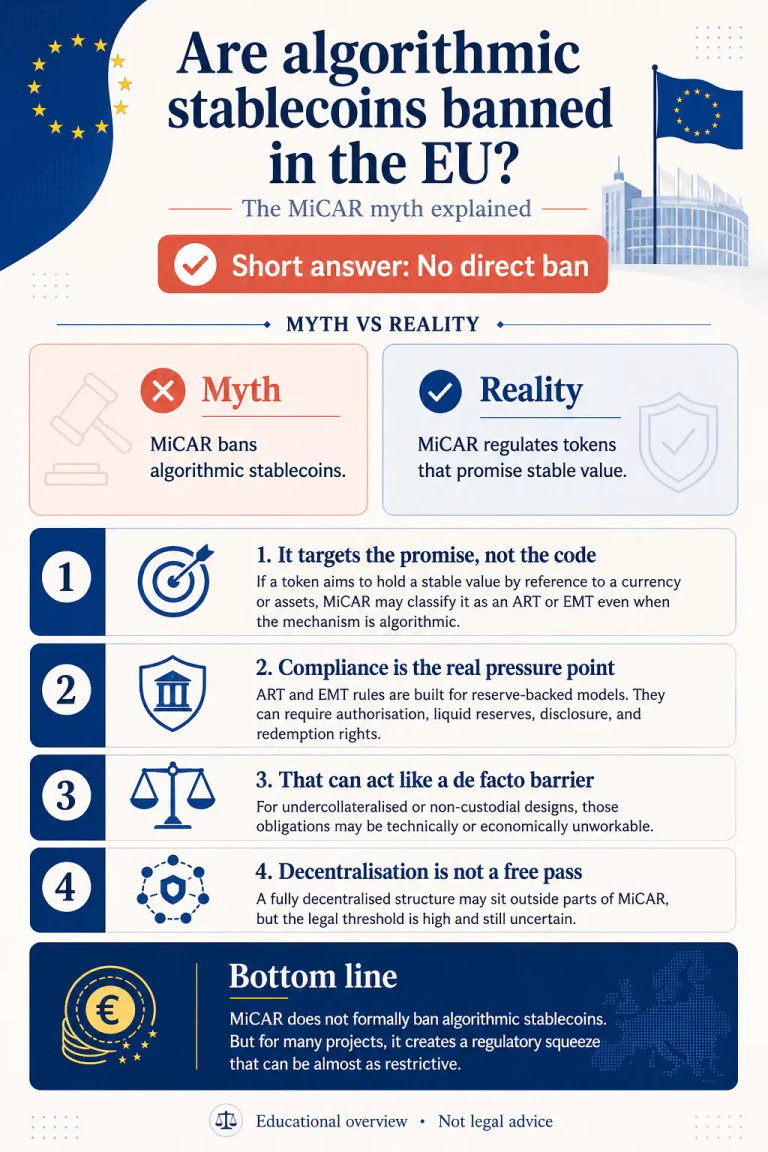
- 1. MiCAR does not ban the algorithmic mechanism itself The regulation does not prohibit algorithmic stablecoins by name. The decisive issue is not whether the token uses an algorithm, but whether it claims to maintain stable value by reference to a currency, asset, basket of assets, or other value. If it does, the token may be treated as an ART or EMT regardless of its technical design.
- 2. The compliance burden may operate like a de facto barrier Once an algorithmic stablecoin falls into the ART or EMT framework, it may face requirements built around reserves, redemption, authorisation, governance, and issuer responsibility. For protocols that are not fully collateralised or lack a conventional issuer, these obligations may be practically impossible to satisfy.
- 3. Decentralisation remains the most uncertain escape route MiCAR leaves space for crypto-assets provided in a fully decentralised manner without an identifiable intermediary. Yet this is a high and legally uncertain threshold. A DAO, open-source code, or automated smart contract structure will not automatically remove a project from regulatory scrutiny if control points, governance concentration, or responsible actors can still be identified.
The short answer is no. The more useful answer is less comfortable: MiCAR does not ban algorithmic stablecoins by name, but it may leave many of them with nowhere sensible to stand.
That is the source of the confusion. In crypto commentary, the phrase “EU ban on algorithmic stablecoins” sounds neat. It is also too neat. MiCAR does not contain a clean sentence saying that an algorithmic stablecoin cannot be issued, traded, coded, deployed or used. What it does instead is more bureaucratic, more European, and in practice possibly more severe. It asks what the token is trying to do. If the token aims to maintain a stable value by reference to a currency, an asset, a basket of assets, rights, or other values, then the legal category may be triggered regardless of the engineering underneath.
So the algorithm is not the decisive point. The promise of stability is.
That is why the debate around algorithmic stablecoins in the EU is so easy to distort. The regulation does not attack the mechanism directly. It attacks the legal and economic claim that sits on top of the mechanism. A protocol may say that it is decentralised, autonomous, algorithmic, community-governed, overcollateralised in some dynamic way, or not collateralised at all. But if the market-facing message is that the token should hold a stable value against the euro, the dollar, or a basket of assets, MiCAR may still treat it as a regulated stable-value crypto-asset.
The myth of the ban
The myth begins in recital 41 of MiCAR. Recitals are not the same as operative articles. They do not normally create free-standing prohibitions. They explain how the law should be read. That distinction matters here, because recital 41 is often treated as though it were a hidden ban on algorithmic stablecoins. It is not.
The recital says, in substance, that so-called algorithmic stablecoins should not escape MiCAR merely because they use protocols that increase or decrease supply in response to demand. If they aim to maintain a stable value by reference to an official currency or other assets, they should be considered under the relevant stablecoin categories. If they do not aim to stabilise value by reference to assets, they fall under the more general rules for crypto-assets. The official MiCAR text reflects this classification logic rather than a direct prohibition.
This is where the legal trick sits. MiCAR does not say: algorithmic stablecoins are forbidden. It says something closer to: if a token behaves legally like an ART or EMT, it will not avoid that treatment just because its stabilisation mechanism is algorithmic.
For a regulator, that is sensible. Otherwise, every issuer could wrap a stable-value promise in technical vocabulary and argue that the rules do not apply. For a protocol designer, however, it creates a much harder problem. The very thing that makes an algorithmic stablecoin algorithmic may be the thing that makes compliance almost impossible.
What MiCAR actually catches
MiCAR avoids the market term “stablecoin” and instead works with legal categories. The two important ones are asset-referenced tokens and e-money tokens.
An asset-referenced token, or ART, is broadly a crypto-asset that aims to maintain a stable value by referencing another value, right, or combination of values or rights. That can include one or more official currencies. An e-money token, or EMT, is narrower: it aims to maintain stable value by reference to one official currency.
These definitions are not interested in the romance of decentralisation. They do not begin by asking whether the protocol is elegant, whether the smart contract is autonomous, or whether the governance token has a clever incentive loop. They begin with the representation made to the user. Is this token supposed to be stable against something? If yes, the regulatory consequences begin.
That is why an algorithmic token pegged to the euro can be much closer, legally, to a regulated stablecoin than to a free-floating governance token. The label chosen by the project is less important than the function it performs and the expectation it creates.
This also explains why the EU approach feels so unsatisfying. It is not technologically precise. It is legally functional. MiCAR does not care deeply whether stability is produced by bank deposits, short-term debt, a mint-and-burn pair, reflexive incentives, or an oracle-driven supply adjustment. It cares that someone is offering a crypto-asset whose value is meant to stay put.
The problem with ART and EMT
The real difficulty is not classification alone. It is what follows after classification.
The ART and EMT regimes were built around a relatively traditional idea of stablecoins. There is an issuer. There are reserve assets. There are disclosures. There is authorisation. There are rules on redemption. There is a supervisory authority that can identify someone responsible when the structure fails.
That architecture fits fiat-backed stablecoins far better than algorithmic ones. A reserve-backed issuer can at least try to answer the regulatory questions. What assets back the token? Where are they held? How liquid are they? Can holders redeem at par? What happens in a stress scenario?
An algorithmic stablecoin answers in a different language. Its stability may depend on arbitrage, supply contraction, protocol incentives, a secondary token, governance decisions, automated liquidations, or confidence that the system will keep working because enough participants believe it will keep working. That may be innovative. It may also be fragile. But it is not the same model.
This is why MiCAR becomes a regulatory straitjacket. Not because it expressly bans the algorithmic form, but because it asks many algorithmic designs to satisfy obligations created for tokens with identifiable backing and redeemability. A system that is deliberately not fully collateralised may be told, in effect, to behave like a system that is.
That is not a ban in legal grammar. It may still be a ban in commercial reality.
The quiet force of redemption
Redemption is where the theory becomes concrete. A stablecoin regime built around holder protection usually expects that someone can redeem the token for something reliable. That expectation is easy to state and hard to fake.
In a collateralised model, redemption is backed by a reserve. If the issuer has good assets and sound liquidity management, the promise may hold. If it does not, the promise breaks. But at least the legal analysis knows where to look.
In an algorithmic model, redemption can become slippery. Who redeems? Against what? From which reserve? At whose obligation? If the peg is defended by market incentives rather than a claim against an issuer, the legal right can be thin or absent. The user may think they hold something dollar-like or euro-like, but legally they may hold exposure to a mechanism.
MiCAR is uncomfortable with that gap. It is not enough that the protocol intends to stabilise. The framework expects a structure that can be supervised, documented and, when necessary, forced to answer. That expectation collides with algorithmic stablecoin design at the deepest level.
The decentralisation escape route
There is another complication. MiCAR contains language indicating that crypto-assets and services provided in a fully decentralised manner without an intermediary should not fall within its scope in the same way. This is often discussed as the decentralisation carve-out. It is tempting for algorithmic stablecoin projects because many of them are built precisely around the promise of decentralised money.
But this is not a magic exit. “Decentralised” in a white paper is not the same thing as fully decentralised in a regulatory analysis.
A project may have a DAO and still have a core team. It may have token voting and still have governance concentration. It may have open-source contracts and still rely on admin keys. It may claim autonomy while a foundation funds development, controls communications, manages the frontend or coordinates upgrades. The more visible these control points are, the harder it becomes to argue that there is no identifiable actor.
This is one of the most unresolved parts of MiCAR. The law wants someone to regulate. DeFi often tries to remove that person, or at least make that person hard to identify. Algorithmic stablecoins sit exactly in that tension. They can be too stable-looking to avoid stablecoin rules, but too decentralised-looking to fit neatly into issuer-based supervision.
Why algorithmic stablecoins worry regulators
The policy concern is not imaginary. Algorithmic stablecoins are not just volatile crypto-assets with better branding. They make a stronger claim. They tell the market that volatility has been engineered away.
That claim can become dangerous because stability in algorithmic systems is often partly psychological. As long as enough users believe the peg can be defended, arbitrage may work. Once that belief breaks, the same mechanism can turn against itself. Supply expands when it should contract. The secondary token collapses when it is needed most. Liquidity disappears. The exit door narrows. The peg is no longer a number. It becomes a story people no longer believe.
This is the familiar death spiral problem. It is not just a dramatic phrase. It describes the moment when a stabilisation mechanism becomes pro-cyclical: instead of absorbing panic, it amplifies it.
A recent academic analysis of algorithmic stablecoins under MiCAR makes a similar point: these protocols pose distinctive risks because their construction is complex, and MiCAR does not specifically target those risks. The authors describe the resulting EU framework as complex and ambiguous in its application to algorithmic stablecoins.
That criticism is important. MiCAR is strict, but strictness is not the same as precision. It may keep many dangerous designs away from the regulated market, but it does not necessarily explain how a safe algorithmic stablecoin, if one can exist, should be built.
The forgotten legislative turn
One detail is often missed. The final MiCAR approach was not inevitable. Earlier legislative thinking was more open to excluding algorithmic stablecoins from the ART and EMT framework. The final text moved away from that more pragmatic distinction.
That shift matters because it shows that the EU did not accidentally stumble into the issue. It chose not to create a bespoke algorithmic stablecoin category. It chose classification by function. If the token seeks stable value by reference to something else, it may be treated as a stablecoin-like instrument even if the stabilisation engine is unconventional. The University of Amsterdam paper notes this change from the initial MiCAR proposal and the difficulty of adapting rules built for collateralised models to algorithmic ones.
This is probably the most honest reading of MiCAR. The EU preferred over-inclusion to under-inclusion. It would rather catch too many stable-value claims than allow a risky token to escape because of its technical design.
That may be defensible after Terra. It is still legally messy.
How the US comparison has changed
The US comparison also needs care. Older commentary often referred to proposed bills that took a more explicit line on algorithmic or endogenously collateralised stablecoins. That is no longer enough. Since July 2025, the central reference is the GENIUS Act, which established a federal framework for payment stablecoins. The White House described the law as requiring stablecoin issuers to back their assets with Treasuries and US dollars, while also imposing compliance and anti-money laundering obligations.
This does not mean the US simply says “all algorithmic stablecoins are banned”. The American framework is more focused on payment stablecoins, permitted issuers, reserves, redemption and compliance. It narrows the regulated category around instruments that are meant to be used for payment or settlement and that claim stable value.
The contrast with MiCAR is still useful, but it should be stated carefully. The US has moved toward a more issuer-and-reserve-based model for payment stablecoins. The EU uses the ART and EMT categories to capture stable-value crypto-assets more broadly. Both approaches are sceptical of unbacked stability. Neither gives algorithmic stablecoins an easy path.
How the UK comparison differs
The UK has been more staged. Its developing cryptoasset regime focuses on regulated activities, FCA authorisation and qualifying stablecoins. Government materials from 2026 describe reforms around UK-issued qualifying stablecoins and payment services, with the intention of avoiding unnecessary overlap between cryptoasset dealing rules and future payments regulation.
The FCA has described qualifying stablecoins as crypto-assets that aim to maintain stable value by reference to one or more fiat currencies, with proposed rules intended to ensure that regulated stablecoins maintain their value and that users receive clear information about backing assets.
That points to a different regulatory instinct. The UK is building the perimeter around fiat-referenced stablecoins, payments, safeguarding and authorised firms. It is not using exactly the same broad ART and EMT machinery as the EU. The practical result may still be scepticism toward algorithmic stablecoins, but the legal path is less sweeping than MiCAR’s classification logic.
The real position in the EU
So, are algorithmic stablecoins banned in the EU?
No. There is no clean MiCAR ban on algorithmic stablecoins as a technology.
But that answer alone is misleading. If an algorithmic stablecoin claims to maintain stable value by reference to a currency or assets, it may be pulled into ART or EMT rules. Once there, it may face requirements that do not fit its design: reserve expectations, redemption logic, issuer responsibility, governance duties, disclosures and authorisation. For many protocols, that is not a regulatory inconvenience. It is an existential problem.
If the token does not claim stable value by reference to assets, it may fall under the general crypto-asset rules instead. If the protocol is genuinely fully decentralised, MiCAR’s scope may be harder to apply. But both routes are uncertain. A token can avoid the stablecoin category only by giving up the very claim that made it useful as a stablecoin. A protocol can rely on decentralisation only if decentralisation is real enough to survive regulatory scrutiny.
That is the uncomfortable middle ground.
Final answer
The phrase “algorithmic stablecoins are banned in the EU” is not legally correct. It is a headline version of a more complicated reality.
MiCAR does not prohibit algorithmic stablecoins outright. It does something more indirect: it treats many stable-value promises as regulated promises, no matter whether the mechanism behind them is collateral, code or market incentives. That makes the algorithmic model difficult to fit into the EU framework, especially where there is no full reserve, no clear issuer and no straightforward redemption right.
The result is not a formal ban. It is a regulatory choke point.
For some projects, that distinction will be academic. If they cannot comply, cannot decentralise convincingly and cannot abandon the promise of stable value, they may be absent from the regulated EU market anyway. For others, especially genuinely decentralised or non-referential designs, the position may remain open but uncertain.
That is the real MiCAR myth. The EU has not banned algorithmic stablecoins. It has made the legal meaning of “stable” much harder to escape.


