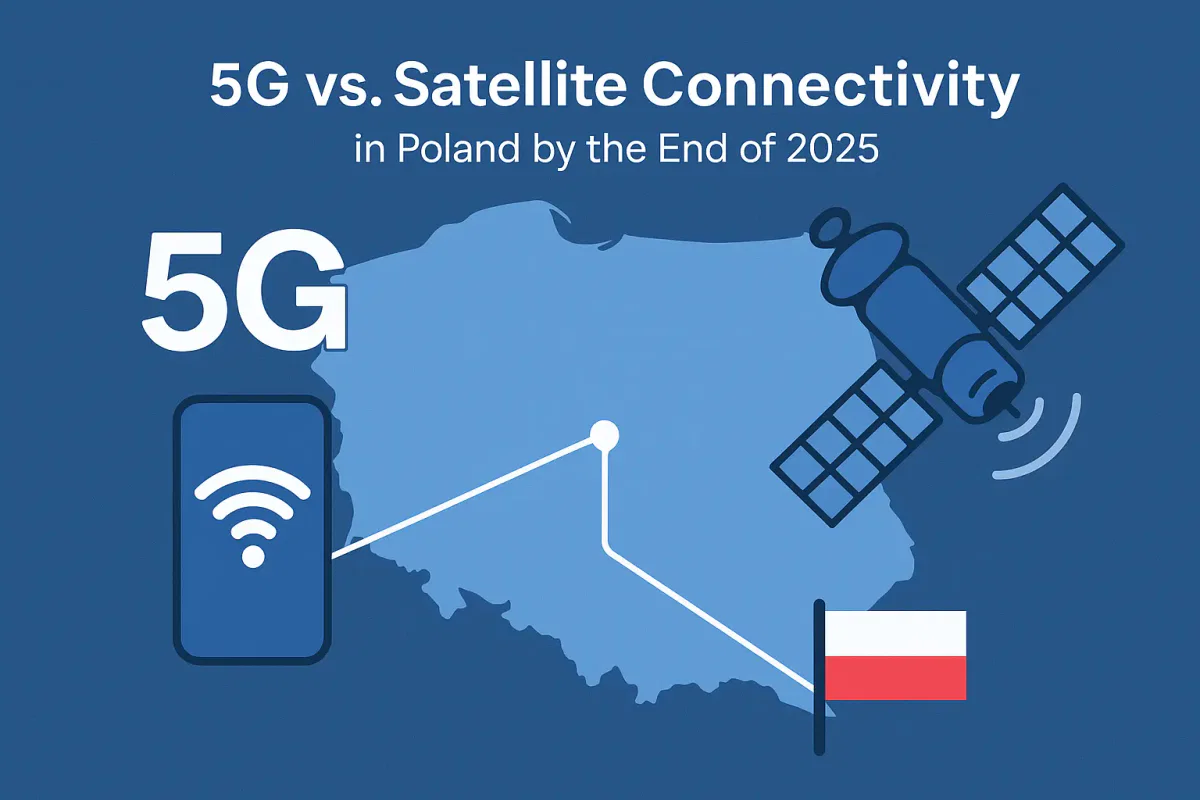
By the end of 2025, the competition between 5G and satellite connectivity will shape how Polish households, businesses, and public institutions access the digital economy. This article explores the strengths, weaknesses, and future trajectories of both technologies, highlighting what is most likely to change in Poland’s connectivity background.
The current state of 5G in Poland
Rollout progress
Poland’s 5G rollout began in 2020 with limited spectrum availability. Since then, operators such as Orange, Plus, Play, and T-Mobile have launched commercial 5G networks in major cities, while regulatory delays slowed access to the full 3.6 GHz C-band spectrum.
By mid-2024, Poland had:
- 5G coverage in most urban centers and along transport corridors.
- Average download speeds of 150–400 Mbps in optimal conditions.
- Initial deployment of standalone (SA) 5G networks, enabling lower latency (~10 ms) and advanced applications such as smart factories and IoT networks.
Remaining challenges
Despite progress, Poland still faces:
- Rural coverage gaps, especially in eastern and northern regions.
- High costs of spectrum licenses and infrastructure upgrades.
- Concerns about network security and vendor dependency.
Nevertheless, with the C-band auction completed in 2023, Polish operators are accelerating network upgrades. By 2025, nationwide 5G coverage (at least 80–90% of the population) is a realistic target.
The state of satellite internet in Poland
Starlink and other providers
Starlink, the satellite broadband service developed by SpaceX, became available in Poland in 2021. It quickly attracted rural users frustrated with slow DSL or limited LTE.
As of 2025, Starlink offers:
- Download speeds of 50–250 Mbps.
- Latency of 30–60 ms (higher than 5G but lower than traditional satellite).
- Nationwide coverage, including remote areas like Podlasie, Mazury, and mountain villages.
Other players are emerging too:
- OneWeb, supported by the UK and Bharti, plans partial coverage in Europe.
- The EU’s IRIS² program, launching satellites in 2024–2025, promises a sovereign European satellite constellation.
Costs and adoption
Starlink’s current pricing in Poland:
- Equipment: around 2,000–2,500 PLN (one-time).
- Monthly subscription: 220–250 PLN.
This makes it more expensive than 5G mobile broadband or fiber, limiting adoption to:
- Remote households without alternatives.
- Businesses in logistics, maritime, and agriculture.
- Emergency services requiring reliable backup connectivity.
5G vs. satellite: performance comparison
| Feature | 5G (Poland, 2025) | Satellite (Starlink, 2025) |
|---|---|---|
| Speed | 150–1000 Mbps (urban, C-band & mmWave) | 50–250 Mbps |
| Latency | 10–20 ms (standalone 5G) | 30–60 ms |
| Coverage | Expanding nationwide, gaps in rural | Nationwide, including remote/rural areas |
| Reliability | Dependent on towers, power, spectrum | Weather-sensitive, needs clear sky |
| Cost | ~70–150 PLN/month | ~220–250 PLN/month + high equipment fee |
| Use cases | Mobile internet, smart cities, IoT | Rural homes, maritime, aviation, backup links |
Impact on Polish consumers
By the end of 2025, Polish consumers can expect:
- Better 5G coverage in small towns and highways, reducing reliance on LTE.
- Lower latency for gaming and video conferencing on 5G compared to satellite.
- Satellite as a niche solution, mainly for households beyond the reach of fiber or mobile broadband.
- Potential price competition, as operators may reduce 5G tariffs to discourage customers from turning to Starlink.
In practice, most Poles will choose 5G or fiber, while satellite remains a backup or last resort.
Impact on Polish businesses
Businesses in Poland will see different opportunities:
- 5G for industry 4.0 - factories in Śląsk, automotive plants, and logistics hubs will adopt private 5G networks for automation, robotics, and predictive maintenance.
- Smart agriculture - 5G sensors will optimize irrigation and crop monitoring in central and western regions.
- Satellite for remote sectors - forestry companies in Podkarpacie, offshore fishing operations in the Baltic Sea, and renewable energy firms will benefit from satellite coverage.
- Disaster recovery - enterprises will use satellite links as redundancy, ensuring business continuity during outages or cyberattacks.
Public services and government initiatives
The Polish government views digital inclusion as a strategic priority. EU funding under Polska Cyfrowa and the Recovery and Resilience Facility (RRF) supports broadband rollout.
By 2025, expect:
- 5G-enabled smart cities in Warsaw, Kraków, Gdańsk, and Wrocław.
- Telemedicine expansion, with hospitals using low-latency 5G for remote diagnostics.
- Education access in rural schools, where satellite may serve as an interim solution until fiber/5G arrives.
- Military and emergency services increasingly adopting dual connectivity (5G + satellite) for resilience.
EU policy and strategic autonomy
Connectivity is not only a technological issue but also a geopolitical one. The EU aims to reduce dependence on foreign providers, whether Chinese 5G vendors or American satellite companies.
- The EU 5G Toolbox promotes security standards for mobile networks.
- The IRIS² constellation (launching 2024–2025) will provide sovereign satellite communications, including services for Poland.
- Cross-border 5G corridors along highways and railways will enable connected mobility and autonomous transport.
For Poland, this means greater integration into EU-wide connectivity strategies, balancing local operators with global satellite players.
What will change by the end of 2025?
Looking ahead, the Polish connectivity landscape will shift in several key ways:
- 5G will become mainstream. Coverage will reach over 80% of the population, making it the default mobile standard.
- Satellite adoption will stabilize. Starlink will serve tens of thousands of rural households, but not compete directly with 5G in urban markets.
- Hybrid models will emerge. Businesses, governments, and even households may combine 5G and satellite for redundancy and performance.
- Prices may diverge. 5G will remain cheaper for everyday use, while satellite stays premium but indispensable for underserved areas.
- European competition will grow. With IRIS², the EU will directly challenge Starlink, offering Poland an alternative satellite option aligned with EU policy.