

Used electric cars · EU battery rules
The code identifies the record. Access determines what it proves.
A battery passport can improve a used-car purchase without turning every public scan into a battery-health check.
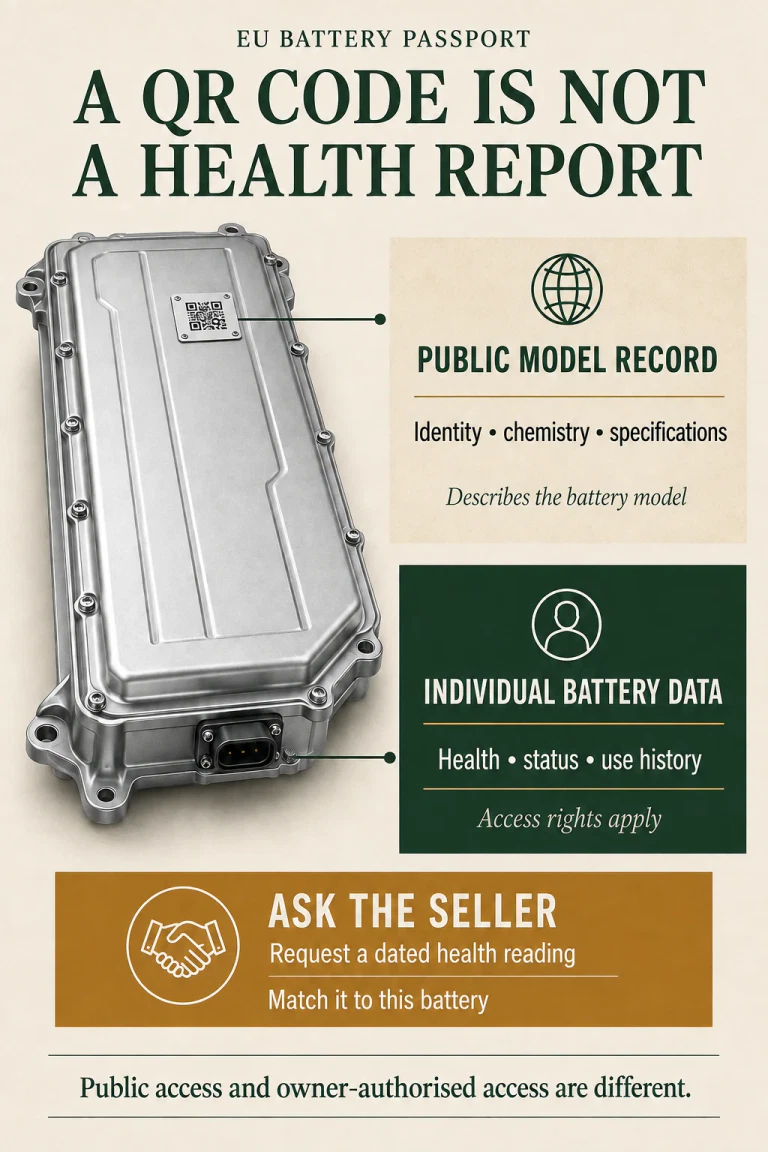
- Model specifications are not this pack's historyThe regulation separates public model information from restricted individual-battery data, including health and use history.
- The seller has a separate access routeArticle 14 provides read-only BMS access to the lawful purchaser or a party acting on their behalf for specified purposes, including assessing residual value.
- 2027 does not put a passport on every older EVThe requirement follows batteries placed on the market or put into service from 18 February 2027, not every later second-hand vehicle transaction.
Imagine comparing two used electric cars. One seller sends a screenshot of a battery passport: manufacturer, chemistry, capacity, an impressive-looking digital identity. The other arranges a dated battery-health reading linked to the pack in the car. These are hypothetical offers, but the distinction is real. The first document can describe what the battery was designed to be. The second may help establish what that particular battery has become.
The European Union's battery passport is often discussed as the moment this uncertainty disappears. Its actual design is more interesting. It contains both model information and individual records, but does not make every category equally public. For a used-EV buyer, the central question is therefore not simply “Does it have a QR code?” It is “Which evidence can I obtain, for which battery, before I commit?”
This analysis reflects the law and Commission material checked on 5 September 2026. It is a reading guide, not a vehicle inspection or advice on a particular dispute.
The public passport view and the individual battery record are different
Article 77 and Annex XIII of Regulation (EU) 2023/1542 separate access by the kind of information involved. Annex XIII point 1 concerns publicly accessible information relating to the battery model. Point 4 concerns an individual battery and is restricted to persons with a legitimate interest.
That second category includes state of health, battery status and information resulting from use. The passport is not merely a digital product brochure. But the fact that it contains a field does not mean an anonymous person scanning its code can read that field. Public accessibility of the doorway is not public accessibility of every record behind it.
This matters when a seller substitutes identification for condition. A model's rated capacity is not a dated measurement of remaining capability. A design-life figure and its reference test are not a count of years that this used pack has left. Even an authentic record can answer the wrong purchasing question.
The seller already has a different route to battery-health data
The useful provision for a resale conversation is not only the future passport rule. Article 14 provides, from 18 August 2024, for up-to-date health-related parameters in the battery management system, or BMS, of the covered battery categories. It requires read-only access for the person who lawfully purchased the battery, or a third party acting on that person's behalf, for specified purposes. Evaluating residual value, remaining lifetime and suitability for further use is explicitly among them.
There is an important word in that provision: purchased. It is not a blanket invitation for any prospective buyer to interrogate any vehicle. A practical pre-sale route is to ask the current owner to obtain the information, or authorise an appropriate independent operator to do so. Whether a particular older battery falls within the obligation still needs checking; the date does not establish a universal retrofit entitlement.
Nor does a read-only data right automatically promise a free workshop appointment, one universal diagnostic connector or a retail certificate in an identical format across brands. Access to a parameter and the labour needed to inspect a car are different services. This is a narrower, more useful distinction than treating all restrictions as the same problem of software-controlled hardware ownership.
A buyer can make the request concrete before travelling to see the car. The following is a suggested request, not wording imposed by EU law.
Please provide a current battery-health reading and identify the metric, the date and the battery it belongs to. Please explain how the battery identifier is linked to this car's VIN, whether the pack has been replaced, and who obtained the reading. If an owner-authorised diagnostic visit is needed, can we arrange it before purchase?
The value of that request is not its length. It prevents three substitutions: a different battery's result, an old result presented as current, and an attractive number whose meaning nobody has established. A seller's inability to supply one item does not by itself prove fraud or a bad battery. It identifies uncertainty that the price, inspection or decision must still account for.
A charge percentage is not the EV health parameter
Annex VII names state of certified energy, or SOCE, as the health parameter for electric-vehicle batteries. It lists a different set for stationary storage and light means of transport. A generic checklist copied from an e-bike or home-storage article is therefore not a reliable account of the EV requirement.
Before comparing two percentages, establish what each describes. State of charge tells you about the battery's present charge level; it is not a measure of how far the battery has degraded. A dashboard at 100% can mean “fully charged now” without establishing that the pack retains all of its earlier usable energy. An aftermarket report labelled “SOH” may be useful, but ask for its definition and method rather than silently treating every health label as the same regulatory parameter.
Changing from conventional lithium-ion to solid-state battery chemistry does not remove this distinction. Chemistry describes a technology. Purchasing a used pack requires evidence about an individual unit.
| Seller provides | What it establishes | Ask next |
|---|---|---|
| Public passport specifications | Model identity and the specifications shown, not automatically the current condition of this pack. | A dated individual health reading and the matching battery identifier. |
| A photograph showing 100% charge | The displayed charge level at that moment, not absence of degradation. | Which health parameter or diagnostic assessment is available? |
| An independent health report | A result obtained using that report's stated method, for its identified unit and date. | Match the identifier, check the method and date, and clarify any later pack replacement. |
This is an evidence-reading aid, not a universal pass mark. Neither the table nor a single percentage certifies accident history, charging behaviour under every condition, remaining warranty coverage or every component of the vehicle. Those are separate questions for the relevant records and inspection.
A battery passport follows market entry, not every used-car sale
The 18 February 2027 start in Article 77(1) applies to the specified batteries placed on the market or put into service. The regulation's definition of placing on the market concerns the first making available on the Union market. It is not a synonym for every transaction in the life of a vehicle.
Consider a battery already placed on the EU market in a car sold in 2025. Selling that car second-hand in March 2027 does not, simply because of the resale date, make that same battery newly placed on the market. A buyer should not interpret the absence of a newly mandated passport as proof that this older car is illegal or that its battery has failed.
Now consider a used battery arriving from outside the EU for its first entry onto the Union market after the start date. “Used” does not necessarily mean “previously placed on the EU market.” The original regulation expressly distinguishes such imports from reuse of batteries already placed in the Union. Replacing, repurposing or remanufacturing a battery can also change the relevant facts; the car's first registration date alone is not a complete answer.
For an actual purchase, ask about the battery's history, not merely the age on the vehicle listing. This is also where the circular economy's reuse promise becomes practical: a material can remain valuable while the information needed to price and safely reuse it becomes difficult to follow.
Seventy-one data points do not mean seventy-one public answers at launch
The Commission's 21 August 2026 update points to guidance organising 71 data points by battery category. Its table distinguishes mandatory, optional, conditional and not-yet-displayed information. It is not a promise that a consumer will see 71 fully populated fields in February 2027. The guidance also says it does not extend the law's rights or obligations.
Access arrangements remain a point to watch. Although Article 77(9) set an August 2026 deadline for implementing rules on legitimate-interest access, the Commission's current indicative DPP timetable lists the battery access-rights implementing act for Q4 2026. A timetable entry is not proof of adoption. It would be premature to promise a particular prospective buyer an exact future login flow or the right to download every private field.
None of this makes the passport pointless. Accurate, up-to-date individual records linked to a persistent battery identity could make a major difference to resale, repair and second life. The regulation requires more than a decorative label. The mistake is to treat that infrastructure as a substitute for obtaining the evidence that a specific purchasing decision requires.
When a seller says “It has a battery passport,” the useful reply is not disbelief. It is a precise follow-up: “Can we see a dated health reading for the battery fitted to this car, and do we know what that reading measures?” That question remains useful before 2027, at launch and after the passport becomes routine.
Primary sources checked on 5 September 2026
- Regulation (EU) 2023/1542, consolidated 31 July 2025 — Articles 3, 14, 77 and 78; Annexes VII and XIII.
- Original Batteries Regulation — recitals 11 and 16 explain first placement, existing stock, reuse and used imports.
- Digital Batteries Passport guidance, version 2.0, 15 August 2026 — category-specific data applicability and the document's non-binding status.
- Commission Digital Product Passport timetable — indicative Q4 2026 timing for battery access-rights rules.
- Commission battery-passport overview — categories, responsibility and the February 2027 start.


