
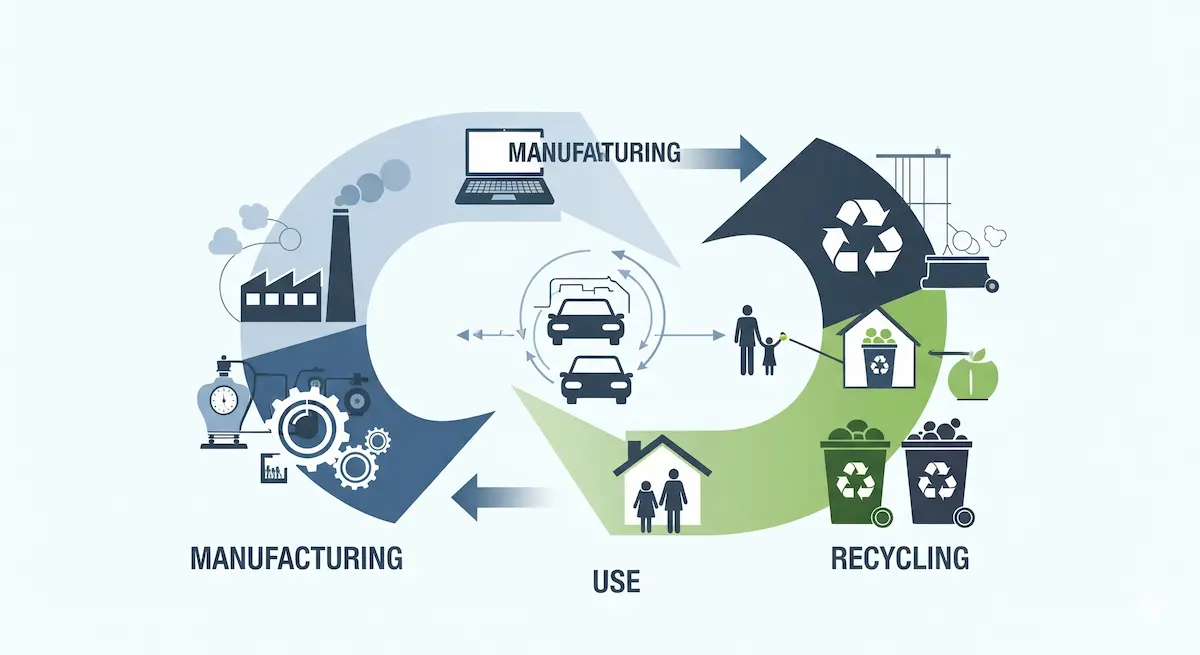
For centuries, the global economy has operated on a simple, linear model: take, make, dispose. We extract raw materials, manufacture products, use them, and then throw them away. This system, born from the Industrial Revolution, has fueled unprecedented growth, but at a significant cost. Today, facing resource scarcity, overflowing landfills, and mounting environmental pressures, we are witnessing a paradigm shift. The concept of a circular economy is moving from a niche environmental ideal to a mainstream business strategy, fundamentally reshaping how we view a resource we've long tried to ignore: waste. This isn't just about recycling more; it's about a radical redesign of our industrial processes where waste is not an endpoint but a valuable input for new creation.
Rethinking waste management - beyond the bin
At the heart of the circular economy is a complete transformation of waste management. Traditionally, the focus has been on efficient collection and disposal—essentially, getting rubbish out of sight and out of mind as cheaply as possible. The circular model, however, reframes waste as a "resource" and waste management as "resource recovery." This requires innovation at every stage of a product's lifecycle, from its initial design to its final destination.
Companies leading this charge focus on several key principles
- design for disassembly and reuse - products are intentionally created to be easily taken apart, repaired, or refurbished. This extends their lifespan and ensures that their components can be harvested for future use, rather than being shredded or melted down.
- industrial symbiosis - this is a fascinating concept where the waste stream of one industry becomes the raw material for another. A classic example is a power plant capturing its excess heat to warm greenhouses or a furniture maker using another company's wood scraps to create particleboard.
- product-as-a-service (PaaS) - instead of selling a product, companies offer it as a service. Think of lighting providers who sell lumens instead of lightbulbs or companies that lease office furniture. This model incentivizes the manufacturer to create durable, long-lasting products because they retain ownership and are responsible for maintenance and end-of-life collection.
Case studies - pioneers turning trash into treasure
The theoretical benefits of a circular economy are compelling, but its real power is demonstrated by businesses that are already profiting from it. These pioneers show that sustainability and profitability are not mutually exclusive.
Interface: a carpet company's zero-waste mission
One of the earliest and most cited examples is Interface, a global manufacturer of modular carpet tiles. Decades ago, founder Ray Anderson challenged his company to have zero negative impact on the environment. This led to groundbreaking innovations. Interface developed ways to recycle old carpets—not just from their own customers, but from competitors too—into new, high-quality products. Their process drastically reduces the need for virgin petroleum-based materials, saving millions of dollars in raw material costs and diverting immense quantities of waste from landfills. They've also pioneered adhesive-free installation methods, making the tiles even easier to replace and recycle.
Gamle Mursten (Old Bricks) - building the future with the past
In Denmark, a company called "Gamle Mursten" has built a thriving business on a simple premise: old bricks are too valuable to be thrown away. Using a patented, chemical-free technology, the company cleans mortar from salvaged bricks sourced from demolition sites. The process uses 95% less energy than manufacturing new bricks. For every two thousand bricks reused, the company prevents the emission of one tonne of CO2. This not only provides a sustainable building material with unique aesthetic character but also creates a profitable business by adding value to what was once considered construction debris.
The circular economy offers Europe an opportunity to increase the productivity of resources, decrease dependence on them (as well as waste), and raise employment and growth. - McKinsey & Company
The economic and strategic advantages
Adopting circular principles is more than an exercise in corporate social responsibility; it's a strategic move that builds resilience and competitive advantage. The economic benefits are becoming increasingly clear. A report by the Ellen MacArthur Foundation suggests that transitioning to a circular economy could generate trillions of dollars in economic value over the coming decades.
The primary advantages include
- cost reduction - reusing materials and designing out waste directly translates to lower spending on virgin resources and waste disposal fees. Energy recovery from waste can also significantly cut utility bills.
- enhanced brand reputation - in an era of conscious consumerism, businesses that demonstrate a genuine commitment to sustainability attract and retain customers. A strong circular model is a powerful marketing tool that builds trust and loyalty.
- innovation and new markets - the challenges of a circular economy spur innovation. Companies are developing new technologies for material recovery, creating novel business models, and opening up entirely new markets for secondary materials and refurbished goods.
The journey toward a fully circular economy is a marathon, not a sprint. It requires significant investment, collaboration across industries, and supportive government policies. However, the evidence is mounting: the businesses that embrace this future-focused model are not just contributing to a healthier planet, but are also building more resilient, innovative, and profitable enterprises. The old linear path of "take, make, dispose" is reaching its end, and in its place, a more intelligent and prosperous circular route is emerging, one where the concept of waste itself may one day become obsolete.


