Decision brief · Google Ads
What matters before August 17
Three conclusions to settle before anyone changes a target, a budget or the campaign structure.
- The change is narrow but commercially important
It concerns campaigns that are Limited by budget and use Target CPA, Target ROAS or, for Demand Gen, Target CPC. Unconstrained campaigns are not expected to change.
- Efficiency above the stated target may disappear
A campaign achieving a $70 CPA against a $100 target may begin delivering closer to $100. Google will not automatically correct the target or the budget.
- One deliberate change is better than five reactions
Decide which economics the business wants to preserve, change one control, then evaluate the result after one to two conversion cycles.
On August 17, 2026, Google Ads will change how target-based bidding behaves when a campaign is constrained by budget. The update is easy to misread as a minor Smart Bidding refinement. In practice, it can change the relationship between the target shown in campaign settings and the CPA or ROAS an advertiser has become accustomed to seeing.
The risk is concentrated in a specific group: campaigns marked Limited by budget that use Target CPA or Target ROAS, plus Demand Gen campaigns using Target CPC. Some of these campaigns currently perform more efficiently than the target entered by the advertiser. After the update, Google intends to optimize them more consistently toward that stated target, even when the daily budget changes.
This means a campaign with a Target CPA of $100 that has recently generated conversions at $70 may move toward the less efficient $100 level. A Target ROAS campaign set to 300% but recently achieving 450% may move closer to 300%. The outcome is not guaranteed for every account, but the setting should no longer be treated as a loose ceiling or floor that a constrained campaign will continue to outperform.
What Google is changing—and what it is not
Google describes the change as a way to make performance more predictable when advertisers adjust budgets. Under the previous behavior, a budget-constrained campaign could substantially overachieve its target. Increasing the budget could then produce unexpected swings because the bidding system had more room to pursue the stated, less efficient target.
From August 17, the target is intended to become a more reliable operating instruction. If the advertiser says that a $100 CPA or 300% ROAS is acceptable, the system may use more of that tolerance to find additional volume. The auction itself is not changing, and daily or monthly spending limits still apply. What changes is how the bidder responds to the combination of a target and a constrained budget.
Which campaigns need attention?
| Campaign condition | Expected impact | First action |
|---|---|---|
| Limited by budget + Target CPA/ROAS | Potentially affected | Compare the stated target with lag-adjusted actual performance |
| Demand Gen + Target CPC + limited budget | Potentially affected | Review the target and channel distribution |
| Target-based strategy, not budget constrained | No behavior change expected | Monitor normally; do not manufacture a change |
| Manual CPC or Target Impression Share | Outside this update | No action for this announcement |
The distinction matters because broad account-wide changes would be counterproductive. This is not a reason to alter every Target CPA or Target ROAS campaign. It is a reason to isolate the campaigns in which a constrained budget and a target-based strategy coexist.
Why a campaign can outperform its own target
A bid target is not the same as a financial forecast. Target CPA tells Google the average amount the advertiser is prepared to pay for a conversion. Target ROAS tells it the average conversion value expected for each unit of ad spend. Smart Bidding can produce results above or below that instruction in individual auctions, then works toward the target across a larger set of outcomes.
A tight budget changes the opportunity set. The system cannot participate in every auction it considers worthwhile, so it may concentrate spend in the safest, highest-predicted opportunities. The resulting campaign can look more efficient than the target because it lacks enough budget to scale into marginal demand.
That overperformance can become misleading. Teams begin to treat recent actual CPA or ROAS as the campaign’s durable economics, while the settings still authorize a materially different result. When the budget rises—or when the new bidding behavior takes effect—the system has permission to move closer to the target the advertiser entered.
This is why the audit must compare three numbers rather than two: the target, recent actual performance and the business break-even threshold. A campaign can outperform its Google Ads target while still being unprofitable after gross margin, refunds, fulfilment costs or lead quality are considered. The broader attribution problem is examined in our analysis of true ROAS across platforms.
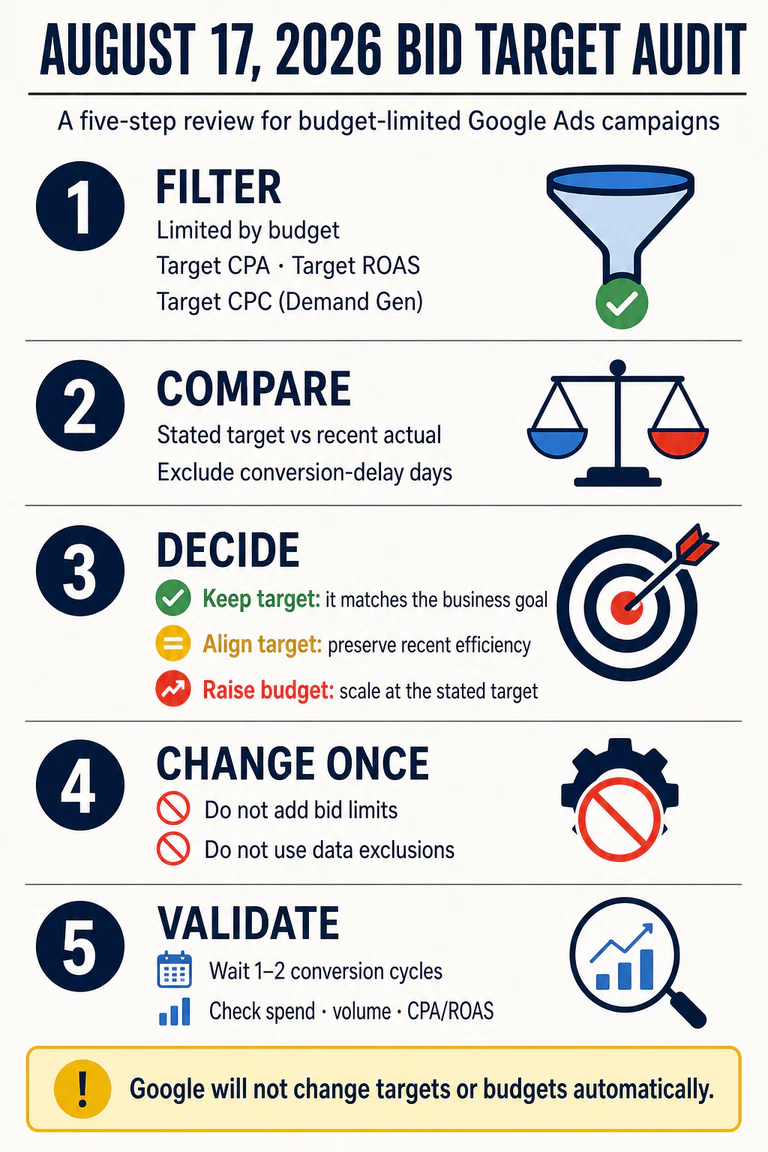
Step 1: build the affected-campaign list
Start with campaigns that have recently shown the Limited by budget status, not only those displaying it today. Google says its service notification may consider campaigns that were constrained at some point during the preceding 12 months. An account can therefore receive the announcement even when no recommendation currently appears.
- Filter for Target CPA and Target ROAS across Search, Shopping, Performance Max, Demand Gen and Travel.
- Add Demand Gen campaigns using Target CPC.
- Record whether each campaign or portfolio strategy is presently budget constrained.
- Separate campaigns with stable conversion values from those whose tracking or lead-quality definitions changed.
- Flag multi-channel campaigns because traffic may redistribute between inventory types after the update.
A missing recommendation is not proof that a campaign is safe. Google does not generate a recommended target for campaigns with fewer than seven conversions, and current data may not meet the system’s recommendation threshold. Low-volume campaigns still require human interpretation.
Step 2: compare like with like
Do not compare today’s target with an unadjusted seven-day dashboard. Conversion delay can make recent performance look worse than it will eventually become, while seasonal promotions can make a short period look unusually strong. Select a window that contains enough conversions to describe normal performance and exclude the most recent delay period.
For Target CPA, compare the average target CPA with actual CPA. For Target ROAS, compare average target ROAS with actual conversion value divided by cost. The average target columns matter when targets changed during the period; using only the value visible in today’s settings can create a false comparison.
Step 3: choose the business outcome before changing the setting
The Bid Target Adjustment Tool, available from July 6, can show historical performance and offer an updated target. It is useful evidence, but the tool cannot decide which economics the business wants to preserve.
Use this when the current target is the genuine economic goal and the business is willing to exchange some efficiency for more conversion volume.
Use this when the recent CPA or ROAS reflects the efficiency that must be preserved. Confirm that the period is representative before applying it.
Use this when the target is valid and additional volume at that economics is desirable. Increase deliberately, then watch marginal performance.
A fourth option is to switch to Maximize conversions or Maximize conversion value when the budget is genuinely fixed and the objective is to extract the greatest total outcome from it. That is a strategy decision, not a temporary patch for August 17, and it should not be combined casually with other structural changes.
Step 4: avoid false fixes
The update does not justify adding bid limits, applying data exclusions or rewriting campaign structure merely to suppress volatility. Google specifically advises against those responses when they are made solely because of the bidding change. Bid limits can prevent Smart Bidding from accessing the auctions needed to meet the strategy, while data exclusions are intended for conversion-tracking outages rather than uncomfortable performance.
It is equally risky to change the target, budget, conversion definitions, creative assets and campaign structure at the same time. The account may improve or deteriorate, but the team will not know which intervention caused the result. If measurement requires repair, fix it first. A clean implementation matters more than the apparent sophistication of the bidding setup; the foundation is covered in our Google Ads, GA4 and GTM setup guide for WordPress.
Step 5: validate over conversion cycles, not calendar days
Google recommends waiting one to two conversion cycles before evaluating the result of a target adjustment. A conversion cycle is the typical interval between an ad interaction and the recorded conversion. For an impulse purchase it may be short; for B2B lead generation it may extend across weeks.
- Track spend, conversion volume, actual CPA or ROAS and the average target.
- Separate the conversion-delay period from the evaluation window.
- For Performance Max and Demand Gen, inspect whether channel distribution changed.
- Check lead quality, margin or backend revenue—not only the platform conversion count.
- Annotate August 17 and every manual target or budget change in the reporting timeline.
If the account also uses increasingly automated Search targeting, keep this bidding audit separate from the governance review described in our analysis of AI Max and the Dynamic Search Ads transition. AI Max changes what traffic and combinations a campaign can reach; the August bidding update changes how aggressively a constrained campaign may pursue the target already entered. Combining both experiments destroys the baseline.
A worked Target CPA example
Consider a Search campaign with a $12,000 monthly budget, a $120 Target CPA and a recent lag-adjusted actual CPA of $78. It has been limited by budget for most of the previous month.
The wrong conclusion is that Google has guaranteed a $78 CPA. The campaign may simply be buying the most promising portion of eligible demand. Under the updated behavior, its bids can move toward the $120 instruction. If the business breaks even at $95, leaving the target at $120 authorizes acquisition that may be unprofitable even if the campaign technically meets its target.
The correct decision begins outside Google Ads. If $90 is the maximum sustainable CPA, set the strategy around that commercial constraint and monitor whether volume falls. If $120 remains profitable and growth is more important than preserving recent efficiency, keep the target and prepare stakeholders for a higher actual CPA. If the company wants more conversions at approximately $78, align the target cautiously and test whether more budget can be absorbed without losing that efficiency.
A worked Target ROAS example
An ecommerce Performance Max campaign is set to a 300% Target ROAS but has delivered 470% after conversion delay. It is budget constrained. The finance team assumes 470% is normal, while the bidding system is explicitly allowed to pursue conversion value down to an average of roughly 300%.
If the business needs 400% after accounting for contribution margin and returns, the current 300% setting is misaligned with the real goal. If 300% is profitable and inventory is available, the efficiency gap may instead represent an opportunity to scale. The correct answer depends on marginal profit, not on whether the green percentage in Google Ads is higher.
Multi-channel campaigns add another layer. Google warns that channel distribution may shift. A stable overall ROAS can conceal a move from high-intent Search inventory toward YouTube, Display or Discover. Use the channel performance report and backend outcomes to establish whether the new mix produces valuable customers rather than merely more attributed conversions.
What to do after August 17
Do not freeze the account indefinitely. Smart Bidding reacts to target changes in real time, and Google says target adjustments do not erase historical learning. The waiting period is required so that enough post-change conversions mature for interpretation, not because the algorithm becomes incapable of responding.
After one to two conversion cycles, compare the post-change period with the baseline. If spend and volume increase while unit economics remain inside the business threshold, the target is functioning as intended. If efficiency moves beyond the sustainable limit, tighten the target or reconsider the budget. If volume collapses after an aggressive target reduction, the account has learned that recent overperformance could not necessarily be scaled.
The wider lesson is that Google Ads settings must be treated as explicit commercial permissions. A Target CPA or Target ROAS is not an aspiration printed on a dashboard. It is an instruction that the bidding system is increasingly designed to follow.
Frequently asked questions
Will Google automatically change my target or budget?
No. Google states that it will not automatically adjust campaign targets or daily budgets. The advertiser must decide whether to keep, align or replace the existing target.
Are all Target CPA and Target ROAS campaigns affected?
No. The announced behavior change concerns target-based campaigns that are limited by budget. Google says unconstrained campaigns should continue to operate as before.
Why is there no recommendation in my account?
The service notice can use a longer history than the recommendation system. Google also does not calculate a recommended target for campaigns with fewer than seven conversions.
How long should I wait after changing a target?
Evaluate after one to two conversion cycles, excluding the most recent conversion-delay period. Calendar days alone are not a reliable waiting rule.