Key takeaways from the Google Ads AI Max transition
AI Max does not simply automate another part of paid search. It brings query matching, ad creation and landing-page selection into one prediction system, shifting the advertiser’s role from building each campaign path to defining the limits within which Google may construct it.
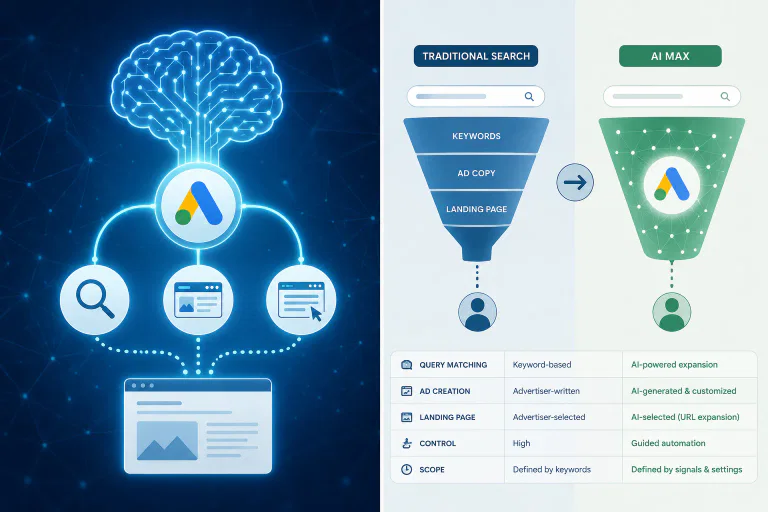
- 1. AI Max combines decisions that advertisers previously controlled separately Keywords, advertising copy and landing pages once represented separate layers of campaign strategy. AI Max can now expand beyond selected keywords, generate new assets from website content and choose a different destination URL when Google predicts that another page will perform better. The system is no longer optimizing only one stage of the campaign. It is increasingly assembling the entire route from search query to conversion.
- 2. Better reported performance does not automatically prove that AI Max creates new demand AI Max may discover valuable searches that a conventional keyword structure would miss. It may also absorb branded traffic, capture users who were already close to converting or move credit away from organic and other paid channels. A higher ROAS inside Google Ads remains useful, but it does not by itself show whether the campaign generated incremental revenue for the business.
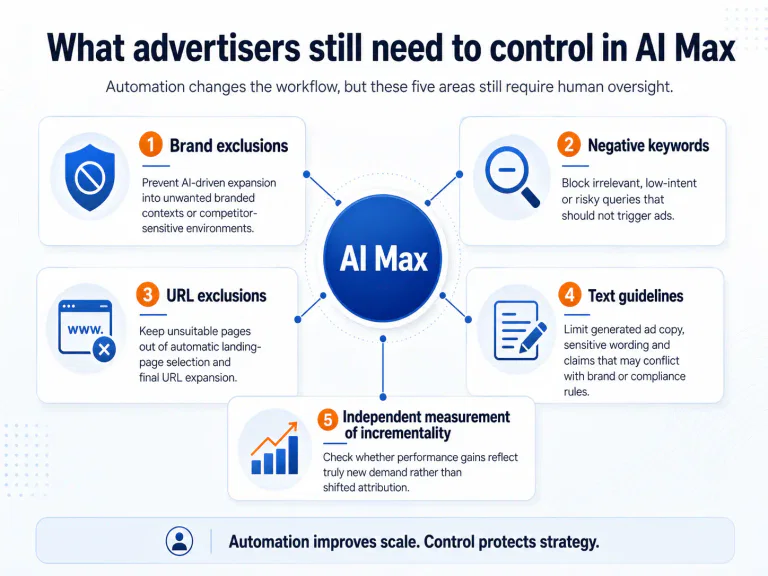
- 3. The advertiser’s main task is shifting from campaign construction to automation governance Brand exclusions, URL restrictions, negative keywords and text guidelines are becoming central elements of campaign management. Advertisers must decide which pages Google may use, which claims its systems may generate and which forms of demand should remain outside automated expansion. The real challenge is not preserving every manual task, but preventing performance gains from making the acquisition process impossible to understand or control.
Google Ads is moving beyond the familiar distinction between keyword-based Search campaigns and Dynamic Search Ads. AI Max is becoming the common automation layer through which Google interprets queries, expands targeting, generates advertising messages and selects landing pages.
The transition has been framed as an operational improvement. According to Google, AI Max can find previously inaccessible searches, adapt ad copy to user intent and direct visitors to pages that are more likely to convert. For advertisers, however, the change raises a more difficult question.
What remains of campaign strategy when the platform no longer automates individual tasks, but increasingly decides how the entire customer journey should be assembled?
The migration is more gradual than the original announcement suggested
Google initially announced that legacy features, including Dynamic Search Ads, would begin upgrading automatically to AI Max in September 2026. It subsequently changed the timeline after receiving feedback from advertisers.
As of July 2026, the automatic migration of Dynamic Search Ads is scheduled to begin in February 2027. Campaigns using automatically created assets, formerly known as ACA, and campaign-level broad match are still expected to begin moving to AI Max in September 2026. Google also intends to end the creation of new DSA campaigns as the transition progresses.
The distinction matters. Dynamic Search Ads users have been given several additional months, but the wider consolidation of Search automation has not been cancelled. The migration of ACA and campaign-level broad match means that many advertisers will encounter AI Max before the formal DSA sunset.
Google recommends voluntary migration and provides tools intended to transfer historical settings and data. During an automatic DSA upgrade, dynamic ad groups are supposed to become standard ad groups. Search term matching, text customization and final URL expansion will be enabled, while existing URL controls are expected to be preserved.
This may reduce the technical disruption of migration. It does not mean that the resulting campaign will operate according to the same logic.
Dynamic Search Ads automated coverage, not the entire decision process
Dynamic Search Ads were never a purely manual product. Google used the content and structure of an advertiser’s website to match searches with relevant pages and dynamically produce headlines. DSA was commonly used to expand coverage beyond a predefined keyword list, particularly on large websites where creating and maintaining keywords for every product or service was impractical.
The automation was substantial, but conceptually limited. The advertiser could still treat DSA as a separate campaign type, isolate it from conventional keyword campaigns and evaluate it as an additional source of traffic. Dynamic ad targets, page feeds and URL rules provided a relatively visible connection between sections of the website and the traffic being purchased.
AI Max absorbs this mechanism into a much broader system.
Its search term matching combines broad match, asset-based matching and landing-page-based technology. Text customization can generate headlines and descriptions using existing ads, keywords, assets and website content. Final URL expansion can replace the landing page selected by the advertiser with another page from the same domain when Google predicts that the alternative will perform better.
These are not three unrelated conveniences. Together, they change the unit being optimized.
The system is no longer merely deciding whether an advertisement should appear. It can determine which query is commercially relevant, what message should be displayed and where the user should arrive after clicking.
AI Max turns campaign structure into a set of suggestions
Traditional Search advertising was never entirely deterministic. Auction dynamics, close variants, automated bidding and responsive search ads had already weakened the idea that the advertiser controlled every impression.
Nevertheless, campaign structure still served as a statement of intent. Keywords described the demand the company wanted to address. Ad groups connected that demand with a particular offer. Advertisements defined the promise. Landing pages were selected to fulfil it.
AI Max changes the relative authority of each component.
Keywords remain available, but they are no longer necessarily the main boundary of reach. Advertiser-written assets remain available, but text customization can supplement them. Final URLs remain available, but final URL expansion may choose another destination. Pinned responsive search ad assets may not be respected when Google selects a different landing page, because the pinned message may no longer match the page chosen by the system.
In practical terms, the advertiser supplies evidence and constraints rather than a complete route.
The campaign contains signals about what the company sells, which pages it considers valuable and which messages it would prefer to use. Google’s system then constructs a route between the search, the advertisement and the website.
This can improve relevance in cases that would otherwise require thousands of manually maintained combinations. It can also make strategic mistakes more difficult to identify. When targeting, creative and destination are optimized together, a weak result can no longer be attributed easily to one element.
A conversion may have originated from a keyword, broad match expansion or keywordless matching. The displayed headline may have been written by the advertiser or generated from website content. The customer may have arrived on the submitted landing page or on another URL selected through expansion.
The campaign still produces a result. Its internal reasoning becomes harder to reconstruct.
The website becomes part of the advertising algorithm
Under AI Max, the website is no longer simply the place to which paid traffic is sent. It becomes an active source of targeting and creative material.
Search term matching can use landing-page content to identify relevant demand. Text customization can use copy from the domain to create new assets. Final URL expansion can search the site for a page that Google considers better suited to the query.
This increases the commercial importance of website architecture.
A page written for organic discovery may suddenly become an advertising destination. An old comparison article may be interpreted as commercially relevant. A support page may contain wording that appears attractive to the model but is unsuitable as a promise in an advertisement. A discontinued offer can remain accessible long after it has disappeared from the main navigation.
The quality of an AI Max campaign therefore depends partly on decisions made outside Google Ads.
Content governance, URL hygiene, canonical implementation, redirects, internal linking and the distinction between informational and transactional pages become paid-media concerns. A website with unclear page purpose gives the advertising system unclear instructions.
This is particularly important for companies with large editorial sections. A domain may contain thousands of pages that are relevant to a subject without being appropriate landing pages for paid acquisition. Semantic relevance does not automatically imply commercial suitability.
Google provides URL exclusions and URL inclusions to restrict the pages available to the system. URL exclusions operate at campaign level, while inclusions can be configured at ad-group level. However, the need to create those rules demonstrates the underlying shift: every eligible page must increasingly be treated as a potential campaign asset unless it has been deliberately removed from consideration.
Better reported performance does not automatically prove incremental demand
Google states that non-retail advertisers using the full AI Max feature suite recorded, on average, 7% more conversions or conversion value at a similar CPA or ROAS than advertisers using search term matching alone. The figure is based on Google’s internal 2026 data.
The result is commercially relevant, but it should not be interpreted as universal proof that AI Max creates new demand.
A platform can improve reported performance through several mechanisms. It may find genuinely incremental searches that would otherwise have been missed. It may also redistribute conversions from other campaigns, capture queries that would have converted organically, increase exposure to branded demand or select users who were already close to purchasing.
These outcomes are not economically equivalent.
An additional conversion generated from a new category-level query may represent genuine growth. A conversion captured from a navigational brand search may simply move attribution from another channel into Google Ads. Both can improve the campaign report.
The problem becomes more acute when the same system expands targeting, chooses the message, selects the page and evaluates the outcome. Optimization is then performed inside a measurement environment controlled by the platform that sells the advertising.
This does not make the reported result false. It makes incrementality a separate question.
Advertisers should therefore preserve independent measurements wherever possible. Backend revenue, new-customer rates, assisted conversions, branded versus non-branded demand, geographic tests and changes in total business volume remain important. A higher platform ROAS is useful, but it is not a complete economic explanation.
Reporting is improving, but visibility is not the same as auditability
Google has introduced reporting specifically for AI Max. The search terms report can identify “AI Max” as a match type and distinguish between broad match expansion and keywordless matching. Advertisers can also view combinations of search terms, headlines and landing pages to reconstruct more of the customer journey. Separate asset and landing-page reports provide additional information about what the system has served.
These changes address one of the strongest criticisms of automated campaign products: the advertiser needs to know what Google purchased, displayed and promoted.
The reports should make obvious failures easier to find. An irrelevant query can be added as a negative keyword. An unsuitable destination can be excluded. A generated asset that does not fit the brand can be removed. Google advises advertisers to allow at least two weeks of learning before making substantial changes to a newly enabled AI Max campaign.
The limitation is that reporting remains retrospective.
It shows what the system did after the auction. It does not give the advertiser a stable rule explaining what the system will do in the next auction. Similar searches may be interpreted differently as models, signals, competition and predicted conversion probabilities change.
Visibility allows the campaign to be reviewed. Auditability would require the decision process to be reproducible.
AI Max offers more of the former than the latter.
Brand controls are becoming a form of advertising governance
Google has added several tools intended to steer AI Max. Advertisers can use brand inclusions and exclusions, location-of-interest controls, URL restrictions and text guidelines. Text guidelines allow the exclusion of certain terms and the imposition of messaging restrictions on assets generated through text customization. The feature remains described by Google as an experimental beta.
These controls should not be treated as optional refinements added after launch.
When advertising copy can be generated from a domain and adapted to a specific search, companies need explicit rules regarding prohibited claims, regulated terminology, competitor references, pricing language and brand tone. The broader the automation, the more important the restrictions become.
This is especially relevant in finance, healthcare, legal services, pharmaceuticals and other regulated markets. A sentence that is acceptable as explanatory website content may become problematic when extracted, shortened and presented as a direct advertising claim.
Text guidelines reduce that risk, but they do not transfer responsibility to Google. The advertiser still supplies the website, enables text customization and benefits from the campaign. Automated creation changes how the message is produced; it does not eliminate the need for human approval and monitoring.
The same principle applies to landing pages. URL exclusions should cover more than broken or irrelevant pages. They should include recruitment sections, legal notices, customer support materials, discontinued products, investor relations content and editorial pages that cannot fulfil the commercial expectation created by an advertisement.
AI Max makes governance part of campaign configuration.
The real loss is not manual work
It would be misleading to describe the transition simply as another conflict between automation and human control.
Much of the manual work removed by AI Max has little strategic value. Maintaining enormous keyword lists, repeatedly adapting similar advertisements and mapping every long-tail query to a page are expensive tasks. A system that performs them accurately can save time without damaging the campaign.
The more serious loss concerns the advertiser’s ability to state exactly why a particular customer journey exists.
In a manually structured campaign, the connection between keyword, advertisement and page may be inefficient, but it reflects a deliberate hypothesis. The company believes that a certain form of demand should receive a certain message and offer.
In AI Max, that hypothesis is distributed across data, models and settings. The advertiser defines the business objective and supplies the available material. Google determines many of the intermediate steps.
This can produce better results while gradually weakening internal knowledge.
A company may know that conversions increased after enabling AI Max without learning which market segment expanded. It may know that a new landing page performed well without understanding whether the page attracted new customers or merely absorbed existing branded demand. It may know that generated advertisements increased conversion rates without knowing which promise influenced the decision.
Performance improves, but the organization becomes less capable of explaining its own acquisition process.
Advertisers should migrate through experiments, not faith
The extended DSA timeline gives advertisers an opportunity to establish evidence before February 2027.
A useful migration should begin with a baseline. Existing DSA campaigns need to be documented before their structure changes. Search terms, landing pages, conversion types, brand traffic, cost distribution and new-customer performance should be preserved in a form that can be compared later.
The website should then be audited as a potential advertising feed. The relevant question is no longer only whether a page can rank or convert. It is whether Google should be allowed to select it automatically for paid traffic and generate advertising language from its contents.
AI Max should initially be tested on a controlled portion of activity. Google provides one-click experiments for comparing campaign performance, but platform metrics should be combined with business-level outcomes.
Search term and landing-page reports require routine review. URL exclusions, negative keywords, brand restrictions and text guidelines should be designed before broad automation is allowed to operate at scale. High-risk offers may require final URL expansion or text customization to remain disabled.
The objective is not to preserve every manual practice. It is to determine which decisions can be delegated without losing the ability to understand the result.
AI Max is the new operating model for paid search
The replacement of Dynamic Search Ads is only the visible part of a broader transformation.
Google is extending AI Max beyond standard Search campaigns into Shopping and travel-specific formats. It is also developing additional mechanisms, including AI Brief, through which advertisers can describe their business, audience and messaging in natural language.
The direction is clear. Campaign management is moving from constructing fixed paths to supervising an adaptive system.
Advertisers will still choose budgets, objectives and broad commercial boundaries. They will increasingly spend less time defining every query and more time deciding what the platform is permitted to infer.
This may be a rational exchange. Search behavior is becoming more conversational, websites are becoming larger and manual campaign structures cannot represent every variation of intent. Greater automation can help companies reach demand that rigid keyword systems would miss.
But automation should not be confused with strategy.
AI Max can predict which combination is most likely to produce a measured conversion. It cannot independently determine whether the conversion is incremental, whether the promise is appropriate, whether the customer is economically valuable or whether the organization is becoming dangerously dependent on a decision system it cannot reproduce.
Google is not merely replacing Dynamic Search Ads. It is changing the role of the advertiser.
The central task is no longer to build every route between demand and an offer. It is to establish the boundaries within which Google is allowed to build those routes on the advertiser’s behalf.