

2026–2027 U.S. flu vaccine
What all three replacements actually mean
The headline is unusually broad, but the evidence does not support a simple “newer equals perfect” interpretation.
- Every antigen slot changed
The H1N1, H3N2 and B/Victoria components are all different from the 2025–2026 U.S. formulation.
- H3N2 subclade K is the central signal
It spread after the previous formula had been selected and dominated characterized U.S. H3N2 samples in interim 2025–2026 data.
- A reformulation is still a forecast
The selected viruses may improve antigenic alignment, but effectiveness can only be measured after the season begins.
The 2026–2027 U.S. flu vaccine is not a small annual tune-up. The Centers for Disease Control and Prevention says all three virus components have changed from the previous season. That is unusual enough to deserve attention, but it is easy to misunderstand what the change proves.
A seasonal flu vaccine is built against a moving target. Global laboratories watch which viruses are spreading, how their genes are changing and whether antibodies raised against earlier vaccine viruses still recognize them. Experts then choose representative viruses months before the Northern Hemisphere season reaches its peak. Manufacturers need that lead time to produce, test and distribute millions of doses.
This article explains the U.S. formulation and the evidence behind it. It is not individual medical advice, and it does not replace current CDC recommendations or a clinician’s assessment.
The formula changed at all three positions
All U.S. seasonal flu vaccines remain trivalent. They target one A(H1N1)pdm09 virus, one A(H3N2) virus and one B/Victoria-lineage virus. “Trivalent” describes the number of targets, not whether the formulation stayed the same. For 2026–2027, every slot receives a new reference virus.
Open the three-slot strain decoder
Each panel separates the name change from the public-health reason. Egg-based and cell or recombinant products sometimes use different representatives of the same antigenic target.
A1H1N1 gets a Missouri referenceOpen the H1 slot
A2H3N2 moves to DarwinOpen the H3 slot
BB/Victoria also resetsOpen the B slot
The names look like a code, but the logic is straightforward. Each name identifies a virus selected to represent a broader antigenic group. The word “like” matters because a vaccine component is not a literal catalogue of every virus that may circulate.
A strain name is a forecast model
WHO’s Global Influenza Surveillance and Response System connects national laboratories and collaborating centres that characterize influenza viruses throughout the year. In February 2026, WHO reviewed surveillance, genetic and antigenic evidence before recommending the Northern Hemisphere composition. The FDA advisory committee then considered the U.S. formulation in March.
That sequence resembles a forecast more than a retrospective diagnosis. The inputs are current, but the output must anticipate what will matter months later. This is why vaccine selection belongs in the same family of evidence problems as other high-stakes models: useful decisions must remain explicit about uncertainty. PolymathDesk has made the same distinction in its analysis of why clinical outputs should not be trusted blindly.
Why subclade K forced the H3N2 reset
The H3N2 story explains why the annual selection window matters. CDC’s interim analysis says subclade K appeared after the 2025–2026 vaccine viruses had already been chosen. By the middle of that season, it dominated the characterized H3N2 samples and was antigenically different from the H3N2 vaccine virus.
Those numbers need context. They describe an interim 2025–2026 U.S. study, not the future performance of the 2026–2027 products. The study estimated lower effectiveness than in several recent seasons, yet still found reduced outpatient visits and hospitalizations. It also reported limitations including preliminary estimates, possible unmeasured confounding and sample sizes that prevented every subtype and age analysis.
The new Darwin H3N2 references are therefore a response to observed drift, not a claim that the next season has already been solved. That distinction is central to understanding how a biological product differs from the technology around it.
How surveillance becomes a vaccine
The annual pipeline contains two different tests. First comes selection: are the recommended viruses the best available representatives of what surveillance can see? Later comes evaluation: did vaccination reduce medically attended illness and serious outcomes in the people who received it? A strong selection process cannot pre-write the second answer.
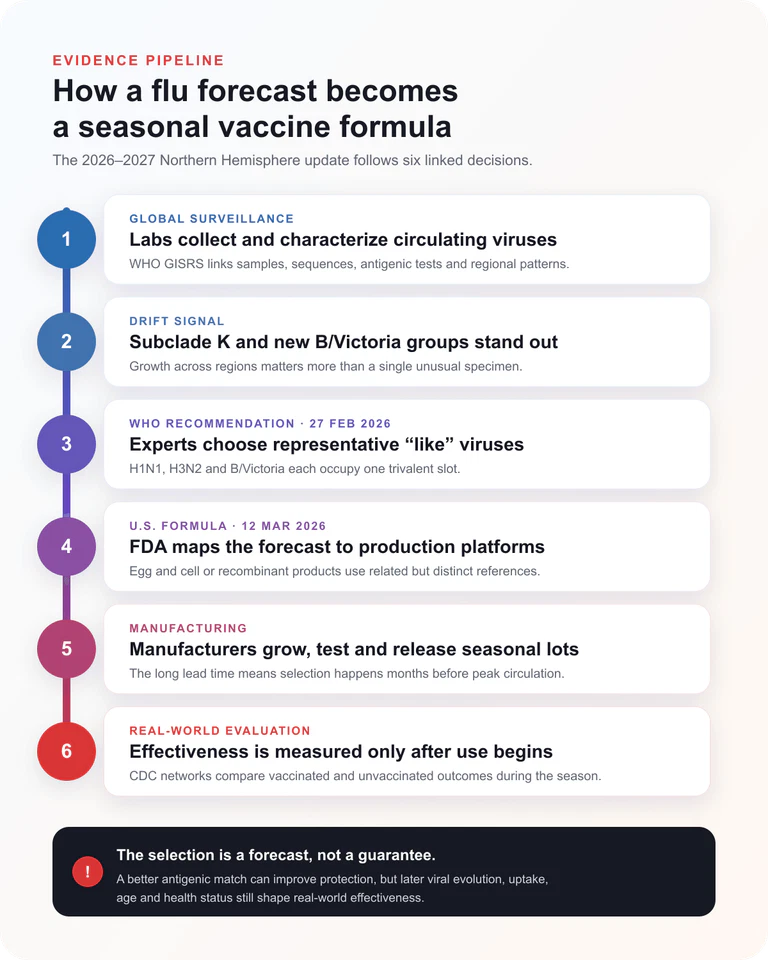
This global infrastructure matters beyond one formulation. The strengths and gaps of international surveillance also shape broader debates about vaccination coverage and global health safety. A better formula cannot compensate for weak access, low uptake or late detection.
Egg and cell formulas use different representatives
The parallel Darwin and B/Victoria names are not evidence that the products target different diseases. They reflect different production systems. Viruses adapted for growth in eggs can acquire changes during that process, so the best egg-propagated representative may not have exactly the same isolate name as the best cell or recombinant reference.
Egg-based and cell or recombinant products still aim at the same three antigenic positions. The production route changes how an appropriate representative is selected and manufactured.
FDA’s formulation notice also anticipates an adequate and diverse supply of approved U.S. vaccines. Availability, age indications and product choice remain separate questions from the scientific composition announcement.
A changed formula does not promise perfect effectiveness
Three replacements can sound like a total redesign. Biologically, the change is more precise: the same three target categories remain, while their representative viruses move closer to the surveillance picture available in early 2026.
A better match is a better starting point, not an immunity forecast written in advance.
Real-world results will still depend on later viral evolution, age, health status, vaccine uptake and the outcomes being measured.
Effectiveness against a laboratory-confirmed outpatient visit is not the same metric as effectiveness against hospitalization. Results can also differ between children, working-age adults and older adults. One percentage without its population, outcome and confidence interval is not a usable summary.
The composition decision is not a timing decision
The March formulation decision tells manufacturers what to make. It does not by itself change who should be vaccinated, which age-appropriate product is suitable or when an individual should receive it. Those questions belong to current CDC recommendations, product labelling and clinical context.
CDC’s public guidance continues to direct readers to annual vaccination for eligible people aged six months and older, with timing considerations that differ for some children, pregnancy and older adults. Because recommendations can be updated as the season approaches, readers should check the live CDC vaccination page rather than treating a composition article as a personal calendar.
What to watch before autumn
The most useful next evidence will arrive in stages. Product availability will show how the selected formula reaches clinics. Early surveillance will show which viruses actually begin circulating. Effectiveness networks will then estimate how vaccination changes outcomes in real use.
For now, the defensible conclusion is narrow but important. The 2026–2027 U.S. flu vaccine uses an entirely refreshed set of three representatives, and the H3N2 change directly addresses the subclade that disrupted the previous season’s match. That is evidence of an adaptive surveillance system. It is not evidence that influenza has become predictable.
Official sources checked on August 12, 2026
Primary public-health evidence
- CDC 2026–2027 flu season overview, updated April 13, 2026.
- FDA influenza vaccine composition for the 2026–2027 U.S. season, March 2026.
- WHO recommendations for the 2026–2027 Northern Hemisphere composition, February 27, 2026.
- CDC MMWR interim 2025–2026 influenza vaccine effectiveness estimates, March 12, 2026.
- CDC guidance on who needs a flu vaccine and timing considerations, accessed August 12, 2026.


