
Key takeaways from the Clinical AI Trust analysis
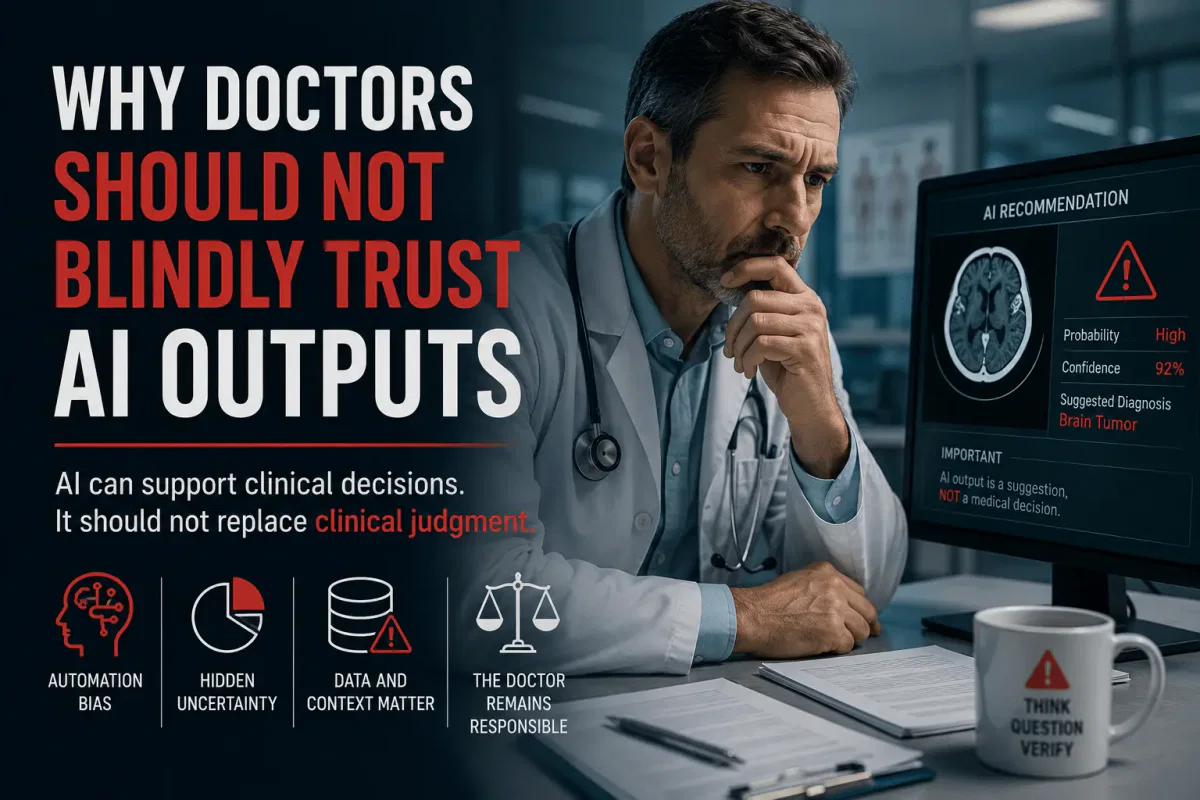
AI can support clinical work, but it should never replace medical judgment. In healthcare, a confident output can become dangerous when it enters diagnosis, triage, documentation or treatment decisions without local validation, human oversight and controlled skepticism:
- 1. AI output is not clinical judgment A model can sound precise, fluent and authoritative while still being wrong, incomplete or poorly suited to the patient in front of the doctor. Clinical AI should be treated as a fallible input, not as an oracle, especially when the decision affects diagnosis, discharge, medication, triage or escalation of care.
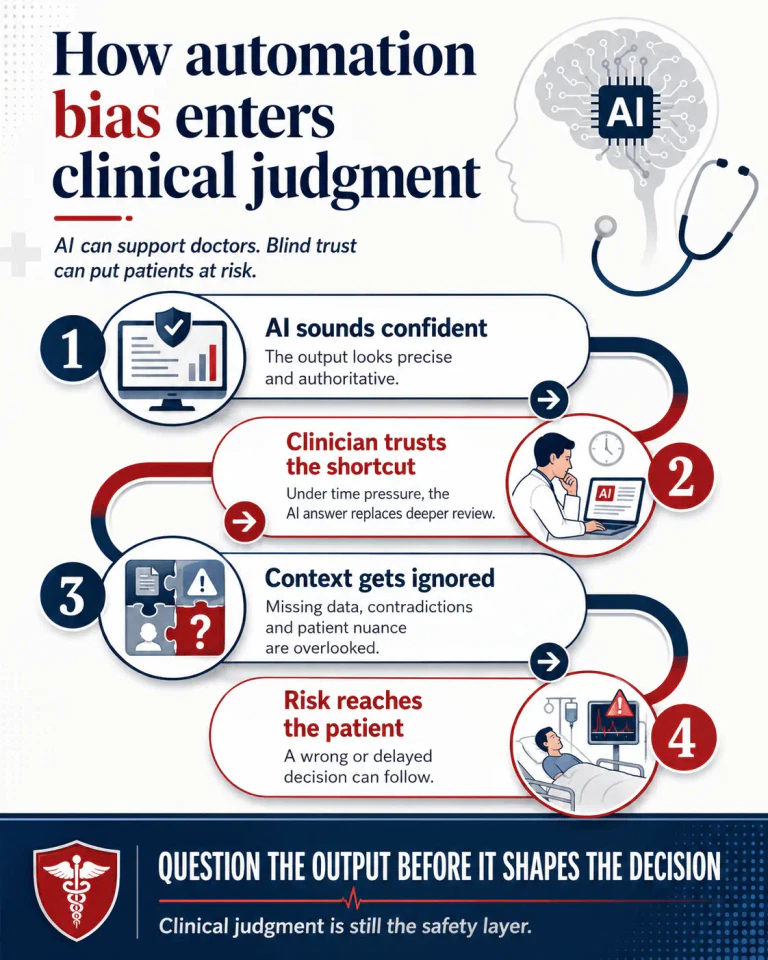
- 2. Automation bias can quietly reshape clinical thinking Doctors do not need to worship AI to be influenced by it. A clean score, generated summary or highlighted image region can make a recommendation feel safer than it is, especially in busy clinical environments. The safest question is not “what did the AI say?”, but “what would make this output wrong?”
- 3. Safe AI use depends on governance, not blind confidence Clinical AI needs local validation, audit trails, monitoring, escalation rules, staff training and clear accountability. Hospitals should not leave doctors alone with black-box outputs and then treat every failure as an individual mistake. AI governance is not paperwork around medicine; it is part of patient safety.
Artificial intelligence is entering medicine through many doors at once. It appears in radiology worklists, pathology tools, emergency triage support, clinical documentation, risk scoring, hospital operations, patient messaging, medication safety systems and experimental decision support. Some tools are regulated medical devices. Some are administrative software. Some are embedded quietly inside platforms doctors already use. Some are general-purpose language models being pulled into clinical work faster than hospitals can write policies for them.
That speed creates an uncomfortable problem.
AI can help doctors. It can notice patterns, reduce administrative burden, support triage, summarize information and sometimes improve diagnostic performance. It can make clinical work less fragmented when it is designed and governed well.
But AI output is not clinical judgment.
A model can be useful and still be wrong. It can be impressive and still be unsafe in a specific hospital. It can perform well in validation and still fail under local workflow pressure. It can sound confident while hiding uncertainty. It can appear neutral while carrying bias from training data, design choices or the population on which it was tested.
The danger is not only that AI makes mistakes. Doctors make mistakes too. The more serious danger is that AI changes how mistakes happen. It can shift responsibility, soften skepticism, compress thinking and make an unsafe recommendation look like an efficient answer.
In healthcare, this matters because a wrong output is not just a bad prediction. It can become a delayed diagnosis, an unnecessary test, a missed deterioration, a distorted medical record, a wrong triage decision or a treatment pathway that feels justified because the machine made it look orderly.
Doctors should use AI where it helps. But they should not obey it.
The problem is not AI
The problem is not that AI exists in healthcare. The problem is the strange authority it can acquire once it appears inside a clinical workflow.
A suggestion from a colleague is usually interpreted socially. The doctor knows who gave it, what their experience is, whether they tend to overcall, undercall, rush or miss certain patterns. A note in a chart can be questioned. A patient story can be rechecked. A lab result can be repeated. A radiology report can be discussed.
AI output often arrives differently.
It may appear as a score, a highlighted region, a generated summary, a risk category, a suggested diagnosis, a draft note or a recommendation. It may look clean, final and computationally calm. It may not show what information mattered, what was missing, where uncertainty sits or whether the patient in front of the doctor resembles the data used to train the system.
This gives AI a psychological advantage.
It can feel less like an opinion and more like infrastructure. Less like advice and more like a fact. Less like “consider this” and more like “the system says”.
That is where blind trust begins.
Not because doctors are naïve, but because clinical environments are pressured. They are busy, noisy, understaffed and full of decisions. When a system offers a fast, confident answer, the temptation is real. Especially when the output agrees with the first impression. Especially when time is short. Especially when the hospital has already purchased the tool and presented it as safe.
A doctor does not need to worship AI to be influenced by it.
Automation bias is a clinical risk
Automation bias happens when people over-rely on automated advice, especially when the system appears authoritative or when users are busy, tired or uncertain. In medicine, this can be dangerous because the clinician may accept a machine recommendation without applying the same level of scrutiny that would be used for a human opinion.
This does not mean AI always makes doctors worse. Sometimes it improves performance. The problem is subtler. AI can improve average performance while still creating dangerous failures in specific cases.
A radiology AI system may help detect more abnormalities overall, but if it misses one lesion, a tired clinician may also miss it because attention was pulled toward the system’s output. A triage model may flag many high-risk patients correctly, but a low-risk label may falsely reassure staff when the clinical picture says otherwise. A documentation assistant may produce a fluent note, but insert a misleading detail that becomes part of the patient’s record.
The error is then no longer only technical. It becomes hybrid.
The machine produces the output. The clinician absorbs it. The workflow normalizes it. The record preserves it.
Automation bias is especially dangerous when AI is wrong in a plausible way. A ridiculous error is easier to reject. A confident, medically plausible error can slip into thinking because it sounds like something that could be true.
That is why doctors need more than basic AI enthusiasm. They need trained skepticism.
Confidence is not competence
Clinical AI can be persuasive because it often presents itself without hesitation.
A language model may explain a diagnosis in polished medical prose. An imaging tool may mark a region with a precise-looking boundary. A risk model may assign a patient to a category with numerical confidence. A summarization tool may produce a note that reads better than the scattered chart it summarized.
This fluency can create trust before verification.
But confidence is not competence. A fluent explanation can still be built on incomplete information. A clean score can still come from a model that performs poorly in a subgroup. A generated note can still omit the sentence that mattered. A highlighted image region can still distract from a second abnormality outside the marked area.
Doctors already know this in other contexts. A confident patient history may still be inaccurate. A neat referral letter may still leave out a crucial detail. A normal lab result may still be wrong if the sample was mishandled. Medicine has always required interpretation.
AI should not be exempt from that discipline.
The clinical question should not be “what did the AI say?” The better question is: what would make this output wrong?
That one question changes the relationship. The doctor stops treating the system as an oracle and starts treating it as a fallible input.
AI does not see the patient the way a doctor does
Most medical AI systems do not experience the patient as a person in a room. They process selected data: images, lab values, notes, codes, waveforms, questionnaires or structured variables. Even when the data is extensive, it is still a representation.
This matters because clinical meaning often lives between data points.
The patient’s hesitation before answering. The family member correcting the story. The smell of alcohol. The way someone walks into the room. The fear in the voice. The contradiction between “I feel fine” and the body in front of the clinician. The social context that explains why medication was not taken. The subtle change from yesterday that never appears in the lab panel.
AI may process more information than a human in some domains, but it does not automatically understand the clinical scene.
A model may classify risk based on historical data while missing that the patient is about to lose housing, cannot afford medication or does not understand discharge instructions. A documentation tool may summarize the chart but flatten uncertainty. A diagnostic assistant may suggest rare conditions while failing to feel the urgency of a deteriorating patient.
This is why blind trust is dangerous. It can push doctors to treat the data shadow as if it were the patient.
The patient is not the dashboard. The patient is not the probability score. The patient is not the generated summary.
The patient is still the patient.
Local validation matters more than vendor claims
A common mistake in healthcare AI is assuming that a model that worked somewhere else will work here.
It may not.
A system trained and tested in one institution can behave differently in another. Patient populations differ. Imaging equipment differs. Documentation habits differ. Lab thresholds differ. Coding practices differ. Disease prevalence differs. Clinician workflows differ. Even the way data is entered into the electronic health record can change model performance.
This is why local validation matters.
A hospital should not deploy clinical AI only because a vendor showed strong aggregate performance. It should ask whether the tool has been tested in its own environment, with its own patient mix, data quality, workflows and failure modes.
For doctors, this matters at the bedside. If there has been no local validation, the AI output should be treated with extra caution. The model may still help, but its confidence is borrowed from another context.
A simple example: an AI system used for sepsis prediction may perform differently in a tertiary hospital, a rural emergency department and an oncology ward. The same alert threshold may create useful warnings in one setting and alert fatigue in another. If doctors learn that the system over-alerts, they may ignore it. If it under-alerts, they may be falsely reassured.
Both outcomes are bad.
A model is not clinically trustworthy because it is accurate in general. It becomes trustworthy only when it is tested where it is used.
Bias can hide inside clinical usefulness
AI bias in medicine is not always obvious. It does not always look like open discrimination. It may appear as unequal performance, poorer calibration, missing data, distorted risk scores or recommendations that reflect historical inequalities.
This is a serious issue because healthcare data is not a clean mirror of biology. It is also a record of access, poverty, referral patterns, clinician behaviour, insurance status, delayed diagnosis, unequal treatment and social bias.
If a model learns from that data without correction, it may reproduce those patterns.
A tool may underperform in groups that were underrepresented in training data. A risk model may use healthcare spending as a proxy for illness and underestimate patients who had less access to care. A dermatology system may work better on lighter skin if darker skin was underrepresented. A triage model may appear neutral while encoding socioeconomic differences through variables that look clinical.
Doctors should therefore be careful when AI output feels objective.
Bias often enters through ordinary variables. It can hide behind numbers. It can look technical instead of moral.
The practical question is not only whether the model works. It is for whom it works, where it works and where it fails quietly.
Explainability is not enough
Many healthcare AI products promise explainability. They may show heatmaps, feature importance, confidence scores or natural-language explanations. These tools can be helpful, but they can also create false comfort.
An explanation is not proof that the recommendation is right.
A heatmap can show where a model focused, but not whether that focus was clinically valid. A confidence score can quantify model certainty, but not guarantee truth. A generated rationale can sound reasonable while being constructed after the fact. Feature importance can help identify inputs, but not fully explain causality.
This is why doctors should not confuse explainability with safety.
A bad recommendation with a neat explanation is still a bad recommendation. Worse, it may be more persuasive because it gives the clinician something to look at.
The safest posture is to treat explainability as one clue, not as a final answer. If the explanation does not fit the clinical picture, the doctor should trust the mismatch enough to investigate.
Sometimes the most important clinical question is: why does this output feel too clean?
AI can distort documentation
Clinical documentation is one of the fastest areas of AI adoption. Ambient scribes and summarization tools promise to reduce paperwork, generate notes, structure visits and free doctors from screens.
This is valuable. Administrative burden is a real problem. Many clinicians are exhausted by documentation work that eats into patient time and personal life.
But AI-generated documentation creates its own risks.
A note can become too polished. It may sound complete while missing uncertainty. It may insert details that were implied but not said. It may normalize a vague conversation into a definitive plan. It may copy forward old problems. It may turn patient language into medical language in a way that changes meaning.
This is dangerous because the medical record is not only a memory aid. It influences future care, billing, legal accountability, handovers, audits, quality metrics and clinical reasoning.
If an AI-generated note says the patient denied chest pain when the conversation was unclear, that matters. If it lists medication adherence without confirmation, that matters. If it summarizes a complex visit as stable when the doctor was uncertain, that matters.
Doctors should treat AI-generated notes as drafts, not records.
If the doctor signs it, the doctor owns it.
AI can make doctors less attentive
One of the less discussed risks is de-skilling. If clinicians repeatedly rely on AI to notice patterns, rank diagnoses, draft notes or flag risk, their own habits may gradually change.
This does not mean doctors become incompetent overnight. It means attention adapts.
A radiologist who knows a system will flag suspicious regions may scan differently. An endoscopist using AI detection may begin to rely on the prompt. A clinician reading generated summaries may stop reading the raw chart as carefully. A trainee using AI explanations may learn the answer without learning the reasoning.
The danger is not that AI helps. The danger is that it becomes a crutch before anyone notices.
Medicine depends on maintained skill. Pattern recognition, skepticism, clinical examination, history-taking, prioritization and uncertainty management all need practice. If AI absorbs too much of the cognitive work, doctors may become faster but thinner.
This is why hospitals should not measure AI success only by efficiency. They should also ask whether clinical skill is being preserved.
A tool that saves time but weakens vigilance may not be a bargain.
The doctor remains responsible for uncertainty
AI systems are often better at producing answers than expressing uncertainty in a clinically useful way.
But medicine is full of uncertainty. Symptoms are incomplete. Tests are imperfect. Patients present early, late or atypically. Diseases overlap. Social context changes risk. The first diagnosis is sometimes wrong. Good doctors do not eliminate uncertainty. They manage it.
Blind trust in AI can damage that process by making uncertainty feel resolved too early.
A generated differential diagnosis may look comprehensive. A risk score may create an artificial sense of closure. A triage label may make a patient seem safer than they are. A normal AI interpretation may reduce the urge to recheck.
This is where clinical maturity matters.
Doctors should ask:
What is missing from the data?
What diagnosis would be dangerous to miss?
Does the patient’s appearance match the AI output?
Would I make the same decision without the tool?
Is this recommendation consistent with guidelines and local practice?
Could this patient belong to a group where the model performs worse?
What follow-up is needed if the AI is wrong?
These questions slow down blind trust without rejecting useful support.
AI should help doctors think. It should not give them permission to stop thinking.
Good use means controlled distrust
The best relationship between doctors and AI is not blind trust or total rejection. It is controlled distrust.
Controlled distrust means the doctor uses the tool, but keeps clinical authority. The AI output enters the reasoning process, but it does not replace it. The clinician asks whether the output fits the patient, whether the data is adequate, whether the model is known to perform locally and whether the recommendation changes management safely.
This attitude is not anti-technology. It is professional.
A good doctor already applies controlled distrust to many things: patient histories, test results, referral notes, imaging reports, guidelines and personal intuition. AI should enter the same discipline.
The output should be checked against the patient, the context and the consequence.
If the AI is wrong and the decision is low-risk, the harm may be small. If the AI is wrong and the decision affects diagnosis, surgery, discharge, medication, triage or escalation of care, the threshold for trust should be much higher.
The more serious the clinical consequence, the less acceptable blind reliance becomes.
What doctors should check before trusting an AI output
A doctor does not need to become a machine learning engineer. But doctors do need practical questions.
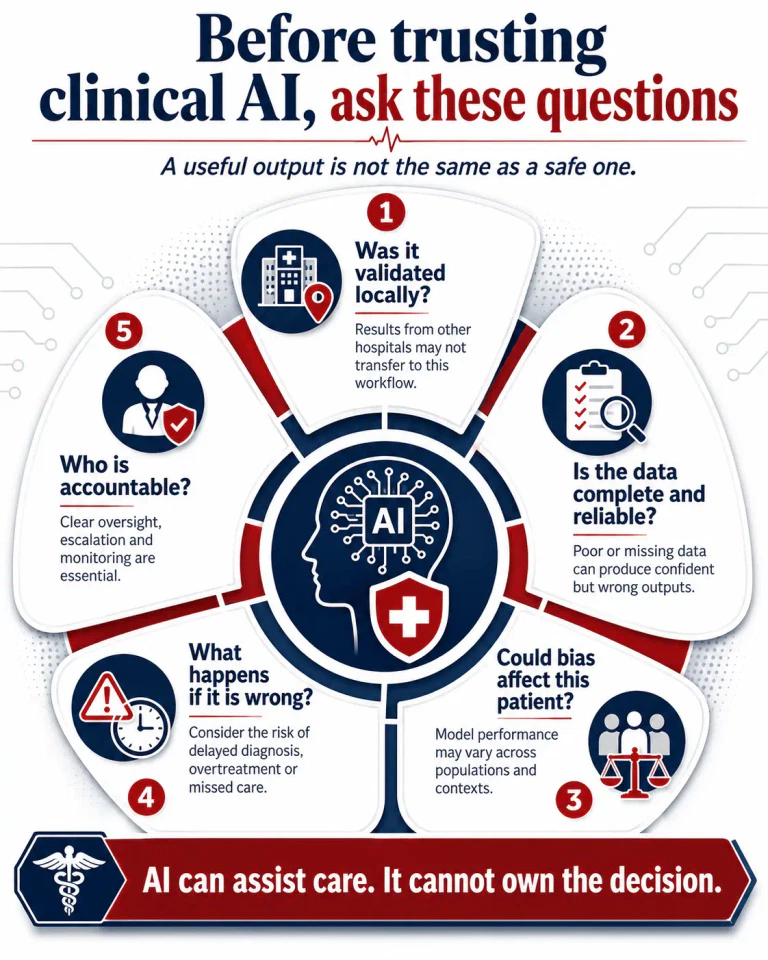
Before relying on AI output, ask:
What is the tool intended to do?
A documentation assistant, a diagnostic tool and a risk prediction model have different risks.
Was it validated in patients like mine?
Performance in another population may not transfer.
Was it tested in this hospital or workflow?
Local data quality and clinical processes can change performance.
What happens when it is wrong?
Some errors are harmless. Others change treatment, triage or diagnosis.
Does it show uncertainty clearly?
A recommendation without meaningful uncertainty can be misleading.
Can I verify the source data?
If the input is incomplete or outdated, the output may be contaminated.
Is there a monitoring process?
AI performance can drift when practice, populations or data systems change.
Who is accountable?
If no one owns the escalation pathway, the tool is not ready for clinical trust.
These questions are not bureaucratic. They are clinical safety checks.
What hospitals owe doctors
Doctors should not be left alone to police AI risk at the bedside.
If a hospital deploys clinical AI, it owes clinicians more than access credentials and a short training video. It should provide governance that makes safe use possible.
That means clear intended use, local validation, performance monitoring, incident reporting, audit trails, escalation pathways, role definitions and practical training. Doctors should know when the system is allowed to influence care and when it is only informational. They should know what to do when the AI output conflicts with clinical judgment. They should know whether the model has known limitations in specific populations.
Hospitals also need to protect clinicians from silent responsibility transfer. It is not acceptable for an organization to deploy AI aggressively, market it as innovative and then treat every failure as an individual doctor’s mistake.
If the system influences care, the organization shares responsibility for how it was selected, validated, integrated and monitored.
AI governance is not paperwork around medicine. It is part of patient safety.
What patients deserve to know
Patients do not need a technical explanation of every model. But they deserve honesty when AI meaningfully affects care.
If AI helps draft a note, interpret an image, prioritize a case or generate a recommendation, patients should not be deceived about the nature of that involvement. Transparency does not mean frightening patients with machine learning jargon. It means explaining that AI is used as a support tool, that clinicians remain responsible and that concerns can be discussed.
This is especially important when AI influences high-stakes decisions.
Trust in medicine depends on relationship, not only performance. A patient may accept AI support if it is presented honestly. The same patient may feel betrayed if they discover later that a tool influenced care without any meaningful explanation.
The clinician-patient relationship should not become a hidden interface between the patient and an undisclosed system.
What this changes
Doctors should not blindly trust AI outputs because medicine cannot afford borrowed certainty.
AI may become a normal part of clinical work. In some areas, it will be helpful. In others, it will disappoint. In a few, it may be dangerous if adopted too quickly or governed too loosely.
The safest future is not medicine without AI. That is unlikely and probably undesirable. The safest future is medicine where AI is treated as a fallible clinical instrument: useful, monitored, limited, questioned and never allowed to erase responsibility.
The doctor’s role will not be to reject every output. It will be to interpret output without surrendering judgment.
That requires a different kind of clinical discipline. Not fear of technology. Not obedience to technology. Something harder: the ability to use AI while remembering that the patient is not an input, the model is not a colleague and the answer is not true just because it arrived quickly.
AI can support care.
It should not become the voice that doctors stop questioning.


