
Blood-bank biology · Health
A longer shelf life answers only the first question
The August 2026 CHIPS findings make more sense when we separate the bag from what happens inside its recipient.
- Cold changes the plateletRefrigeration can alter how quickly transfused platelets are removed from circulation.
- The trial tested surgical bleedingIts storage finding is not a claim of 21 days of protection after transfusion.
- Read the product and the populationRefrigerated, frozen and room-temperature platelet studies cannot be treated as interchangeable.
A blood donation does not leave the collection center with one universal expiry date. In the American Red Cross description of its processing pathway, red cells go into refrigeration and can be stored for up to 42 days. Platelets remain at room temperature, in agitators, for up to five days. The difference is striking: the component with the shorter storage window is also the one being kept warm.
Why not put both in the refrigerator? The answer begins after the bag is opened. A storage method must preserve something that works in another person's body, where cells recognize, use and remove transfused material. A platelet can remain useful for one task while becoming less suitable for another.
Cooling changes how the body recognizes a platelet
A 2003 experiment published in Cell helped explain the puzzle. Chilling caused receptors on the platelet surface to cluster. Those clusters were recognized by receptors on macrophages in the liver, helping remove the chilled platelets from circulation. The work included mouse experiments and studies of human platelets; it was a mechanistic investigation, not a trial proving which transfusion a particular patient should receive.
The revealing part was that rapid removal did not simply mean the platelet had become inert. The researchers could demonstrate function under experimental conditions while investigating the clearance pathway. That separates two ideas often compressed into the word viable: being capable of a biological action and remaining available in circulation to perform it.
Later research in healthy volunteers made that distinction measurable. Investigators stored platelets for seven days, then followed their recovery and survival after transfusion. They also tested temperature cycling. The abstract reports separate paired comparisons, with different sample sizes, rather than one large three-way clinical comparison. Its measurements cannot be converted into a timetable of protection for an injured patient. They show why the number of days in storage and the time spent circulating must be reported separately.
Warm storage creates a different safety problem
Room temperature is not a consequence-free solution. The CDC explains that platelet storage temperatures can facilitate bacterial growth. Screening is essential, but no method detects every contaminated unit. This is a different problem from viral screening of the donor: bacteria introduced into a component can multiply during storage.
A CDC investigation of transfusion-associated sepsis in 2018 illustrates the limits. Implicated units included one treated with pathogen-inactivation technology and others with negative testing. Investigators used genetic comparisons of bacterial isolates to examine a possible common source. The lesson is not that testing is pointless; it is that a reassuring result and complete absence of risk are different claims.
For the reader, three questions now replace the vague question of whether stored platelets are “still good.”
- Storage quality and safety ask what has happened inside the unit before it reaches a patient.
- Recovery and circulation ask how much of the transfused material remains in the bloodstream, and for how long.
- Clinical efficacy asks whether the transfusion achieves the outcome needed in the studied situation.
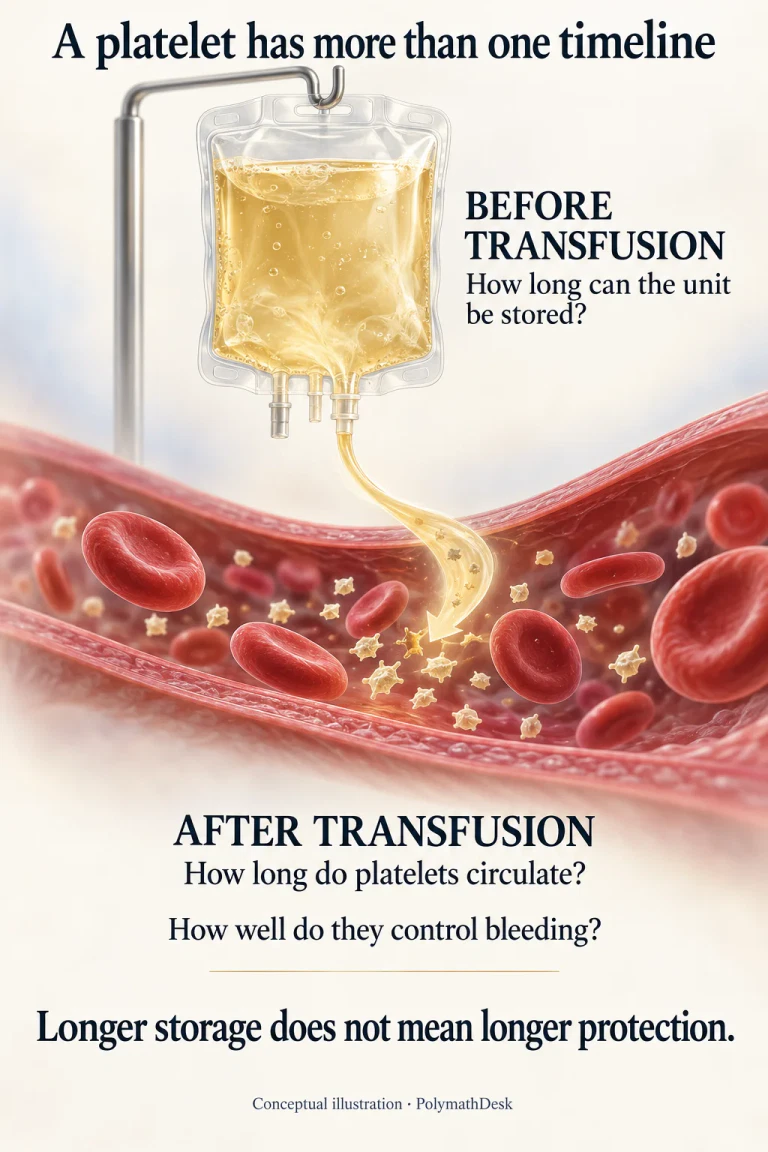
The expiry date describes the product before use. It cannot, by itself, describe the patient's benefit afterward.
CHIPS put the question inside cardiac surgery
The CHIPS trial, published on August 17, 2026, compared cold-stored platelets with room-temperature platelets for active bleeding in cardiac surgery involving cardiopulmonary bypass. Of 1,000 transfused participants, 989 entered the primary analysis. Cold storage extended up to 21 days, versus up to seven days for the comparator.
The main outcome was a bleeding-related efficacy score from one to five, with higher values indicating more bleeding. The study used a one-point noninferiority margin and met its criterion. That supports its specified comparison; it does not mean every outcome was identical. The abstract also reports increased reexploration rates in the cold-storage group. This qualification belongs alongside the positive headline, not hidden behind a general statement that safety was the same.
For interpreting the result, the decisive phrase is active surgical bleeding. Prevention of future bleeding asks another question. As with interpreting evidence across different patient groups, the population and endpoint determine how far a finding travels.
More storage days could change which hospitals can keep stock
Consider a deliberately simplified example: a small service receives a usable unit, but no suitable patient needs it before expiry. A longer permitted storage window could let that same unit remain available until a later need. The potential gain would be access at the moment of bleeding, rather than a longer effect inside the recipient. This is an inventory illustration, not a calculation of hospital savings or a result measured by CHIPS.
The distinction matters for evaluating a blood-supply breakthrough. Ask whether an announcement reports units discarded, days with no stock, patients unable to receive a component, or a clinical outcome after transfusion. Those measures can be related without being substitutes for one another. A longer maximum storage duration alone cannot reveal how many shortages a service will avoid.
This is also a later stage of the process than automating the physical blood draw. Collection success does not settle processing, storage, distribution or appropriate use. A donation has to make it through the whole chain.
A trial finding and a storage authorization are separate documents
The FDA's June 2023 guidance describes alternative procedures for apheresis platelets stored at 1–6°C for up to 14 days, intended for active bleeding when conventional platelets are unavailable or impractical to use. It distinguishes this from routine room-temperature storage at 20–24°C and from prophylactic transfusion. The document remains listed among FDA blood guidances when checked for this article.
Reporting a 21-day study therefore does not authorize a hospital to relabel an existing product. Clinical evidence, regulatory permissions, product instructions and the service's validated procedures have to be considered separately. This article describes the research and US guidance, not a universal storage policy or transfusion advice.
There is another easy category error: refrigerated platelets are not the same as cryopreserved platelets. The CLIP-II randomized trial of cryopreserved versus liquid-stored platelets investigated a different preservation approach and did not establish noninferiority for its primary bleeding outcome. Its findings should not be folded into CHIPS under a single label such as “cold blood.” The preparation method is part of the intervention.
The useful change in perspective is quite practical. Next time a platelet headline announces a new number of days, ask where those days occur: in a storage bag, in circulation, or in follow-up after treatment. Only then ask what happened to bleeding. The answer can be genuinely promising without all four measurements moving together.
Questions about platelet storage
Does a longer shelf life mean platelet donations are no longer needed?
No. Extending the time a collected unit may remain usable does not produce new donated material. It changes a constraint on supply, rather than removing the need for supply. Local blood services determine their current donation needs.
Why do sources quote five days and seven days?
Storage duration depends on the product, approved system and bacterial risk-control strategy. FDA's 2023 guidance explains the conditions behind room-temperature dating periods up to seven days; the Red Cross page cited here describes a five-day workflow. Neither number should be assumed for every unit worldwide.
Primary research and blood-service guidance
Clinical trials, biological research and official guidance checked September 8, 2026
- CHIPS randomized clinical trial — JAMA, August 17, 2026. Public abstract used; population, primary endpoint and reported reexploration signal.
- The clearance mechanism of chilled blood platelets — Cell, 2003.
- Temperature cycling during platelet cold storage — Transfusion, 2018.
- CDC guidance for bacterial contamination and blood safety.
- CDC investigation of a potential common source of platelet contamination — 2018 events, 2019 report.
- FDA alternative procedures for cold-stored platelets — June 2023.
- American Red Cross — What Happens to Donated Blood?
- CLIP-II randomized trial of cryopreserved versus liquid-stored platelets — JAMA. A different preservation intervention.


