

The Ministry of Justice’s provisional figures put applications at 5,997. The scheme covers several kinds of land, including residential plots, farmland and forest. These are plots and applications, not a count of abandoned houses rescued or families rehoused.
Land is usually discussed as something a family hopes to acquire. In this part of Japan’s property system, the problem runs in the other direction. An heir can receive a place they do not need, far from where they live, with continuing work attached to ownership. A willing recipient becomes worth paying for.
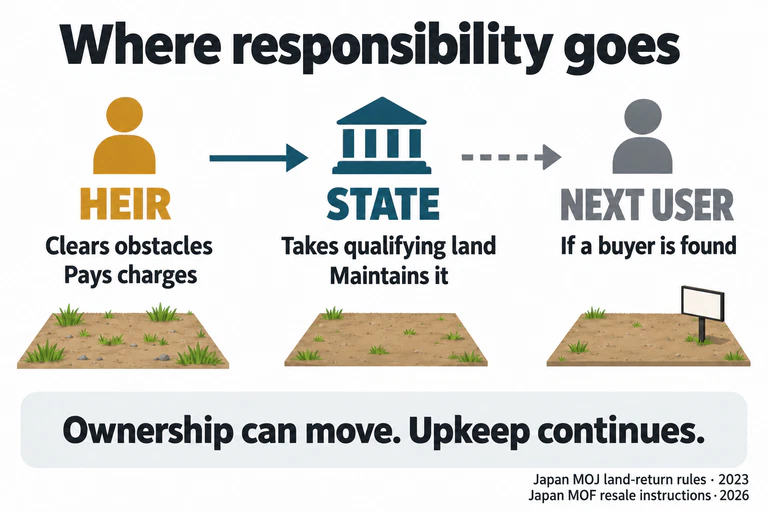
The state offers an exit, but it draws a line around the liabilities it will accept. Putting the entry rules beside the government’s new resale instructions reveals the bargain: the heir must first make the plot acceptable; the state then takes on the job of managing it and looking for another use.
The house has to go before the land can qualify
The inherited-land return system opened in April 2023. It is aimed at people who obtained land through inheritance or a bequest to an heir. Someone who simply bought unwanted land generally cannot use it. Co-owned land requires a joint application by all the owners. The official eligibility guide also lists land the government will not take.
A plot with a building on it cannot enter the scheme. Neither can one with certain third-party rights, contaminated soil, unclear boundaries or disputed ownership. Further restrictions concern features that make ordinary management unusually expensive or difficult.
For an inherited empty house, that first exclusion is decisive. The owner cannot hand the building and its demolition problem to this programme. Removing the house would address that particular obstacle, while the land would still have to meet the other conditions. Paying for clearance therefore comes before knowing that the plot can finally leave the family.
There are two separate public charges. Applying costs ¥14,000 per plot, and the examination fee is not refunded after withdrawal or rejection. Once approval is obtained, the applicant pays a contribution calculated to represent ten years of standard land-management costs. The government’s guide gives ¥200,000 as the basic contribution, with area-based calculations for specified urban land, agricultural land and forests.
The familiar ¥200,000 figure is consequently not an all-in price for escaping an inheritance. Clearing a building, resolving a boundary problem and obtaining help with the paperwork can add costs before the application succeeds. Those costs depend on the actual plot; a single national fee cannot tell an heir whether this route is affordable.
The government has to find a use for what it receives
A Ministry of Finance directive dated 24 June 2026 describes most returned land as having little marketability. It anticipates long periods of management and says public auctions may fail to attract a buyer. The recurring jobs include mowing, patrols and dealing with trees or dumped waste.
The directive permits specified plots to be sold in their existing condition, with some surveys and investigations omitted under defined conditions. Buyers must be told what has not been checked and what risks follow. It also provides routes for negotiated sales, including to neighbouring landowners. These are permissions to simplify a transaction, not assurances that a plot is ready for a new building.
The policy is trying to keep the cost of finding a buyer proportionate to the property’s value. Spending more on preparation can make a parcel easier to understand without producing anyone who wants it. An as-is sale can reduce that preparation bill, while leaving the next owner with more to investigate. The cost changes hands along with the land.
For the heir, an accepted transfer can end a recurring obligation. For the public owner, it begins one. The up-front management contribution helps fund that obligation, but the scheme still needs a way to maintain each plot and, where possible, move it into use. A change in the name on the register does not itself supply a buyer, a business or a resident.
A neighbour may want what a distant buyer does not
The latest statistics contain a useful counterweight to the picture of permanently unwanted property. There were 1,139 withdrawn applications by 31 August. In 586 cases, the recorded reason was that a prospect of effective use had emerged. The Ministry of Justice gives examples: a public body found a use, an adjoining owner offered to take the land, or an agricultural committee helped arrange future farming. These are reasons for withdrawal, not 586 certified sales.
A neighbouring owner is looking at a different proposition from someone searching for a complete home or a stand-alone development site. An adjoining parcel can be useful as an extension of a place they already occupy. Its value to that person depends on what it joins. That helps explain why finding a specific local recipient can matter more than advertising the land to an ever wider audience.
This is also a different problem from Kyoto’s planned tax on unused homes. Kyoto wants existing housing to become available to households. The national return scheme accepts qualifying land after excluding buildings. Its agricultural and forest plots cannot be counted as spare homes for families simply because ownership has changed.
Our earlier essay on family property and access to adulthood in Poland follows an inheritance that helps the recipient move forward. Here the inherited asset can require an up-front payment to make the recipient free of it. The difference is the property’s usable value to someone in a position to take responsibility for it.
The entry costs also make this an uneven form of relief. An owner who can finance clearance and the charges has a route that another heir may be unable to afford. That follows from the programme’s design; the published counts do not show how many households were priced out before applying. Accepting every costly parcel would move more burdens to the public. Screening them leaves some burdens with families.
The 586 withdrawals with a new prospect of use suggest a second result worth watching alongside transfers to the treasury. A plot can find a recipient before the state has to own it. Where that happens, the family gains an exit and a local user gains something they actually need. Where it does not, the government has inherited the next mowing season.


