

Key takeaways from the Poland inheritance economy analysis
Poland still describes adulthood as something earned through education, work and responsibility. But housing pressure is changing that story. For many young adults, the decisive question is no longer only how much they earn, but whether their family can help them cross the first threshold of independence:
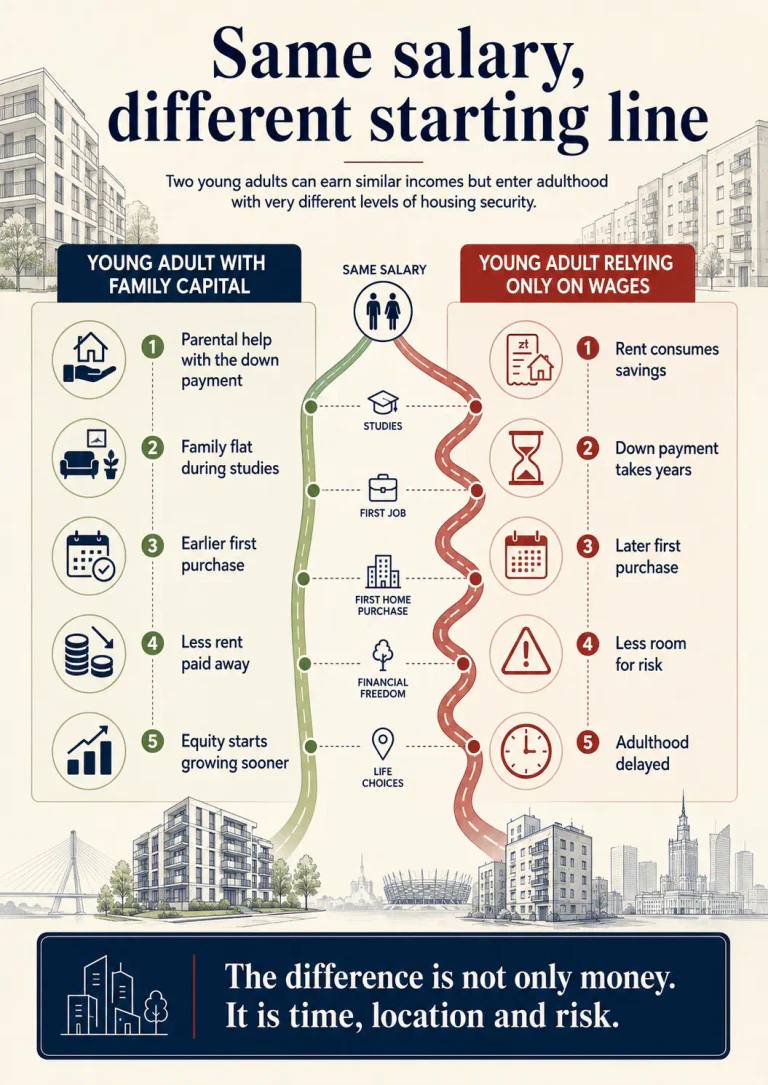
- 1. The down payment is becoming a class border Two young adults can have similar degrees, jobs and salaries, but very different futures if one receives family help and the other relies only on wages. Parental support does not merely add money. It changes timing, location, risk and access to ownership.
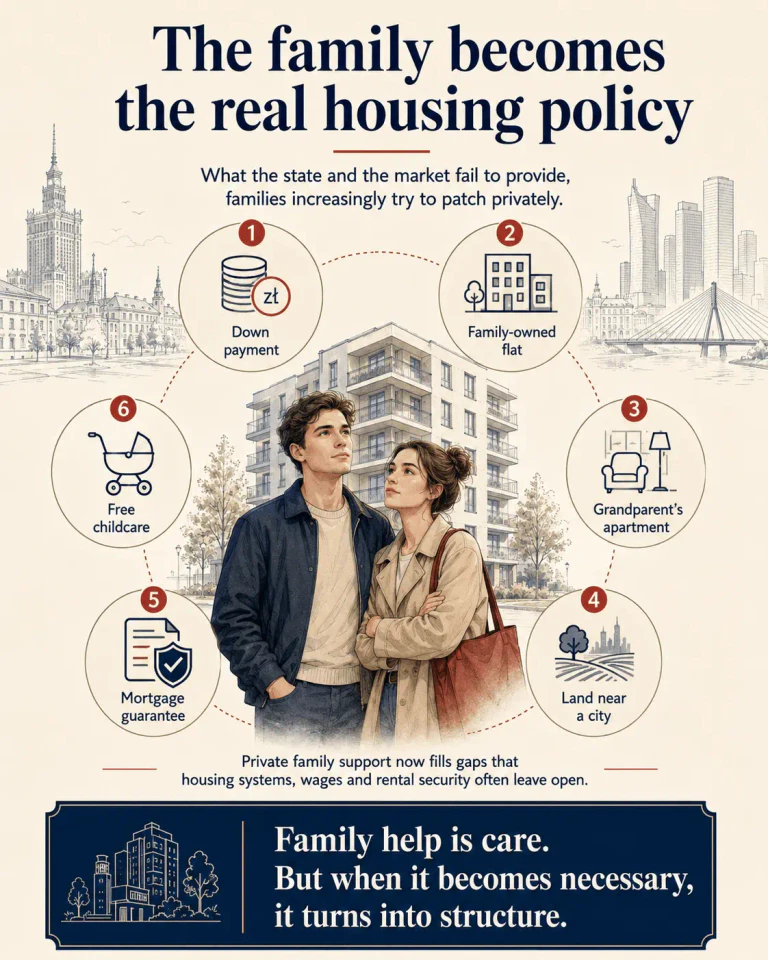
- 2. Family solidarity is quietly replacing housing policy Parents who help their children are not the problem. The problem is a system in which private transfers become the hidden bridge to independence. When the family becomes the real housing policy, inequality is passed on through care, not only through wealth.
- 3. Housing inequality is becoming demographic inequality Access to property now shapes more than comfort. It affects when people leave home, whether they can stay in large cities, how much risk they can take, and whether having children feels realistic. Stable adulthood is becoming easier to inherit than to build from wages alone.
There are two young adults in the same Polish city.
They may have similar degrees, similar jobs, similar ambitions and even similar salaries. On paper, they belong to the same generation. They scroll through the same property portals, complain about the same rent, watch the same mortgage rates and hear the same advice about patience, discipline and hard work.
But one of them has parents who can help.
The other has only wages.
That difference is becoming one of the quietest and most powerful class borders in Poland.
It does not always look dramatic from the outside. No aristocratic title is involved. No inherited manor. No visible social wall. Sometimes it is just a down payment. A studio bought by parents during university. A room in a family-owned flat in Warsaw. A plot of land near a growing suburb. A grandmother’s apartment. A transfer hidden under the ordinary language of family help: “we only gave them a start”, “they will pay us back later”, “it is better than renting”, “every parent would do the same”.
And of course, many parents would.
That is precisely the point.
When the state, the housing market and the labour market fail to provide a realistic path into stable adulthood, the family steps in. At first, it looks like care. Then it becomes structure. Then it becomes inequality.
Poland still talks about adulthood as something earned through education and work. But the housing market increasingly asks a different question:
What do your parents own?
The down payment as a class border
The Polish dream of adulthood used to be simple in its moral language, even if life was never easy. Study, work, save, buy, settle. A flat was not only a place to sleep. It was proof that life had moved into its proper shape.
That story has not disappeared.
It has become harder to believe.
For many young adults, the price of entry is no longer just effort. It is the ability to cross the down-payment threshold before rent, inflation and everyday costs consume the possibility of saving. A person can be responsible, employed and educated, yet still remain stuck in the waiting room of adulthood because the first serious housing step requires capital that wages alone cannot produce quickly enough.
This is where parental help becomes decisive.
A transfer from parents does not merely add money. It changes time. It allows one person to buy earlier, avoid years of rent, secure a better location, and begin building equity while another person is still trying to assemble the minimum required to enter the game.
The difference compounds.
One adult pays rent to a landlord and calls it temporary for ten years. Another repays a mortgage on an asset that may rise in value. One has to choose between savings and independence. Another receives independence as the condition that makes saving easier. One delays children because the next flat is unreachable. Another moves to a larger apartment before the first child is born because the family helped again.
This is not only inequality of money.
It is inequality of sequence.
Some people begin adulthood from the starting line. Others begin already several years behind.
Family help is not a scandal. It is a symptom
There is nothing morally wrong with parents helping children.
In fact, it would be strange to expect parents not to help if they can. Families are built around support, sacrifice and intergenerational care. Polish parents have often carried enormous burdens for their children: education, childcare, unpaid labour, housing help, emotional stability, emergency money, contacts, food, repairs, transport, paperwork. Much of social life would collapse without these invisible transfers.
The problem begins when private family help becomes the substitute for a missing public architecture.
If the only realistic path to independence is parental support, then the market is not rewarding responsibility. It is rewarding family background.
This is the uncomfortable truth behind the phrase “Bank of Mum and Dad”. In Poland, it is not only a cute metaphor. It is becoming a housing institution. It decides who can leave home, who can buy in a large city, who can avoid unstable renting, who can have a child before thirty-five, who can take a job in Warsaw without being swallowed by rent, who can survive a breakup without returning to a childhood bedroom.
The family becomes the real housing policy.
But families are not equal.
Some parents can buy a flat. Some can contribute to a down payment. Some can give land. Some can let adult children live rent-free. Some can provide childcare, freeing money for mortgage repayments. Some can use their own property as security. Others can only give advice, soup, worry and love.
That love may be no less real.
It just does not satisfy a bank.
Poland’s ownership culture has a hidden cost
Poland is a country where ownership carries enormous emotional weight. Renting is often treated as temporary, inferior or slightly humiliating. Owning a flat means stability, adulthood, safety, dignity, protection against landlords and protection against the future.
This is historically understandable.
For many families, property became the main shield against uncertainty after the transformation. Owning a flat meant not being fully exposed to the market. It meant something could be passed on. It meant that even if wages were modest, the family had an asset.
But when ownership becomes the dominant route to security, those outside ownership become more exposed. A weak rental sector does not only inconvenience mobile professionals. It traps entire life plans. If renting is insecure, expensive or socially devalued, buying becomes the only respectable exit. If buying requires family capital, adulthood becomes hereditary.
That is the trap.
Poland’s high ownership culture protects those already inside it, but it can punish those trying to enter. The older household looks stable because it owns. The younger household looks irresponsible because it rents, delays children or stays with parents. But the younger household may not be choosing instability. It may be inheriting exclusion from an ownership model that no longer admits people through work alone.
The result is a country where property ownership is celebrated as independence while increasingly depending on dependence.
A young adult becomes “independent” because parents made independence financially possible.
The inheritance machine has already started
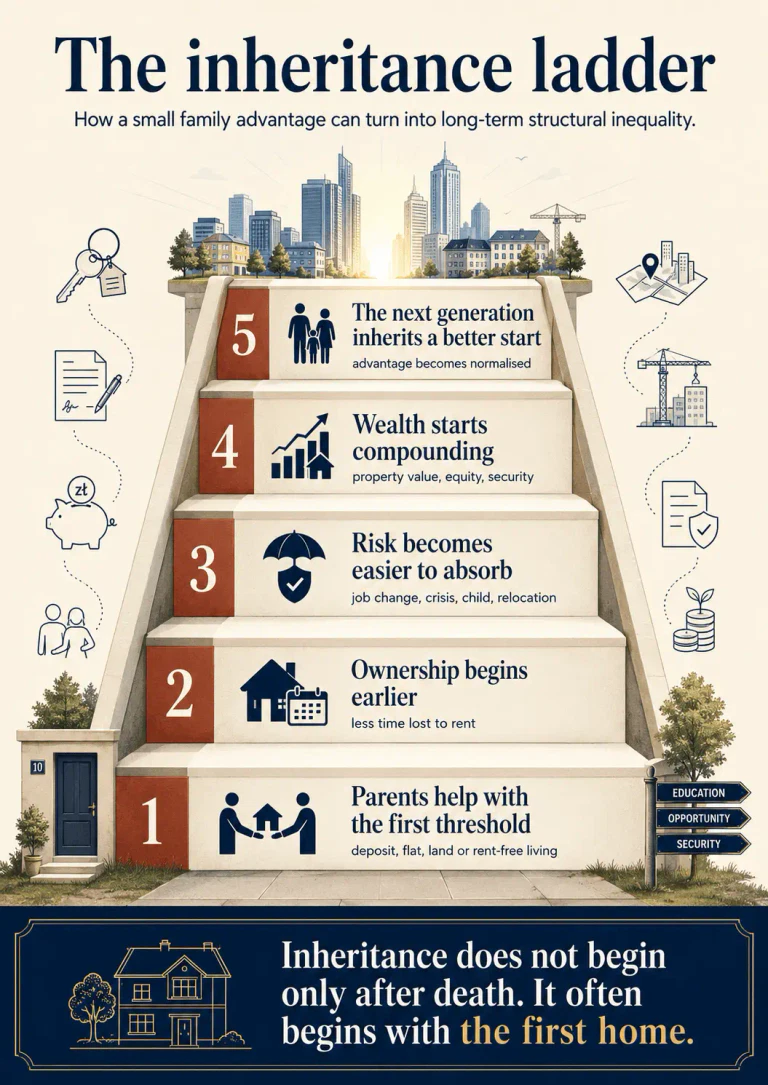
Inheritance does not begin only when someone dies.
It begins much earlier.
It begins when a child can study without working full-time because parents pay rent. It begins when a young adult lives in a family flat during university. It begins when parents cover the deposit. It begins when a grandparent’s apartment becomes the first home. It begins when one person can take an unpaid internship, move to Warsaw, start a business, survive a bad year, or leave a toxic job because the family safety net exists.
That is why inheritance should not be understood only as a legal transfer after death. It is also a living system of advantage.
Some families can absorb risk for their children. Others cannot.
This changes the meaning of talent. Two people may be equally capable, but only one can afford to make strategic mistakes. Only one can take a low-paid first job in a better city. Only one can move without immediate panic. Only one can wait for a better offer. Only one can treat a crisis as a delay rather than a collapse.
The modern Polish class border is not always visible in consumption. Many young people dress similarly, work in similar offices and drink coffee in similar places. The difference appears when life becomes expensive.
A dental bill. A rent increase. A breakup. A pregnancy. A job loss. A bank decision. A developer contract. A down payment.
That is when one person calls parents and another person opens a spreadsheet.
The large city as a family-capital filter
The strongest Polish cities do not only attract ambition. They filter it.
Warsaw, Kraków, Wrocław, Gdańsk and Poznań promise work, education, culture, networks and modern life. They also increasingly require financial insulation. A salary that looks good in a smaller town may become ordinary after rent in a large city. A young specialist may be professionally upwardly mobile and residentially stuck at the same time.
This is why parental help matters so much in metropolitan Poland.
It allows people to remain close to opportunity before their own earnings are strong enough. It protects them during the most fragile years of career formation. It turns the city from a hostile cost environment into an investment platform.
Without that help, the same city can become a machine for exhaustion.
The worker arrives, rents, pays, commutes, shares, delays. Every month of city life costs money before it produces stability. The city offers opportunity, but charges rent for access to it. The person with family capital can wait for the city to pay off. The person without it must survive the entry fee.
In this way, big cities begin to reproduce class differences even when they appear open.
The gate is not a formal prohibition.
It is affordability.
Staying with parents is not always failure. But it is not always freedom
The rise of adult children living with parents should not be mocked. In many cases, it is rational. It allows people to save, study, care for relatives, avoid bad rental conditions or remain in a city where independent housing is impossible. Multigenerational living can also be supportive and culturally normal.
But when millions of young adults remain in the parental home because the market gives them no realistic alternative, something has changed.
The family home becomes both shelter and bottleneck.
It protects people from rent, but it can also freeze life. Privacy shrinks. Relationships become harder. Decisions are postponed. Adult children return to old family roles. Parents carry responsibilities longer than expected. The household becomes an improvised welfare state.
The public debate often treats this as a generational lifestyle issue. Young people are said to be cautious, spoiled, comfortable or immature. That explanation is convenient because it moves attention away from structure.
The harder truth is that many young adults are not refusing adulthood.
They are priced away from it.
Work still matters, but it matters differently
It would be false to say that work no longer matters in Poland. It matters enormously. Education, skills, industry, location and career choices still shape life chances. People do improve their position through effort. Social mobility has not disappeared.
But work now operates inside a stronger property regime.
A good salary can help a person live decently. It may not be enough to buy early in a major city without help. A stable job can support rent. It may not generate a down payment fast enough. A promotion can improve comfort. It may not close the gap between someone starting from zero and someone starting with inherited housing capital.
This creates a strange psychological tension.
Young people are told to become more productive, more mobile, more qualified, more flexible, more entrepreneurial. Yet the housing market quietly rewards something they cannot produce themselves: the past financial success of their family.
Work remains necessary.
But family capital increasingly decides how far work can go.
That is a dangerous message for a society built on the promise of catching up. Poland’s post-1989 story depended heavily on the belief that effort could move a family upward. If young adults begin to feel that property, inheritance and parental transfers matter more than work, trust in the social contract weakens.
People do not need perfect equality to believe in a system.
They need to believe that the game is still playable.
The demographic effect
Housing inequality does not stay inside the housing market.
It enters demography.
People do not have children in slogans. They have children in flats, rooms, commutes, budgets and family arrangements. A couple that cannot move beyond a small apartment delays. A single adult who cannot leave home delays. A person who depends on parents for housing may also depend on them emotionally, spatially and logistically in ways that complicate partnership and parenthood.
The state may offer cash transfers, but cash does not fully compensate for spatial insecurity. A monthly benefit cannot create an extra room in an expensive city. It cannot remove years of rent. It cannot turn a precarious lease into a stable home. It cannot erase the feeling that having a child without family support is an act of financial recklessness.
This is where Poland’s demographic crisis meets the inheritance economy.
People with family capital can often move faster through life stages. They can leave home earlier, buy sooner, plan children with less fear, and use grandparents’ help as part of the household economy. People without that support face more waiting, more renting, more risk and more exposure to every price increase.
The decision to have children becomes less universal.
It becomes stratified.
A country that wants higher fertility cannot ignore the fact that stable adulthood itself is becoming unevenly distributed.
The middle class is reproducing itself through housing
The Polish middle class often describes itself through education, work ethic and aspiration. But increasingly, it reproduces itself through housing.
A flat bought for a child is not just generosity. It is class reproduction. A down payment is not only support. It is an early transfer of security. A family apartment in a university city is not only convenience. It is a mechanism that keeps the child near better networks and better jobs.
This does not mean parents are cynical. Most are not. They simply act rationally within an unfair system. They see how hard the market has become and try to protect their children from it.
But when enough families do this, private protection becomes public inequality.
Children of property owners become property owners faster. Children of renters remain renters longer. Children of metropolitan homeowners inherit access to metropolitan opportunity. Children from smaller towns must pay to enter the same space. The family that already has assets can turn them into more assets. The family without assets must turn wages into survival before it can turn wages into wealth.
This is how a society becomes less open without formally closing anything.
No one says: you may not enter.
The price says it.
Where this leaves Poland
The uncomfortable part is that none of this looks like a scandal from the inside.
Parents help because the market is brutal. Grandparents pass on flats because property is the one form of security many families actually have. Young adults accept help because refusing it would often mean paying rent for years without moving any closer to stability. Everyone behaves rationally, even lovingly, inside a system that quietly turns family support into a sorting mechanism.
That is why the inheritance economy is so difficult to name. It does not arrive as an ideology. It arrives as a transfer, a spare room, a deposit, a family flat, a plot of land, a mortgage guarantee. It arrives as care. Only later does it become structure.
Poland does not need to condemn parents for protecting their children. That would miss the point completely. The real problem is that private family protection is increasingly asked to do the work that wages, rental security, housing policy and urban planning no longer do well enough.
This changes the meaning of social mobility. A young person can still study, work, move cities and build a career. But the distance between effort and stability is no longer the same for everyone. For some, family capital shortens the road. For others, every stage of adulthood has to be bought month by month from current income.
The result is not a society divided only between rich and poor. It is a society divided between those who can enter adult life with a buffer and those who must enter it exposed.
That distinction will shape much more than housing. It will shape who stays in large cities, who can afford children, who can take professional risks, who survives a crisis without falling backwards, and who begins accumulating wealth early enough for the next generation to inherit it.
Poland can keep telling young adults that hard work opens doors. Sometimes it still does.
But more and more often, the first door is opened from the other side.


