

Election case · World
Read the result beyond first place
The local contest and the allocation of parliamentary seats answer different questions.
- A larger winning margin can still end without a seatRhein-Neckar’s CDU lead was 14.06 percentage points; Heilbronn’s was 9.93. The latter crossed the seat cutoff.
- The ranking uses a candidate’s share of valid first votesIt compares winners of the same party within the same federal state. CDU had 35 such winners and 29 seats in Baden-Württemberg.
- A missing-votes claim needs a denominatorIn our fixed-entitlement scenario, 909 switched first votes and 1,398 additional valid first votes produce the same change of rank through different arithmetic.
A fourteen-point lead normally sounds safer than a ten-point lead. In two constituencies at the edge of Germany’s 2025 seat allocation, that intuition points in the wrong direction. CDU finished first in both Rhein-Neckar and Heilbronn. Its larger winning margin belonged to the constituency that did not receive a covered constituency seat.
This was not a recount that reversed the winner. It was the interaction of a local contest with a second allocation rule. Rebuilding the relevant ranking reveals something more useful than the headline that “winners lost”: it identifies which measure of victory mattered, which rivalries it created and why a claim about a few hundred missing votes needs careful wording.
The wider lead fell below the cutoff
The official final results give CDU 55,930 first votes in Rhein-Neckar and 67,516 in Heilbronn. The nearest challengers received 33,086 and 48,360 respectively. Divide each lead by that constituency’s valid first votes and Rhein-Neckar has the more comfortable margin. Divide the winning candidate’s own votes by the same denominator and Heilbronn has the higher share.
Two different measures of a local win
| Measure | Heilbronn | Rhein-Neckar |
|---|---|---|
| CDU first votes | 67,516 | 55,930 |
| All valid first votes | 193,001 | 162,479 |
| CDU first-vote share | 34.98% | 34.42% |
| Lead over runner-up | 9.93 percentage points | 14.06 percentage points |
| CDU rank in the state | 29 | 30 |
| Covered constituency seat | Yes | No |
The distinction matters because the runner-up’s strength is part of the margin but absent from the ranking formula. A candidate can win more comfortably when opponents split their votes, without increasing the winning candidate’s own share. The table demonstrates the mathematical difference; it does not establish why individual people voted as they did.
Thirty-five winners entered a twenty-nine-seat ranking
For party candidates, the 2025 electoral rules required a constituency victory to be backed by sufficient second votes. Second votes determine a party’s seat entitlement. Within each federal state, its constituency winners are ranked by their share of valid first votes, and the available seats go down that ranking. Independent candidates follow a separate rule.
The official final seat calculation gives CDU 29 seats in Baden-Württemberg against 35 constituency victories. Heilbronn occupied the last covered position. Rhein-Neckar was next. Six CDU constituency winners in that state therefore remained without a seat under this procedure.
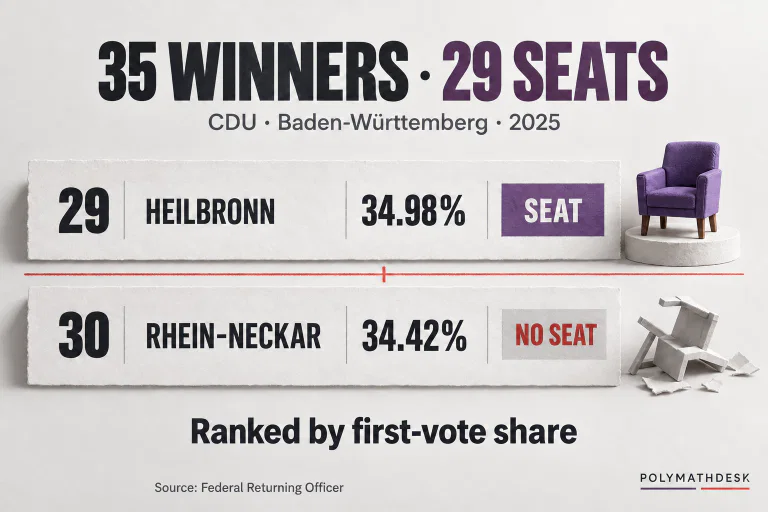
The comparison pool is crucial. Rhein-Neckar was not competing in a single nationwide ranking of every candidate, or against every constituency winner regardless of party. The decisive comparison was with other CDU winners in Baden-Württemberg. Nor was 35% a general legal threshold. Heilbronn’s approximately 34.98% happened to mark the edge of this particular allocation.
A similar interpretive mistake appears when a large population share is treated as sufficient to block a decision in the EU Council. A result that looks decisive under one measure can fail a separate institutional condition. Here, the missing condition was coverage within a specific party-and-state seat entitlement.
Rebuilding the result exposes the wrong shortcut
We downloaded the Federal Returning Officer’s official result CSV, marked final as of 14 March 2025 at 10:50. For each constituency, we selected the largest first-vote count, retained CDU winners in Baden-Württemberg and calculated their shares from integer vote counts and valid-first-vote totals. Sorting those shares produced 35 winners; comparing the first 29 with the published elected marker matched all 35 covered or uncovered outcomes.
We then deliberately ranked those same winners by raw vote counts. That shortcut changed three admissions at the cutoff: it would have included Rhein-Neckar, Lörrach–Müllheim and Tübingen while displacing three officially covered winners. The exercise is a counterexample to the shortcut, not an alternative legal result. Constituencies have different valid-vote totals, so absolute counts and percentage shares need not produce the same order.
The calculation used full counts throughout. Rounded display percentages are convenient for reading but unsafe for recreating a close ranking. The official data documentation also distinguishes a first-vote leader from an elected candidate: a dash in the relevant elected field can indicate insufficient second-vote coverage. A colored constituency map alone can conceal that distinction.
Switching 909 votes differs from adding 1,398
How far was Rhein-Neckar from passing Heilbronn? The answer changes with the hypothetical. Keep CDU’s 29-seat entitlement, every other constituency result and all second votes fixed. Change only Rhein-Neckar’s first votes. This is an arithmetic illustration, not a campaign forecast or a simulation of real additional turnout.
Switch existing valid first votes. If votes move from another candidate to CDU, the denominator stays at 162,479. The crossing condition is (55,930 + x) / 162,479 > 67,516 / 193,001. The smallest whole number that satisfies it is 909; 908 does not.
Add valid first votes for CDU. If those votes are additional, they enlarge both CDU’s count and the total. The condition becomes (55,930 + x) / (162,479 + x) > 67,516 / 193,001. It now takes 1,398; 1,397 does not. The underlying official results are unchanged between these two exercises. Only the assumption about the denominator differs.
We checked both minimums independently with integer cross-products, testing the crossing value and one vote below it. In either scenario, Rhein-Neckar moves just above Heilbronn. With every other result and the entitlement fixed, Rhein-Neckar takes 29th position and Heilbronn falls to 30th. CDU still has 29 seats.
This is the boundary of the calculation. Real new voters may also cast second votes; those could change entitlements. Other candidates’ results could change too. An election-wide forecast would have to recompute those relationships. “909 votes short” is therefore incomplete unless the speaker means switched first votes under the fixed conditions above.
An uncovered constituency is a specific loss
The result creates a real tension between two expectations of representation. A local contest appears to identify a local winner. Proportional allocation asks how many seats a party should receive across a wider electorate. When the party has more local winners than covered seats, guaranteeing both expectations becomes impossible within that allocation.
The Bundestag’s explanation describes a 630-seat parliament and the priority of proportional second-vote allocation. Uncovered constituency victories do not mean those seats are simply subtracted from the parliamentary total. They also do not prove that nobody in parliament has ties to the affected area, or that its residents’ party votes were excluded.
At the same time, formal proportionality does not answer every question about whose local problems receive attention. Our analyses of Poland’s commuting communities and who benefits from the Emscher restoration examine place-specific needs and outcomes. A seat-allocation table cannot, by itself, measure that kind of political attention.
The defensible claim is narrower and more revealing: in this final 2025 result, the wider local winning margin did not decide access to parliament. The candidate’s own first-vote share, its position among the party’s state-level winners and the second-vote entitlement did. Any account of who “really won” has to specify which of those contests it means.
Official election results and reconstruction method
- Federal Returning Officer — The electoral system for 2025 explains the two votes, ranking procedure and independent-candidate exception.
- Final 2025 seat calculation and allocation gives CDU’s Baden-Württemberg entitlement and the official ranking annex.
- Final Heilbronn constituency results and final Rhein-Neckar constituency results supply the two complete count tables.
- Official final result CSV with field documentation supports the reproducible reconstruction. Input snapshot: 14 March 2025, 10:50.
- German Bundestag — Election of Members explains the parliamentary allocation. This article concerns the 2025 result, not a current membership audit.
- Our computations reconstruct constituency coverage from an already determined 29-seat entitlement. They do not independently reproduce the national Sainte-Laguë/Schepers allocation.


