
Key takeaways from the Poland commuting class analysis
Poland’s housing crisis does not end when a household finds a cheaper home outside the city. In many cases, the price simply moves into daily life: longer commutes, car dependency, fragmented services and family schedules built around movement:
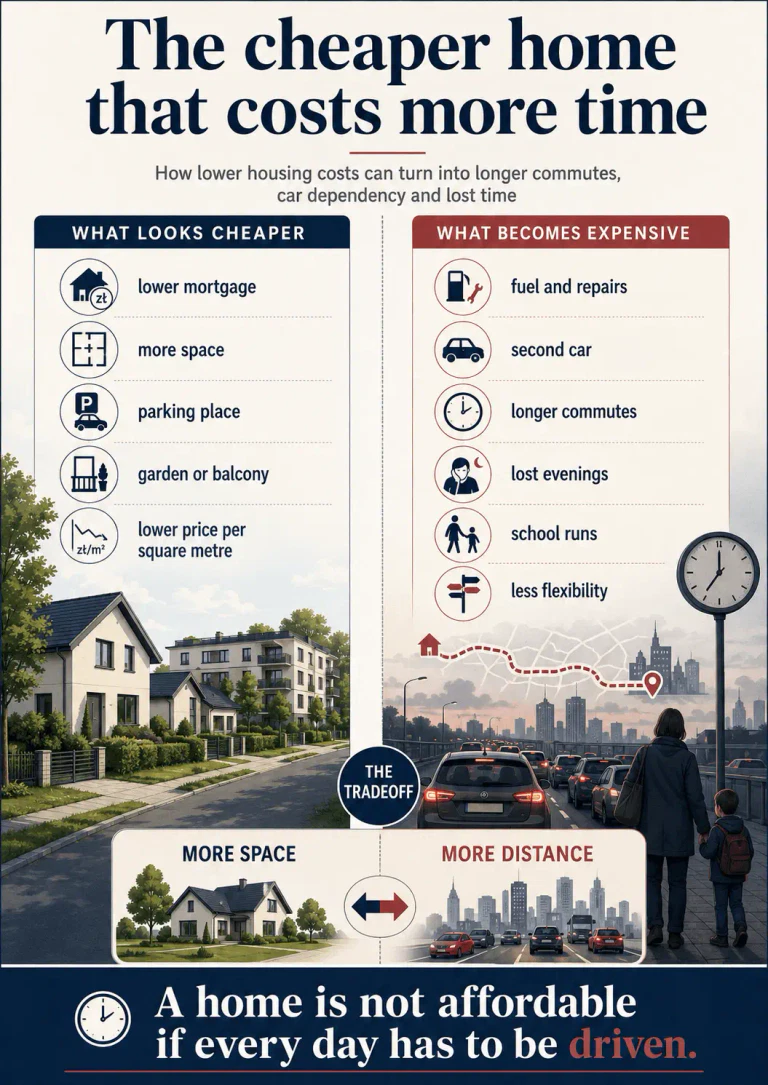
- 1. A cheaper home can become expensive in time Lower housing costs outside the city can hide a second bill: fuel, repairs, parking, second cars, longer routes and hours lost in traffic. The household may gain space, but lose proximity. In practice, affordability often depends on how much daily movement the family can absorb.
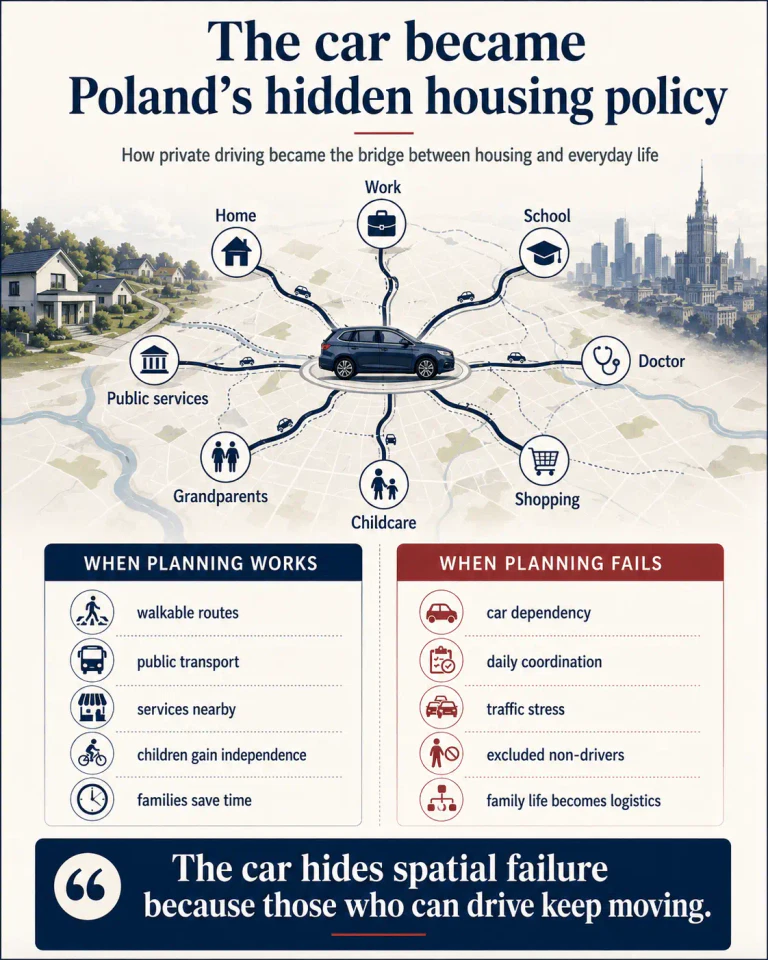
- 2. The car has become a private substitute for public planning In poorly connected areas, the car is no longer only a convenience. It replaces weak buses, distant services, unsafe walking routes, scattered schools and jobs located elsewhere. This makes normal life harder for teenagers, elderly people, single parents, low-income workers and anyone who cannot easily drive.
- 3. Broken spatial planning turns family life into logistics When home, work, school, healthcare and services no longer belong to the same daily map, families pay with coordination, exhaustion and lost time. Poland has not only pushed people out of expensive cities. It has often pushed them into a commuting system that quietly shapes work, parenting and social life.
The day begins before the city is ready for it.
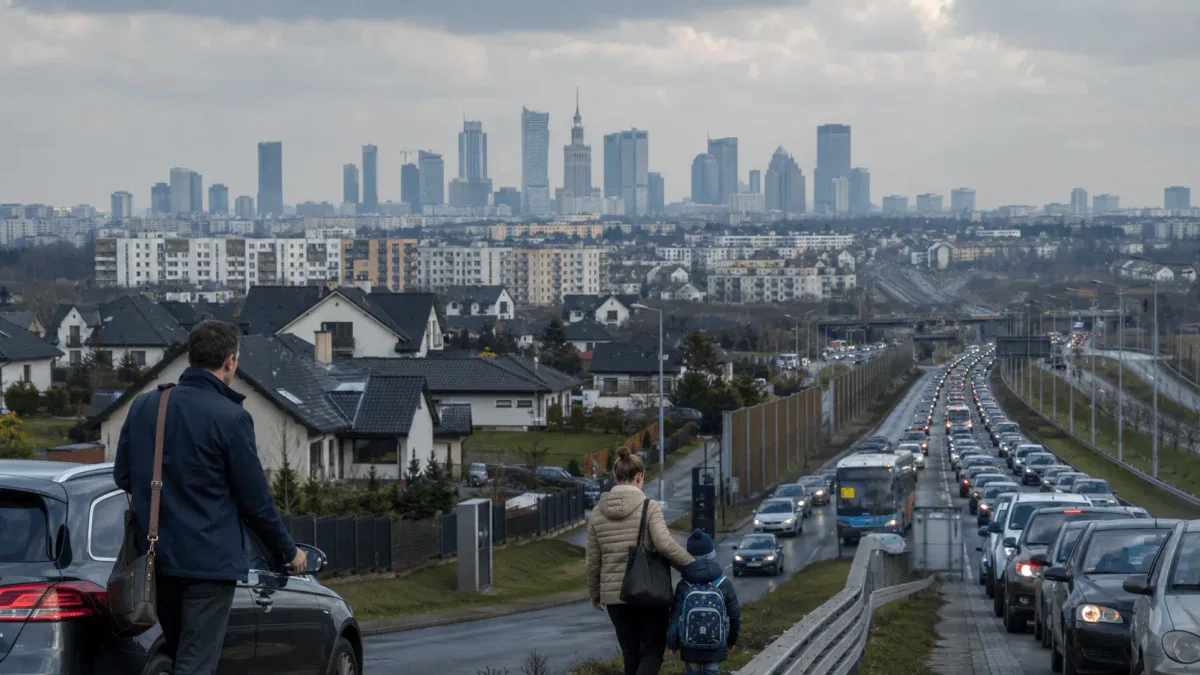
A parent wakes up earlier than they want to. The child has to be dressed, packed, fed, delivered. The car is not a luxury object anymore. It is the bridge between home and school, between school and work, between work and shopping, between shopping and an evening appointment that should have been simple but is not. One delay breaks the whole chain. A sick child, a traffic jam, a closed road, a late meeting, a missed bus, a broken car, each small accident becomes a domestic crisis because the entire day has been built on movement.
This was not how the promise sounded.
The promise sounded calmer. A bigger flat outside the city. A small house beyond the most expensive districts. More space. A balcony, a garden, a parking place, maybe a quieter street. A way out of the metropolitan price trap.
For many Polish households, that was the only reasonable choice. The city became too expensive, the better-connected districts moved out of reach, rents consumed too much, and the next step in life required more square metres than the centre could offer. So families moved outward.
They did not always move into freedom.
Very often, they moved into logistics.
Poland did not simply push people out of expensive cities. It pushed many of them into a daily system where distance, cars, roads and schedules decide the shape of family life. The cheaper home may solve the housing problem on paper, but it can create another problem in practice: every ordinary day has to be driven.
This is the commuting class.
Not a formal class, not a political category, not a group that describes itself with one voice. It is a condition. A way of living between the place where housing is still barely affordable and the place where work, education, services and opportunity are concentrated.
It is the price of broken spatial planning.
The cheaper home that makes life more expensive
A cheaper home is not always cheaper.
The mortgage may be lower. The rent may be more bearable. The household may gain a room, a garden, a parking space or a sense of escape from urban compression. But daily life does not end at the front door. It begins there.
If every day requires a car, the calculation changes.
Fuel. Insurance. Repairs. Tyres. Parking. Second car. Time lost in traffic. Time lost between appointments. Time lost because a child cannot walk safely or independently to school. Time lost because the nearest doctor, nursery, railway station, office or decent shop is not really near.
Polish households often understand this too late because the housing market trains them to think in square metres. More space looks like success. A lower price per metre looks rational. A house outside the city looks like adulthood finally becoming possible.
But a home is not only a building.
It is a position inside a daily map.
If that map is badly planned, the household pays twice. First for the home, then for the movement required to use it.
This is why the suburban dream can become ambiguous. It offers privacy, ownership and space, but often demands time, driving and permanent coordination in return. The family gains a living room and loses hours. It gains a parking place and loses walkability. It gains quiet and loses proximity. It escapes one form of pressure and enters another.
The market sells distance as affordability.
Life later sends the invoice.
Poland built housing faster than everyday life around it
Many new Polish estates are physically complete before they are socially complete.
The buildings are there. The road is there, at least in some form. The parking spaces are there. The sales office has gone. The render has become concrete. People move in, unpack furniture, install kitchens, hang curtains and begin to discover what the neighbourhood still lacks.
The bus is too rare. The pavement ends too early. The school is overcrowded or too far. The nursery has no places. The nearest clinic requires a car. The local shop is not enough. The workplace is somewhere else entirely. The district has apartments, but not yet the density of everyday life.
This is one of the quiet failures of spatial planning.
Poland has become capable of producing housing units in places where the surrounding system is not ready to support them. Developers build projects. Municipalities inherit consequences. Families absorb the gap.
A new estate can look modern and still be functionally incomplete.
That incompleteness is not always visible in advertisements. A balcony photographs well. A parking space photographs well. A green strip photographs well. But nobody photographs the twenty-five minutes added to a morning route, the lack of a safe crossing, the absence of a reliable bus after 8 p.m., or the fact that every family errand requires starting the engine.
The result is a strange form of modernity.
New buildings, old dependence.
Modern flats, weak public transport.
Private comfort, public absence.
A country can keep building homes and still fail to build places where everyday life is easy to organise.
The car becomes a private welfare system
In a well-connected place, the car is one option.
In a badly connected place, it becomes the condition of participation.
This difference changes everything.
When the car is optional, it gives flexibility. When it is compulsory, it becomes a private welfare system. It replaces missing buses, weak local services, poor pedestrian routes, unsafe cycling, scattered schools, distant doctors and jobs concentrated elsewhere. It carries the whole burden of spatial failure.
The family car becomes transport policy.
It becomes school policy.
It becomes healthcare access.
It becomes childcare logistics.
It becomes the only way to remain connected to a normal life.
This is why car dependency is not only an environmental issue. It is a social issue. It divides people by income, age, health, driving ability and family structure. A household with two adults, two incomes and two cars may survive the system. A single parent, an elderly person, a teenager, a disabled person or a low-income worker experiences the same geography very differently.
The same place can feel comfortable to one household and exclusionary to another.
The car hides the weakness of planning because those who can drive keep moving. They suffer, but they move. They complain about traffic, costs and time, but the system still functions for them, badly. Those without access to a car simply have fewer choices.
That is the deepest danger.
A car-dependent region may look active from the road. People are moving, shopping, commuting, delivering children, working, returning. But beneath that activity lies a silent fact: ordinary life has become too difficult without private machinery.
A country should be careful when normal life requires ownership of a vehicle.
That is not freedom.
It is dependency with a steering wheel.
Family life becomes logistics
The phrase “family policy” usually brings to mind benefits, parental leave, childcare, housing support and tax rules.
But family policy also lives in the distance between home and school.
It lives in whether a child can reach friends without being driven. Whether a parent can get to work without turning the morning into a military operation. Whether a doctor, nursery, pharmacy, playground and grocery shop belong to the same daily radius. Whether one adult can manage the household if the other works late. Whether grandparents can help without crossing half the region. Whether teenagers can build independence before they own a licence.
Spatial planning is family policy because families live through space.
A poorly planned everyday map exhausts people.
It makes children dependent for longer. It makes parents drive more than they want. It makes every activity compete with every other activity. It compresses evenings. It turns weekends into errands. It makes a household feel busy even when nothing extraordinary has happened.
This matters for demography.
People do not decide to have children only through income. They also imagine the daily system that will hold that child. A second child is not only another mouth to feed. It is another route, another schedule, another school run, another illness, another appointment, another layer of coordination.
When life is already a logistics trap, family expansion feels heavier.
This is one of the reasons housing cannot be separated from fertility. A larger home outside the city may make a child physically possible, but the location may make parenting more demanding. A smaller home in a better-connected area may be too expensive. A cheaper home may cost too much time. The family is left choosing between space and access, because planning failed to provide enough places with both.
That is not a private inconvenience.
It is a national design problem.
The commuting class has less time to be a class
The Polish middle class is often described through income, education, consumption and aspiration.
But time may be its most underestimated resource.
A household that spends hours commuting, driving children and coordinating fragmented routines has less time for rest, culture, friendships, civic engagement, local politics, volunteering, sport, learning, small business, or simply doing nothing. It may own a home and still feel permanently poor in time.
This creates a tired middle class.
Not poor enough to be treated as excluded.
Not rich enough to buy its way out of inconvenience.
Stable enough to keep going.
Exhausted enough to stop expecting much.
The commuting class pays for broken spatial planning not only with fuel and mortgages, but with attention. Its members have less energy to demand better public services because daily life already consumes them. They may be angry, but their anger is practical, not ideological. Another delay. Another roadworks. Another school run. Another evening lost to logistics.
This is politically important.
A society organised around long daily routines becomes harder to mobilise. People retreat into households because the household itself requires constant management. Local community weakens when residents live in one municipality, work in another, shop in a third and send children somewhere else. The place of residence becomes a sleeping base, not a shared civic world.
This is how spatial planning affects democracy quietly.
It determines whether people have time to belong.
Suburbs are not the enemy
It would be too easy to turn this article into an attack on suburbs.
That would be wrong.
Many people genuinely prefer lower density, gardens, quieter streets or smaller communities. Suburban and semi-rural life can be healthy, attractive and socially strong when it is planned well. Not everyone wants central-city living. Not every solution should be dense, vertical or metropolitan.
The problem is not that people move outward.
The problem is when outward movement happens without the infrastructure of life following it.
A good suburb is not just a collection of homes. It has transport, services, schools, public spaces, safe routes, local work options and a relationship with the larger city that does not depend entirely on cars. A good smaller municipality does not have to become a city. It has to be connected enough that residents are not punished for living there.
Poland’s failure is not suburban life as such.
It is cheap spatial compromise sold as aspiration.
The household is told it has chosen space. In reality, it may have accepted the costs of poor coordination between housing, transport and services. The municipality gains residents but struggles with infrastructure. The city gains workers without housing them. Roads absorb the contradiction. Families absorb the rest.
That is not suburban freedom.
It is metropolitan pressure leaking outward.
Remote work did not solve the map
Remote work changed some expectations, but it did not abolish geography.
For some workers, working from home made suburban or smaller-town life more realistic. Fewer office days can reduce commuting pressure and make a larger home farther from the centre more attractive. This is real, and it matters.
But remote work is not universal. It is unevenly distributed by occupation, income, education, sector and employer culture. Nurses, teachers, retail workers, factory workers, drivers, cleaners, technicians, carers and many service workers cannot move their workplace into a laptop. Even office workers often remain hybrid rather than fully remote, which means the commute does not disappear. It becomes less frequent, but still decisive.
Remote work may soften the logistics trap for some.
It does not repair spatial planning for all.
There is also a risk that remote work encourages another wave of scattered settlement. If people move farther away because they commute less often, municipalities may face even more dispersed demand for roads, utilities, schools and services. A household may improve its private comfort while the public system becomes harder to maintain.
The laptop can reduce one commute.
It cannot build a clinic, a school, a rail line or a coherent region.
Broken planning turns private choices into public costs
Every household decision has a reason.
A family moves outward because the city is expensive. A developer builds where land is available. A municipality welcomes new residents because it needs tax base and growth. A buyer accepts a longer commute because the alternative is no ownership at all. A parent buys a second car because the day cannot function without it.
Each decision is understandable.
Together, they create a system nobody would design honestly from scratch.
Longer commutes. More cars. More road pressure. More emissions. More scattered services. More pressure on suburban municipalities. More time lost. More land consumed. More dependence on private solutions.
This is the tragedy of broken spatial planning: rational private choices can produce irrational collective outcomes.
No single family caused the problem. No single developer caused it. No single municipality controls it. The pattern emerges because housing, transport, schools, healthcare, labour markets and planning decisions are treated as separate fields.
But families experience them as one life.
That is why policy language often feels detached from reality. People do not live in sectors. They live in mornings, routes, payments, deadlines, bus timetables, school catchments and traffic.
A functioning country has to plan at the scale of the day.
Poland too often plans at the scale of the plot.
Where this leaves Poland
Poland’s housing crisis did not stay inside housing.
It spilled into roads, car parks, ring roads, school runs, fuel bills and family calendars. It produced households that look successful from a distance, but whose daily lives are held together by movement that should not have to be so difficult.
This is the hidden cost of the commuting class.
It is not only congestion. It is not only emissions. It is not only lost time.
It is the feeling that adulthood requires constantly moving between things that should have been closer together.
Home in one place. Work in another. School somewhere else. Doctor farther away. Grandparents across town. Services near a retail park. Culture in the centre. Affordable space on the edge. Opportunity beyond the commute.
The map becomes a task list.
A cheaper home can still be a victory. For many families, it is the only victory available. But a country should not confuse private adaptation with public success. If households must solve spatial disorder with cars, patience and exhaustion, the system has not become affordable. It has merely moved the price into time.
Poland does not need to force everyone into dense city centres. It needs to stop producing places where the car is the only reliable connection between housing and life.
The question is not whether people should live in cities, suburbs or smaller towns.
The question is whether their daily lives have been planned as if time matters.
Because time is not a side effect of housing policy.
It is where the real cost often appears.


