

Key takeaways from the Agency-Client relationship analysis
The digital agency model is facing an operational and psychological collapse. Driven by algorithmic lag, macroeconomic illusions, and toxic communication, agencies must radically restructure their boundaries to survive:
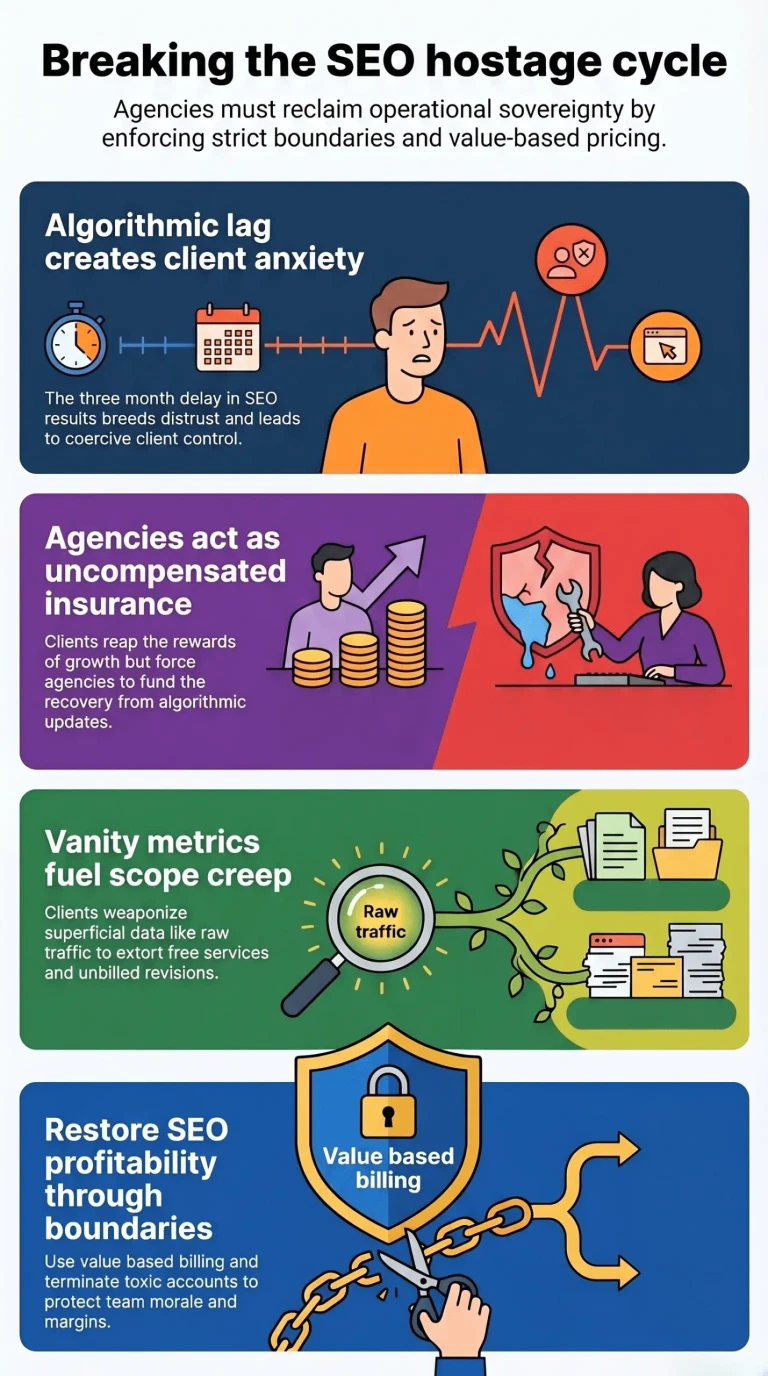
- 1. The psychology of algorithmic lag and risk transfer The inherent 3-month delay in SEO visibility breeds intense client anxiety. Dominant clients weaponize this lag through "coercive control" and "epistemic injury," forcing agencies to act as uncompensated insurance policies that absorb the infinite financial downside of external search engine updates and crisis management.
- 2. Extortion via scope creep and vanity metrics When pipelines remain static, clients fixate on superficial vanity metrics (like gross followers or raw traffic) to extort free services. This "silent death by direct message" bypasses formal project management, completely destroying profit margins through unbilled labor for endless minor tweaks and asset revisions.
- 3. The global commoditization and AI illusion trap Agencies are caught in a race to the bottom against offshore "digital sweatshops" and the false client perception that AI execution is instantaneous and zero-cost. Capitulating to these demands floods domains with penalized, homogenized content and fuels a toxic "churn and burn" culture that drives top talent out of the industry.
- 4. Reclaiming operational sovereignty To restore profitability, agencies must abandon the flawed hourly billing model in favor of value-based or flex budgets. They must enforce radical deliverable specificity in Statements of Work (with explicit exclusions), instantly attach financial costs to demands via formal Change Requests, and ruthlessly terminate toxic accounts.
The architecture of organic search marketing is uniquely cursed by a structural delay in the manifestation of its value. Unlike paid advertising channels where capital deployment yields immediate visibility, organic search engine optimization requires a prolonged gestation period. This intrinsic delay serves as the initial catalyst for the rapid deterioration of professional agency-client relationships. The executing agency implements complex technical interventions, yet the client perceives absolutely no immediate change in their financial ecosystem. This temporal disconnect breeds an environment of profound uncertainty.
As weeks turn into months without a definitive spike in revenue, the vacuum created by this lag time is rapidly filled by intense client anxiety. Corporate stakeholders funding these campaigns operate under strict, quarter-to-quarter financial pressures. They demand continuous validation for their expenditures, viewing any marketing budget that fails to return an immediate profit as a severe liability. The pressure mounts exponentially, resulting in severe behavioral shifts within the client's management team. They no longer view the agency as a strategic partner navigating a complex digital ecosystem.
Instead, the agency is perceived as an underperforming asset that must be strictly managed, coerced, and psychologically dominated. This anxiety is systematically transferred onto the agency personnel. Operational precision is quickly replaced by reactive crisis management as the client demands visible proof of effort. The lag time is weaponized, used as definitive evidence that the agency's strategy is fundamentally flawed.
Psychology of the lagging indicator
This dynamic quickly evolves into a system of sustained behavioral manipulation. Clinical literature often describes this pattern as coercive control, defined as a sustained campaign of psychological assault aimed at undermining the autonomy of a target. Within the professional sphere, this manifests as a client who utilizes the lack of immediate organic traffic to induce chronic self-doubt within the agency team. The client creates a pervasive narrative that the agency's technical interventions are either flawed or insufficient.
To maintain this dominance, the client employs tactics that inflict profound damage on the agency's operational confidence. This phenomenon is known as epistemic injury, occurring when a dominant party systematically distorts reality. When an agency implements a technically sound optimization strategy that requires time to mature, a dominant client will relentlessly challenge the validity of the approach. They demand immediate, visible alterations to a plan that simply needs time to index.
The constant barrage of skepticism forces the agency into a highly defensive posture. Highly trained professionals abandon data-driven strategies in favor of appeasing the client's irrational demands. This erosion of professional confidence ensures that the agency remains subservient. They readily accept out-of-scope requests in a desperate attempt to prove their worth during the quiet period of algorithmic indexing.
The breach of unwritten expectations
At the core of this breakdown is the violation of the unwritten expectations that govern professional engagements. Organizational psychologists refer to this as the psychological contract, which encompasses the implicit assumptions regarding support, mutual respect, and operational boundaries. While the formal statement of work dictates the deliverables, the psychological contract dictates the actual tone of the engagement.
When the client's expectation for rapid returns is met with the reality of algorithmic lag, they perceive a severe breach of this implicit contract. This perceived betrayal justifies their retaliatory and demanding behavior. The agency, eager to please and fearful of losing the account, often fails to recognize this breach. They mistakenly believe that endless appeasement will somehow restore operational equilibrium.
Small breaches of trust begin to compound rapidly. A manager asks an SEO specialist to stay late for an emergency audit, or a scheduled development plan is postponed to address a client's sudden panic. Left unaddressed, these fractures deepen, and valuable agency employees start experiencing severe burnout. Studies show a clear link between these psychological breaches and exhaustion, anxiety, and low team morale.
| Phase of engagement | Technical reality | Client psychological state | Resulting behavior |
| Month 1. Foundation | Auditing, fixing crawl errors, architecture updates. | High expectations, anticipation of immediate ROI. | Collaborative, but closely monitoring initial reports. |
| Month 2. Indexing | Google slowly crawls and scores new entities. | Growing anxiety, pressure from corporate board. | Questioning strategy, demanding proof of activity. |
| Month 3. Maturation | Rankings begin to fluctuate, slow upward trajectory. | Panic sets in due to static sales pipeline. | Hostility, epistemic injury, demanding out-of-scope work. |
Algorithmic chaos and risk transfer
The vulnerability of the agency is compounded exponentially by the unpredictable nature of external search environments. Search engines continuously refine their systems to improve output quality, implementing thousands of minor tweaks annually. These are frequently punctuated by major, disruptive architectural shifts that redefine ranking parameters. When these algorithmic realignments occur, entire sectors of the digital economy can experience sudden, drastic fluctuations in visibility.
Rather than accepting these external shocks as inherent environmental hazards, the client typically redirects the entirety of the blame onto the executing agency. This creates a profound risk asymmetry, completely distorting the financial reality of the partnership. The client happily reaps all the financial rewards during periods of algorithmic favor, capturing the surplus value of increased organic traffic.
However, during periods of volatility, the client forces the agency to bear the full cost of mitigation. When an unannounced update decimates a website's organic visibility, the dominant client immediately rejects any requests for additional budgetary allocations. They demand that the agency diagnose and rectify the issue within the confines of the existing retainer.
Funding the uncompensated insurance
The client views the sudden traffic drop not as an act of algorithmic disruption, but as a direct failure of the agency's initial service delivery. The agency is then forced to divert critical resources away from planned strategic initiatives. They must engage in emergency forensic analysis, deep content auditing, and complex technical remediation just to stop the bleeding.
Because the client refuses to compensate the agency for this sudden influx of high-level diagnostic work, the agency's profit margins evaporate. The agency is effectively forced to operate as an uncompensated insurance policy, underwriting the client's entire digital risk profile for free. This systemic absorption of external volatility has catastrophic implications for the financial sustainability of the service provider.
The unbilled hours required to recover a site from a major algorithmic penalty completely consume the lifetime profit margin of the account. Furthermore, pulling senior technical staff into unbillable crisis management starves other, healthier client accounts of the attention they deserve. The agency's overall profitability plummets because they have structurally agreed to absorb the infinite downside risk of a third-party platform.
The panic of the static pipeline
When the initial technical infrastructure of a campaign is completed, the lag time reaches its most critical psychological threshold. The site architecture is optimized, the content is published, yet the client's sales pipeline remains entirely static. In this void, the client desperately seeks alternative indicators of success to justify their expenditure to their superiors.
This leads to a dangerous fixation on superficial data points that lack strategic value. Metrics such as gross impression volume, basic social media follower counts, and raw page views become the primary focus of the client's intense scrutiny. Because these vanity metrics are highly visible and easily manipulated, they serve as the perfect weapon for a client looking to exert control.
The panic mechanism is triggered when the client realizes these superficial indicators are not translating into tangible business growth. Driven by internal financial pressures, the client weaponizes these numbers against the agency. They use them as undeniable proof that the current strategy is failing, completely ignoring the sophisticated leading indicators of search success.
Weaponizing the vanity metrics
Clients deliberately ignore improvements in crawl efficiency, indexation rates, and non-branded long-tail keyword growth. Instead, they point to stagnant social media engagement or flat raw traffic as definitive evidence of agency incompetence. This deliberate misinterpretation of data allows the client to seize the moral high ground during status meetings.
They position themselves as the aggrieved party who is paying heavily for a service that is ostensibly not being delivered. Having established a false narrative of failure based on irrelevant data, the client initiates the extortion phase. They demand comprehensive out-of-scope services to ostensibly compensate for the perceived marketing shortfall.
The client argues that since the organic search campaign is not generating immediate sales, the agency must urgently launch a social media initiative. They demand the production of additional editorial copy or the free management of paid ad channels to salvage the relationship. This aggressive scope creep is not a misunderstanding of the contract; it is a highly calculated negotiation tactic.
| Extortion focus | Commercial focus | Strategic reality |
| Total social media followers | Social-attributed revenue | Followers do not indicate purchasing intent, brand loyalty, or actual market share. |
| Raw website page views | Qualified organic leads | High traffic with zero conversion indicates wasted resources and poor targeting. |
| Email list gross size | Revenue per active subscriber | A large, inactive list destroys deliverability and inflates software costs. |
| Gross ad impressions | Customer acquisition cost (CAC) | Impressions without clicks merely drain the advertising budget while providing false momentum. |
Extortion via scope expansion
The client knowingly leverages the agency's fear of account churn, presenting the demand for free services as the only alternative to immediate termination. This hostage dynamic places the agency in an impossible position, forcing them to choose between losing a flagship client or working for free. The success of this extortion relies entirely on the structural failure of the agency's internal boundaries.
Front-line staff, particularly creatives and copywriters, are often highly empathetic and eager to please their clients. This natural inclination makes them highly susceptible to client manipulation and guilt-tripping. When clients bypass formal project management channels and send direct messages demanding "one quick revision," the staff usually complies without resistance.
They execute the work without logging the time or triggering a formal change order, hoping to keep the peace. This invisible accumulation of unbilled labor destroys the project's margin before management even realizes a breach has occurred. The project shifts from a profitable enterprise into a severe financial deficit without a single formal complaint being filed.
The collapse of operational borders
Scope creep is rarely a singular, explosive event; rather, it is a localized economic collapse resulting from the methodical erosion of perimeters. It manifests as the unplanned expansion of project deliverables executed without any corresponding adjustment to the timeline or budget. In the digital agency sector, this phenomenon quietly taxes every single stage of creative and technical production.
It presents initially as harmless requests—an extra file format, a slightly altered template, or a reopened approval stage. However, when aggregated, these micro-expansions catastrophically erode profit margins and forcefully push back established delivery deadlines. They subject the technical teams to severe psychological and physical burnout, leading to a toxic workplace culture.
The facilitation of this economic drain is primarily enabled by the breakdown of formalized communication channels. When agencies fail to establish a strict hierarchy, clients quickly learn to bypass the account managers who are trained to defend the scope of work. Clients realize that technical staff are less likely to push back on financial matters.
The silent death by direct message
Through direct messaging platforms like Slack or Teams, clients request ongoing modifications that are rarely logged in the agency's time-tracking software. This unauthorized expansion operates completely off the books, rendering the true cost of the project invisible to financial directors. By the time the final invoice is evaluated against the labor expended, the damage is irreversible.
The accumulation of these unbilled hours triggers a vicious cycle that destabilizes the agency's entire operational architecture. As the technical team absorbs the endless requests, their capacity to service other profitable accounts is severely diminished. This utilization distortion ensures that urgent, out-of-scope add-ons crowd out planned, high-value strategic work across the entire portfolio.
To compensate for the lost time, employees are forced into evening and weekend work to meet their original deadlines. This precipitates a sharp drop in morale and drives avoidable, incredibly costly staff attrition. The agency's overall profitability plummets as they write off hours, absorb rush fees, and dedicate contingency budgets to endless cycles of rework.
| Request category | Operational definition | Standard processing time | Financial requirement |
| Minor tweak | Small visual adjustment or minimal copy edit. | 2–5 business days | Included in standard retainer buffer. |
| Asset revision | Significant adaptation of an existing campaign asset. | 1–2 weeks | Requires minor scope adjustment. |
| Idea enhancement | Repurposing a core concept for an entirely new channel. | 3–4 weeks | Requires formal change order. |
| New concept | Development of completely original campaign architecture. | 6–10 weeks | Requires new contract negotiation. |
The global race to the bottom
The expectation of unlimited revisions and uncompensated labor is fundamentally rooted in a severe macroeconomic distortion. Over the past decade, the proliferation of globalized freelance platforms has effectively commoditized complex technical services. Clients have been conditioned by the availability of aggressively underpriced services from emerging markets.
They have developed a deeply warped perception of what high-level digital architecture actually costs to produce. This phenomenon has initiated a devastating labor arbitrage within the digital marketing sector. The baseline financial expectations of corporate clients are now tethered to the lowest possible global denominator.
This pricing expectation completely disregards the vast disparities in technical proficiency, strategic insight, and local market understanding. Clients demand the expertise of a seasoned professional but expect the invoice to reflect the rates of a digital sweatshop. This fundamental disconnect makes honest pricing negotiations nearly impossible for legitimate agencies.
The offshore commoditization trap
At the center of this economic distortion is the proliferation of massive business process outsourcing entities. Operating predominantly out of regions like India and the Philippines, these firms offer search optimization at mathematically impossible rates. The workforce in these offshore centers is subjected to intense piece-rate production quotas, focusing entirely on high-volume output.
While human rights advocates highlight the exploitative nature of this labor, corporate clients remain captivated by the artificially deflated pricing. They use these offshore quotes as leverage to batter down the pricing structures of premium, localized agencies. The reliance on this hyper-commoditized labor pool invariably leads to the catastrophic degradation of the end product.
Offshore entities operating on microscopic margins rely heavily on automated, heavily penalized tactics to simulate progress. They generate spammy backlinks from private networks, spin duplicate content, and apply outdated keyword stuffing methodologies. The client initially celebrates the financial savings, completely unaware that their digital infrastructure is being systematically poisoned.
The artificial intelligence illusion
The rapid integration of sophisticated artificial intelligence systems has dramatically accelerated the devaluation of expert cognitive labor. Tools like ChatGPT and Gemini have created a dangerous illusion among corporate clients regarding the effort required for content production. They believe high-level technical writing, strategic planning, and code generation can be executed instantaneously and at zero cost.
This perception fundamentally alters the negotiation dynamic, as clients no longer merely compare domestic rates to offshore labor. They now compare human expert rates to the fractional penny-cost of an automated API call. Artificial intelligence has normalized the expectation of infinite, instantaneous output.
Clients increasingly demand that human agencies match the speed and price of a machine. They effectively treat expert practitioners as biological extensions of an automated process, stripped of their strategic value. This expectation ignores the reality that current generative systems are largely producing an ocean of homogenized, low-value content slop.
| Operational metric | Hyper-commoditized outsourcing | Premium agency execution |
| Strategic foundation | Generic, recycled templates applied universally to all clients. | Bespoke analysis based on localized market research and entity graphs. |
| Link building protocol | Toxic backlinks from private networks, comment spam, and directories. | Relationship-based outreach, digital PR, and citation auditing. |
| Communication cadence | Unresponsive, severe language barriers, frequently ignored deadlines. | Dedicated account managers, transparent reporting, active consultation. |
| Algorithmic liability | High probability of severe manual penalties and ranking drops. | Future-proofed via strict adherence to search engine quality guidelines. |
Subsidizing the digital sweatshop
Digital ecosystems are becoming heavily polluted with undifferentiated text that lacks original insight, emotional resonance, or strategic nuance. While clients view AI as a magic bullet for cost reduction, search algorithms are rapidly evolving to filter out this synthetic noise. Search engines are actively prioritizing content that demonstrates genuine human experience, deep expertise, and authoritative consensus.
Agencies that capitulate to client demands to use AI merely to lower costs end up flooding their clients' domains with commoditized trash. This actively damages their organic visibility and erodes any existing brand authority. Furthermore, the illusion of AI's autonomous brilliance obscures the dark economic reality of how these systems are actually trained.
The entire ecosystem of generative AI is heavily subsidized by a vast, invisible underclass of human workers. Millions of educated workers in the Global South are subjected to exploitative piece-rate labor. They spend countless hours manually labeling data, filtering toxic content, and reinforcing the neural networks of multibillion-dollar tech conglomerates.
The agency churn and burn culture
The client's demand for magically cheap, AI-driven marketing solutions is directly funding a system of profound global inequality. This reinforces the exact race-to-the-bottom economics that destroy domestic agency margins and workforce morale. The internal culture of digital agencies often collapses under the weight of these impossible client demands and squeezed margins.
Developers and specialists routinely complain about the toxic "churn and burn" culture inherent in agency life. They are subjected to insane, unpaid overtime, forced to meet unrealistic deadlines promised by sales teams who never consulted them. When management refuses to push back against client extortion, the resentment within the technical team reaches a boiling point.
Hourly billing forces exhaustive time tracking, and when a project inevitably goes over budget due to unmanaged scope creep, the developers take the blame. This creates an adversarial relationship not just between the agency and the client, but between agency management and their own staff. The most talented individuals flee the agency world entirely, seeking refuge in stable, single-product software companies.
Reclaiming operational sovereignty
To halt the erosion of profit margins and eliminate the psychological distress inflicted upon their staff, agency leadership must forcefully reclaim operational control. This requires fundamentally restructuring the psychological contract that dictates client interactions. The unspoken assumptions that historically favored the client's demand for limitless flexibility must be replaced with rigid, explicit boundaries.
This process begins long before the first invoice is paid, during the critical phases of marketing, sales, and onboarding. Agencies must engage in aggressive expectation management from the very first consultation. They must clearly articulate not only what technical services will be provided, but explicitly detail the operational cadence and communication limitations.
The primary mechanism for establishing these boundaries is the transformation of the Statement of Work from a vague list of aspirations into a binding contract. Vague deliverables like "optimize website" serve as open invitations for endless scope creep. Agencies must enforce radical deliverable specificity, defining the exact outputs expected each month.
The structural defense mechanisms
Elite agencies mandate an explicit exclusions section in every proposal, unequivocally listing the tasks that are not included. This includes extra revision rounds, weekend communication, or free crisis management following a third-party algorithm update. When a client inevitably tests these newly established boundaries, the agency must execute a swift and emotionless response protocol.
The culture of the agency must be rewired so that front-line creatives no longer view a refusal to do free work as a failure of customer service. Every request that falls outside the rigid SOW must immediately trigger a formal change request rule. Staff must be trained to respond with standardized language, offering to execute the work only after a supplemental quote is approved.
By instantly attaching a financial cost to every modification, the agency forces the client to evaluate the actual necessity of their demand. This rapidly extinguishes the casual extortion of free labor via direct message. Furthermore, agencies must aggressively overhaul their pricing methodologies to insulate themselves from the unpredictability of digital execution.
Abandoning the hourly trap
The traditional hourly billing model is fundamentally flawed, as it penalizes the agency for efficiency and invites microscopic client scrutiny. Instead, agencies should transition toward value-based pricing or implement a flexible budget model. A flex budget builds a hidden financial buffer directly into the initial retainer.
This allows the agency to absorb minor, inevitable friction points without constantly negotiating micro-invoices. This maintains positive client relations by appearing accommodating, while structurally ensuring that the profit margin is protected. To achieve operational scale without sacrificing quality, the agency must mercilessly standardise its internal workflows.
Implementing rigorous task automation for repetitive processes ensures that the agency operates with machine-like precision. This standardization presents a unified, highly professional front to the client. It signals that the marketing agency is a structured corporate entity that cannot be easily bullied, coerced, or taken hostage by unreasonable demands.
The necessity of termination
Ultimately, the most powerful operational framework is the willingness to execute swift and decisive termination protocols for toxic accounts. When a client repeatedly violates the communication hierarchy or utilizes abusive language, the agency must act. When a client continuously rejects strategic recommendations or weaponizes churn threats to extort free labor, the account is fundamentally unviable.
Attempting to salvage a relationship with a client who relies on psychological domination is a catastrophic misallocation of resources. It drains the morale of the staff and the profitability of the firm, poisoning the entire working environment. By evaluating the contract, wrapping up immediate deliverables, and professionally firing the abusive client , the agency reclaims its sovereignty.
This clears the pipeline for strategic partnerships built on mutual respect and equitable financial exchange. The modern digital agency operates in a highly volatile, asymmetric environment where structural realities are routinely weaponized. The future of sustainable digital marketing belongs exclusively to those entities that refuse to operate as hostages. They must demand that their deep technical expertise be met with fair compensation and unwavering professional respect.


