

Response and rendering · SEO
Inspect the policy before the script runs
Use three observations to locate the exclusion and verify its removal.
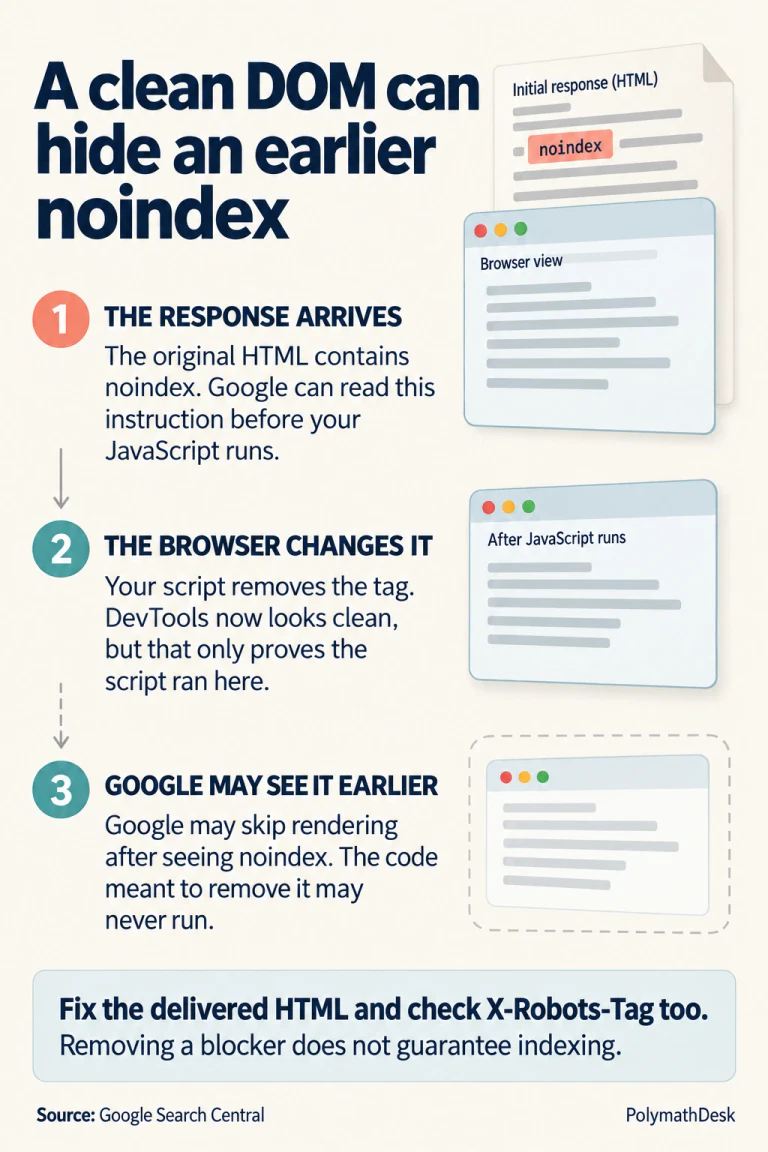
- A clean DOM is incomplete evidence.Google may see the initial noindex and skip the JavaScript meant to remove it.
- Check the response header separately.An applicable X-Robots-Tag noindex survives a clean HTML document or an added index tag.
- Verify the fix before tracking recovery.Compare delivered and rendered policy; use Search Console to distinguish a current fetch from indexed data.
The page looks ready. Its headline loads, the article is readable, and DevTools shows no robots tag telling search engines to exclude it. Yet the response that arrived before the application started contained noindex.
That difference is enough to make the browser a misleading acceptance test. A successful script can clean up the DOM without making the original delivery safe for indexing. To investigate, keep three observations separate: the response body, the response headers, and the document after JavaScript executes.
The removal depends on a step Google may skip
Google's JavaScript SEO guidance warns that an initial noindex can cause it to skip rendering and script execution. The code intended to remove that instruction may therefore never run. The wording is conditional: Google may skip the step. This is an unreliable dependency, not evidence that every affected URL follows an identical schedule.
Imagine a public article template that ships an exclusion by default, then removes it when the client confirms that the article is published. The browser executes the confirmation and looks correct. The release still asks a crawler to run code after receiving an instruction that can stop that work.
For a page intended for search, resolve that publication state before sending its HTML. Keep a separate, explicit exclusion for pages that should remain out of search. A blanket instruction to delete every robots tag would lose other intentional controls.
Five local cases separate the response from the DOM
We tested five small HTML documents in an isolated Chrome session. Each response had status 200 and the same visible article. The cases changed only the robots metadata, a response header, or a short inline script. We captured the delivered response and inspected the resulting DOM separately.
- Remove in JavaScript — HTML starts with noindex; the rendered DOM has no robots tag.
- Append index — HTML starts with noindex; the DOM ends with both noindex and index.
- Header remains — HTML and DOM both say index; X-Robots-Tag still says noindex.
- Clean response — Neither the HTML, the rendered DOM nor the header contains noindex.
- Add in JavaScript — HTML starts without a robots tag; the rendered DOM contains noindex.
The first case is the deceptive success. The tag really disappeared; the browser mutation worked. The second exposes a different mistake: appending an index tag leaves the existing noindex in place. The third shows why a document inspection cannot substitute for checking response headers.
Twenty assertions passed across the five cases: the expected initial meta values, final meta values, header value, and absence of JavaScript errors. These are local browser observations, not measurements of Googlebot or Google indexing. We did not submit these fixtures to Search.
To reproduce the removal case, save a small HTML page with <meta name="robots" content="noindex"> in its head. At the end of the body, add a script that selects meta[name="robots"] with document.querySelector and calls .remove() on that element. Compare the document response in the Network panel with the Elements panel after loading. The former retains what was sent; the latter reflects the mutation. Repeat with JavaScript disabled to expose the dependency.
The fifth case deliberately goes in the other direction: JavaScript adds the exclusion. Google documents adding noindex for some client-rendered error pages. That does not make removal of an initial veto symmetrical. A render that happens can add a restriction; a render that is skipped cannot remove one.
A header can preserve the exclusion
An HTTP response can carry X-Robots-Tag: noindex even when its HTML has no exclusion. In our header case, the DOM said index while the header still said noindex. The script does not rewrite the headers of the response that delivered it.
Google's robots specification allows indexing rules in either location and applies the more restrictive applicable rule when instructions conflict. Adding an unrestricted meta value does not cancel that header. Inspect both generic rules and rules addressed to Googlebot; do not infer the effective policy from one matching tag.
Assign the repair to the layer producing the instruction. A template-generated tag belongs in the template or CMS publishing logic. A header added by the web server, hosting configuration or edge rule belongs there. A client script inserting an unwanted exclusion needs its own correction. The same visible page can involve more than one owner.
Test the delivered response before testing recovery
For the target public URL, capture a fresh document GET in the browser Network panel. Record the final URL, status, response headers and original HTML. Search the actual meta elements for robots and googlebot, and inspect every X-Robots-Tag header. A text search alone can also match an example inside a script or article, so confirm where each occurrence lives.
Then inspect the rendered DOM. Compare all relevant tag values with the response, rather than stopping at the first tag that says index. Test a published page and a deliberately excluded page from the same template. The expected result is two correct policies, not a site-wide absence of restrictions.
Capture the delivered path a visitor or crawler reaches, including the relevant cache layer. If an origin fix has not reached a stored representation, the result can still be old. Our faulty 304 example covers a separate way corrected HTML can fail to travel. The data-nosnippet example instead concerns excluding passages from snippets; it is not a substitute for checking page-level indexing policy.
Separate a fixed response from a recovered index state
Google must be able to crawl the URL to read the updated instruction. Blocking it in robots.txt prevents that observation; it does not deliver the corrected policy. Google's noindex documentation explains the need to fetch and process the page. A change in your browser is not proof that a crawler has revisited it.
After deploying a verified fix, compare Search Console's live inspection with its indexed data. URL Inspection distinguishes a present fetch from information about the indexed version. Where available, inspect the tested HTML and response headers, then request indexing for the corrected URL or allow normal recrawling.
A clean live test does not promise inclusion, a deadline, or a ranking. Canonical selection and other indexing conditions still matter, as our soft 404 diagnosis also explains. Close the implementation bug when the delivered and rendered policies match the intended publication state. Track Google's later processing as a separate outcome.
Official documentation and test scope
- Google Search Central — Understand JavaScript SEO basics
- Google Search Central — Robots meta tag and X-Robots-Tag specifications
- Google Search Central — Block Search indexing with noindex
- Google Search Console Help — URL Inspection tool
Sources checked 24 September 2026. Five synthetic local HTML cases and 20 assertions; no live Google index experiment, crawler scheduling measurement or traffic-recovery claim.


