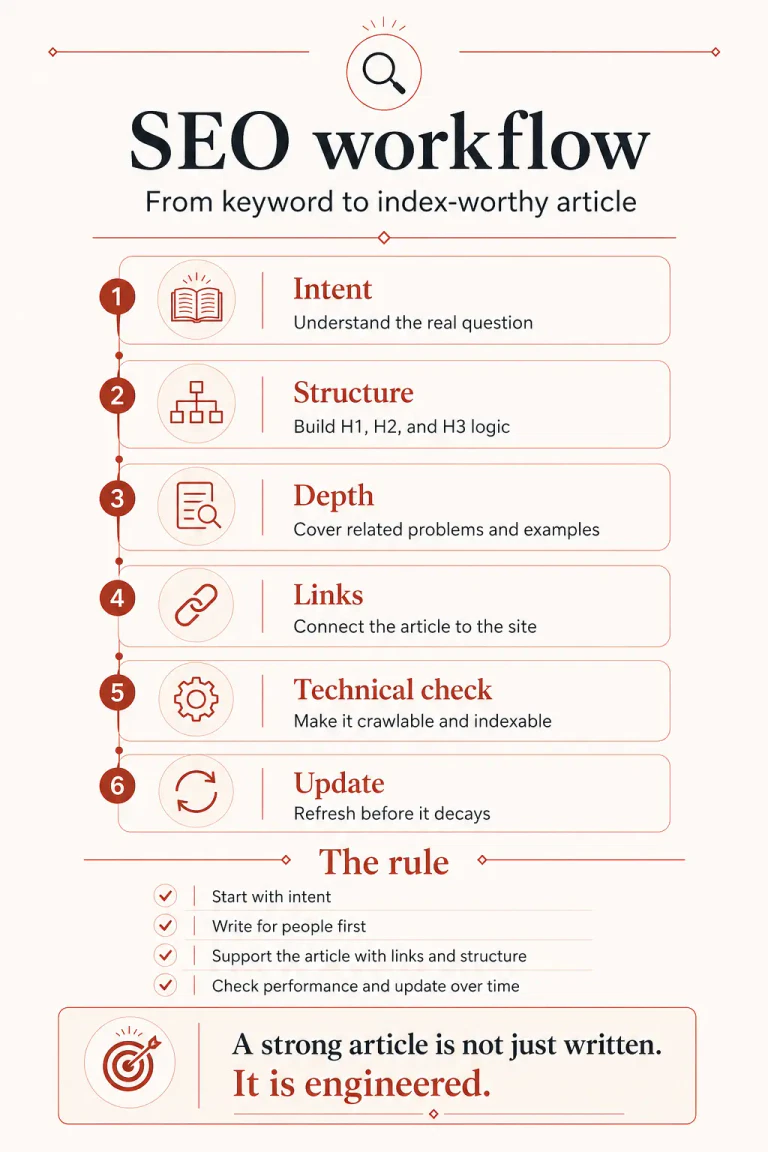
Key takeaways from the SEO Article Optimization analysis
SEO article optimization is no longer about repeating keywords or following a mechanical checklist. A strong article must satisfy search intent, earn trust, connect with the rest of the website, and give both readers and search engines a clear reason to value the page.
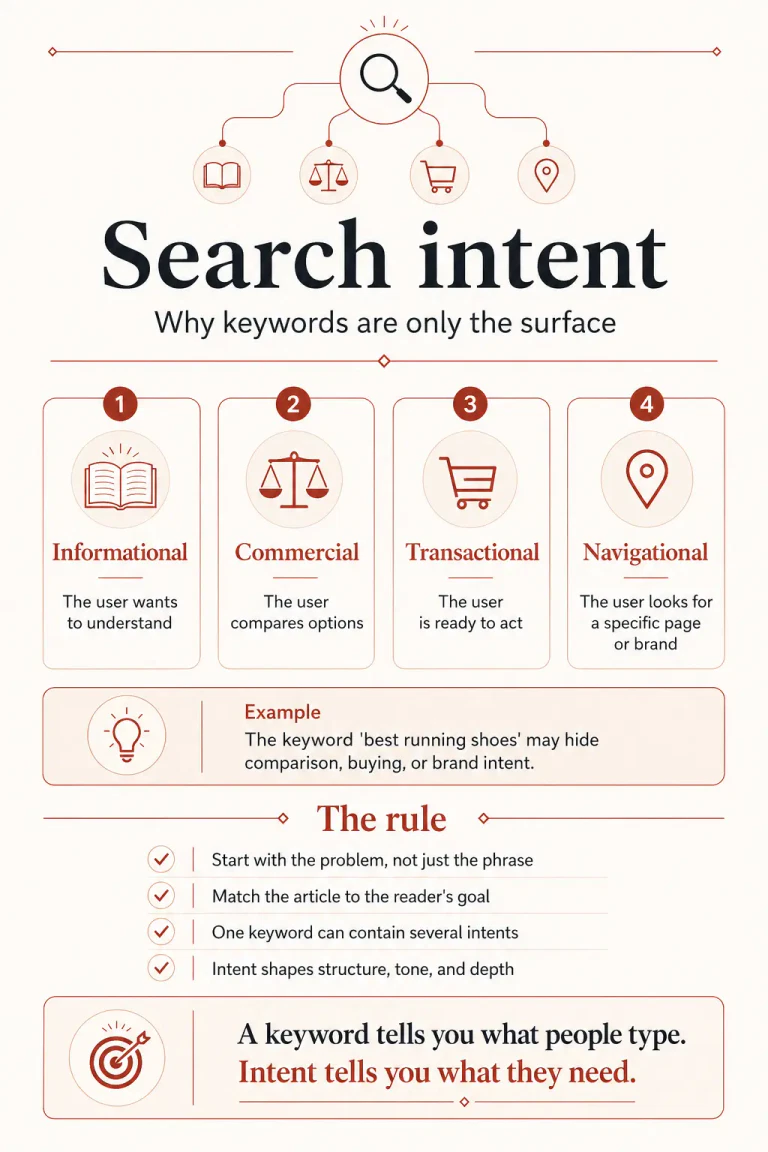
- 1. Search intent comes before keyword placement A keyword only reveals the surface of the query. The article has to answer the real problem behind it: what the reader wants to understand, compare, fix, choose, or accomplish. Strong SEO begins with intent, not with keyword density.
- 2. Structure makes the article easier to trust and scan One clear H1, logical H2 and H3 sections, descriptive headings, short paragraphs, and visible summaries help readers move through the page. They also help search engines understand the hierarchy and topical depth of the content.
- 3. Length should follow usefulness, not a fixed formula There is no universal perfect word count. An SEO article should be long enough to satisfy the query, explain the topic, answer related questions, and provide examples, but not so long that it becomes repetitive or padded with filler.
- 4. Internal linking turns isolated posts into a content system Relevant internal links help users discover related resources and help search engines understand the structure of the website. A strong article should not stand alone; it should belong to a wider topical cluster.
- 5. Technical SEO decides whether good content can perform Even a useful article can struggle if it is slow, poorly linked, blocked from indexing, missing a proper canonical tag, weak on mobile, or disconnected from the sitemap. Content quality and technical accessibility have to work together.
SEO used to be described as a set of tricks: put the keyword in the title, repeat it in the first paragraph, add a few headings, build links and wait. That version of SEO is no longer enough. It may still produce content that looks optimized, but it often fails at the more important task: being worth indexing, reading and referencing.
Modern article optimization is closer to editorial engineering. A good SEO article is not just written. It is designed. It has a purpose, a structure, a search intent, an internal linking role, a technical environment and a reason to exist beyond occupying a keyword.
Google’s own documentation consistently pushes creators toward helpful, reliable, people-first content rather than content made primarily to manipulate rankings. That does not mean technical optimization is irrelevant. It means technical optimization works best when it supports a page that already gives users something valuable.
The best SEO article in 2026 is therefore not the longest article, the most keyword-heavy article or the most “AI-optimized” article. It is the article that gives the reader a satisfying answer, proves topical competence, connects naturally to the rest of the website and removes as many technical barriers as possible between the page and search visibility.
Start with the search intent, not the keyword
Every article should begin with one question: what is the user really trying to accomplish?
A keyword is only a surface signal. The intent behind it is the actual target. Someone searching “how to optimize articles for SEO” may want a beginner checklist, a professional workflow, an explanation of ranking factors, a content brief template, or a diagnosis of why their existing articles are not indexed. The same keyword can hide several different needs.
This is why an article should not be planned only around keyword volume. It should be planned around intent clusters.
For example, a strong article about SEO article optimization may need to cover:
- how to structure the first paragraph,
- how to use headings,
- how long an article should be,
- how to write for search intent,
- how to use internal links,
- how to avoid keyword stuffing,
- how to improve indexing,
- how to update older articles,
- how technical SEO affects content performance,
- how AI-generated content should be handled.
These subtopics are not random additions. They represent related questions that naturally appear around the main search intent. Covering them helps the article become a more complete answer.
A weak article targets a keyword.
A strong article targets the problem behind the keyword.
Write the first paragraph as orientation, not overload
The first paragraph has a specific job: it should confirm that the reader is in the right place.
It does not need to answer everything immediately. It should not become a miniature version of the whole article. A crowded opening can feel unnatural, especially when it tries to include the main keyword, related keywords, definitions, benefits and a summary all at once.
A good first paragraph should do three things:
- introduce the topic clearly,
- show why the topic matters,
- create enough momentum for the reader to continue.
For SEO purposes, the main keyword or core phrase can appear early, but it should be integrated naturally. Search engines are better at understanding context than old-school keyword formulas suggest. The first paragraph should sound like a human opening, not a mechanical ranking attempt.
A poor opening says:
“SEO article optimization is important for SEO because optimized SEO articles help SEO rankings and SEO visibility.”
A better opening says:
“Optimizing an article for SEO is no longer a matter of repeating a keyword. The page must answer the user’s intent, show topical depth, load cleanly, connect to the rest of the site and give search engines a clear reason to index it.”
The second version is clearer, more useful and less artificial.
Build the article around a logical heading structure
Headings are not decorations. They are the architecture of the article.
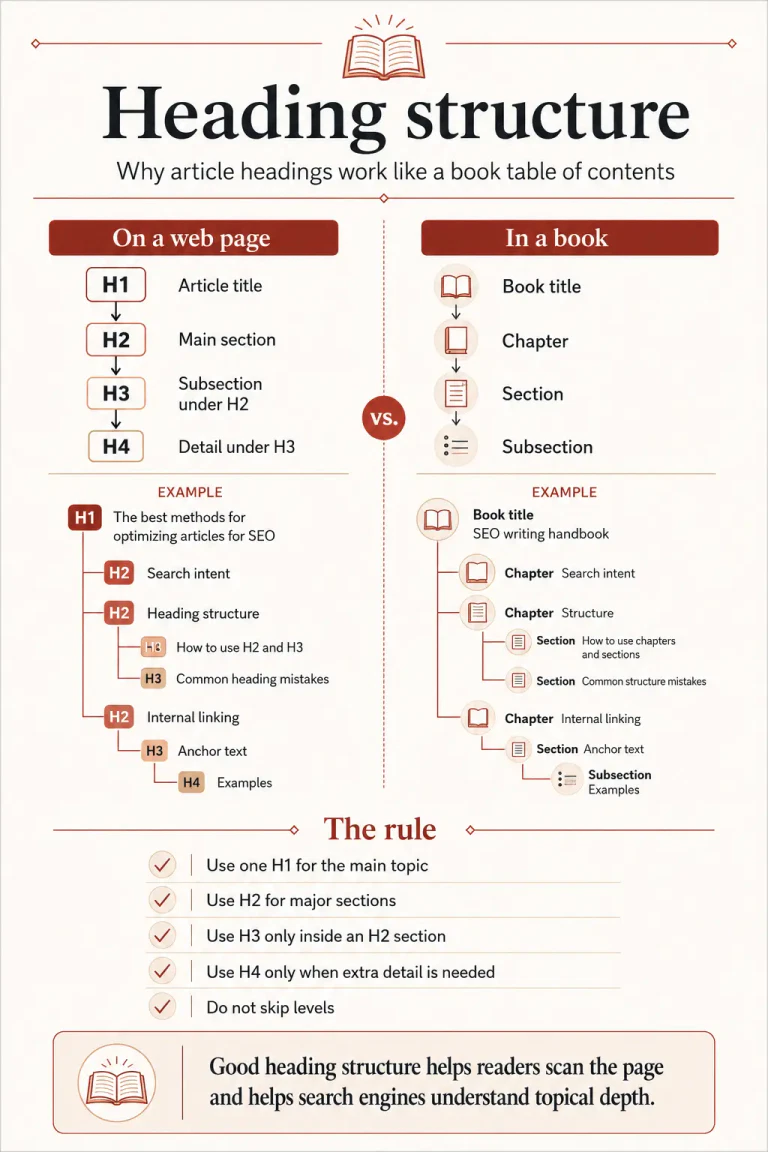
A well-structured article usually has:
- one H1 for the main topic,
- H2 headings for major sections,
- H3 headings for subsections,
- H4 headings only when the article is complex enough to need them.
The order should be logical. Avoid skipping levels just for visual styling. If a section is part of an H2, use H3. If it is part of an H3, use H4. This helps both readers and search engines understand the relationship between ideas.
Google’s SEO Starter Guide emphasizes making pages easy for users and search engines to understand, including clear organization, useful text and sensible linking. Good headings support that broader goal because they make the page easier to scan and interpret.
A strong heading should usually be:
- specific,
- descriptive,
- useful without being clickbait,
- written for the reader first,
- connected to a real subtopic.
Weak heading:
“Important things”
Better heading:
“How to use internal links without over-optimizing anchor text”
The second heading tells the reader exactly what they will get.
Do not chase a universal article length
There is no single perfect article length for SEO.
Some queries need 800 words. Others need 2,500. Technical guides, legal explanations, medical articles, software tutorials and research-based essays often require more depth. A simple definition or news update may not.
The mistake is treating length as a ranking formula. Longer content can perform well because it often covers a topic more completely, includes related questions and gives users more value. But length itself is not the point. A 3,000-word article full of repetition is weaker than a 1,500-word article that directly satisfies the search intent.
The right length depends on:
- complexity of the topic,
- user intent,
- competition in the search results,
- need for examples,
- need for data or sources,
- number of related questions,
- depth expected by the audience.
A practical rule is this: the article should be long enough that the reader does not need to return to Google immediately for the same question.
That does not mean answering every possible adjacent question. It means covering the main topic with enough clarity, examples and structure that the page feels complete.
Replace keyword stuffing with semantic coverage
Keyword stuffing is not optimization. It is a sign that the article does not trust its own topical relevance.
Modern SEO depends much more on semantic coverage: related concepts, entities, synonyms, examples, definitions, use cases and natural language around the topic. Instead of repeating “SEO article optimization” twenty times, a strong article uses related terms naturally:
- search intent,
- heading structure,
- internal linking,
- indexability,
- crawlability,
- structured data,
- meta title,
- content quality,
- topical authority,
- anchor text,
- Core Web Vitals,
- content updates,
- user experience.
This gives search engines a richer understanding of the page. It also makes the article more useful to readers.
A good SEO article should sound like it was written by someone who understands the topic, not by someone trying to satisfy a density calculator.
Make the article genuinely helpful
Google’s helpful content guidance is built around a simple principle: content should be created primarily to help people, not to manipulate search rankings. The guidance encourages creators to self-assess whether their pages provide original information, substantial value, clear sourcing, expertise and a satisfying experience.
For article optimization, this means asking harder questions before publishing:
- Does this article add anything beyond what already exists?
- Does it include original examples, experience or analysis?
- Does it answer the query fully?
- Does the title accurately describe the content?
- Would a reader bookmark, share or cite it?
- Is the article written for a real audience or only for search engines?
- Are claims supported when they need support?
- Is the content updated enough for the topic?
This is especially important in competitive niches. Generic articles are easy to produce and easy to ignore. Search results are already full of broad, interchangeable guides. To stand out, an article needs a sharper angle.
For example, instead of writing only “How to optimize articles for SEO,” a better version may include:
- a real optimization workflow,
- before-and-after examples,
- a checklist,
- common mistakes,
- recommendations for indexing problems,
- editorial standards,
- internal linking patterns,
- update strategy.
The article becomes more useful because it does not merely describe SEO. It helps someone do SEO.
Use E-E-A-T as an editorial standard
E-E-A-T stands for experience, expertise, authoritativeness and trustworthiness. It is not a simple ranking score that can be “added” to a page with one plugin. It is better understood as an editorial quality framework.
A page demonstrates experience when it shows first-hand knowledge. It demonstrates expertise when it explains the topic accurately. It demonstrates authoritativeness when the site or author has credibility in the subject area. It demonstrates trustworthiness when the page is transparent, accurate, well-sourced and safe for users.
For ordinary SEO articles, this can be strengthened through:
- clear author information,
- relevant credentials or experience,
- links to reliable sources,
- updated publication dates when meaningful,
- examples from practice,
- honest limitations,
- no exaggerated promises,
- transparent methodology.
Google’s guidance on AI-generated content also recommends evaluating content through “Who, How, and Why”: who created it, how it was produced and why it exists. This is useful even when no AI is involved because it pushes publishers to think about transparency and purpose.
A page that hides authorship, uses vague claims, lacks evidence and exists only to capture traffic will usually feel weaker than a page that clearly shows why it deserves trust.
Optimize titles without turning them into clickbait
The title is one of the most important pieces of an article. It shapes user expectations, click-through rate and topical clarity.
A strong SEO title should be:
- specific,
- readable,
- aligned with search intent,
- not overpromised,
- not stuffed with variants,
- emotionally clear when appropriate.
Poor title:
“SEO Optimization Article Best Methods Guide Tips 2026”
Better title:
“The best methods for optimizing articles for SEO in 2026”
Even better, depending on intent:
“How to optimize articles for SEO: structure, content, links and indexing”
The best title depends on the article’s function. A beginner guide can be direct. A professional guide can be more specific. A thought-leadership article can be more provocative. But the title must always match the content.
Clickbait creates a short-term click and a long-term trust problem.
Write meta descriptions as invitations, not ranking tricks
A meta description does not directly guarantee rankings, but it can influence how users understand the page in search results. Google may rewrite it, but writing one is still useful because it forces you to clarify the article’s value.
A good meta description should:
- summarize the article accurately,
- include the main topic naturally,
- show the benefit of reading,
- stay concise,
- avoid exaggerated promises.
Example:
“Learn how to optimize articles for SEO through search intent, heading structure, internal linking, content quality, schema, Core Web Vitals and regular updates.”
This is simple, accurate and useful.
Avoid descriptions that sound like ads:
“Discover the secret SEO method that guarantees top rankings overnight.”
SEO is hard enough without making promises that cannot be kept.
Use internal links as a content system
Internal linking is one of the most underused SEO tools.
A strong internal link does three things at once:
- helps users discover related content,
- helps search engines crawl the site,
- helps define the relationship between pages.
Google’s documentation explains that links help Google discover pages and understand what linked pages are about. It also recommends useful, descriptive anchor text rather than vague phrases like “click here.”
For article SEO, internal links should be planned intentionally.
A guide about SEO article optimization could link to:
- a guide about keyword research,
- a guide about technical SEO,
- a guide about internal linking,
- an article about Core Web Vitals,
- an article about content audits,
- a case study about indexing problems.
The anchor text should be natural and descriptive.
Weak:
“Read more here.”
Better:
“learn how to build an internal linking structure”
Internal links should not be forced into every paragraph. Too many links can distract users and dilute the page’s focus. The goal is not to fill the article with links. The goal is to help users move through the site logically.
Make links crawlable
Internal linking only helps if search engines can actually access the links.
Google’s link best practices recommend using proper HTML links with crawlable href attributes. Links hidden behind scripts, buttons or non-standard elements may be harder for search engines to process.
In practical terms:
- use normal HTML anchor links where possible,
- avoid relying only on JavaScript navigation,
- make important pages reachable from other pages,
- use descriptive anchor text,
- avoid orphan pages,
- ensure pagination and category pages are crawlable when needed.
This matters especially for blogs. Many good articles remain weak because they are isolated. Google can crawl them, but the site gives little signal that they are important. A strong internal linking system turns individual posts into a topical network.
Add external sources where they improve trust
External links are not a sign of weakness. They can strengthen an article when they support factual claims, cite research, refer to official documentation or give readers a path to verify information.
This is especially important in sensitive or technical topics:
- law,
- medicine,
- finance,
- technology,
- SEO,
- science,
- public policy.
For SEO articles, linking to official Google Search Central documentation is often better than citing random SEO blogs. For medical topics, official health organizations and peer-reviewed sources matter. For legal content, statutes, court rulings and government sources matter.
A strong article does not need a citation after every sentence. But important claims should not float without support.
Use structured data when it fits the page
Structured data is not a magic ranking booster. It is a way to help search engines understand the meaning of a page and potentially enable rich results when the content is eligible.
Google describes structured data as a standardized format for providing information about a page and classifying its content. For example, structured data can clarify recipes, products, events, reviews, FAQs and other specific content types.
For article SEO, common schema types may include:
- Article,
- BlogPosting,
- NewsArticle,
- FAQPage, when appropriate and eligible,
- BreadcrumbList,
- Organization,
- Person.
The most useful structured data is accurate structured data. Do not mark up content that is not visible to users. Do not use schema to misrepresent the page. Structured data should describe the content, not invent a richer version of it.
Optimize images as content, not decoration
Images can improve SEO when they add meaning.
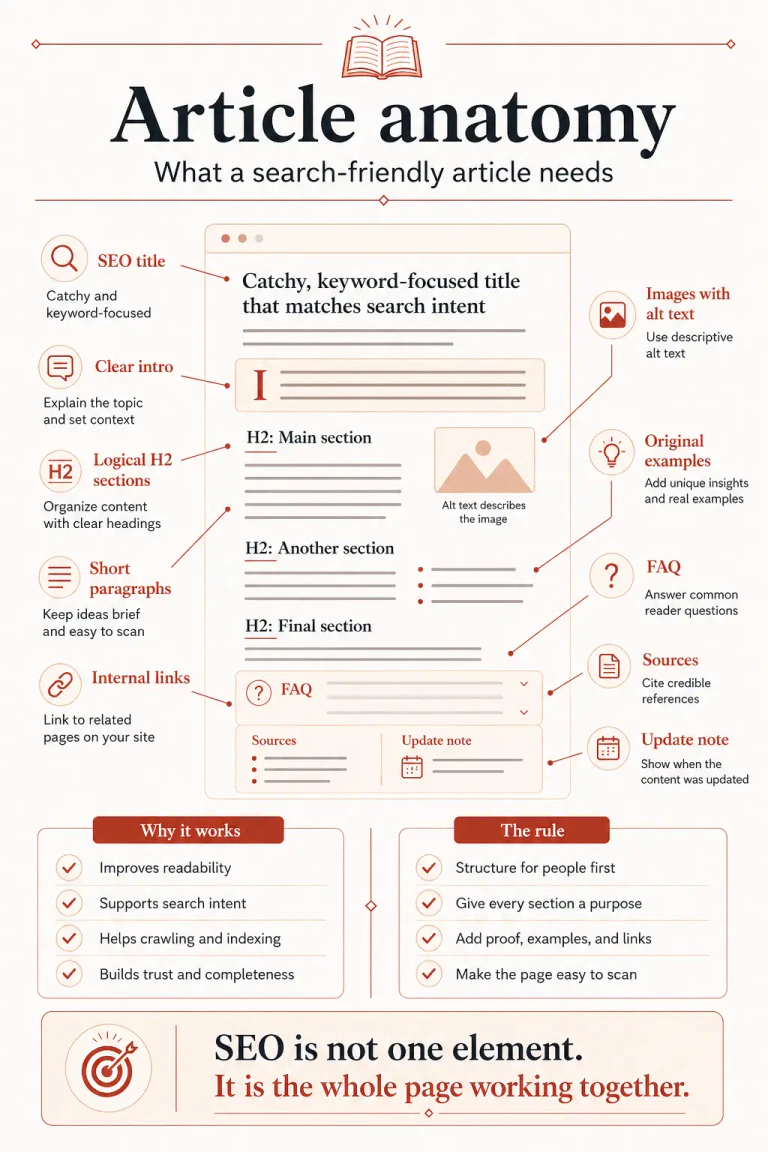
For articles, images should not be treated only as visual filler. A useful image can explain a process, summarize a comparison, show a diagram, present data or make a complex concept easier to understand.
Good image optimization includes:
- descriptive file names,
- meaningful alt text,
- compressed file size,
- responsive image handling,
- captions where helpful,
- original graphics when possible,
- avoiding heavy images that slow down the page.
For example, an infographic called seo-article-optimization-workflow.png is more informative than image123.png.
Alt text should describe the image for accessibility and context. It should not be used as a keyword dumping ground.
Weak alt text:
“SEO SEO article optimization best SEO guide”
Better alt text:
“Diagram showing the SEO article optimization process from search intent to internal linking and content updates.”
Make the page mobile-first
Most users experience content on mobile devices. A page that looks polished on desktop but feels cramped, slow or broken on mobile is not properly optimized.
Mobile optimization includes:
- readable font size,
- comfortable line spacing,
- short paragraphs,
- responsive images,
- visible headings,
- buttons that are easy to tap,
- no intrusive pop-ups,
- fast loading,
- stable layout.
Mobile-first does not mean mobile-only. It means the mobile version must contain the important content, links, images and structured data that the desktop version contains.
If key content is hidden, missing or difficult to access on mobile, the article may underperform even if the writing is strong.
Improve Core Web Vitals, but keep perspective
Core Web Vitals measure real-world user experience for loading performance, interactivity and visual stability. Google recommends that site owners achieve good Core Web Vitals for success in Search and for a better user experience generally.
For article pages, the most common problems are:
- oversized hero images,
- slow fonts,
- render-blocking scripts,
- layout shifts from ads or embedded content,
- heavy page builders,
- too many plugins,
- unoptimized third-party scripts.
Improving Core Web Vitals will not rescue poor content. But poor performance can weaken strong content. SEO is cumulative. A page can fail not because of one big error, but because of several small frictions: slow load, weak title, poor internal links, thin content, missing mobile optimization and no freshness signals.
Make the article index-worthy
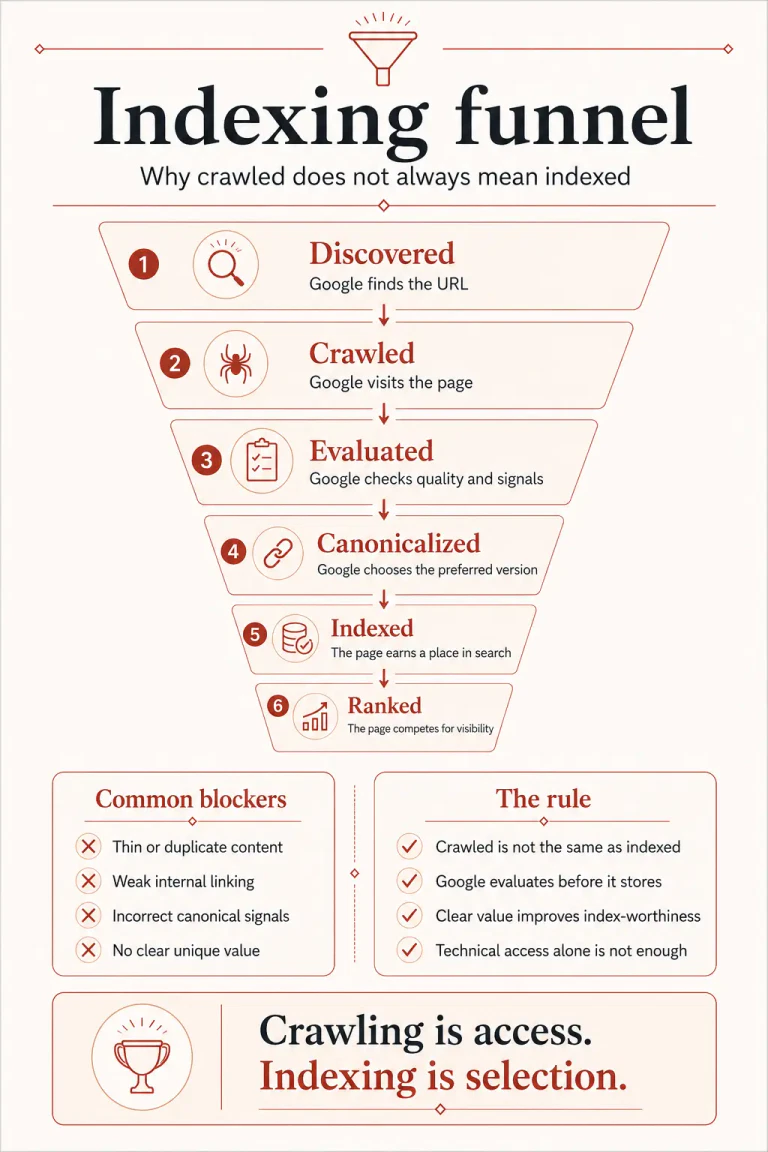
Crawling and indexing are not the same.
A page can be crawled by Google and still not be indexed. That usually means Google discovered the URL, but did not consider it necessary or valuable enough to add to the index at that time, or found technical/indexing signals that reduced its eligibility.
To improve index-worthiness, check:
- is the page blocked by robots.txt?
- does it have a
noindextag? - is the canonical tag correct?
- is the page included in the sitemap?
- is it internally linked from relevant pages?
- does it duplicate another article?
- does it provide unique value?
- does it load properly for mobile users?
- does it have enough text content?
- is it part of a coherent topical cluster?
A page that is technically accessible but editorially weak may still struggle. Indexing is not only about being found. It is also about being worth storing.
Build topical clusters instead of isolated posts
One article rarely builds authority alone.
A strong SEO strategy groups related articles into topical clusters. A central guide covers the broad topic. Supporting articles cover narrower subtopics. Internal links connect them in both directions.
For example, a website about digital marketing could build a cluster like this:
Main guide:
- The best methods for optimizing articles for SEO
Supporting articles:
- How to write SEO titles
- How to structure H2 and H3 headings
- How to use internal links
- How to update old blog posts
- How to fix indexing problems
- How to optimize images for SEO
- How Core Web Vitals affect content performance
This structure helps readers and search engines understand that the website covers the subject in depth. It also gives older and newer articles a stronger internal linking framework.
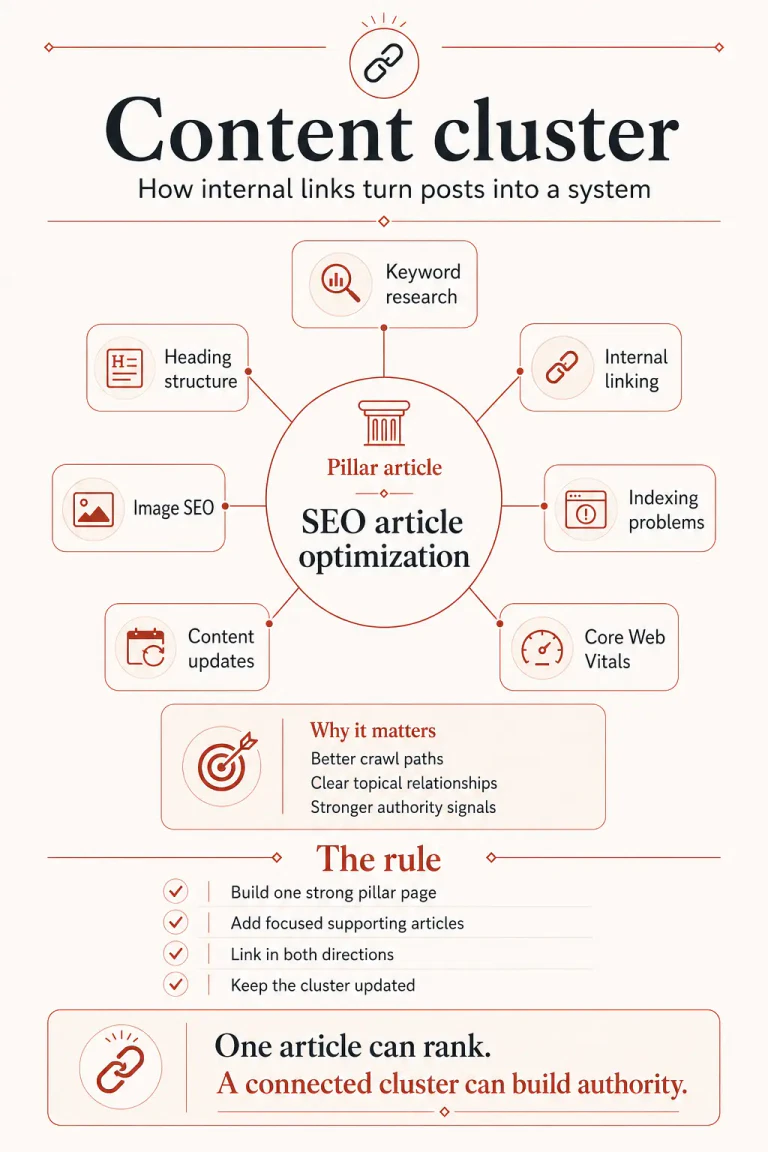
Topical authority is not created by publishing many disconnected posts. It is created by connecting useful pages into a coherent knowledge system.
Update articles before they decay
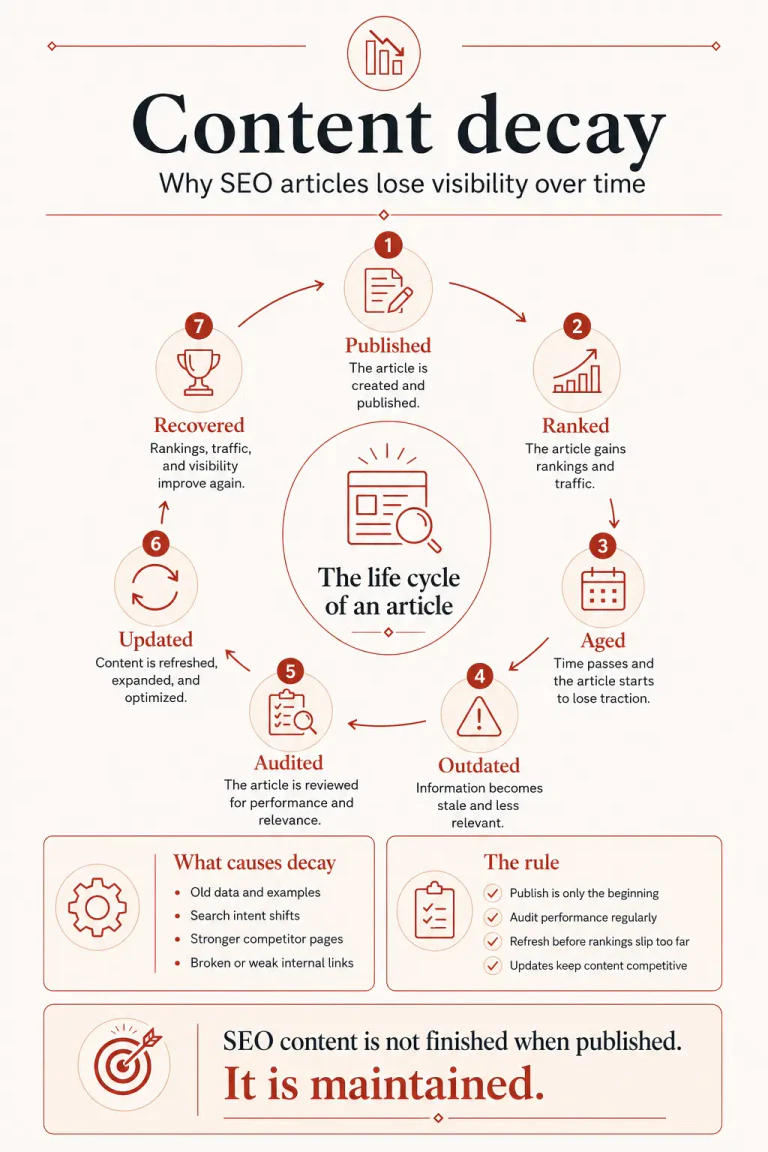
SEO content ages.
Statistics become outdated. Screenshots change. Search intent shifts. Tools update. Google documentation changes. Competitors publish stronger resources. A page that ranked well in one year can slowly lose relevance if it is never maintained.
A good update process includes:
- checking whether the title still matches search intent,
- adding new examples,
- removing outdated claims,
- refreshing sources,
- improving internal links,
- adding missing sections,
- compressing or replacing images,
- checking indexing status,
- comparing the page with current search results.
Not every update needs to be large. Sometimes a page needs only a refreshed paragraph, a better FAQ section and a few stronger internal links. Other times it should be rewritten substantially.
The important thing is that content should not be treated as finished forever.
Avoid thin summaries of other people’s content
One of the weakest forms of SEO writing is the recycled summary.
It usually looks like this:
- generic introduction,
- obvious definitions,
- list of common tips,
- no examples,
- no original judgment,
- no sources,
- no practical workflow,
- no reason to trust the author.
This kind of article may be grammatically correct, but it is not memorable. It adds little to the web.
A stronger article adds at least one of the following:
- original examples,
- expert interpretation,
- current sources,
- visual explanation,
- original diagrams,
- templates,
- checklists,
- case studies,
- decision frameworks,
- mistakes to avoid,
- concrete recommendations.
If the article can be replaced by any other article on the same topic, it needs more editorial value.
Think about AI search, but do not abandon classic SEO
AI search tools and AI-generated summaries have changed how users discover information, but they have not removed the need for strong pages. In many cases, AI systems still rely on content that is clear, structured, trustworthy and easy to interpret.
To make an article more useful in both traditional and AI-influenced search environments:
- define concepts clearly,
- use descriptive headings,
- answer common questions directly,
- include examples,
- cite reliable sources,
- avoid vague claims,
- use structured lists where helpful,
- add original insights,
- keep the article updated.
Google’s guidance on AI-generated content makes an important distinction: automation itself is not the issue; using automation primarily to manipulate rankings is the problem. Content should still be helpful, reliable and created for people.
This is a useful principle for all publishing. AI can help with research, outlines or editing, but the final article still needs human judgment, accuracy and purpose.
Common mistakes in SEO article optimization
The most common SEO mistakes are not always technical. Many are editorial.
Writing for keywords instead of readers
The article repeats phrases but does not solve the user’s problem.
Using headings as visual styling only
The page looks organized but has no semantic structure.
Publishing articles with no internal links
The page becomes isolated and weaker within the site architecture.
Overusing AI-generated generic content
The article sounds polished but adds nothing original.
Ignoring indexation problems
The page is crawled but not indexed, and nobody checks why.
Using outdated data
The article looks current but contains old assumptions.
Adding too many external scripts
The page becomes slow and unstable.
Publishing without a content update plan
The article decays slowly and loses relevance.
Confusing length with quality
The article becomes long, repetitive and less readable.
Treating SEO as a one-time task
Optimization is ongoing, especially for competitive topics.
Practical SEO article checklist
Before publishing an article, check the following:
Intent
- Is the main user intent clear?
- Does the article answer the real question behind the keyword?
- Does the title match the content?
Structure
- Is there one clear H1?
- Are H2 and H3 headings logical?
- Can the reader scan the article easily?
- Is the first paragraph clear and not overloaded?
Content
- Does the article add original value?
- Are claims accurate?
- Are sources used where needed?
- Are examples included?
- Is the content free of unnecessary filler?
Internal linking
- Does the article link to relevant pages?
- Do relevant pages link back to it?
- Are anchor texts descriptive?
- Is the page part of a topical cluster?
Technical SEO
- Is the page indexable?
- Is the canonical tag correct?
- Is the article included in the sitemap?
- Does it work well on mobile?
- Are images optimized?
- Are Core Web Vitals acceptable?
Trust
- Is the author visible?
- Is the publication or update date clear?
- Are sources reliable?
- Is the article transparent about limitations?
Maintenance
- Is there a plan to update the article?
- Are statistics and screenshots current?
- Are old internal links still relevant?
- Can the article be improved with diagrams or infographics?