
🤖 Key takeaways on llm.txt
The web is shifting from "read-only" for bots to "read-and-act" for agents. Optimizing for LLMs requires a different approach than traditional SEO. Here are the 3 critical concepts:
-
1. The markdown advantage
Modern websites are full of code noise (JavaScript, CSS) that confuses AI and wastes expensive tokens. By providing a clean
llm.txtfile in Markdown, you create a frictionless API for agents. If your site is "cheaper" and faster to read, AI models are economically incentivized to prioritize your content over a competitor's complex site. -
2. Ignore google on this one
Google has dismissed
llm.txtas redundant for search rankings, but that misses the point. You aren't building this for Googlebot; you are building it for ChatGPT, Claude, and autonomous agents that will book flights or buy products. Relying solely on Google's advice leaves you invisible to the emerging AI economy. -
3. Context over keywords
Traditional SEO is about keywords; LLM optimization is about context availability. The
llm.txtfile acts as a curated dataset that reduces hallucinations. By feeding the model structured, high-density information about your pricing or documentation, you indirectly control the accuracy of the answers it generates about your brand.
The internet is currently undergoing a fundamental infrastructure shift driven by artificial intelligence. Webmasters and developers are facing a new challenge regarding how content is consumed by machines. Traditionally, we optimized websites for human eyes and keyword-based crawlers like Googlebot. Today, we must also optimize for Large Language Models (LLMs) and autonomous agents.
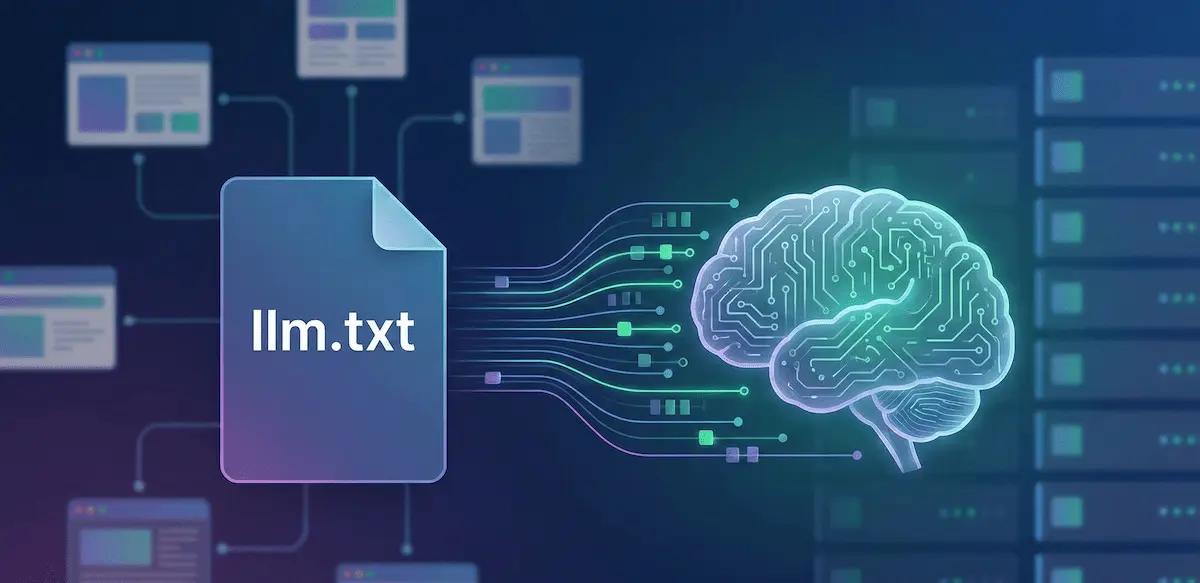
The llm.txt file is a proposed standard to bridge this gap effectively. It serves as a clean and structured map of your website specifically designed for AI training and retrieval. While traditional SEO focuses on rankings, this new file format focuses on accuracy and context availability. It ensures that when an AI speaks about your brand, it uses the correct information.
Understanding the file purpose
The core purpose of an llm.txt file is to provide a markdown-native view of your website. Most modern websites are heavy with javascript, css, and complex html structures that confuse simple parsers. An AI model consumes text tokens, and stripping away the code overhead makes processing your site significantly cheaper and faster.
Think of this file as an API for content that requires no authentication. It tells an AI agent exactly where to find the most important information without needing to navigate menus or close pop-ups. This reduction in friction is the primary value proposition for adopting this standard. It creates a direct pipeline from your database to the model's context window.
The file typically resides in the root directory and points to other markdown files. This structure mimics the traditional sitemap but with a focus on semantic readability rather than just url listing. It is an invitation for the bot to read, understand, and cite your work.
The reality of google stance
It is critical to address the current position of the world's largest search engine regarding this file. John Mueller of Google has explicitly stated that they do not currently use llm.txt for ranking purposes. He compared it to the deprecated meta keywords tag, suggesting it might be redundant for advanced crawlers.
However, relying solely on Google's current operational advice is a strategic error for forward-thinking businesses. Google is no longer the only gatekeeper of information on the internet as users migrate to chat interfaces. Platforms like ChatGPT, Claude, and Perplexity operate on different incentives and architectural needs than Google Search.
Optimization for LLMs is distinct from traditional Search Engine Optimization. While Google might ignore the file, an autonomous agent trying to book a service on your site will rely on it. We are optimizing for the broader ecosystem of AI agents, not just the ten blue links on a search results page.
Mechanics of retrieval augmented generation
To understand the value of this file, one must understand Retrieval Augmented Generation, or RAG. RAG is the process where an AI fetches external data to answer a user's question accurately. When a user asks about your specific pricing or documentation, the AI looks for a source of truth.
HTML pages are often filled with navigational noise that degrades the quality of this retrieval. A clean text file ensures that the retrieved context is dense with information and free of distractions. This increases the probability that the AI will use your content to generate its answer rather than hallucinating.
High-quality input leads to high-quality output in generative models. By controlling the input via a structured text file, you indirectly control the output of the AI. This is the closest we can get to reputation management in the era of generative text.
Technical structure and syntax
The proposed standard usually involves two specific files located in your root directory. The first is /llms.txt which acts as a brief summary and index for the crawler. The second is often /llms-full.txt which contains the concatenated full text of your primary content.
The syntax relies heavily on standard Markdown formatting to ensure universal compatibility. You should use clear headers, bullet points, and absolute links to guide the parser. Avoid proprietary formatting or complex visual elements that cannot be rendered in plain text.
Here is the hierarchy you should aim for when building the file. Start with a project overview, followed by documentation links, and end with specific usage examples. This logical flow mimics how a human developer would want to learn about your project.
Why markdown is the standard
Markdown is the lingua franca of the large language model training data. Models like GPT-4 and Claude were trained on vast repositories of code and markdown files. They are naturally better at understanding the hierarchy and emphasis in this format than in raw HTML.
Using Markdown also significantly reduces the token count of your content. Tokens are the currency of the AI world, and saving tokens means saving money for the inference provider. By making your site "cheaper" to read, you incentivize bots to consume more of your pages.
This efficiency becomes even more critical when we discuss the context window limits. An AI can only "remember" a certain amount of text at one time. A concise Markdown file allows you to fit more relevant information into that limited memory slot.
Selecting content for inclusion
You should not simply dump your entire website database into your text file. Curating the content is an essential step in defining your entity to the artificial intelligence. Prioritize your "About Us" page, core product documentation, and detailed pricing pages.
Exclude dynamic pages that change constantly or provide little semantic value. Search result pages, login screens, and tag archives usually waste the bot's time. Focus on "evergreen" content that establishes your authority and expertise in your specific niche.
Think about the questions your customers ask most frequently. If you have a detailed FAQ section, it should be a primary candidate for inclusion in the text file. You want the AI to have the answer ready before it even tries to guess.
Dealing with security risks
Opening a direct line to your data requires a serious conversation about security implications. You must ensure that no sensitive internal documentation is linked within your public text files. AI bots will relentlessly follow every path you provide, respecting no boundaries other than what is public.
Prompt injection is another risk vector to consider when designing your content. Malicious actors could theoretically hide instructions in your content to manipulate the AI's behavior. Sanitize your text inputs to ensure they do not contain hidden commands that could be interpreted by an agent.
Regular audits of your text files are necessary to maintain a secure environment. Treat this file with the same security protocols as you would your robots.txt or sitemap.xml. Accidental exposure of private API keys or admin routes in a text file is a common vulnerability.
Difference from robots.txt
It is easy to confuse the function of llm.txt with the traditional robots.txt protocol. The robots.txt file is a directive for permissions, telling bots where they are allowed to go. It is a restrictive document designed to block access to specific areas of your server.
In contrast, the llm.txt file is a descriptive document designed to facilitate understanding. It does not block or allow access but rather guides the bot to the best content once access is permitted. You use robots.txt to say "stop" and llm.txt to say "look here first."
Both files should exist in harmony on a well-optimized modern website. Do not assume that having one negates the need for the other. They serve different technical layers of the web stack.
Economic incentives for ai companies
We must look at the adoption of this standard from the perspective of the AI companies. Crawling the modern web is incredibly expensive due to the computational cost of rendering javascript. If websites provide clean text files, the cost of data acquisition drops dramatically.
This economic alignment suggests that adoption will likely grow over time. AI search engines will naturally favor sites that are cheaper and faster to process. By adopting this standard early, you align your business with the financial goals of the major tech platforms.
It is a symbiotic relationship where you provide structure and they provide traffic. The harder you make it for them to read your site, the less likely they are to send you users. Reducing friction is the ultimate SEO strategy for the AI age.
Future of autonomous agents
The internet is moving towards a model where software acts on behalf of humans. These autonomous agents will need to navigate your website to perform tasks like buying products or booking appointments. An llm.txt file can serve as a directory of capabilities for these agents.
Imagine a future where a user tells their phone to "buy me a pair of red shoes." The agent will look for sites that clearly expose their product catalog in a machine-readable format. If your site is a black box of complex code, the agent will bypass it for an easier target.
This is the difference between passive indexing and active usage. We are moving from a "read-only" web for bots to a "read-and-act" web. Your text file is the instruction manual for these digital workers.
Implementing version control
Your content is not static, and neither should your text file be. You need a system that automatically updates the file whenever you publish new articles or products. Serving an outdated text file is worse than serving none at all, as it leads to hallucinations.
Use your Continuous Integration (CI) pipeline to generate these files during the build process. If you use a static site generator, there are likely plugins available to handle this automatically. Automation ensures consistency and removes the risk of human error in maintenance.
Versioning your file can also help with debugging and performance tracking. You might want to maintain a changelog to see when the AI started picking up new information. Treat your content infrastructure as a software product that requires regular releases.
Measuring success and impact
Tracking the ROI of this implementation is challenging but not impossible. You should monitor your server logs for requests to the /llms.txt endpoint. An increase in hits from user agents like GPTBot or ClaudeBot is a clear sign of adoption.
You can also perform "shadow testing" by querying LLMs about your specific content. If the answers become more accurate over time, your context optimization is likely working. Qualitative data is often more valuable than raw traffic numbers in the AI space.
Look for referral traffic from AI-powered search engines in your analytics. Segments coming from Perplexity or Bing Chat should be analyzed for behavior and conversion. This traffic often has a higher intent than generic search traffic.
Eeat and authority building
Google's principles of Experience, Expertise, Authoritativeness, and Trustworthiness apply here. By providing a structured and accurate file, you demonstrate technical competence and transparency. This signals to any parser that the entity behind the site is legitimate and organized.
Use the file to explicitly link to your credentials and author bios. Connecting your content to real-world identities helps the AI build a knowledge graph of your authority. This is crucial for establishing trust in sensitive niches like finance or health.
A messy or spammy text file can have the opposite effect on your reputation. Ensure that every link in your file works and provides value to the reader. Broken links or keyword stuffing in this file will damage your trust score with the bots.
Impact on developer experience
There is a secondary benefit to this file that is often overlooked. It serves as excellent documentation for human developers who want to understand your site structure. A clean markdown summary is often easier to read than a visual sitemap or complex navigation menu.
This improves the "hackability" of your content for third-party integrations. If you want other developers to build tools on top of your platform, make it easy for them. The llm.txt file effectively lowers the barrier to entry for ecosystem growth.
It promotes a culture of open data and accessibility within your organization. When you prioritize clean data for bots, you often end up cleaning up your internal data processes. It forces a discipline that benefits all aspects of your technical stack.
The multi modal future
We are rapidly approaching a time when AI will consume more than just text. Future versions of this standard may include references to multi-modal capabilities, such as images, video transcripts, and audio files. Preparing your text infrastructure now lays the groundwork for these capabilities.
Your text file could eventually serve as a manifest for all media types on your site. Describing your images in text within this file helps the AI "see" your visual assets. This connects your visual content to the semantic understanding of the model.
Staying adaptable is the key to surviving in this fast-paced environment. The standards will evolve, but the core principle of machine readability will remain constant. You are building a foundation for technologies that have not even been invented yet.
⚖️ Implementation strategy
✅ What works (Clean data)
- Curated selection Including only high-value "evergreen" pages like documentation, pricing, and FAQs. This maximizes the utility of the AI's limited context window.
- CI/CD automation Using your build pipeline to automatically generate the text file every time you deploy. This ensures the AI never reads outdated specs or hallucinated features.
- Semantic structure Using clear Markdown headers and bullet points. LLMs are trained on code repositories and understand this hierarchy better than visual HTML layouts.
❌ What fails (Data dumping)
- Security negligence Accidentally including internal API keys or private admin routes in the text file. Bots respect public boundaries but will index anything you explicitly list.
- Including noise Listing login pages, search results, or tag archives. These waste the bot's time and budget, discouraging it from crawling your site deeply.
-
Relative links
Using paths like
/docs/apiinstead of absolute URLs. AI agents consuming the text file outside of a browser environment often lose track of the base domain.


