

Key takeaways from the Content Pruning analysis
Maintaining a massive, outdated content library is no longer a viable SEO strategy. In the age of AI search, keeping low-value pages actively damages your domain authority, wastes critical crawl budget, and hides your most profitable core products:
- 1. The devastating cost of "editorial debt" Publishing massive amounts of off-topic or outdated content dilutes your domain authority and wastes finite search engine crawl budgets. This "editorial debt" leads to catastrophic visibility drops (e.g., HubSpot losing 80% of organic traffic) and delays the indexing of vital, revenue-generating campaigns.
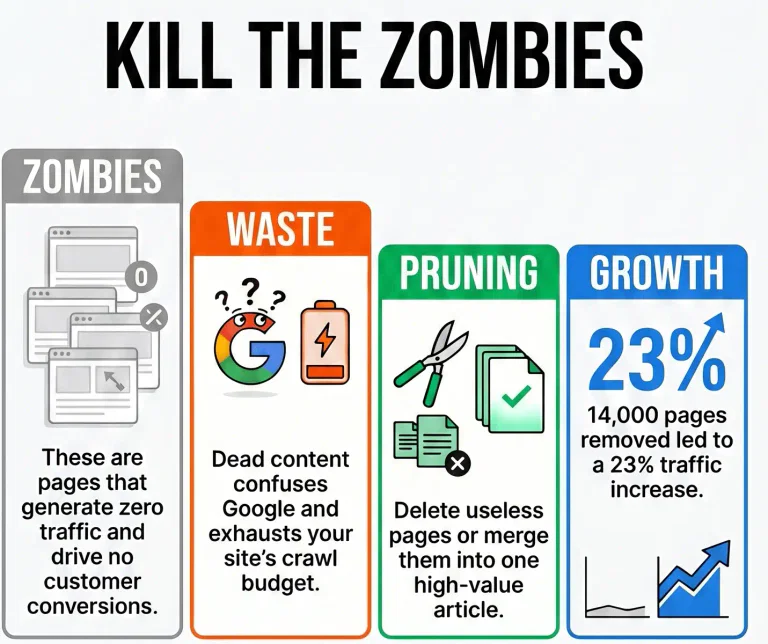
- 2. Resource reduction drives massive traffic growth Strategic content pruning consistently reverses multi-year organic declines. For example, by aggressively removing 14,000 low-value pages, a major insurance firm successfully consolidated its authority, resulting in a remarkable 23% year-over-year increase in highly qualified organic traffic.
- 3. The shift from volume to deep topical authority In the era of generative AI search, superficial metrics like "total session volume" are entirely obsolete. Search engines now ruthlessly prioritize impression concentration and deep, highly focused topical authority over broad, shallow content libraries.
The decade of false promises is over. For years, the digital marketing industry operated on the comfortable but fundamentally flawed belief that the only path to stable visibility was relentless, almost mechanical content production. We accepted a pathological model where a web domain functioned as a bottomless warehouse, accepting every keyword variation without the slightest reflection on the long-term maintenance costs. We ignored harsh economics. Today, the mathematics of modern ranking systems ruthlessly verify the consequences of this irresponsible approach by cutting off empty reach.
More is absolutely not better. The phenomenon classified in technical nomenclature as zombie content refers to pages that physically occupy server space and remain in the index but generate zero traffic, drive no conversions, and are completely ignored by analytics systems. We keep corpses alive. Software licensing valuations, processor overhead, and wasted auditor time are just the tip of the iceberg masking the slow, systematic degradation of site quality scores. Treating every published text as an untouchable asset is a recipe for failure in an environment where algorithms reward only freshness and surgical information precision.
The naivety of marketers is terrifying. We pump tens of thousands of dollars into campaigns generating empty traffic from overseas, and then feign surprise when the conversion rate flatlines, is this what mythical growth hacking looks like? Generating pageviews through thematically unrelated articles destroys the behavioral profile that machines assign to our website, ultimately lowering the profitability of the entire operation. If a user's visit does not end in a satisfactory transaction, the site bleeds trust capital in the global ranking ecosystem.
Editorial debt architecture
Every outdated article is a hard financial liability. Instead of building real brand capital, obsolete texts create a dense layer of informational noise that distorts the domain's image in the multidimensional vector space of search algorithms. Search systems rely on analyzing random structural samples. When a crawling bot fetches a hundred URLs from a server and forty of them are holiday greetings from the last decade, the machine classifies the entire architecture as deeply neglected. Authority drops immediately. This mechanism does not care that you might host exceptional, highly converting product pages in another section of the site.
The economics of information management abhor a vacuum. Software quality consortium reports show that the cost of poor software quality and technical debt in the United States alone consumes over two trillion dollars annually. When we apply these exact analytical frameworks to website maintenance strategies, it becomes brutally clear that editorial debt destroys e-commerce profitability in exactly the same way. Losses stemming from poor data quality cost enterprise companies like Unity over one hundred million dollars in lost revenue in just one cycle. Neglecting to purge your database of dead subpages directly hands your profit margin over to competitors operating on optimized, lightweight platforms.
Managers instinctively fear deleting anything. This phenomenon, rooted in behavioral psychology as loss aversion, physically stops organizations from modernizing their infrastructure. We remain completely paralyzed. We falsely assume that if an article cost us a specific amount five years ago, removing it means destroying capital. In reality, maintaining the status quo generates constant liabilities by slowing down decision-making processes and fragmenting search engine attention.
The illusion of free organic traffic
Organic traffic never functioned as a cost-free revenue stream. Acquiring any user involves specific investment outlays, including material production costs, advanced technical optimization, and the arduous expansion of backlink structures. However, the most destructive myth in modern marketing remains the conviction that any session volume automatically translates into CRM value. Numbers do not lie. Massive impressions generated by top-of-funnel posts rarely cover the basic costs of server maintenance.
Broad net strategies destroy conversion fundamentals. We attract hundreds of thousands of accidental visits annually. People enter from a search engine, scan the first paragraph, and immediately bounce back to the results, drastically inflating exit rates. From the perspective of brutal digital economics, this behavior sends a strong negative signal to machine learning systems about the irrelevance of our offer. Search intent dilution causes a phenomenon where the search engine stops trusting the site even in those rare instances when we actually possess a perfect answer to a complex product query.
The economics of crawl budget allocation
Google's infrastructural resources are subject to absolute limits on power and computational capacity. The search engine does not possess infinite server potential, which forces it to allocate a strictly defined time allowance to analyze each domain's expanding content footprint. We call this allocation the crawl budget, and consciously directing its flow is the absolute baseline for survival in the enterprise sector. Ignoring the laws of physics governing Mountain View data centers is tantamount to sabotaging your own retail sales.
Waste hits the financial bottom line directly. When exploring bots waste precious seconds rendering expired promotional offers, duplicated navigation filters, or articles with zero market demand, they simply fail to reach the pages generating actual capital. The scale of this error is astronomical. For complex e-commerce architectures, such inefficiency translates into millions of unproductive HTTP requests monthly and massive, proportional losses in sales opportunities. The competitor takes everything. Your flagship, highest-margin products never even existed in the organic index.
Server resource opportunity costs
Distributed system logic leaves no room for mercy. If your infrastructure must process hundreds of thousands of outdated navigation nodes daily, the discovery process for new, business-critical inventory is paralyzed. Imagine an expensive product line premiere relying on a very narrow holiday sales window. If Google's bots are stuck in a thicket of dead URLs from previous years, the new campaign will simply fail to appear in search results before the profitability deadline expires. Indexation latency represents a hard, irreversible loss of working capital.
The correlation between environment performance and ROI is completely linear. High load times for individual elements, endless script rendering errors, and faulty internal linking loops effectively block the flow of indexing bots. When a site cannot quickly respond to a simple server request, Google automatically slashes the visit limit to protect its own network bandwidth. From a technical standpoint, poor performance communicates a lack of operational professionalism to the search engine.
Log analysis as a diagnostic protocol
The paralysis problem scales exponentially as the website grows. Years of negligence in information architecture accumulate, creating thousands of pages generated by faulty faceted navigation or unsecured internal search systems. Every bot hit on such an address is the virtual incineration of hard cash from the corporate marketing budget. Log file analysis conducted on a live environment by the Seer Interactive agency proved that purging low-value pages resulted in an immediate eight percent lift in crawler hits to critical commercial sections. Bots stopped wandering aimlessly. They finally focused on the subpages that close transactions.
Managing such a vast architecture resembles a constant battle to optimize data streams. Keeping pages that convert at a statistical error margin inside the index is a critical flaw in resource allocation strategy. The solution requires immediate, decisive developer intervention, usually in the form of permanent resource deletion or enforcing hard restrictions via directives in the robots.txt file to physically cut off access at the HTTP request level. We must actively steer the machine's attention, forcing it to explore only transactional spaces.
| Vanity metrics | Business reality |
|---|---|
| Abstract session volume on generic guides | Ratio of indexed to submitted URLs in GSC |
| Massive number of total pages in Google's index | Frequency of bot requests on core product pages |
| Overall organic traffic lacking purchase intent | Time and cost savings via technical debt reduction |
| Number of articles published per month | Conversion rate from optimized critical paths |
The collapse of mass publishing strategies
The reach collapse of the HubSpot corporation is a perfect, brutal case study exposing the fundamental weakness of models built on metrics lacking financial backing. A globally recognized firm, functioning for years as the absolute synonym for inbound marketing, experienced an unimaginable implosion of its organic traffic structure. Between November and December 2024, the site's visibility collapsed, plummeting from thirteen and a half million visits to just eight and a half million in a single analytics cycle. That was just the beginning. Over the following months, total losses reached nearly eighty percent of their peak reach. Hard data exposed the intellectual void of endlessly chasing cheap clicks.
Algorithms ruthlessly stopped rewarding content disconnected from a corporate entity's foundational business model. The strategy of casting a wide net to capture top-of-funnel users resulted in a catastrophe when Google shifted weights in its expert authenticity verification mechanisms. The loss of rankings hit hundreds of texts that had absolutely nothing to do with CRM systems. The machine verified their true utility. The resulting evaluation proved unforgiving for the entire ecosystem.
The vanity metrics syndrome
Building a digital empire on queries devoid of intent always ends in a slaughter when a new generation of anti-spam mechanisms deploys. The list of URLs that generated the biggest losses for the HubSpot platform reads like a grim joke compared to its market positioning. Top rankings were lost for queries regarding famous sales quotes, free cover letter templates, generic small business ideas, and even technical guides on flushing DNS cache. What logical purpose does a B2B system provider have fighting for rankings on real estate broker licenses?
This is a textbook example of a phenomenon where operational metrics completely cannibalize the higher strategic goals of the enterprise. Corporate boards rewarded marketing departments for years based on beautiful presentations showing constantly rising traffic bars, completely ignoring the zero relevance of the acquired cohorts. Publishing shallow articles solely to hijack queries with zero transactional density drastically diluted the brand's image. In the long run, this action ruined the site's reliability score within search system clusters that now profile consumer intent with terrifying accuracy.
Wiping out eighty percent of visibility
The stock market-style algorithmic valuation correction was merciless, and its scale terrified even the most cynical analytics veterans. The paradigm shift initiated by the December core update hit like a battering ram straight into the foundations of an operating model based on a bloated, thematically disconnected architecture. The verdict was final. A volume drop from over thirteen million to a mere two and a half million monthly visits is a clear signal that the old rules of the game are dead. The era of cheap, mass informational traffic is history.
The neural network punished the domain for the assembly-line production of pages lacking substantive weight. It is a painful lesson proving that modern search engines do not count simplistic keyword density on a single subpage, but rather perform advanced contextual synthesis on the entire studied environment. If the majority of a platform's architecture consists of low-quality guides written solely to satisfy a bot, trust in the remaining sections freezes. HubSpot fell victim to its own horizontal scaling, generating massive reach completely devoid of vertical topical authority. Salvaging such projects requires an immediate redefinition of publishing processes.
Algorithmic verification of semantic authority
Today's data retrieval and analysis systems have rapidly evolved from primitive keyword density calculators into powerful, vector-based market credibility verification engines. The foundational axis of this transformation was the integration of rigorous evaluation guidelines known by the acronym E-E-A-T, which verify the experience, expertise, authority, and trustworthiness of provided information. This complex setup no longer relies on blindly counting anchor texts in backlink profiles. Today's artificial intelligence maps entity relationships in multidimensional space with mathematical precision.
If generic guides on planting balcony flowers suddenly appear in the architecture of an advanced store selling specialized welding equipment, the system immediately registers a deep vector anomaly. A brutal semantic dissonance emerges. The consequence of this architectural error is a drastic reduction in the algorithm's trust score regarding the actual specialization of the analyzed domain. In the attention economy, where trust directly dictates click-through rates, publishing random articles is an act of financial sabotage against your own business.
Relevance signal dilution
A lack of ironclad thematic discipline destroys the market potential of even the most technically powerful internet domains. Every indexed subpage must be treated as a vector in knowledge space, while Google's software constantly calculates the average resultant vector for the entire organizational unit. When we implement documents with wildly divergent meanings—for instance, mixing advanced aerospace component specifications with trivial employee motivation tips—the final vector approaches absolute zero. We lose sharpness. The system categorizes our site as a chaotic collection of random information, categorically denying it industry expert status.
This mechanics explains the phenomenon of incomprehensible visibility drops on crucial commercial phrases, which hit wallets hard even when the sales pages themselves were untouched by developers. Signal dilution means multi-billion dollar machine learning models cannot conclusively correlate a specific address with queries from users ready to pull out their credit cards. Restoring these lost signals requires radical amputations of entire site sections that generate nothing but empty noise. Hermetic thematic isolation is essential to enable flawless business categorization within the search engine's database structures.
Generative models displacing clicks
Deploying artificial intelligence technology ultimately changes the rules of engagement regarding direct consumer interaction with query results. Implementing direct, generated text answers (AI Overviews) at the very top of the screen effectively destroys the user's need to visit destination URLs for superficial definitions. The radical phenomenon of zero-click demand is now becoming the absolutely dominant behavioral pattern. This is the final death sentence for shallow guides.
Internet users looking for a banal resignation letter template receive a precisely formatted document straight from the generative overlay. As a result, once-powerful domains that based their revenue streams for years on displaying intrusive pageview ads are now staring in horror at collapsing liquidity charts. In this new battleground, only organizations capable of offering hard empirical data, unique interactive tools, or perspectives based on field experience inaccessible to AI will win. Survival in these new realities forces the destruction of cliché-based structures to build architectures strictly optimized for high information density.
Ruthless reduction as a growth mechanism
The surgical removal of entire website segments has grown to become a critical instrument for saving e-commerce project margins. This radical intervention, known in the industry as content pruning, does not involve blind, vandalistic deletion of site history, but the precise elimination of resources acting as ballast on outdated infrastructure. The high-profile case study of publishing giant CNET, despite being a catastrophic public relations failure, perfectly exposes the ruthless technological motivations behind mass archive purges. Thousands of texts were deleted. The resource withdrawal decision relied on a cold calculation showing that the cost of dragging digital baggage far exceeded the programmatic revenue it generated.
The official stance of Google spokespeople is highly conservative; engineers from Mountain View explicitly warn against mass-deleting texts based solely on their original publication dates. However, agency practice, when colliding with hard server logs, paints a completely different reality. Analysts at Seer Interactive mathematically prove that permanently severing diseased, unprofitable tissue allows indexing systems to achieve an unprecedented concentration of resources around sections generating real sales. Brutal reduction of excess code de facto forces the algorithm to work faster and evaluate the company's core offering more effectively. It is a classic operational cost-cutting procedure elegantly disguised as advanced technical optimization.
Keyword cannibalization and consolidation
A severe burden for mature enterprise projects is retaining dozens of articles covering the exact same topical scope, which fight internally for a negligible fraction of organic exposure. The consumer sees three mediocre, repetitive subpages. The search algorithm also identifies three blurred vectors, effectively promoting none of them and willingly yielding the leadership position to a precisely optimized competitor domain that successfully compressed the knowledge into one murderously effective asset. The solution to this destructive stalemate is aggressive, uncompromising asset consolidation. You must merge the best paragraphs, discard the useless fluff, and apply hard server response codes.
The physics of this operation demands absolute discipline in architectural management. By merging five blurry posts of marginal commercial significance into one powerful, exhaustive node (Pillar Page), we accumulate the entire flow of valuable authority from external links into a single target address. We remove the conflict of interest in the code. Eliminating internal cannibalization guarantees the new, refined asset rapidly positions itself at the top of search results, which directly spikes sales closing rates due to a precise match with user offer queries.
Mathematical proof of pruning ROI
Aggressive reductions generate exponential growth. Indisputable, empirical proof of the power of strategic amputations lies in a process conducted by the aforementioned research group, which successfully reversed a dramatic five-year traffic collapse trend for a major player in the insurance market. The client's baseline situation involved structural, painful visibility losses averaging over seventeen percent year-over-year. After mathematically defining the profitability threshold and targeting over fourteen thousand completely useless URLs, their permanent disposal or strict redirection was ordered. Waste was ruthlessly blocked.
The reaction of the burdened indexing systems was lightning fast. Deleting the platform's dead fragments brutally forced exploration bots deep into the strategic inventory sections, which instantly translated into improved key financial metrics. Within just six months, the organization began registering massive gains, closing the first quarter with a spectacular twenty-three percent increase in relevant organic traffic compared to the previous year. Such numbers conclusively prove to shareholders that consciously steering the publication lifecycle is just as critical to the business as the traffic acquisition process itself.
Operationalizing the structural cleanup
No strategy, regardless of how well it prices out on paper, will deliver an ROI without flawless, engineering-grade execution. Effective elimination of informational ballast requires basing all decisions on ruthless statistical analyses of large datasets, not on the illusory intuition of PR departments or the sentimental urges of creators. Triggering external programming interfaces in software like the Screaming Frog SEO Spider and mass mapping data from Google Search Console and Analytics systems is fundamental. We must strictly correlate user behavioral paths with raw data from server logs. Only then do we clearly see what generates capital and what constitutes pure environmental cost.
Corporate boards are paranoid about losing total traffic volume after purging old assets. This fear is completely irrational, provided the entire operation is based on a solid verification of vector relationships, and the surgical cut is applied exclusively to addresses showing a flat zero in any attribution model. Professional risk management in these deployments boils down to a cold tabular analysis where developers definitively set the threshold conditions for keeping an asset in mass storage. We cut out the diseased tissue. We focus on saving and scaling the core of our e-commerce engine.
Break-even point auditing
Defining what qualifies for immediate removal from the index begins with establishing rigorous performance barriers. For example, an analytics agency applied absolute minimum utility criteria based on measurable engagement metrics and spatial visibility in Google results. A specific URL landed on the ruthless deletion list if, during a given billing period, it failed to generate a minimum of fifty real sessions, fifty organic impressions, lacked backing from at least five linking domains, or appeared for fewer than fourteen keywords in the top 100 results. The line was drawn. Such an extremely heartless quantitative evaluation strips a highly expensive decision-making process of unnecessary, business-destroying emotions.
Utilizing API connections in parsing software allows for the automatic ingestion of hundreds of thousands of parameter rows directly into the decision processor. However, it remains critical to accurately filter noise out of the analytical samples; materials from the last thirty to forty-five days are strictly excluded from the pruning logic to give systems physical time to gather behavioral signals from the market. A serious operational offense is basing deletion decisions on excessively narrow time windows, proper verification must account for a full twelve months of site operation, which prevents the accidental destruction of inventory subject to strong seasonal fluctuation. Ignoring market data costs you twice.
| SEO audit page evaluation status | Required technical action & business impact |
|---|---|
| Empty traffic (0 conversions) and no backlinks | HTTP 404/410 Code. Aggressive asset removal. Frees up compute resources. |
| Expired offer but retains strong external links | HTTP 301 to related category. Transfers accumulated trust capital. |
| Internal competition (multiple texts on same topic) | Content fusion and 301s to parent document. Centralizes visibility. |
| Architectural junk (sorting parameters, tags) | Noindex directive / robots.txt rules. Protects bot budget. |
Infrastructure remediation mapping
Identifying a specific structural problem forces the application of an adequate rescue script by the development team. Applying universal solutions to diverse code pathologies always leads to disaster. The decision to trigger an HTTP 404 (Not Found) error code is made absolutely when a page has become entirely obsolete, lacks the potential to generate any margin, and possesses zero backing in the form of third-party backlinks. The system is amputated. This operation instantly sends a hard signal to Google's bots, forcing them to stop wasting data center compute limits servicing that address.
A completely different protocol applies when an aging guide still functions as a reservoir accumulating power from old link-building campaigns. In that case, mindlessly wiping the file from the disk would mean the total evaporation of previously incurred investment costs. In this scenario, the absolute requirement is implementing a permanent 301 redirect to the most profitable and semantically cohesive equivalent in the updated menu structure. Capital is protected. A perfectly engineered flow routing is the foundation of collision-free site cleanup deployments, enabling the transfer of massive ranking power from dead sections straight into the subpages responsible for the primary cash stream.
The new digital ROI paradigm
Traditional campaign effectiveness calculations in the organic sector require a brutal, ground-up revision. The blind pursuit of inflating session statistics, which destroyed budgets for years and ultimately led a market hegemon to a reach collapse, must immediately be replaced by surgical analytics of actual purchase paths. If, after restructuring, total traffic across the domain drops by twenty percent, but simultaneously profits from the core B2B software line grow by fifteen percent, then in market logic, the project was closed as a spectacular success. We reject emotional noise. Complex return on investment modeling must exclusively weigh the real costs of document production and indexation directly against the pure financial profit from its market consumption.
The ruthless implementation of rigorous Key Performance Indicators (KPIs) firmly secures enterprise funds against embezzlement disguised as so-called branding activities that merely generate thousands of empty characters annually. We squander massive capital blowing up corporate blog sections, yet no director can correlate the operational expenses incurred with actual signed contracts—doesn't this resemble building a business plan on a foundation of sand? The burden of proof must immediately shift to variables confirming that the entire domain architecture tangibly helps algorithms flawlessly route user offer intents straight to the payment screen. This is exactly how we define modern digital profitability.
Shifting Attribution to High-Density Nodes
When supercomputers stopped tolerating any informational ambiguity, the true measure of success became exclusively the hard degree of demand density within a given node. Impression concentration boils down to analytically monitoring the precise percentage of organic exposure generated by an extremely narrow and militarized pool of the most commercially critical URLs. Instead of squandering ten thousand visits scattered across three hundred worthless, old posts, we strive to ruthlessly accumulate all demand onto five absolutely dominant articles directly connected to the sales interface. Concentration eliminates algorithmic chaos. We execute a strategic transition from a flawed distributed model to a hyper-centralized conversion architecture.
Strict monitoring of progress in the resource consolidation process provides ironclad evidence of the ultimate correctness of the implemented cuts. Analysts observe a drastic drop in the total number of URLs competing against each other for identical queries within the analyzed domain, accompanied by a massive, monopolized surge in impression share reserved exclusively for the heavily guarded survival section. This proves conclusively and permanently that the attention of Google's mechanisms and the potential of market demand have been precisely channeled. Confirming this state requires constant, almost daily verification of the index structure in advanced diagnostic tools to rule out potential server errors.
Pricing the conversion flow optimization
The final, most difficult test for any large-scale environment cleanup operation remains the mathematical change in the e-commerce conversion rate itself. The immediate reduction of duplicated digital inventory brutally forces clients to make final financial decisions faster and with greater certainty by fundamentally simplifying the navigation paths of the entire domain. By ejecting all pages exhibiting extreme bounce rates and provoking negative feedback signals from the index, we automatically boost the average experience score across all deep learning models. An ecosystem purged of technical debt operates significantly smoother. From now on, every single click leads the client through a perfectly programmed sequence of events toward the final macro-conversion.
In deep multi-channel analyses, we exclusively track whether the flagship pages selected during the pruning process appear significantly more often in the early stages of the user journey, ultimately culminating in profit for the company. If the tables confirm such a correlation, it means the surgical amputation of unnecessary, dying sections indisputably and directly contributed to a quantum leap in purchase density. As an industry, we are definitively moving away from superficial excitement over session traffic toward the ruthless, calculated monetization of digital visibility, because in the current balance of power, only those elements of the code infrastructure capable of generating the cash for their own survival will endure. This is absolutely no arcane knowledge; it is simply the hard laws of capitalism and uncompromising operational logic at the lowest level of modern network architectures.


