

Key takeaways from the Server Logs and Endpoint Security analysis
Relying on superficial vanity metrics blinds corporate boards to severe technical vulnerabilities. Analyzing raw server data is the only way to expose architectural flaws, protect cloud budgets, and understand algorithmic visibility:
- 1. Server logs act as the ultimate ground truth While boards are easily distracted by vanity metrics, server logs and Google Search Console data reveal exactly how indexing bots consume bandwidth. Furthermore, leaked documentation confirms that algorithms heavily rely on behavioral signals, proving that user experience directly dictates search visibility.
- 2. Exposed staging environments trigger massive financial ruin Unsecured endpoints and staging areas are relentlessly discovered by bots via browser telemetry. Failing to lock down these environments leads to catastrophic data leaks and hijacked cloud tokens, which can generate staggering, unauthorized cloud billing costs within hours.
- 3. Legacy rate limiting fails against modern attacks Outdated application defenses are no longer effective. Cybercriminals deliberately spoof client headers to bypass standard rate limiting, silently draining corporate capital through the automated, relentless scanning of unprotected endpoints.
Marketing actually works. But only when stripped of vanity metrics and aligned with technical infrastructure. Most agencies sell digital mirages, collecting massive commissions for delivering virtual traffic that never converts. We pump thousands of dollars into campaigns generating empty clicks, and then wonder why the conversion rate flatlines. Is this the peak of modern strategy? Business reality on the internet does not rely on aesthetic reports. It relies on the ruthless mathematics of network requests and infrastructure bandwidth. Marketing directors obsess over metrics that do not correlate with company revenue, entirely handing over control of the platform to external contractors. Money evaporates forever. When backend systems bleed data through open ports, no brand awareness campaign will save the quarterly profit and loss statement.
Machines do not read. The mechanics of modern search engines come down to the brutal consumption of source code. Indexing software does not admire modern design or carefully selected color palettes. It exclusively verifies the HTTP response code returned by the target server. If the infrastructure responds with a 200 OK message, the machine assimilates every received byte packet, treating it as a trusted part of the website's ecosystem. This process happens fully automatically. It is not subject to business negotiations. From the scanning software's perspective, a massive news portal and a forgotten test application left on an unprotected server possess the exact same structural value.
Relying on external tools estimating traffic is currently a massive industry blind spot. External scanners operate exclusively on a fraction of available keywords. They attempt to mathematically guess a domain's potential based on position variance, leading to drastic distortions in estimating actual visibility. E-commerce boards base their core investment decisions on charts that have absolutely no connection to the actual behaviors of indexing systems. They ignore the only reliable source of truth. Raw server access logs provide irrefutable proof of what exactly happens inside the infrastructure. Only they can precisely demonstrate which specific URLs devour corporate hardware resources.
We report fictional growth. We pay for optimization audits analyzing keyword density on category pages, while server logs openly show the main web spider spends ninety percent of its time analyzing an improperly implemented booking calendar. Every infinite combination of URL parameters that generates a unique, empty page consumes a fraction of the search engine's limited attention. Nailing down this technical foundation enforces the crawl capacity limit established by the search engine. If your platform forces bots to navigate a labyrinth of pointless filters, your newest inventory will not surface in search results. You hand revenue directly to faster competitors.
| Vanity metrics | Business reality | Financial consequence of error |
| Estimated organic traffic from external scanners | Request volume with 200 OK code in server logs | Investing capital in campaigns generating zero revenue |
| Load speed score in points (0-100) | Average server response time in milliseconds (TTFB) | Limiting indexing throughput and drastic visibility drops |
| Number of referring domains (Backlinks) | Request distribution by purpose (Discovery vs Refresh) | Losing rankings due to delayed reindexing of modified pages |
| Number of pages in sitemap.xml | Percentage of addresses in "Discovered - currently not indexed" | Burning margin on producing content systematically rejected |
Deconstructing the crawl stats report
The statistics panel hidden in property settings is a ruthless technical auditor. Most managers remain completely ignorant of its existence. Meanwhile, the Crawl Stats report provides raw telemetry data illustrating a site's scanning history over a ninety-day perspective. It mercilessly exposes any network configuration weaknesses. This report ignores the quality of marketing content, evaluating exclusively the efficiency with which servers handle massive data packets requested by centralized platforms. Any sudden spike in the total download request charts is an immediate alarm bell. It signals potential redirect loops, massive automated attacks, or cache failures revealing duplicate addresses. The machine meticulously accounts for every faulty byte.
The architecture of diagnostic data
Understanding this report's structure requires abandoning the concept of a website as a cohesive document. The interface precisely groups bot behaviors, segmenting them into response codes, downloaded file types, and the purpose for which the request was generated. The detailed response table exposes system health. Instead of admiring a properly functioning homepage, a skilled analyst immediately filters data looking for 5xx server errors or queries ending with a Not Found message. These indicate the destruction of the internal linking structure. Every error returned during such verification is a clear signal to the algorithm that the platform struggles with performance issues.
The illusion of crawl budget control
Applying meta directives does not solve your resource problems. Using a noindex tag does absolutely nothing to preserve the computational resources allocated to your site. This is a mathematical absurdity. The search engine must still physically request the page, download the HTML, and parse the header just to discover the prohibition. The bandwidth is already consumed. The only mechanical way to save server throughput and protect your crawl capacity limit is to block the crawling entirely at the server layer. Half-measures cost thousands in lost visibility.
The JSON file type anomaly
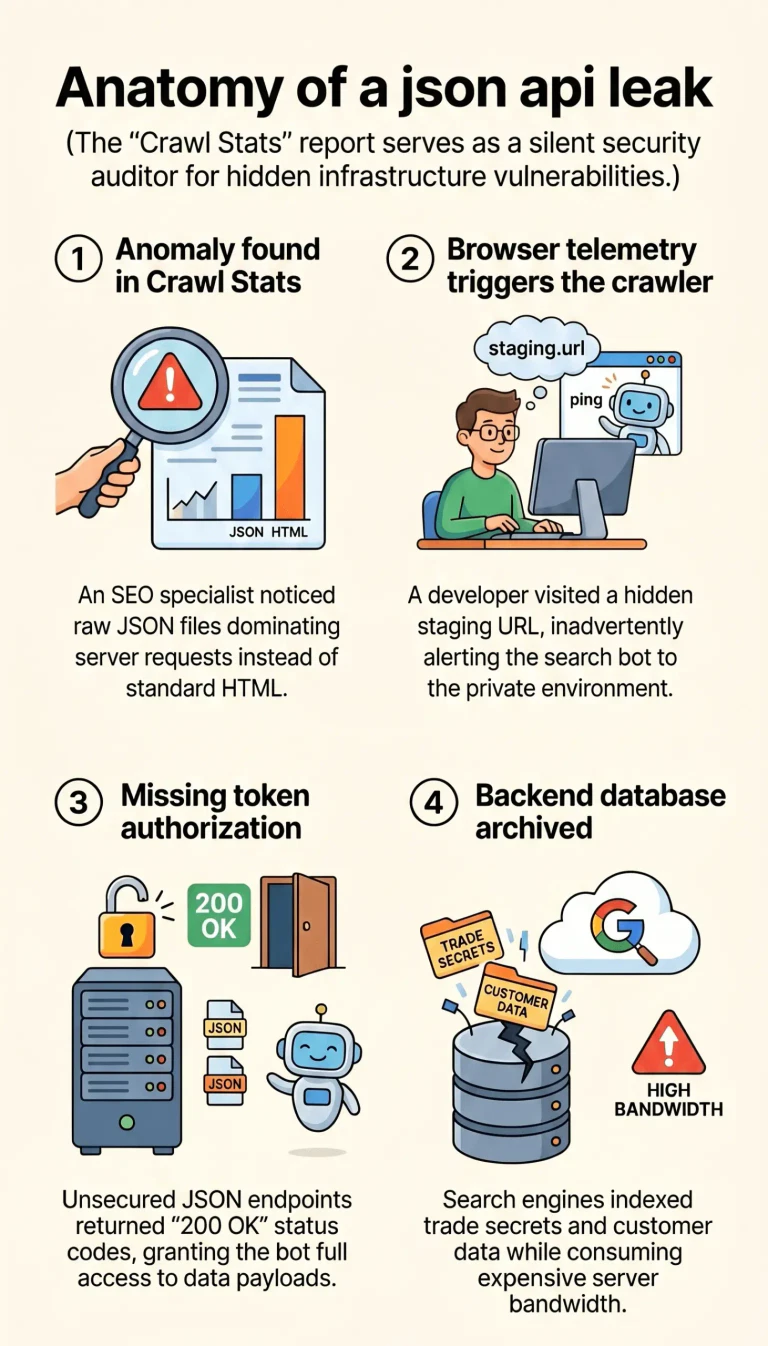
An SEO specialist conducting a routine technical audit opened the crawl stats interface and noticed a devastating anomaly. The file type distribution was completely inverted. Instead of standard HTML documents, the vast majority of server requests were consumed by raw files. This is not a content problem. This is a severe infrastructure hemorrhage. Drilling down into the "Hosts" tab of the report exposed a completely unknown developer subdomain that was supposed to remain isolated from the public web. The system was relentlessly querying exposed JSON endpoints.
Uncovering the hidden developer host
How did the algorithm find an unlinked staging environment? A programmer simply loaded the test application in a popular web browser, sending an automated ping to the central indexer via browser telemetry. The machine never sleeps. Once the bot found the unprotected API, it executed standard GET requests. Because the developers failed to implement proper token authorization, the server happily returned a 200 OK status code for every query. The search engine methodically archived the company's entire backend database, treating sensitive data payloads as indexable public knowledge.
Infrastructure and security vulnerabilities
How do automated systems find subdomains that are not linked anywhere? Developers often create temporary staging sites or test APIs, assuming that a lack of hyperlinks provides adequate security. This security through obscurity is a dangerous fallacy. Search engines possess a vast network of discovery mechanisms, relying heavily on browser telemetry to map the web. If a developer visits a hidden staging URL using a popular browser, that telemetry data can be sent back, prompting an automated crawler to investigate the new address. Machines never sleep. Once discovered, the bot will relentlessly catalog the exposed environment.
When a crawler hits these unprotected areas, it does not stop at the HTML shell. It indexes the underlying data. Applications built on modern JavaScript frameworks often communicate via background APIs, passing sensitive information back and forth. If these endpoints lack rigorous token authorization, any properly formatted request will return an unfiltered data payload. An indexing bot will happily archive these structural files, exposing your proprietary business logic and customer data. You are essentially paying for the server bandwidth used to leak your own trade secrets to the public internet.
The threat environment expands significantly when we look at actors disguising their identity. Cybercriminals routinely scan corporate infrastructures for vulnerabilities, outdated plugins, and exposed admin panels. To avoid triggering security alerts, they spoof their user agents, pretending to be legitimate search engine bots. Attackers fake their identities. Afraid of accidentally blocking search engines and losing organic traffic, many system administrators whitelist these user agents in their Web Application Firewall. They let malicious traffic bypass security controls completely, cheering for an artificial increase in indexing statistics while the server is being breached.
Defending against these types of massive infrastructural abuses does not require hiring expensive consultants. It requires the implementation of hard, mathematical verifications of network layers. The only indisputable way to confirm a query sender's authenticity in an internet system is to use precise Reverse DNS verification. If outgoing traffic in server logs identifies itself with a powerful corporation's header, the analytical script must automatically resolve the IP address back to a public domain name. Genuine indexing software always operates within a closed addressing environment. If the verification fails, the firewall must drop the connection immediately.
The brutal economics of digital breaches
API vulnerabilities cause massive financial drain. Negligence in the architectural planning of interfaces represents tangible, logarithmically growing financial losses erasing the operational profits of tech corporations. The phenomenon of abandoned interfaces constitutes one of the dominant attack vectors in complex digital ecosystems. Cybersecurity operations teams remain entirely blind to the existence of these hidden data exchange processes. It is impossible to implement a protective policy for a Shadow API if the monitoring systems have no clue it exists. Attackers meticulously and methodically exploit this communication gap between enterprise departments.
The numbers leave absolutely no illusions. According to recent global analyses, the average unit cost of a breach incident worldwide sits at 4.44 million dollars for 2025. In the United States, the average cost reached a record high exceeding 10.22 million dollars for a single information security breach. Markets do not forgive competence gaps. The average incident lifecycle dropped slightly to 241 days, with the vast majority of this massive time buffer being the period when an attacker silently operates inside company systems. Every day of delay means thousands of secretly exfiltrated records and wasted bandwidth. Time is money.
| Operational risk analysis metric | 2024 level | 2025 level | Direct strategic consequences |
| Global average incident cost | $4.88M | $4.44M | Brutal depletion of free cash flows |
| Average breach cost in USA | $9.36M | $10.22M | Extreme hit to market valuation |
| Breach lifecycle (Ident. + Contain.) | 258 days | 241 days | Permanent loss of trust from B2B partners |
| Attacks using malicious encryption | N/A | $5.08M | Irreversible capital drain to hackers |
| Quantified lost business impact | $1.58M | $1.47M | Revenue cannibalization from downtime |
Source: https://www.bakerdonelson.com/webfiles/Publications/20250822_Cost-of-a-Data-Breach-Report-2025.pdf.
The Gemini API billing catastrophe
The devastating financial impact of exposed infrastructure was brutally demonstrated recently. For over a decade, developers were officially encouraged to embed certain identifiers directly into client-side code, as they were meant only for billing identification. Indexing tools meticulously archived every openly exposed character string. They created a global database of potential skeleton keys waiting for a technological paradigm shift. The resulting security debt exploded overnight. What was once a harmless string instantly transformed into a highly privileged cryptographic identifier for powerful cloud services.
The strike came when the cloud provider linked powerful interfaces to advanced language models without rigorous restrictions. The mechanism automatically assimilated the permissions of all historical touchpoints existing within a specific developer environment. Security researchers immediately demonstrated the destructive scale of this phenomenon. They found nearly three thousand fully functional access keys in the open spaces of the internet. These keys suddenly gained the right to run incredibly expensive processes on the provider's massive GPU computing machines. The Generative Language API turned an open address book into a list of defenseless victims of a billing system.
Budget alerts proved entirely useless against automated exploitation. Cloud billing systems operate with significant latency, often taking up to 30 hours to report actual usage from distributed server clusters. Attackers scraped public keys and used them to power massive botnets making endless inference requests. One independent developer woke up to a 15,400 dollar bill despite revoking his key within minutes of an alert. In another instance, a small development team was hit with an 82,314 dollar charge in just 48 hours. The asynchronous billing delay allowed malicious software to operate unhindered, systematically increasing the victim's technological debt before any human intervention could stop the bleeding.
Economics, marketing, and algorithmic reality
For years, the digital marketing industry operated in a vacuum. We were forced to rely on corporate public relations statements regarding how ranking algorithms functioned. A massive leak of over 2,500 pages of internal documentation shifted the industry entirely. While we must treat this documentation analytically, it provided unprecedented insight into the actual mechanisms of search visibility. The files strongly suggest that the algorithm is deeply integrated with user behavior. The Content Warehouse API leak effectively validated the efforts of marketers who prioritize brand building and user experience over manipulative keyword stuffing.
The most profound revelation points to a system heavily reliant on clickstream data. Known internally by a specific moniker, this module allegedly evaluates the quality of a website based on actual user engagement. It measures the difference between a long click, where a user stays on the site and consumes content, and a short click indicating massive dissatisfaction. User behavior dictates ranking. This NavBoost mechanism proves that real marketing matters. If a company invests in exceptional usability and strong brand recall, users will engage deeply with the site, generating the exact behavioral signals the algorithm requires.
The leaked documentation also contradicted long-standing public denials regarding the existence of a unified domain metric. The files suggest the presence of a variable evaluating the overall strength and trust of a host. Brands win eventually. This metric implies that isolated, technically perfect pages will still struggle if they belong to a domain with zero market recognition. Building digital public relations and establishing an authoritative brand presence are not vanity exercises. They are structural requirements for competing in high-stakes B2B markets. The siteAuthority metric forces a radical reorientation of traffic acquisition strategies.
The modern digital ecosystem requires a complete collapse of traditional corporate silos. The SEO team cannot operate in a vacuum, optimizing title tags while ignoring the server's error rate. The security team cannot lock down APIs without understanding how those rules impact the crawler's ability to render the site. And the marketing department cannot expect to rank without delivering a frictionless user experience. Silos must fall. True business continuity and profitable growth now demand a unified strategy where technical precision, bulletproof infrastructure, and authentic brand marketing operate seamlessly together.


