

Key takeaways from the Keyword Cannibalization analysis
Keyword cannibalization and misaligned user intent silently destroy site architecture and conversion rates. To stop competing against yourself and hold marketing agencies accountable, you must actively consolidate your digital assets:
- 1. The destructive cost of topical duplication Failing to diversify content forces your own pages into a ranking war. This cannibalization splits organic traffic, drops aggregate click-through rates, and drains your crawl budget, causing search engine bots to process worthless copies instead of your core product pages.
- 2. Misaligned intent and agency deception When marketing vendors mistakenly position informational pages for transactional queries, conversion rates are instantly killed. Agencies frequently attempt to hide this complete lack of impact on actual corporate revenue behind superficial vanity metrics.
- 3. Data-driven detection and consolidation Utilize automated detection tools, like the Herfindahl-Hirschman Index (HHI), to precisely measure click dispersion and prioritize failing URL clusters. Resolving these bottlenecks via permanent 301 redirects is the most cost-effective way to fuse weak articles into a single, dominant ranking asset.
The digital marketing market thrives on radical information asymmetry. Vendors regularly exploit executive ignorance to monetize processes that mathematically cannot yield a return on investment. This is pure fiction. When a company pays for thousands of aimless visits generated by automated scripts, and directors applaud artificial visibility spikes at quarterly meetings, they ignore the brutal financial truth. Agencies deliberately focus reporting on indicators that show zero statistical correlation with sales funnel throughput or ultimate project profitability. Proper analysis completely discounts organic traffic that lacks transactional intent, treating it as an operational loss.
Promising a guaranteed first-place ranking remains the most damaging manipulation in the tech industry. Mountain View engineers deploy hundreds of code modifications annually, and quality evaluation parameters undergo continuous, dynamic recalculation in real-time. Nobody controls this system. Firms that promise flawless positioning usually select phrases with zero commercial search demand or deploy risky hyperlink manipulation techniques. Markets quickly verify operating models built on false promises. Authentic technical optimization requires patience and deep investment, yet the pressure for instant charts forces clients to buy the illusion of control over an unpredictable algorithm. We burn thousands of dollars on campaigns driving empty traffic from distant markets, and then act surprised when the order system is empty—is this what scalable growth looks like?
A lack of transparency serves as the standard operating procedure for many lower-tier execution entities. Hiding behind confidentiality clauses while simultaneously masking actual programmatic work on the client's server is an immediate red flag. Verifying profitability demands full access to server logs, link structures, and source code modification history. If a subcontractor refuses to grant administrative access to tracking tools, they are likely hiding the leasing of worthless private networks or complete inactivity regarding their assigned tasks. Cutting the marketing director off from their own analytics tools is a practice as insolent as it is widely accepted by unaware entrepreneurs.
In the pursuit of artificial growth, agencies frequently base their strategies on massive, uncontrolled link production. The promise of delivering five hundred backlinks a month sounds impressive on a proposal spreadsheet. Reality disappoints. The vast majority of these originate from private blog networks (PBNs) or fully automated exchange systems, which categorizing machines easily ignore or flag as blatant manipulation attempts. Rigorous selection always outweighs volume when building a link profile, and ignoring this mathematical fact results in manual penalty filters. Rebuilding domain reputation after such an incident consumes budgets far exceeding the costs of slow, organic expansion.
| Agency metric (The illusion) | Business reality (Hard data) | Algorithmic mechanism |
|---|---|---|
| First place guarantee | Zero growth in sales inquiries | Targeting long-tail phrases with zero market demand |
| 1000 new backlinks | Burning $5,000 on PBN link farms | Penguin algorithm ignores signals or applies filters |
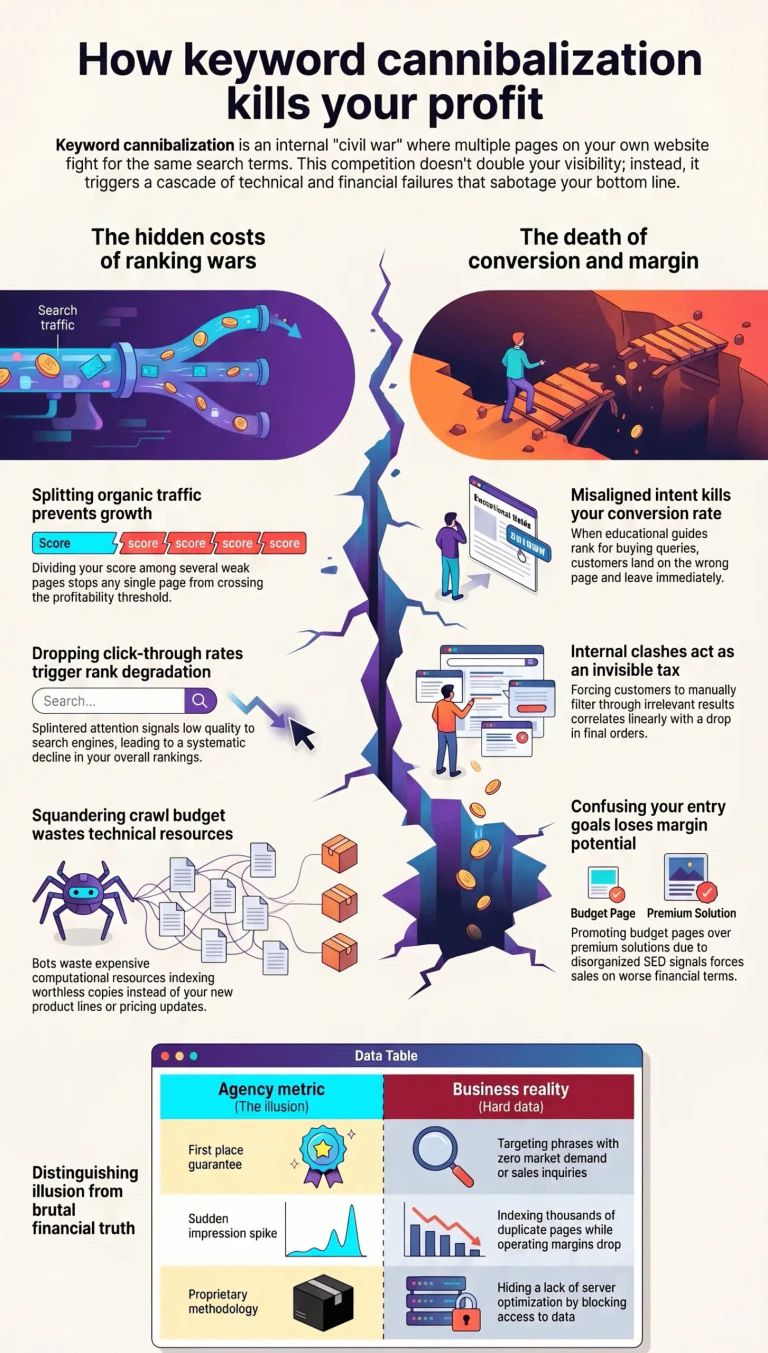
| Sudden impression spike | Drop in e-commerce operating margin | Indexing thousands of duplicate content pages |
| Proprietary methodology | No access to client's own data | Agency hides the lack of source code optimization |
Reporting mystification is the art of bypassing the financial consequences of one's actions. Automated PDF documents sent monthly, stripped of any critical interpretive layer, serve solely to justify the issued invoice. They carry zero value. The absence of data linking specific site interventions to bounce rates or average lead acquisition costs exposes these summaries as useless. Reliable execution relies on continuously adapting tactics to the search engine's shifting boundary conditions. Mechanically reading ranking positions misses the point completely, as results fluctuate wildly depending on mobile devices and user geolocation.
Ignoring the specific nature of a client's business model is another common error. Extrapolating identical, boilerplate optimization templates onto every client is a direct route to destroying their visibility. Understanding the product life cycle, purchasing decision workflows, and target consumer habits is absolutely necessary to calculate profitability. Competitor analysis defines the budget. Genuine information architecture requires structuring data in a way that reflects the enterprise's business logic, otherwise, it wastes resources attracting an audience that will never pull out a credit card.
Technical definition and algorithmic chaos
Competing for bot attention against your own server assets is the most absurd scenario in digital management. As corporate websites swell, individual publications inevitably overlap in vector space. This phenomenon occurs ruthlessly when two or more URLs within the same domain target identical queries, throwing indexing scripts into analytical paralysis. Machines lose certainty. Instead of selecting one indisputably dominant candidate for the top three results, the system is forced to divide the score among several much weaker units. Ultimately, none of the indexed landing pages cross the profitability threshold. This civil war directly devalues historically accumulated equity.
We must surgically separate text duplication from this specific conflict. HTML documents do not need to contain copied paragraphs to destroy each other in the eyes of the machines. An extensive guide on a corporate blog can completely block the sales potential of a product page, even if different authors wrote both pages three years apart. It is enough that they semantically answer the exact same user problem. Ignoring this fact is a costly structural error. Building topical authority does not mean blindly publishing texts touching every possible aspect of the industry, but strictly assigning narrow thematic clusters to specific locations. Keeping dozens of mediocre articles instead of one exhaustive compendium is the fastest way to lose visibility.
The presence of multiple subpages within a query does not always indicate an operational pathology. The key to deciphering search engine intent lies in precisely categorizing diverse consumer needs. If one broad phrase conceals different motivations—for example, an urgent desire to purchase a device, a need for a review, and hard specification analysis—the algorithm deliberately promotes varied formats from the same domain. Tech giants like Apple capture entire user screens using exactly this tactic, serving perfectly tailored answers for every funnel stage. However, for the vast majority of mid-sized enterprises, a lack of control over search intent guarantees a financial disaster.
Attention economics and signal fragmentation
When several pages from the same portal rotate between the fifth and tenth positions for a primary query, the attention of potential clients drastically splinters. The global number of impressions divides proportionally. This prevents any single page from generating a dense enough traffic stream, which sends a powerful signal of low material quality to machine learning systems. Statistics never lie. A systematic decline in the aggregate click-through rate (CTR) acts as a direct trigger for rank degradation, because algorithms constantly adjust the ranking structure to historical behavioral patterns. By paying for the production of new texts, a company effectively finances the eviction of its own services from the first page of results.
Score dispersion also hits the most expensive resource in the digital ecosystem: links. Building external credibility based on natural recommendations strains the budget to an extreme degree. When trusted industry portals direct their hyperlinks to diverse subpages discussing the exact same knowledge segment, the earned link equity is brutally fragmented. Instead of a single, ironclad category page, the domain keeps several useless entities alive. Consolidating this precious ranking power (PageRank) onto a carefully selected document would immediately boost its value in the mathematical evaluation process. Tolerating this stratification is agreeing to waste cash.
Information vectors delivered to indexing bots become highly contradictory in this scenario. Fluctuations and sudden jumps, defined in industry literature as "flipping", illustrate a situation where the search engine drastically changes its mind every few days about which document should represent the company. This means constant destabilization. Each internal rotation resets the accumulated data pools regarding attention retention metrics. The machine simply cannot pinpoint an absolute source of truth. Forcing evaluation algorithms to constantly verify your site's own priorities generates opportunity costs amounting to tens of thousands of dollars in lost monthly revenue.
Technical infrastructure and indexing budgets
Managing the attention of automated network bots is a rarely discussed, yet absolutely critical foundation for large-scale optimization. Every domain receives a mathematically calculated limit of visits and computational resources that the Mountain View corporation is willing to allocate. Maintaining thousands of URLs with similar meanings forces crawlers to unproductively analyze redundant character strings. Instead of instantly detecting newly introduced product lines or refreshing crucial pricing changes, the system burns its crawl budget traversing endless labyrinths of duplicated guides. These consequences manifest as product indexing delays, which for e-commerce stores means a direct loss of turnover.
From a cost-benefit perspective, squandering network infrastructure bandwidth on processing repeated concepts drains the bank account. The cost of copywriter labor, server space rental, and technical department man-hours is simply canceled out. The situation becomes dramatic when newly published, high-budget reports lose the visibility battle to forgotten texts from several years ago. We expect a return on investment from new architecture, while technical debt sabotages expansion. Disregarding the hard laws of rigorous information structure is managerial negligence that ruthlessly slashes the EBITDA margin in any digital project.
The financial fallout of flawed optimization
The consequences of overlapping intent extend far beyond the aesthetics of charts in monitoring applications. The most painful dimension of this problem is the complete collapse of the purchasing logic. Consider a Chief Financial Officer searching for invoicing software. He types in a query of a strictly business nature. Instead of a cleanly designed table featuring subscription models and a system demonstration, Google servers load a prehistoric article defining a VAT invoice. The visit counter ticks. Transactions remain zero. Strong commercial intent crashes against a primitive educational format, which instantly drives up the bounce rate and reduces conversions to a mathematical zero.
Internal clashes within extensive e-commerce environments function as an invisible tax on technical incompetence. When an expansive main category page starts fighting for a position against a specific product model from the same manufacturer, the consumer is forced to click back and filter manually. Forcing additional actions on the user correlates linearly with a drop in final orders. A buyer looking for a precise model lands in a sea of a hundred and fifty other items. Closes the tab. Properly separating general queries from highly specific ones requires implementing advanced internal linking and flawless script handling. Otherwise, we are funding the success of our direct competition.
Misclassifying the entry goal generates irreversible losses in the profitability of individual transactions. When a client seeking a premium solution gets redirected to a subpage promoting a budget equivalent—simply because the latter accumulated more disorganized external signals in the past—the enterprise closes the sale, but on significantly worse financial terms. We lose margin potential. Document architecture on servers is not a matter of front-end aesthetics. It is hard engineering that dictates the shape of cash flows, stemming from the need to maintain full control over the journey of capital across the enterprise's digital assets.
Vector analysis and algorithmic intent evaluation
Understanding the mechanisms by which modern learning systems interpret word relations is a fundamental condition for maintaining profitability online. The traditional, primitive counting of word occurrences in text has faded into oblivion, replaced by vector analysis in multidimensional spaces. Engines like BERT group queries based on their hidden operational meaning, completely ignoring morphological differences. This forces the abandonment of old habits. Grouping hundreds of interrelated synonyms and intents around one powerful document is now the only effective tactic. Architecture based on semantic clustering has evolved from a theoretical curiosity into a ruthless technological requirement implemented by the market's largest players.
Introducing automation in detection forces teams to adapt tools from the economics of monopolistic phenomena. Traffic concentration within specific subpages can and must be precisely modeled mathematically. A low concentration level proves that destructive cannibalization processes are underway, and quality indicators melt away every day. A high coefficient isolates the winner. Applying hard measures from financial markets to evaluate network behavior allows for the immediate localization of leaks in sales funnels. Calculated within an analytical environment, the Herfindahl-Hirschman Index ruthlessly exposes site structural weaknesses that traditional metrics remained completely blind to.
Advanced detection and concentration metrics
The HHI (Herfindahl-Hirschman Index) mathematical model, originally designed to measure market share concentration in industry, has found a brilliant application in visibility engineering. The algorithm calculates the sum of the squared percentage shares of all competing subpages for an analyzed query within the site ecosystem. Numbers never lie. This creates a hard dispersion metric. The resulting parameter allows for instant sorting of conflicts based on their destructive potential. The highest repair priority goes to segments where traffic splits in a 40/60 ratio, which signals to the machine a complete inability to select a leader. Regularly evaluating click share using this index turns guessing into a hard decision-making process.
Mastering this model enables rapid allocation of man-hours where they will yield the highest profit. Medium-severity conflicts, usually manifesting as fluctuations between the fourth and fifteenth positions, can enter the highest-margin zone within weeks after physical document consolidation. The system flags these events as the easiest optimization targets. In situations where one variant captures over 90% of all user activity, analytics classify the incident as a low-harm error that can be safely ignored from a business perspective. Basing work on algorithmic prioritization protects marketing departments from wasting time on defects that have absolutely zero impact on the final profit and loss statement.
Diagnosing the problem in Google Search Console
The free diagnostic platform provided by the most popular search engine operator remains the most raw, direct source of data regarding a project's technical health. The biggest mistake is relying on interpolated estimates from commercial tools while ignoring hard system logs. Proper behavior interpretation requires the ruthless application of filtering layers. The strategist isolates one specific, highly lucrative query in the system. The subsequent step seals the diagnosis. Switching the view to the performance report tab and sorting the URLs mercilessly exposes the machine's attempts to promote more than one asset for the exact same purchasing intent.
Numbers reveal truth. True detective work begins when plotting timelines and analyzing long-term volatility. Reviewing data from extensive intervals reveals pathological patterns where different URLs systematically cannibalize each other in monthly cycles. When a deep technical article suddenly and inexplicably eliminates the main service page from the ranking, only to vanish into the void days later, we witness classic proof of vector chaos. Such jumps completely destroy revenue predictability. Routine checks of historical visibility for phrases generating 80% of company profits is a non-negotiable duty in any smoothly functioning marketing structure.
Verifying intent for grouped conflicts, however, requires human intelligence. Scripts will flawlessly identify the rivalry, but a human must make the business decision on whether the identified subpages actually overlap in the context of transactional intent. Does a cursory audit of both disputed addresses indicate they try to solve the identical customer pain? If the diagnosis is positive, structural cuts are inevitable. Sometimes, however, it turns out that one address offers wholesale pricing while the other provides implementation instructions—in which case the rivalry is merely a false artifact of query broadness. A lack of proper query analysis leads to absurd decisions to delete content that effectively served specific niches in the conversion funnel.
Automation and third-party tools
Machines operate faster. When site size is measured in hundreds of thousands of subpages, attempting manual verification using free tools borders on managerial incompetence. Adapting software that utilizes APIs to suck in and process gigabytes of raw logs becomes a hard operational requirement. Algorithms from the TrueRanker or Unclash AI family scan visibility in real-time, assigning health metrics to specific clusters and alerting technical teams to escalating URL collisions. Shifting this burden to automated monitoring frees the most expensive experts from manual labor, allowing them to focus entirely on fusion architecture.
Preventative engineering, relying on machine learning to stop problems from forming before the coding stage, defines modern campaign planning. Verifying the concept replaces treating the symptoms. Analytics platforms measure SERP similarity coefficients for projected clusters, blocking copywriters from generating digital clones right at the brief stage. The cost of prevention is a fraction of the subsequent repair cost. Weaving these verification mechanisms into the daily publication rigor is the only dam against advancing system entropy. Implementing a preventative audit definitively cuts off the head of the mass and useless document duplication hydra.
Architectural restructuring and repair methods
A correct diagnosis is merely a starting point for brutal and necessary structural modifications. After confirming pathological intent overlap, selecting the repair procedure defines the shape of future financial streams. The most invasive technique, yet the one guaranteeing the highest rate of return, is the physical fusion of competing assets. Several bloated, mediocre articles merge into one monumental, factually flawless foundation. Drop the ballast. This process forces the editorial team to extract from the deleted pages only those paragraphs that historically delivered actual traffic. The content consolidation operation generates a hard quality signal with an incomparably higher concentration of trust from the search engine.
Deleting duplicated documents from the server without feeding bots a new vector is begging for an avalanche of HTTP errors and the immediate destruction of visibility built over years. The main safety mechanism during a fusion is forcing the robots to intercept and transfer old ranking signals to the new target address. The tool for this purpose is a permanent location change at the header level. When crawlers encounter this server directive, they transfer all accumulated link capital to the dominant document without objection. Rigorous implementation of 301 redirects sums up the strength of the removed subpages, instantly catapulting the refreshed asset over the heads of dormant competition. Pick one winner.
Business reality sometimes dictates maintaining both rival documents, especially when one is essential for informational queries and the other drives primary revenue. When physical deletion is off the table, aggressive reverse engineering of the commercially weaker asset is required. The technical team completely rewrites the H1 tag structure, titles, and body copy snippets, forcing the algorithm to assign this document to multi-word phrases at the very end of the long tail. This clears the battlefield. This type of rigorous de-optimization retains guide traffic while simultaneously freeing up critical ranking space for the high-margin transactional page.
Managing hierarchy through linking
When limitations imposed by database management systems block server-level manipulation, hyperlinks woven into the site's own code take over steering virtual capital flow. The density of relationships within a service directly programs learning machines, informing them about the importance of specific entities. A massive increase in hyperlinks directing the bot to the core sales page, supported by absolutely precise keyword selection, serves as irrefutable proof of authority. We impose hierarchy. Simultaneously, cutting the rival article off from support across other parts of the site is often enough to extinguish the fire. Precisely modeling internal linking is a powerful, entirely free weapon requiring no input from external software firms.
Unfortunately, glaring editorial negligence regularly leads to the sabotage of internal structures. The most common sin involves directing users to archival blog posts using the exact same broad terms that link to the most expensive e-commerce categories in the top navigation. The logical system completely decomposes. This demands iron discipline regarding phrase mapping across the entire portal. The architecture of anchor texts cannot rely on interns typing random words; it must stem from a rigid guideline document protecting the integrity of the main sales funnels.
Parameterization and canonical tags in e-commerce
The architecture of massive digital storefronts inherently forces pathological duplication, directly resulting from the need to filter thousands of product variants. On-the-fly URL parameterization generates hundreds of irrelevant clones that look to the indexing robot like aggressively warring armies from the same nation. In this closed environment, server-level 301 cuts would destroy the database and eliminate sorting capabilities. The only salvation is pasting a special directive into the document's code, pointing the machine to the absolute, parameter-free original. This mechanism forces the system into submission. Perfect integration of canonical tags absorbs signals scattered across thousands of variants and injects them into one base URL, protecting the entire structure from drowning in its own garbage.
However, artificial intelligence systems ruthlessly test the effectiveness of this method. Code verifying a document's originality is merely a strong suggestion for Google's engines, which means that given noticeable differences in page rendering, robots will simply ignore it and pick a false favorite on their own. Furthermore, recalculating capital flow via this attribute takes significantly longer than hard server interventions. Despite these technological weaknesses, it remains the only scalable way to protect massive product databases. Rigorous handling of sorting parameters saves hundreds of thousands of dollars in commissions that would otherwise vanish into the abyss of the fourth and fifth result pages, where no client ever voluntarily ventures.
Preventative architecture and scaling growth
Reacting to structural crises in real-time consumes capital that should be invested in market expansion. The definitive escape from endless ranking fires is building a logical cluster structure before ever signing a contract with the first copywriter. Mapping tightly related topics around a single thematic core, with a strict ban on crossing intents, forms an unbreakable foundation. One business need always equals one file. Such ruthless assertiveness during content mapping at the interface wireframing stage lowers future server and positioning costs by orders of magnitude. Lacking this plan guarantees failure.
Expanding the reach of corporate portals cannot rely on chaotically tacking on random features. Top-tier educational articles must support specific commercial pages, rather than attempting to steal fractions of a percent of their click-through rate from the mainstream. Concentrating hard knowledge and hyperlink power around a selected, narrow group of communication nodes generates algorithmic pressure that competitors with smaller budgets cannot possibly fight against. A thoughtfully designed Silo architecture protects the ecosystem from rotting from the inside out, precisely tunneling user queries directly to the checkout screens.
Fluctuation monitoring and market risk assessment
Even perfectly designed systems cannot be left entirely to the mercy of continuously learning machines. These phenomena require constant oversight, particularly after massive migrations or portal acquisitions. A monthly, automated review of the entire structure for intent duplication must become ingrained as a standard security procedure. We keep a finger on the pulse. Pushing a batch of updates exceeding a dozen pages to production should instantly trigger diagnostic scripts. Utilizing applications executing daily rank tracking with an address rotation warning module gives engineers a chance to react before traffic instability inflicts damage on the corporate account.
Ignoring hidden conflicts between subdomains—for instance, a blog hosted on a separate subdomain versus the core e-commerce platform—guarantees a painful reckoning by the brutal laws of the market. Google's machines will treat both sections as separate organisms, which nevertheless devour the same resources and ultimately destroy each other on the battlefield for the exact same client. Losing integration is a managerial failure. This forces the construction of integrated analytics dashboards. Only aggressive, analytical rigor and ruthless attention to project profitability guarantee that the marketing budget will transform into market share, rather than into commissions for vendors selling the illusion of supposedly free organic traffic. The numbers must align.


