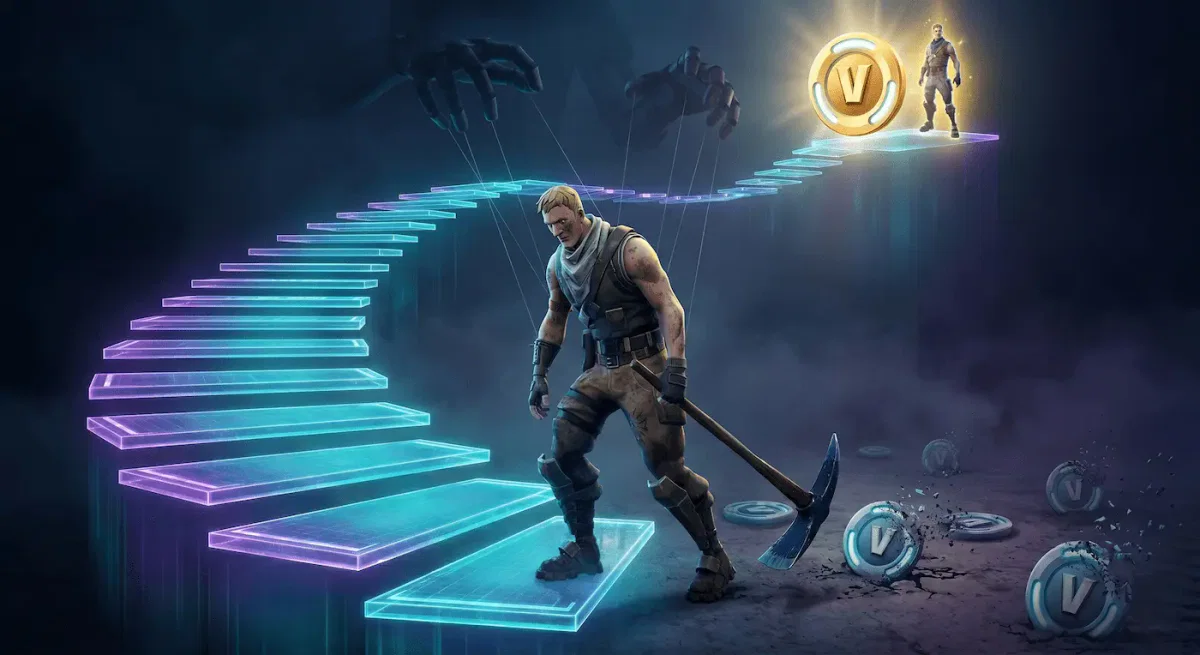
Epic's March 2026 changes made the currency trade-off less generous: the pass moved to an 800-V-Buck purchase price with 800 V-Bucks available through completion, replacing a 1,000-V-Buck price and up to 1,500 in rewards. This analysis uses that dated change as its reference point; it is not a claim that every future season will have the same terms.
- The surplus disappeared. Under the March terms, completing the pass replenished its purchase price but did not generate the previous 500-V-Buck surplus.
- Time is a separate cost. A player may enjoy the progression, dislike it or feel obliged to finish. There is no verified universal hours-per-pass estimate here.
- The FTC record concerns specific historical practices. It supports scrutiny of purchase design, not a medical diagnosis of current players or every current feature.
What changed in March 2026
Epic publicly announced a V-Bucks price increase effective March 19. The advertised US dollar pack prices stayed the same while the amount of currency in each pack fell. The company also described the pass's new 800-cost, 800-reward structure and the end of V-Bucks in Bonus Rewards. Epic's March 10 price notice.
- $8.99. Previous V-Bucks: 1,000 New V-Bucks: 800 Fewer V-Bucks: 20.0% Increase in price per V-Buck: 25.0%
- $22.99. Previous V-Bucks: 2,800 New V-Bucks: 2,400 Fewer V-Bucks: 14.3% Increase in price per V-Buck: 16.7%
- $36.99. Previous V-Bucks: 5,000 New V-Bucks: 4,500 Fewer V-Bucks: 10.0% Increase in price per V-Buck: 11.1%
- $89.99. Previous V-Bucks: 13,500 New V-Bucks: 12,500 Fewer V-Bucks: 7.4% Increase in price per V-Buck: 8.0%
The two percentages answer different questions. For the smallest pack, 200 fewer units out of 1,000 is a 20% quantity reduction; paying the same amount for 800 instead of 1,000 raises the unit price by 25%. These calculations exclude regional differences and any separate rewards credit.
There is a useful counterpoint: both the old 1,000-V-Buck pass and the new 800-V-Buck pass could be funded by the advertised $8.99 pack in their respective structures. The smallest-pack cash entry cost therefore did not rise in this comparison. What changed was the currency received and the potential surplus after completing the pass.
Break-even is conditional, not imaginary
The arithmetic is straightforward. Previously, 1,500 earned minus 1,000 spent left 500 V-Bucks. Under the new terms, 800 earned minus 800 spent leaves zero. That is a reduction in reward generosity; it does not mean a player who completes the pass cannot fund the next one.
The word “profit” can be misleading here. These are units of game currency, not a cash return. A player buys access to cosmetic rewards and progression, not an investment promising financial earnings. Their value depends partly on whether the player wants the items and enjoys the play involved.
Renewal also depends on not spending the returned currency in the shop. If a player uses it on another item, the next pass may require an additional purchase. That is a real budget trade-off, but it should be described plainly rather than as proof that renewal never works.
The time cost needs a method
A credible estimate of completion time needs a defined season, target rewards, starting position, quest access, modes played and a measured earning rate. An XP-per-minute table without those details can create false precision. Quest rewards, updates and play styles can change the result.
This article does not establish that a player must earn 155,295 XP every day, play Battle Royale for 7.4 hours daily or spend 80–150 hours to finish. Those quantities should not be used to diagnose the pass or the player's behavior without a reproducible calculation and dated evidence.
A more useful personal calculation starts with time someone actually wants to spend. In an illustrative example, three hours a week over eight weeks is a 24-hour leisure budget. That is not a completion estimate. It is a boundary against which the player can judge whether the desired rewards remain attractive. If completion requires unwanted extra play, skipping rewards or the pass can be the sensible outcome.
Enjoyed play is not automatically wasted time. The relevant cost is the alternative the person gives up, especially when the game stops being enjoyable. This makes the same progression system a good fit for one player and a poor fit for another.
Why deadlines can feel like obligations
A purchase can encourage someone to keep playing because they have already paid. That is a possible sunk-cost effect: a past expense starts influencing a choice about future time. It is an interpretation of incentives, not evidence that every pass holder experiences it.
Seasonal deadlines and limited bonuses can add pressure. Epic's Showdown announcement offered a launch-week Stealth Tech Foundation bonus for obtaining the pass before March 26, 2026, at 11:59 PM ET. That particular condition was an early-purchase deadline, not a requirement to complete first-week quests. The season also connected faction competition to rewards, with the winning side determining a reward for all Battle Pass owners. The official Showdown conditions.
These designs encourage participation during a specified period. Calling that encouragement coercion, or claiming a secret motive to extract health-damaging levels of play, requires evidence beyond the existence of an event. A critical argument is stronger when it identifies the actual condition and explains why a reader may dislike it.
Exclusivity is more complicated than “never returns”
Epic changed its policy for future Battle Passes in August 2024. Items from those passes may appear in the shop at least 18 months after a pass expires. Return is possible, not guaranteed, and special conditions still need to be read for the particular item. Epic's exclusivity-policy announcement.
That does not eliminate the attraction of obtaining an item during its original season. It does invalidate the blanket claim that all contemporary pass rewards are permanently unavailable afterward. Criticism of fear of missing out should use the rule that actually applies.
Cosmetic categories also need accurate chronology. Kicks arrived in November 2024, while the first Sidekick was introduced through the November 2025 pass. They were not both new inventions of 2026. Their presence can change a player's perception of reward value, but it does not by itself establish that each displaced V-Bucks in a fixed one-for-one exchange. Kicks announcement; Sidekicks announcement.
What the FTC case actually establishes
The December 2022 announcements concerned two separate settlements: a $275 million penalty over children's privacy allegations and $245 million in consumer refunds over unwanted billing and dark-pattern allegations. The total was not a single $520 million fine for the Battle Pass. FTC's announcement.
The later administrative order addresses informed purchase consent and treatment of disputed charges. This is important historical evidence about purchase design. It does not show that every described old interface remains present today, or that the 2026 progression system causes clinical illness. FTC's case record.
How to judge the pass on your own terms
The useful questions are practical. Do you want the particular rewards? Would you play this amount anyway? What happens if you stop halfway? Are you counting on currency you have not yet earned? Is a purchase deadline changing a decision you would otherwise postpone?
For a family, the same discussion can separate spending permission from playtime. An agreed budget does not require buying a pass, and owning a pass does not create an obligation to finish it. Reviewing the current parental and purchase controls can support those boundaries, but no setting should be described as eliminating every accidental or impulsive purchase.
Buying an individual shop item is not automatically a better deal: it may cost more and should be evaluated against the same budget. The option to buy nothing is just as relevant as choosing between two paid products.
The March 2026 change supplies a concrete reason to reassess value: less currency came back after completion. The broader criticism is a judgment about whether time-limited progression fits the player's life. That argument is strong enough without invented XP rates, fabricated reports of suffering or unsupported claims about neurological harm.