

Evidence brief · Health
The second line changes the warning window
Libre Duo makes ketone direction visible beside glucose, but the new visibility must be kept separate from a clinical diagnosis.
- Direction is the new informationA spot ketone result says where the body was at one moment. Continuous readings show whether beta-hydroxybutyrate is stable, falling or accelerating.
- Normal-looking glucose cannot clear the riskAbout one in ten DKA presentations are euglycemic, with glucose below 200 mg/dL. A calm glucose trace is therefore not a complete safety signal.
- The sensor hands off rather than diagnosesDKA still requires ketosis, acidosis and the relevant clinical context. The wearable can bring that assessment forward; it cannot replace it.
The first United States wearable authorised to monitor glucose and ketones continuously does not merely add another number to a diabetes app. Libre Duo changes the time structure of ketone information. Instead of asking someone to notice illness, find a strip and take a single blood measurement, it can reveal the direction of beta-hydroxybutyrate every minute beside the glucose trace already used for daily decisions.
That is a meaningful safety advance for people at elevated risk of diabetic ketoacidosis, including some insulin users and people taking SGLT2 inhibitors. It is also easy to overstate. The device does not measure blood acidity, it does not determine why ketones are rising and it cannot establish DKA on its own. Its real contribution is narrower and more useful: it can shorten the period in which metabolic deterioration remains invisible.
A second trend changes the warning window
Ketone testing has traditionally been event-driven. A person tests because glucose is high, illness has begun, insulin delivery may have failed or symptoms such as nausea and abdominal pain are already present. The result is valuable, but it is a snapshot taken after someone has decided that a snapshot is needed.
Libre Duo moves part of that decision upstream. The FDA-authorised Libre Duo 10 Day is indicated for people aged two years and older and reports glucose and ketone information every minute for up to ten days. Abbott's European system also includes a 15-day version for adults. The crucial shift is not simply greater measurement frequency. It is the ability to see whether two metabolic signals are moving together or separating.
The trace helps guide glucose management, but it can remain below the level many people associate with DKA.
A rising beta-hydroxybutyrate trajectory can expose a developing problem earlier. It still does not show whether the blood is acidotic.
A glucose line that stays relatively flat while a ketone line rises is not a contradiction. It is a clinically important divergence. Continuous dual sensing makes that divergence visible without requiring the user to infer the need for a separate test first.
Euglycemic DKA breaks the glucose-first mental model
The common mental model of DKA begins with very high glucose. That model catches many cases, but not all of them. The American Diabetes Association notes that roughly 10% of people presenting with DKA have euglycemic DKA, defined by glucose below 200 mg/dL in the presence of ketosis and metabolic acidosis.
This matters especially around SGLT2 inhibitors. These medicines can lower glucose through urinary excretion while ketoacidosis develops through a different metabolic path. A person or caregiver who treats the glucose display as the master alarm can therefore receive false reassurance from the very line they know best.
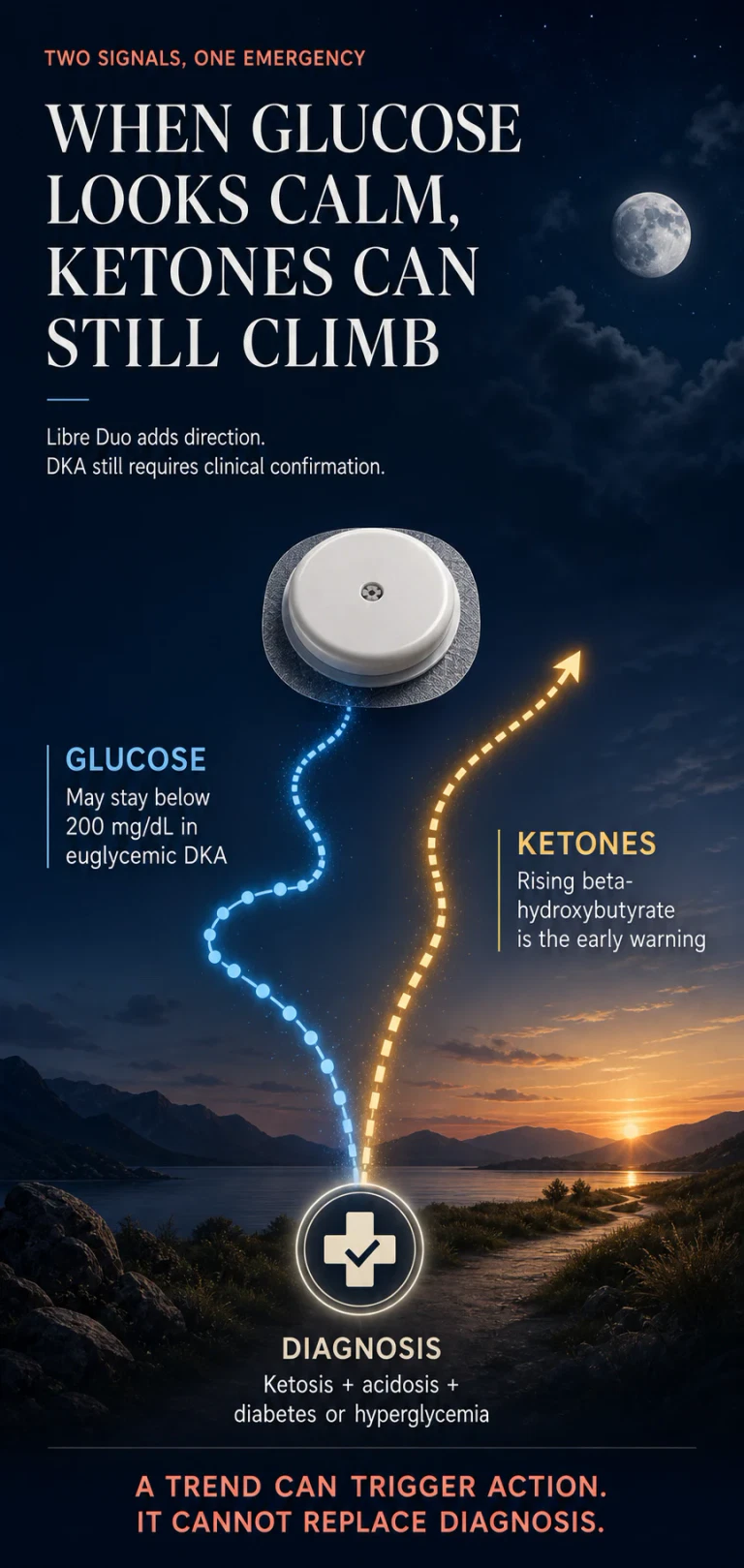
The visual benefit of Libre Duo is therefore not that ketones become more important than glucose. It is that neither line has to impersonate the other. Glucose describes one part of the metabolic state. Beta-hydroxybutyrate describes another. The separation is what makes the pair informative.
The alert is a handoff rather than a diagnosis
FDA's authorisation is explicit that ketone information must be interpreted alongside glucose, symptoms and other available information. That language protects an important distinction. A sensor can identify a pattern that deserves attention; a DKA diagnosis asks a broader physiological question.
Three evidence layers must agree
The wearable supplies a continuously updated signal. The diagnostic conclusion still belongs to the combined clinical and laboratory record.
Under the ADA hospital criteria, DKA requires diabetes or hyperglycemia, beta-hydroxybutyrate of at least 3.0 mmol/L or equivalent ketone evidence, and metabolic acidosis shown by a pH below 7.3 and/or bicarbonate below 18 mmol/L. Libre Duo can contribute to the ketone evidence and show its direction. It does not measure pH or bicarbonate.
This boundary is not a defect in the product. It is the reason the product can be useful without becoming an autonomous diagnostic system. Earlier uncertainty can be actionable. A device does not need to pronounce DKA to help a person follow a sick-day plan, confirm a reading, contact a care team or seek urgent assessment when symptoms and trends align.
Every-minute visibility creates an alert-design problem
More frequent information does not automatically produce better decisions. Ketones can rise during fasting, carbohydrate restriction, prolonged exercise or illness without every rise becoming DKA. A continuous system must therefore make escalation understandable without turning ordinary variation into a permanent emergency.
What each observation can and cannot establish
| Observation | Useful interpretation | Unsafe shortcut |
|---|---|---|
| Ketones rising over consecutive readings | A metabolic change deserves confirmation and the planned response | The wearable has diagnosed DKA |
| Glucose below 200 mg/dL | Classic severe hyperglycemia is absent | DKA is impossible |
| Vomiting, abdominal pain or rapid breathing | Symptoms raise the urgency of ketone information | Wait for the graph to become dramatic |
| Ketones falling after the care plan begins | The direction is reassuring when the person is also improving | No further monitoring or clinical advice is needed |
The design challenge is behavioural as much as analytical. Alerts need a defined action ladder, not just a threshold. For one person that may mean confirming the reading and checking an insulin-delivery problem. For another it may mean contacting the diabetes team or seeking urgent care. The safe action depends on the treatment plan, symptoms, rate of change and clinical history.
That is where continuous monitoring differs from the consumer use of glucose sensors discussed in our analysis of digital weight-loss technologies. In DKA risk, the data is not a lifestyle score. It sits inside a predefined emergency response and must be interpreted with much tighter consequences.
The first authorisation is narrower than a closed-loop promise
FDA reviewed Libre Duo through the De Novo pathway and described six clinical studies involving more than 600 participants. The authorisation establishes a new device category and makes continuous dual sensing available in the United States. It does not establish that ketone readings should directly command automated insulin delivery or that the system can manage DKA without human interpretation.
This is the same evidence discipline that matters when evaluating advanced therapies such as Genglycos in GSDIa or a patient-specific CPS1 base-editing treatment. The innovation can be substantial while the claim remains bounded. In Libre Duo's case, the bounded claim is precisely what makes the new information trustworthy enough to integrate into care.
The value is earlier uncertainty rather than automated certainty
Libre Duo should not be judged by whether it makes DKA diagnosis disappear. It should be judged by whether it reveals a dangerous metabolic direction soon enough for the right next action to happen earlier. That is a different standard from convenience and a more realistic standard than autonomy.
The dual trace is most powerful when glucose and ketones disagree. It can challenge false reassurance, expose the onset of euglycemic DKA and make a sick-day protocol less dependent on remembering to take a separate test at exactly the right moment. But the signal earns its value by handing the case to symptoms, laboratory evidence and clinical judgment, not by pretending those layers have become obsolete.
Questions about Libre Duo and continuous ketone monitoring
Can Libre Duo diagnose diabetic ketoacidosis?
No. It provides continuous glucose and ketone information. DKA diagnosis also requires metabolic acidosis and the relevant clinical context.
Why monitor ketones when glucose is not very high?
Euglycemic DKA can occur with glucose below 200 mg/dL. Ketone direction can reveal risk that a glucose-first mental model misses, particularly around SGLT2 inhibitor use.
How often does Libre Duo measure?
The FDA-authorised Libre Duo 10 Day reports glucose and ketone information every minute and is worn for up to ten days.
Does a ketone rise always mean DKA?
No. Fasting, illness, exercise and dietary patterns can affect ketones. The trajectory must be read with symptoms, glucose, treatment context and the individual's clinical action plan.
Primary clinical and regulatory sources
Materials checked 28 August 2026
- US Food and Drug Administration authorisation announcement for Libre Duo 10 Day
- Abbott product and CE Mark information for Libre Duo
- International expert recommendations for continuous ketone monitoring in diabetes
- ADA Standards of Care 2026 on hyperglycemic crises and ketone monitoring
- ADA Standards of Care 2026 hospital diagnostic criteria for DKA


