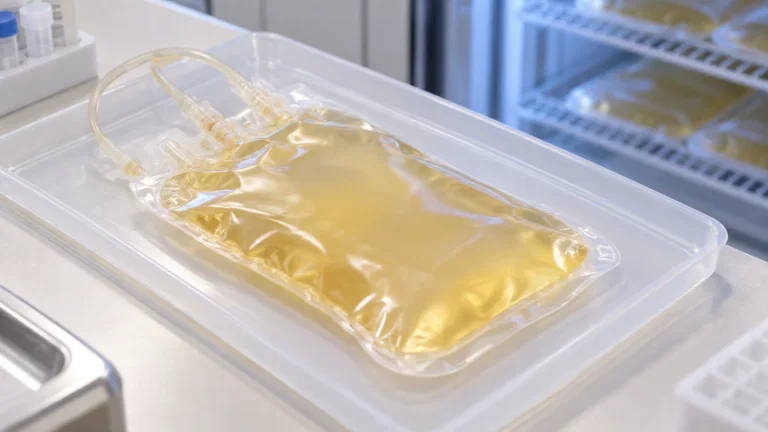
Growing animal cells still needs biological inputs
The FDA overview of food made with cultured animal cells describes cell collection, banking, growth, differentiation and harvesting. The cells come from an animal source, while nutrients and other process inputs support their growth. The composition and sourcing of those inputs must be identified before making claims about the production chain.
Saying the process completely removes animals from the equation is therefore too broad. A more precise claim would explain the source cell line and the medium used by a named process, and state exactly which stage avoids a particular animal-derived input. That can be a meaningful change without pretending the original biological source did not exist.
Cell cultivation also differs from making a target ingredient through microbial fermentation. Both may be discussed under cellular agriculture, but their organisms, inputs and finished products differ. A result from one process should not automatically be transferred to every food in the category.
An environmental result is a scenario with boundaries
The 2023 prospective life-cycle assessment by Sinke and colleagues modelled commercial-scale cultivated-meat production in 2030. It used information from companies and supply chains together with projected improvements. It is an ex-ante assessment of possible future production, not a measurement of an already operating 2030 factory.
The study found that energy sourcing strongly affects the carbon footprint. Its scenarios ranged from more than 14 kg CO₂-equivalent per kilogram of meat with global-average energy to less than 3 kg in an ambitious renewable-energy scenario. The model also found lower land use than the conventional meats it compared. Energy demand and upstream culture-medium production remained important.
Those results do not justify a single guaranteed reduction of more than 90% in both land and water for every product. A responsible comparison identifies the functional unit, reference meat, energy mix, medium and production scale. Lower land demand can coexist with substantial industrial energy demand; different environmental indicators should not be collapsed into one sustainability score.
A cheaper prototype is not a retail price
The same study explicitly distinguishes its assumed future commercial scale from a promise of cost competitiveness. An announcement that a demonstration product became cheaper is not an audited cost for a sustained manufacturing process. Nor is production cost the same as the eventual restaurant or supermarket price.
Before repeating a cost claim, ask what it includes: ingredients, failed batches, capital equipment, labour, quality control, processing and distribution can change the comparison. A historical demonstration burger price and a later laboratory estimate should not be joined into a universal current price of tens of dollars.
Safety requires a product-specific process
The FAO-WHO food-safety work on cell-based food describes the need to identify hazards and apply appropriate controls. A novel production method is not automatically unsafe, but neither can safety be inferred from the appealing idea of a controlled environment. Inputs and manufacturing conditions still matter.
In the United States, the FDA explains its pre-market consultation work and the division of oversight with USDA-FSIS for relevant livestock and poultry products. FDA oversight covers cell collection through growth and differentiation; oversight transfers at harvest for the products covered by the agreement. Subsequent inspection and labelling requirements are separate parts of the process.
A completed consultation for a particular product is therefore not permission for every company to sell any cultured food. It also does not establish worldwide availability: a market claim needs the jurisdiction and current product-specific permissions.
The useful question is which production claim survives checking
For a new announcement, keep four records separate: demonstrated biological performance, independently described production assumptions, product-specific safety and authorization, and actual commercial supply. Progress in one can be real while the others remain unfinished.
Cultivated meat may become an important part of food production, but a reliable assessment will name the process and comparison rather than treat the category as a promise. The most informative milestone is one whose scope can be checked—what was produced, at what scale, using which inputs and under which conditions.
The production method also does not settle the nutritional value of a diet. Our analysis of two diet studies and heart-health outcomes explains the different questions answered by dietary patterns, observed disease events and calculated risk scores.