

Key takeaways from the User-Generated Content Governance analysis
User-generated content is not merely community engagement; it is a critical production system. Without rigorous governance and structural controls, UGC rapidly devolves from a valuable commercial asset into severe operational and legal debt:
- 1. Decoupling contribution from publication A user submission is only an input, not an automatic public asset. Treating UGC as a governed system requires enforcing a strict content lifecycle with separate states for approval, rejection, and archival to ensure only verified, valuable contributions reach your audience.
- 2. Quality controls prevent SEO index bloat Platform design shapes user behavior. Systems that reward high volume and low friction produce thin, duplicate content that creates destructive index bloat. To support organic search visibility, review systems must enforce strict fraud controls and signal weighting.
- 3. Risk management dictates moderation priority Moderation is not just about removing clutter; it is about mitigating severe legal and safety risks. Governance efforts must be prioritized by business exposure, utilizing clear escalation paths, evidence logs, and proactive takedown procedures for sensitive surfaces.
User-generated content is often misunderstood before it is mismanaged. Companies tend to describe it as marketing, community engagement, social proof, or a convenient source of SEO inventory. Those labels are not entirely wrong, but they are incomplete. Before UGC becomes any of those things, it is a production system: a system that accepts external input from people with different incentives, uneven competence, limited accountability, and, in some cases, considerable persistence in exploiting weak controls.
That distinction matters. Once a company treats UGC as a production system, the conversation changes. The issue is no longer only whether users can contribute. The issue is what happens after they do: who reviews the content, which submissions become public, which pages are indexable, which ratings influence commercial decisions, which claims need escalation, and which old contributions should quietly lose visibility over time.
Most UGC failures begin with a classification error. A product team sees a review widget. SEO sees long-tail content. Growth sees contribution volume. Legal sees potential future disputes. Support sees tomorrow morning’s queue. Trust and safety sees the part that is usually acknowledged too late: a public submission surface with incentives, loopholes, persistence, and distribution.
By the time the company notices the system, the content has often already moved through several stages. It has been submitted, stored, published, internally linked, marked up with structured data, indexed, quoted by users, challenged by a business owner, reported by a customer, and routed to a team that was not involved when the submission form was approved.
That is not community strategy. That is deferred platform governance.
Contribution is not publication
The most basic control failure is the collapse of contribution and publication. A user submits something, the platform stores it, and a template makes it visible. Sometimes the page is immediately crawlable. Sometimes it appears in internal search. Sometimes it is attached to a commercial page, as if proximity to a product, listing, or service has somehow converted the submission into trustworthy material.
Those are separate decisions.
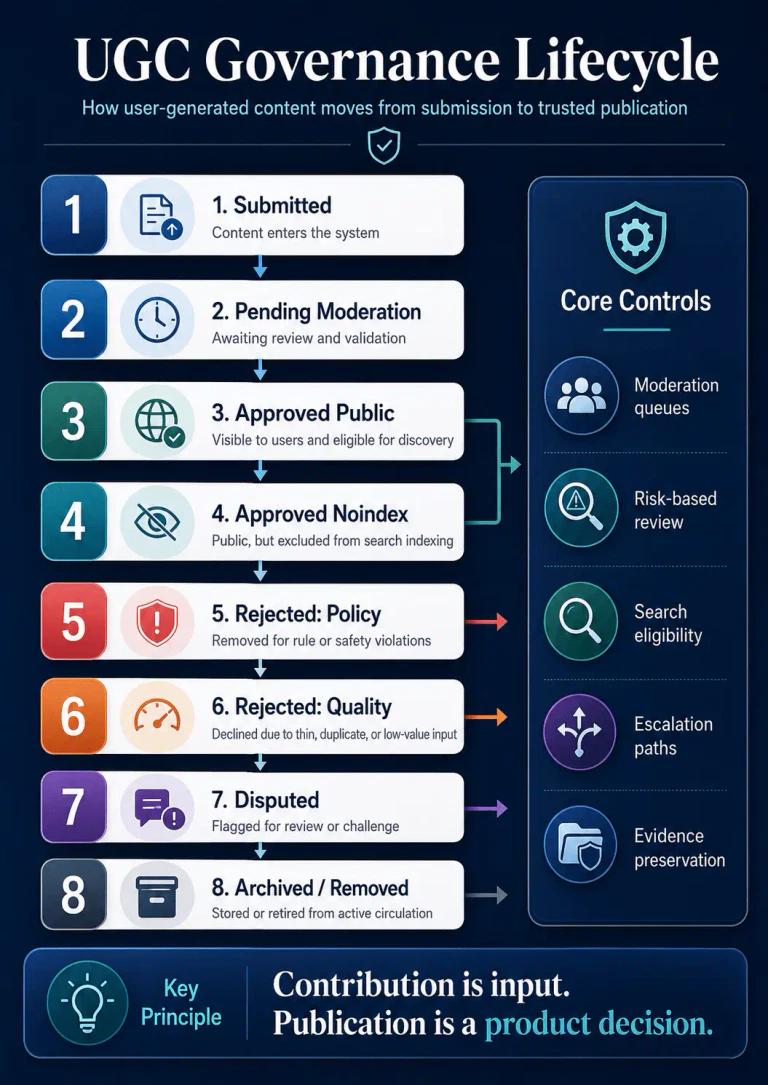
A contribution is an input. Publication is a product decision. Indexation is a search decision. Ranking and internal promotion are distribution decisions. Conversion impact is a trust outcome. Legal accountability does not disappear because the first draft came from an account named “travelking782”.
A platform should be able to answer a simple question: which user submissions are allowed to publish, index, rank internally, and carry review markup? If that answer is unclear, the system is not being governed. It is merely accepting content and hoping downstream teams can manage the consequences.
A serious UGC program needs clear lifecycle states. Submitted content should not behave like approved content. Disputed content should not behave like verified content. Removed content should not remain in sitemaps because a CMS plugin was never configured properly.
At minimum, a platform should distinguish between content that is:
- submitted;
- awaiting moderation;
- approved for public display;
- approved but excluded from search indexing;
- rejected for policy reasons;
- rejected for quality reasons;
- disputed;
- removed for legal or safety reasons;
- archived.
This is not bureaucratic decoration. It gives product, moderation, SEO, legal, and support teams a shared operating model. Without it, every department invents its own version of reality. SEO sees URLs. Moderation sees tickets. Legal sees risk. Engineering sees database rows. Users see a page and assume the company stands behind it.
The expensive part is rarely storing UGC. Storage is cheap until content becomes operational evidence, search inventory, legal material, and conversion friction. Then the old “just let users contribute” decision begins to bill the company through other departments.
Moderation debt has a business cost
A moderation queue is not merely a place where unpleasant content waits to be reviewed. It is a capacity model. It determines how quickly useful contributions become visible and how long harmful or low-value submissions remain in circulation.
Underfunded moderation creates two opposite failures at the same time. Good submissions wait too long, reducing the value of participation. Bad submissions get through, reducing trust in the platform. Both outcomes damage the economics of UGC, although they appear in different dashboards.
Growth may celebrate the number of submissions. Support receives the complaints. SEO audits the index bloat. Legal asks for removal history. Engineering is asked to patch forms that should never have shipped without validation. The dashboard was green, which is how many governance failures introduce themselves.
Moderation should therefore be designed around risk, not merely chronology. Not every contribution deserves the same review treatment. A short comment from an established user on a low-traffic discussion thread is not the same as an accusation attached to a high-revenue marketplace listing. A photo upload is not the same as a star rating. A duplicate question is not the same as a defamatory claim naming an individual.
Risk-weighted moderation reduces waste. It also prevents teams from spending equal time on harmless noise and commercially damaging content. New accounts posting links may need spam review. Low ratings naming specific people may need legal review. Unverified reviews on high-value listings may need trust review. Duplicate questions may need merging rather than publication.
This is not glamorous work. It is useful work. Moderation systems do not need to impress conference audiences. They need to prevent avoidable damage before content becomes indexed, screenshotted, disputed, and escalated.
Moderation delay is also revenue delay
Moderation is often discussed only in terms of harm reduction. That is too narrow. Moderation also controls the speed at which high-quality user contributions become usable assets.
A detailed review from a verified customer, a practical answer in a product Q&A section, or a useful marketplace correction can improve conversion trust. If that content waits in a generic queue behind spam, duplicate comments, abuse reports, and low-risk noise, the platform is delaying its own useful content.
That delay has a cost. It may not appear as a neat line item, but it shows up in weaker page quality, slower contributor feedback, lower motivation to participate, and greater dependence on paid acquisition or internally produced content.
A well-governed UGC system does not simply remove bad content. It accelerates useful content.
Reviews Are Trust Infrastructure
Review volume is not automatically a trust asset. If ratings can be submitted without purchase verification, account history, fraud scoring, or sampling review, the review layer becomes a liability with star-shaped formatting.
The problem is not only fake positivity. Negative manipulation matters too. Competitors, disgruntled users, bots, incentivized reviewers, and low-context drive-by accounts can all distort the signal. The business consequence is conversion trust erosion: users stop treating the rating layer as evidence and begin treating it as decoration.
Once that happens, the platform loses more than review credibility. It loses a trust mechanism that could have reduced hesitation before purchase, booking, registration, or contact.
A rating average is a compression mechanism. It takes many user actions and converts them into a number. That number then appears in product cards, marketplace listings, category pages, search snippets, landing pages, and recommendation systems. If the inputs are weak, the compression makes the weakness harder to inspect.
A five-star average from three unverified accounts should not carry the same commercial weight as a 4.6 average from a large base of verified, recent, text-supported reviews. Without source weighting, the system treats thin participation as trust. That is how platforms end up with highly rated listings that no serious buyer believes.
Review schema requires the same discipline. Structured data should describe governed content, not decorate whatever the database happens to contain. Review markup should appear only when the underlying content is eligible, recent enough, non-duplicative, policy-compliant, and not dominated by suspicious account patterns.
Markup without governance can turn weak UGC into a scaled trust claim.
Search controls are publication controls
UGC creates search value when it adds specific, useful, differentiated information that the platform would not otherwise possess. Product questions, location-specific observations, expert community answers, detailed experience reviews, correction notes, and usage examples can all improve page usefulness.
The same infrastructure can also create index bloat.
Thin comments, abandoned threads, duplicate questions, empty profiles, low-effort ratings, scraped bios, spam replies, and unmoderated uploads can produce large numbers of URLs with little value. If those pages are crawlable, internally linked, present in sitemaps, or attached to commercial templates, the platform may be manufacturing a search quality problem while believing it is building a community.
This should not be reduced to “UGC helps SEO” or “UGC hurts SEO”. Both statements are too blunt. The real question is which user contributions deserve discovery, indexation, ranking support, and internal authority.
Indexation should be tied to quality states. A page containing only a duplicate question and no approved answer does not deserve the same search treatment as a mature thread with verified contributors and useful responses. A listing with unverified ratings should not receive the same structured-data treatment as a page with moderated, purchase-linked reviews.
Good UGC should be findable. Weak UGC should not be promoted into search inventory just because the CMS can generate a URL.
Internal linking also needs governance. In UGC-heavy platforms, internal links are not neutral. They distribute authority and attention. If category pages, listing pages, or recommendation widgets link heavily to weak threads, empty profiles, thin reviews, or duplicate Q&A URLs, the platform spends internal authority on low-value material.
Internal linking rules should favor approved, useful, active, and commercially relevant UGC, not merely recent UGC. Recency is a poor substitute for quality when the newest contribution is spam in a discussion thread.
Platforms create the behavior they reward
UGC quality problems are rarely caused only by bad users. Platforms train contributors through interface design, reward systems, visibility rules, and friction levels.
If the form rewards speed, users submit fragments. If the platform rewards volume, contributors produce repetitive material. If badges are tied to count rather than usefulness, the system manufactures low-value activity. If ratings can be submitted without evidence of experience, manipulation becomes cheaper. If profiles publish by default, empty user pages multiply quietly.
The platform gets the behavior it funds, reduces friction for, and celebrates in dashboards.
Reputation should therefore affect permissions. It should not be treated as community decoration. New accounts may be allowed to submit, but not publish instantly. Trusted contributors may receive faster approval for low-risk categories. Commercially sensitive claims may require manual review regardless of reputation. Upload privileges may require account age, prior approvals, or stronger identity signals.
A simple permission model can prevent avoidable abuse without turning every interaction into airport security.
Legal Exposure Is Not a Cleanup Task
UGC legal risk should not be handled only after publication. By then, the content may already have been indexed, cached, shared, quoted, or used in a transaction.
Reviews may contain defamatory claims. Comments may expose personal data. Media uploads may raise copyright, privacy, or image-rights issues. Marketplace descriptions may include prohibited claims. Community posts may contain harassment, threats, impersonation, or regulated product language.
A platform does not need to solve every legal question inside the moderation interface. It does need escalation paths.
When content is removed for legal or policy reasons, the platform should preserve enough internal evidence to reconstruct what happened: what was submitted, who reported it, what policy was applied, who acted, when the action was taken, whether the user was notified, and whether appeal was available.
That does not mean unsafe content should remain public. It means the company should not lose its own decision history. Legal exposure becomes more expensive when the platform lacks records, policy mapping, and appeal history. Vibes do not age well in disputes.
CMS architecture can manufacture UGC debt
Many UGC problems are architectural before they are editorial. A CMS or marketplace engine may generate pages for every tag, profile, thread, question, review cluster, media upload, and localized variant. Each page may be crawlable by default. Pagination may create near-duplicate URLs. Sitemaps may include everything because exclusion rules were never scoped. Review plugins may output schema automatically because that is easier than deciding whether the content deserves it.
This is how platforms build search quality problems while believing they are building participation.
URL creation should not equal search eligibility. Public visibility should not equal sitemap inclusion. Sitemap inclusion should not equal internal promotion. Each step should require quality signals.
A thread might become public after moderation approval but remain noindexed until it contains a useful answer. A profile might become public only after the contributor has approved submissions. A Q&A page might be merged when similarity thresholds show repeated questions. A review page might be excluded from structured data until verification thresholds are met.
These are product rules, not SEO aftercare.
Old UGC also needs lifecycle controls. Some forum answers, reviews, and Q&A threads remain useful for years. Others become stale, wrong, abandoned, or commercially misleading. The platform needs freshness labels, archival states, noindex transitions, merge rules, and review prompts for high-traffic pages. Without them, the archive becomes a museum of unresolved user input.
Some companies call this long-tail content. Users call it “why is this page still ranking?”
Prioritize by exposure, not annoyance
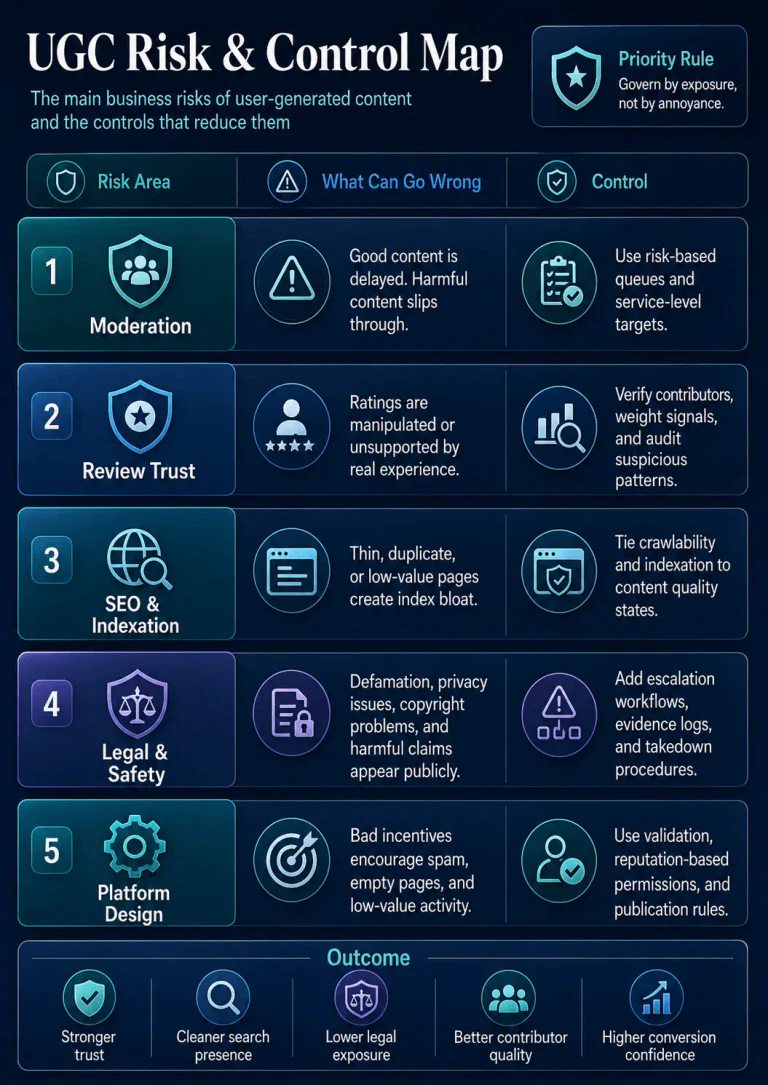
UGC governance should not be prioritized by irritation alone. A spam comment on an obscure archived thread may be ugly but low priority. A manipulated rating on a high-revenue listing is different. An unverified medical, financial, legal, or safety-related claim is different again. A duplicate Q&A pattern generating thousands of crawlable pages may matter more to acquisition economics than a small number of offensive comments that are quickly removed.
A useful prioritization model should combine trust impact, legal exposure, SEO risk, conversion impact, recurrence, revenue exposure, moderation cost, and engineering effort.
The purpose is not mathematical purity. The purpose is to stop prioritizing whichever problem shouted loudest in the last meeting.
The more useful metric is not total submissions. It is quality-weighted contribution value.
A platform should distinguish between contributions that improve user decisions, duplicates that require merging, rejected submissions that consume moderation time, indexed pages that attract qualified traffic, indexed pages that weaken template quality, reviews that support conversion trust, ratings that create manipulation exposure, media uploads that improve confidence, and media uploads that create rights or privacy risk.
This changes the conversation. A community that produces many submissions but few useful assets is not healthy. It is busy. Busy systems can still be commercially inefficient.
The operational correction
UGC does not need to be distrusted by default. It needs to be governed before it is scaled.
That means contribution forms with validation, account-level friction where risk justifies it, moderation queues designed around impact, review systems tied to evidence of experience, schema rules linked to eligibility, noindex logic for weak pages, appeal and takedown workflows, and ownership that does not disappear between product, SEO, legal, support, and trust teams.
The highest-value correction is usually lifecycle governance. Once a platform can distinguish submitted, approved, disputed, rejected, archived, noindexed, and legally removed content, every other control becomes easier to implement. Without that lifecycle, every downstream team works from a different version of the same mess.
UGC can strengthen trust, search visibility, conversion quality, marketplace liquidity, and customer confidence. It can also become indexed clutter, synthetic trust, and legal overhead. The difference is rarely the enthusiasm of the user base. It is the discipline of the system that decides what user input is allowed to become part of the product.


