

Key takeaways
The screen changes the campaign unit
TikTok Out of Phone does not merely enlarge a post. It moves creator video into public, venue-regulated and one-to-many media.
- Sound-off is a rewrite, not a mute buttonCaptions, pacing, branding and the first frame must carry meaning without the phone feed's audio and interaction cues.
- The venue becomes part of the creativeA taxi, supermarket, university, mall and billboard create different distances, dwell times, audiences and local obligations.
- A DOOH impression is not a TikTok viewAd plays can be multiplied by modelled opportunities to see. Neither number proves that a person watched or engaged.
TikTok expanded its Out of Phone programme across Europe in August 2026 through partners covering the United Kingdom, France, Belgium, Spain and Italy. The inventory now reaches taxis, shopping centres, wellness venues, bars, supermarkets, universities and large outdoor screens. TikTok describes the product as a way to extend advertiser and creator content beyond the app.
That phrasing can make the operation sound like syndication. It is closer to a context transplant. A person chooses to open TikTok, can hear audio, can touch the interface and is usually close to the screen. A passer-by may meet the same video silently, at an angle, for seconds, beside traffic or checkout queues. The venue changes what the asset can communicate and what its delivery can honestly prove.
A private feed becomes a public encounter
Inside the feed
Chosen, close, sound-capable
The viewer opens the app, holds the device, can replay, follow a creator, tap a link and interpret familiar interface cues.
Inside the venue
Incidental, distant, usually silent
The audience may be moving, sharing the screen with others and unable to act immediately. Location supplies meaning that the phone never had.
TikTok's own creative guidance acknowledges the discontinuity. Most Out of Phone screens operate without sound, so the company recommends captions or subtitles, strong contrast, clear branding and simple calls to action. Billboard assets should generally communicate within ten to fifteen seconds or less. Those are not finishing touches. They change the edit.
A sound-on story has to survive without the soundtrack
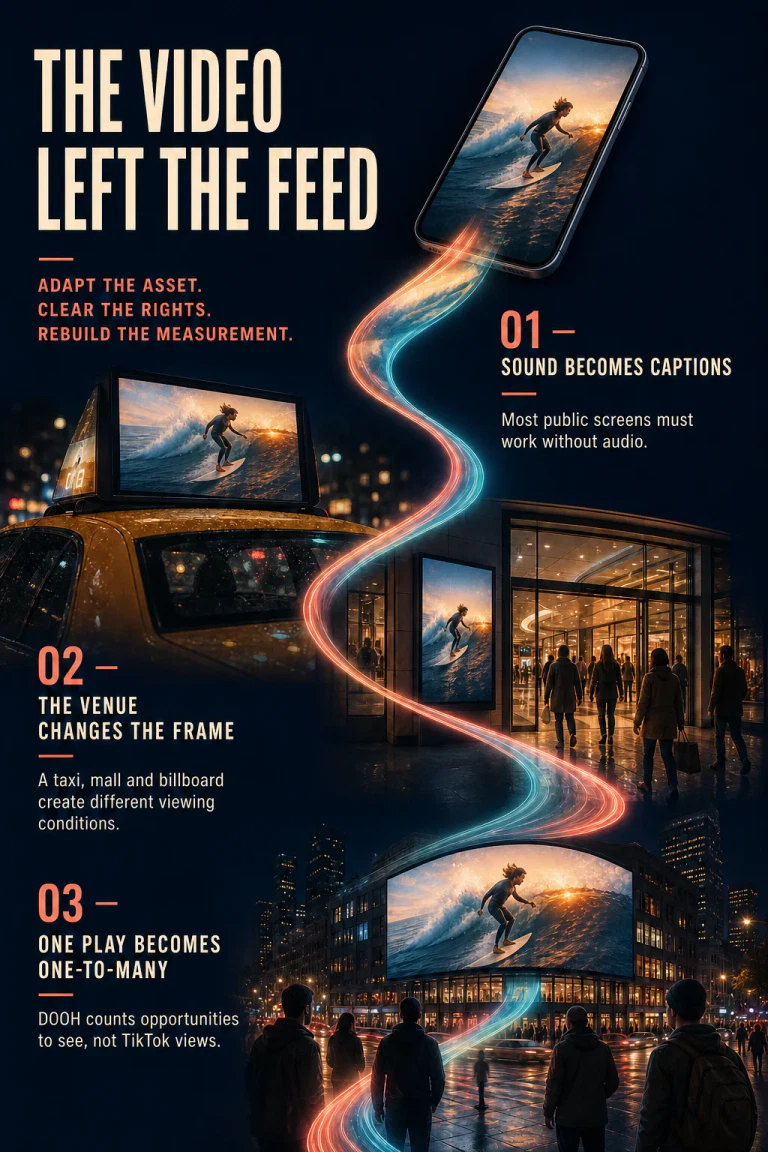
Removing audio can erase more than dialogue. Music may set irony, explain a cut or supply the creator's identity. A caption pass therefore begins with a question: what must a person understand after a glance with no sound? If the answer requires watching the original post, the public asset is unfinished.
The adaptation should also remove interaction-dependent language. “Tap”, “comment” and “use this sound” describe actions unavailable on a street screen. A usable DOOH version gives the passer-by a complete visual proposition and, where appropriate, one memorable next step that can survive distance and motion.
The venue changes the frame before media begins
One asset, four viewing conditions
TaxiNear-field, moving city context; a short visual promise must survive traffic and changing angles.
MallLonger dwell is possible, but retail clutter competes for attention and the audience is shared.
BillboardDistance and speed reward one idea, high contrast and immediate brand recognition.
UniversityLocation supplies demographic context, but placement and claims still need local review.
TikTok separates advertiser-led ad extension from community amplification and says approved partners can help source content, secure creator rights and build the final asset. That workflow matters because permission to use a creator post in a feed does not automatically describe every public screen, territory, duration or edit.
Use a phone-to-place release sheet
Operational instrument
Approve one record for every asset–venue pair
The release sheet is complete only when five owners can point to evidence for the same version.
- Creative owner: sound-off comprehension, duration, contrast, captions and safe crop.
- Media owner: named venue, screen format, loop length, dates and geography.
- Rights owner: creator, music, likeness, territory, term and permitted edits.
- Compliance owner: TikTok review plus applicable local OOH and sector rules.
- Measurement owner: ad-play logs, multiplier source, OTS definition and any attention study.
If the asset, venue or measurement method changes, issue a new release record.
One play can represent several opportunities to see
IAB measurement guidance draws a line that social reporting often blurs. An ad play is a delivery event recorded by the screen. A DOOH impression is commonly an estimated opportunity to see, derived from presence in a visual exposure zone and an impression multiplier for the venue or device. It is not automatically one person, one view or one completed watch.
Measurement reconciliation
Keep delivery, opportunity and attention separate
| Term | What it establishes | What it does not establish |
|---|---|---|
| Ad play | The screen served the asset. | That anyone was present. |
| OTS impression | A modelled opportunity to see in the exposure zone. | That the person looked or remembered. |
| Attention evidence | Observed or researched contact with the screen. | A click, visit or sale without another link. |
The practical reconciliation is simple: report ad plays, the documented multiplier and calculated OTS impressions in separate fields. Add attention or brand-lift evidence only when a study actually measured it. Never rename the resulting number “TikTok views”.
The strongest early claim is operational, not causal
TikTok's expansion announcement includes a partner-reported uplift in engagement and dwell time. That observation may justify a local test, but it should not become a universal forecast. Venue mix, creative, audience movement, screen position and the partner's measurement design can all change the result.
What would support the thesis
Sound-off comprehension improves, every venue has documented rights and local clearance, and reporting preserves the difference between plays, OTS impressions, attention and business outcomes.
What would break it
A campaign performs consistently with an unchanged feed asset, one rights grant and one view definition across materially different venues. Current platform and IAB guidance makes that outcome unlikely, but it is testable.
This scope is distinct from PolymathDesk's TikTok Symphony Agent approval analysis, which follows scene-level human review of generated advertising, and the YouTube dynamic brand segment dossier, which follows ownership of a replaceable sponsorship slot. Out of Phone is a context and measurement problem created when creator video becomes public infrastructure.
Questions about TikTok Out of Phone
Is Out of Phone a new social placement?
It extends TikTok-related advertiser or creator content to out-of-home screens through approved partners. The public venue and DOOH measurement method make it materially different from an in-app placement.
Can the original TikTok video run unchanged?
Sometimes the visual core can remain, but the final asset still needs sound-off comprehension, venue-appropriate duration and crop, suitable calls to action, confirmed rights and local review.
Is an OTS impression the same as a TikTok view?
No. It is an estimated opportunity to see based on presence and a venue or device multiplier. It does not establish a completed watch, interaction or guaranteed attention.
Who clears creator and music rights?
TikTok says approved partners can help source content and secure creator rights, but the advertiser should retain evidence that covers the actual territories, venues, dates, edits, music and likeness uses.


