

Key takeaways from the B2B Marketing & "Dead Internet" analysis
The mass deployment of AI sales agents has completely broken traditional B2B marketing. The internet has devolved into a closed-loop "server war" where bots pitch to other bots, forcing genuine human commerce to retreat into physical spaces and untrackable dark social channels:
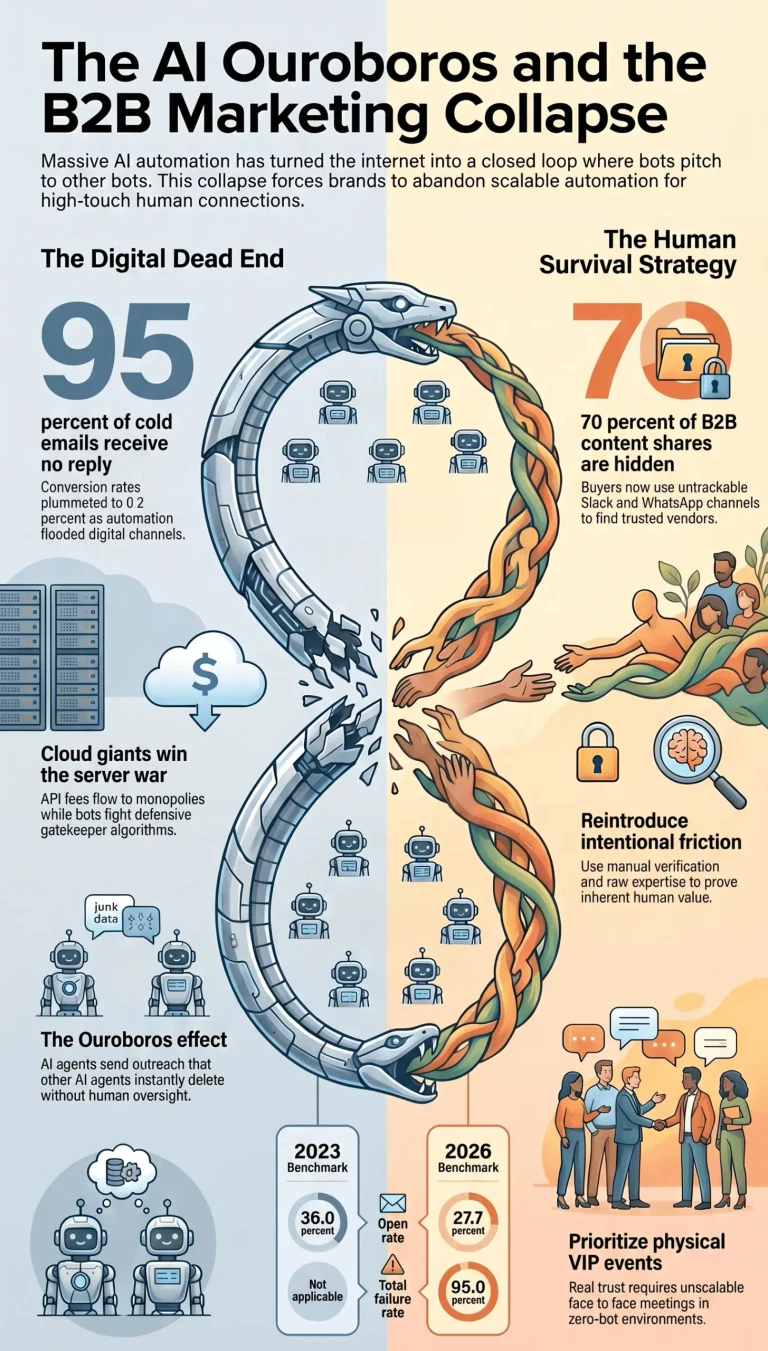
- 1. The catastrophic collapse of the outbound funnel Automated AI outreach is cheap ($1,800/month vs $14,500 for a human), leading to infinite volume but zero attention. By 2026, 95% of cold emails fail to generate a reply, and conversion rates have plummeted to 0.2%, rendering traditional digital prospecting mathematically unviable.
- 2. The symmetric "Cloud Extortion" loop As marketers deploy AI to send millions of hyper-personalized emails, executives deploy AI "gatekeepers" to automatically intercept and delete them. The only actual winners are cloud monopolies (AWS, Azure), who extract massive API fees from both the attacking marketers and the defending procurement teams.
- 3. The premium of the unscalable and the "Dark Funnel" With public platforms ruined by zero-click AI search and algorithmic decay (enshittification), real buyers have fled to private, untrackable networks (Slack, WhatsApp). To survive this bot-saturated wasteland, brands must intentionally embrace "friction" by investing heavily in unscalable, physical VIP events and raw, human-authored contrarian expertise.
The initial promise delivered to the corporate world was one of absolute, frictionless efficiency. Revenue teams were aggressively sold a vision where generative models would entirely eliminate the grueling manual labor of enterprise sales, perfectly matching the ideal value proposition to the right buyer at the precise moment of intent. Fast forward to 2026, and this vision of digital marketing automation has succeeded so completely that it has triggered a systemic and irreversible collapse. The machinery worked too well, scaling communication to a point where the fundamental value of the message was diluted to zero.
Instead of facilitating better human connections, the industry has devolved into a closed-loop, highly absurd simulation. A server sitting in a Virginia data center seamlessly drafts a hyper-personalized outreach sequence, firing it across the internet to a server in Dublin. That receiving server intercepts the message, summarizes its presumed intent, and silently archives it without human intervention. No human eyes ever scan the meticulously crafted copy, and no human cognition processes the B2B value proposition.
This is the artificial ouroboros of modern business generation, where the snake continuously eats its own digital tail. Marketers triumphantly report their budgets as successfully deployed on sophisticated outreach, while procurement executives concurrently report their inboxes as successfully managed and sanitized by intelligent assistants. The grim reality is that enterprise digital marketing has ceased to be a communication channel between professionals, transforming instead into a symmetrical, highly resource-intensive server war.
Naive corporate boards and executive teams continue to fund this escalation, fundamentally misinterpreting automated vanity metrics as genuine market traction. They look at dashboards flashing green with high delivery rates and massive content output, completely blind to the fact that their sales generation budgets are essentially funding a shadow economy. The consequences of this willful ignorance extend far beyond wasted software subscriptions or bloated marketing departments.
This structural shift has aggressively destroyed the traditional acquisition funnel, enriching a tiny oligopoly of infrastructure providers while forcing real human commerce into hidden, unscalable environments. The technology has inadvertently engineered a scenario where volume is infinite, but attention is mathematically scarce. Understanding this total systemic collapse requires examining the exact mechanisms that allowed artificial intelligence prospecting to entirely replace human interaction, and why the resulting noise has broken the internet's original promise.
Death of the funnel
The foundational model of outbound demand generation is now mathematically broken, suffering from a fatal flaw in its core assumptions. The classic strategy of building a massive list of prospects and nurturing them through sequential touches relied heavily on the belief that a percentage of the audience would organically and eventually engage. Today, automated outbound campaigns operate in a complete vacuum of artificial noise, where traditional human response rates no longer apply.
Metrics of a collapse
The statistical degradation of outbound communications over the past three years is completely unprecedented in the history of direct marketing. Between 2023 and 2026, the effectiveness of cold outreach did not merely decline; it fell off a catastrophic cliff. Average open rates have stabilized at an abysmal 27.7%, representing a massive drop from the 36% benchmark seen just a few years prior. More critically, a staggering 95% of all cold emails now fail to generate any reply whatsoever, proving that the B2B email machinery is running at maximum capacity to produce almost nothing.
The sheer volume of this digital pollution is difficult to comprehend. Approximately 160 billion spam emails are generated and sent daily, with modern filters forcibly diverting nearly one in five messages directly into junk folders before they even register in the primary inbox. Even when these automated messages manage to pierce the primary inbox defenses, the platform-wide average reply rate sits at a dismal 3.43%. The average cold conversion rate has plummeted to a devastating 0.2%, meaning a sales team must blast roughly 500 emails to secure a single won deal. This apocalyptic reality forces revenue operations professionals to compensate for incredibly low quality by authorizing catastrophic quantities of outreach.
| Metric category | 2023 Benchmark | 2026 Benchmark | Trajectory assessment |
| Average Open Rate | ~36.0% | 27.7% | Severe structural decline |
| Platform Reply Rate | ~7.0% | 3.43% | Severe structural decline |
| Lead Conversion Rate | N/A | 0.2% | Stagnant at absolute zero |
| Total Failure Rate | N/A | 95.0% | Critical ecosystem failure |
To achieve a standard pipeline coverage target of three-to-one, single-channel outbound is no longer mathematically or financially viable for any enterprise. Teams are instead forced to adopt aggressive multichannel cadences, which reportedly provide a 287% lift over single-channel efforts. However, this strategy simply spreads the automated lead generation toxicity across email, LinkedIn, and phone networks simultaneously. It does not solve the underlying problem of buyer apathy; it merely accelerates the degradation of all available communication channels at once.
Economics of automation
The total collapse in organic response rates coincided perfectly with the mass deployment of fully autonomous sales agents. By the beginning of 2026, roughly 22% of modern sales teams had already fully replaced their human Sales Development Representatives with artificial intelligence. The financial arithmetic behind this transition makes it entirely irresistible to startup founders and corporate financial officers alike. A traditional human SDR costs upwards of $14,500 per month when fully loading their base salary, data tools, management time, and sequencing software. This human requires months to ramp up, suffers from morale issues, and can realistically research only a tiny fraction of the total addressable market. In stark, brutal contrast, an AI outbound stack costs approximately $1,800 per month to operate continuously.
This $1,800 monthly stack is a masterpiece of unholy and ruthless efficiency. It utilizes cheap, burnable domain infrastructure to send 2,500 emails daily, leverages tools like Clay for deep account enrichment, deploys Apify for aggressive web scraping, and uses cheap API calls to synthesize SEC filings, recent hiring data, and social media activity into hyper-personalized copy in milliseconds. The resulting synthetic sales intelligence allows a single solo founder or a tiny marketing team to execute more sheer volume than a historical five-person enterprise SDR team ever could.
The global market vehemently reflects this massive shift in capital allocation and operational design. The AI SDR sector is currently expanding at a 29.5% compound annual growth rate, projected to reach an astonishing $15.01 billion in value by 2030. Gartner confidently predicts that by 2028, artificial agents will outnumber actual human sellers by a ratio of ten to one. When 89% of all revenue organizations use artificial intelligence in some capacity to draft emails or score leads , the competitive advantage of hyper-personalization drops immediately to zero. Every modern sales organization is now fully capable of synthesizing a target's recent podcast appearance into a customized introductory paragraph, meaning that when everyone is hyper-personalized, absolutely no one is.
Rise of the gatekeepers
For every aggressive action taken in a networked digital ecosystem, there is an equal and opposite algorithmic reaction from the defense. As marketing departments weaponized large language models to exponentially scale their outreach, target audiences quietly weaponized identical models to protect their fragmented attention. The true target of a B2B marketing sequence is no longer a human decision-maker sitting at a desk; it is a highly tuned defensive algorithm acting as a digital bouncer.
The defensive side of this technological arms race has birthed an entirely new, highly lucrative software category. The global AI email assistant market, which was valued at just under $900 million in 2025, is projected to surge to nearly $8.9 billion by 2035, growing at a massive CAGR of 25.8%. Exhausted executives are eagerly deploying inbox gatekeeper software that natively integrates with platforms like Slack, Teams, and Gmail to automatically intercept the daily chaos of inbound solicitations.
These defensive systems are not legacy spam filters relying on simple keyword matching or IP reputation scores. They are highly sophisticated, context-aware agents capable of deep semantic analysis and autonomous decision-making. Platforms like Operant AI have introduced Agent Protector systems that continuously monitor and govern autonomous agentic workloads, originally designed for cloud security but proving highly effective at blocking unauthorized machine-to-machine interactions. A modern executive AI assistant literally reads every incoming message, cross-references it against the executive's private calendar and strategic priorities, drafts a polite rejection if necessary, and permanently archives the thread.
The absolute top use case for these defensive enterprise agents is research and summarization, representing 58.2% of all current enterprise AI deployments. Knowledge workers, who historically spent a painful three hours daily managing their email, are now reclaiming up to 70% of that time by delegating inbox triage entirely to their own localized models. When an AI SDR confidently sends a perfectly crafted pitch, the recipient's AI agent receives it, parses the text for genuine value, determines it is merely a synthetic cold solicitation, and eliminates it from existence. The sender registers a successful delivery metric, the receiver registers a beautifully clean inbox, and the transaction itself remains a complete phantom.
The infrastructure extortion
In a protracted war where both opposing sides build increasingly sophisticated automated weaponry, the only guaranteed victors are the arms dealers supplying the ammunition. The spectacular collapse of organic digital marketing into a bot-driven wasteland has engineered a massive, silent transfer of wealth from regular operating businesses to the infrastructure tier of the internet. This dynamic functions as a mandatory technological infrastructure tax levied indiscriminately on the entire global economy.
Cloud monopoly profits
The financial data surrounding cloud computing vividly exposes the true, undeniable beneficiaries of the AI marketing boom. The global cloud market scaled incredibly rapidly to generate $752.44 billion in revenue in 2025, with quarterly infrastructure spending hitting nearly $99 billion. This vital market is heavily and dangerously monopolized, with the "Big Three" collectively controlling up to 71% of the total infrastructure.
The explosive growth of these hyperscalers is directly and intrinsically tied to the explosion of generative corporate workloads. Cloud spending specifically dedicated to AI workloads increased by over 150% year-over-year in 2025 alone. AWS alone generates over $100 billion in annual revenue, providing nearly 60% of Amazon's total corporate operating profit due to its incredibly high margins. Every single time a marketer utilizes a generative AI tool to casually draft 10,000 personalized emails, they trigger API fees that flow directly and predictably into the coffers of these cloud giants.
This wealth extraction dynamic is absolutely not isolated to simple text generation. The marketing cloud platform industry itself relies entirely on this public cloud infrastructure, heavily concentrated in North America, which commands a 39.9% global revenue share of the marketing cloud space. As brands desperately attempt to process vast, messy lakes of intent data to find a single verified human buyer, their relentless consumption of raw compute power skyrockets. The cloud infrastructure providers profit relentlessly and exponentially, regardless of whether the underlying marketing campaign ever generates a single dollar of actual business revenue.
| Cloud provider | 2025 Market share | Primary growth rriver | Economic role |
| Amazon Web Services | ~30.0% | AI model hosting | The primary arms dealer |
| Microsoft Azure | ~20.0% | Enterprise AI integration | The corporate backbone |
| Google Cloud | ~13.0% | Data pipelines / SGE | The search monopolist |
| CoreWeave & Neoclouds | Emerging | Specialized GPU access | The niche compute supplier |
Symmetric cyber warfare
The true, undeniable absurdity of this economic model lies in its perfect, mirrored symmetry. A mid-market software company eagerly pays OpenAI and AWS thousands of dollars to power their automated SDRs, generating millions of digital touchpoints designed to penetrate target accounts. Simultaneously, the exact same target enterprise pays Microsoft Azure or Google Cloud thousands of dollars to power their defensive email gateways and web application firewalls specifically to block those exact touchpoints. This constitutes a perfect bidirectional technology extortion loop where the house always wins.
Cybersecurity vendors continually highlight that artificial intelligence is totally transforming email security specifically because attackers and aggressive marketers use the exact same tactical playbooks: scraping LinkedIn data, identifying psychological pressure points, and deploying customized payloads at massive scale. Defending against this requires immense, uninterrupted data center power. As one Reddit observer astutely noted, combating AI-generated spam has been a massive consumer of global compute resources operating quietly in the background for years.
The flow of capital always moves upward toward the servers. The selling company eagerly buys software tools to generate digital noise; the buying company eagerly buys software tools to perfectly filter that noise. Neither company experiences a tangible increase in worker productivity or actual business output. The entire transaction merely forces both corporate entities to pay a recurring digital operational toll just to maintain the fragile illusion of functioning digital communications.
Enshittification of platforms
While private communications via email rapidly devolved into autonomous bot warfare, public distribution via social media and search engines suffered an equally catastrophic, algorithmically driven fate. The social platforms that once beautifully democratized B2B audience building now possess actively hostile architectures designed to trap users. Coined by acclaimed author Cory Doctorow, the precise term "enshittification" perfectly captures the inevitable lifecycle of these digital monopolies.
The Doctorow doctrine
Doctorow’s theory of enshittification articulates a deeply cynical but highly accurate three-stage lifecycle for all major internet platforms. First, platforms offer immense, subsidized value to users to lock them in; second, they actively abuse those users to offer massive value to business customers and advertisers; finally, they abuse those business customers to claw back all the generated value for their own shareholders. By 2026, the primary B2B content networks have universally entered this final, toxic stage of their lifecycle.
Platform executives recognize that they possess a captive audience of business professionals who physically cannot afford to delete their accounts without risking their careers. Consequently, the platforms continually degrade the organic user experience to maximize short-term ad revenue and algorithmic retention. Doctorow notes that when the enshittification eventually hits the fan, the underlying tech companies will face a massive reckoning regarding their bloated AI infrastructure investments. The platforms are completely willing to destroy their own core utility if it means boosting quarterly engagement metrics for Wall Street. The corporate social ecosystem is no longer a town square; it is a meticulously designed digital casino where the exit doors have been bricked over.
Algorithm decay mechanics
LinkedIn serves as the absolute prime example of platform decay within the enterprise sector. Historically, it was the ultimate, undisputed distribution channel, single-handedly generating 80% of all B2B social media leads and driving a massive 46% of all social traffic directly to corporate websites. By 2026, the platform had fundamentally rewired its proprietary algorithm to trap users permanently inside its walled ecosystem. The network enacted severe, immediate algorithmic penalties for any organic post containing an external link, resulting in a staggering 60% reduction in overall reach.
Marketers can absolutely no longer use social networks as a reliable bridge to drive traffic to their owned properties. They are now algorithmic hostages. To achieve even basic visibility, they must continuously create native content optimized entirely for the platform's arbitrary engagement metrics. This desperate reality has led directly to the proliferation of toxic, polarizing content and hollow, formatted "bro-etry" designed solely to trigger the algorithm. However, even the algorithm is now aggressively turning on its own creators. Explicit engagement bait, such as demanding users to "Comment YES if you agree," is now heavily penalized and explicitly flagged as spam.
| Content tactic | 2024 performance status | 2026 Performance status | Algorithmic impact |
| External hyperlinks | Moderate organic reach | Severely penalized | -60% visibility collapse |
| Text-only posts | High organic reach | Highly rewarded | Depth and dwell time preferred |
| Engagement baiting | Viral, massive reach | Flagged as spam | Shadowbanned or suppressed |
| Native Video (<90s) | Growing adoption | Maximum reach | Platform's top priority format |
In a desperate response to these shifting rules, marketers relentlessly flood the feed with AI-generated carousels and vertical videos, causing immense and unprecedented content inflation. When originality becomes expensive and generic creation becomes virtually free, raw curation and distinct human voice are the only differentiators left. Yet, the platforms continually squeeze organic reach tighter every quarter specifically to force brands into purchasing B2B digital advertising. It is the absolute final stage of Doctorow's enshittification: extracting maximum monetary value from business customers who simply have nowhere else to go.
Search generative zero
The secondary, formerly reliable pillar of inbound marketing has been equally devastated by the introduction of generative artificial intelligence. The aggressive rollout of Search Generative Experience (SGE) by Google explicitly means that the search engine itself now completely satisfies user intent without ever requiring a click to an external website. In the United States alone, an astonishing 58.5% of all Google searches now end permanently without a single click to the open web. Out of every 1,000 searches conducted, only 360 actually result in a tangible website visit.
This zero-click reality violently destroys the traditional "click-to-site-to-form" pipeline model that completely dominated the early 2020s. A modern B2B buyer asks an AI a technical question; the AI rapidly scrapes the marketer's highly optimized, expensive blog post; and the AI delivers a seamless summary directly to the buyer on the search page. The creator of the content receives zero traffic, zero marketing attribution, and absolutely zero leads. Consequently, nearly 30% of all marketers have reported heavily decreased search traffic as consumers permanently migrated to these generative search interfaces.
To merely survive this extinction event, SEO strategy has shifted wildly and desperately toward "Generative Engine Optimization" (GEO) and a frantic pursuit of AI Share of Voice (AI SOV). Brands must somehow force their proprietary messaging into the training data of Large Language Models. They optimize heavily for E-E-A-T signals (Experience, Expertise, Authoritativeness, Trustworthiness) precisely because AI algorithms are supposedly tweaked to prefer genuinely human-made content to prevent the core models from hallucinating on their own synthetic exhaust. The entire inbound content strategy of a modern enterprise has been tragically reduced to writing mathematical signals for web crawlers, praying that an LLM might eventually cite the brand name in a footnote.
Dead internet theory
The cumulative effect of automated outreach and generative search perfectly aligns with the once-fringe "Dead Internet Theory," which posits that a vast majority of internet traffic is now entirely non-human. Jordan Resnick, a senior director of marketing operations at CHEQ, highlights that fake and invalid traffic has recently jumped to 17.9% of all monitored digital sessions. Marketing dashboards are constantly illuminated with bright green arrows showing massive traffic spikes and sudden form fills, yet actual closed-won revenue remains mysteriously stagnant. This is the practical, terrifying manifestation of the dead internet within B2B marketing operations.
Not all of this synthetic traffic is explicitly malicious or designed for fraud. A highly significant portion consists of "machine customers" autonomous agents deployed by procurement teams to rapidly scrape pricing pages, evaluate complex technical documentation, and synthesize vendor comparisons without ever speaking to a human sales representative. These sophisticated agents operate with extreme speed, completely bypassing normal human navigation paths and skipping traditional discovery phases. They absolutely do not read thought leadership blog posts; they extract raw data schemas and move on.
| Traffic type classification | Observable behavioral texture | Impact on marketing analytics |
| Genuine Human Buyer | Erratic navigation, slow reading, form hesitation | High true intent, accurate conversion data |
| Fraudulent Click Bot | Hyperspeed, skips logic paths, massive clicking | Severe funnel contamination, false engagement |
| Deployed Machine Customer | Rhythmic, precise extraction, compressed cycles | Skews lead scoring, invisible evaluation |
Marketing operations teams are now begrudgingly forced into the role of specialized cybersecurity analysts, constantly studying the specific "behavioral texture" of website visitors to determine if a session is actually human. If an organization fails to aggressively filter this synthetic demand generation, their CRM quickly becomes fatally polluted with shadow pipelines and ghost leads. They mistakenly optimize their advertising spend based on which campaigns generate the most bot clicks, actively training global ad networks to serve their expensive content exclusively to other bots.
Premium of the unscalable
In a brutally efficient economic environment where generating 1,000 articles, 500 videos, and 10,000 highly personalized emails costs exactly $5 and takes under a minute, the core economic law of supply and demand dictates a harsh reality. Everything that is digital, scalable, and reproducible fundamentally loses its intrinsic value. The massive hyper-inflation of synthetic content has naturally sparked a massive, aggressive counter-movement. The absolute future of effective enterprise marketing is a brutal, intentional reversion to the physical, the verifiable, and the totally unscalable.
Retreat to dark social
Because the public internet is severely compromised by scraping bots and hostile algorithms, genuine human buyers have fully retreated into hidden, deeply private digital enclaves. This widespread phenomenon, commonly known as the "Dark Funnel" or "Dark Social," encompasses private Slack channels, closed Discord servers, highly vetted WhatsApp group chats, and one-to-one direct messages. Within these locked, invite-only environments, professionals ask trusted peers for honest vendor recommendations, completely shielded from the prying eyes of digital attribution software.
The verified statistics surrounding this behavioral shift are profound and undeniable. Approximately 70% of all event links and B2B content are now shared exclusively via these private, untrackable channels. Deep analytics data from SparkToro indicates that 100% of links shared in Slack or WhatsApp register in traditional marketing platforms as generic "direct traffic" with absolutely zero tracking data. A B2B buyer might listen to a brand's podcast, ask a trusted former colleague in a private community for their honest opinion, and then directly type the company URL into their browser to request a demo. The marketing dashboard incorrectly attributes the million-dollar deal to "Direct Traffic," entirely missing the complex, invisible dark funnel journey that actually generated the pipeline.
| Content sharing channel | Percentage of untracked clicks | Visibility to marketing platforms |
| Private Slack / WhatsApp | 100% | Completely hidden from tracking |
| Facebook Messenger | ~75% | Mostly hidden from tracking |
| Instagram Direct Messages | ~30% | Partially hidden from tracking |
| Public LinkedIn Feeds | ~14% | Highly visible to tracking |
Leading revenue teams have finally accepted that they simply cannot track this deep influence through traditional Multi-Touch Attribution (MTA) models, which fail spectacularly in privacy-first, heavily fragmented modern environments. Instead, they invest heavily and strategically in dark social community building. They deploy actual subject matter experts into private communities not to blindly distribute links, but to answer complex, nuanced questions and build unquantifiable, long-term trust. They eagerly implement self-reported attribution to uncover the hidden word-of-mouth that is actually driving their revenue.
Return to physical spaces
The ultimate, foolproof defense against total bot saturation is genuine physical presence. A sophisticated artificial intelligence currently cannot physically shake a hand, share a confidential meal, or accurately read the nuanced, shifting body language of a skeptical procurement committee. Consequently, the most sophisticated B2B marketers have violently and permanently pivoted their budgets toward highly curated, extremely expensive in-person experiences. By 2026, an impressive 60% of marketing leaders report heavily investing their capital in face-to-face engagements.
The bygone era of the massive, chaotic, and impersonal trade show is rapidly giving way to intimate, high-friction formats. Brands are successfully executing highly targeted experiential roadshows, bringing mobile demo environments and specific experts directly to regional tech hubs and localized business parks. Even more potent and lucrative are VIP client retreats, exclusive, invite-only, multi-day events designed specifically and entirely for C-level executives. These physical events represent the absolute pinnacle of unscalable relationship marketing. By strictly restricting access and carefully curating the attendee list, companies guarantee a zero-bot environment where actual peer-to-peer trust can immediately catalyze massive, complex enterprise deals.
This macro trend is strongly mirrored in highly successful consumer and B2B crossover campaigns. The absolutely most memorable marketing efforts of the current era rely entirely on physical stunts and undeniable, physical reality. For example, Apple TV aggressively promoted a show by dropping a massive physical glass cubicle directly into New York's Grand Central Terminal. Similarly, State Farm utilized massive star power in highly produced, cinematic commercials to capture fragmented attention. These activations command respect because they require immense physical effort, significant capital risk, and intense logistical competence, traits that simply cannot be hallucinated by an offshore server. Doing things that explicitly and painfully do not scale has rapidly become the ultimate brand authority signal.
The friction mandate
The overarching theme of this new era is the intentional reintroduction of friction into the buying process. For years, the ultimate goal of B2B marketing was to make conversion as seamless and frictionless as mathematically possible. However, when bots can instantly clear a frictionless path, friction becomes the only reliable filter for human intent. Modern companies are intentionally putting hurdles in place, such as double email verification, mandatory manual meeting confirmations, and highly complex CAPTCHAs, just to ensure they are dealing with a human being.
This friction extends to the content itself. Audiences no longer want perfectly polished, AI-smoothed corporate prose. They crave raw, unedited expertise. They want first-person posts from founders containing actual industry secrets, highly opinionated podcast interviews, and deeply researched original data studies. These formats are difficult to produce, prone to human error, and absolutely impossible to automate at scale. By refusing to leverage the artificial intelligence advantages available to everyone else, a brand proves its inherent, undeniable human value.
The companies that truly thrive in 2026 are not the ones using the best AI agents to send the most emails. They are the ones using AI internally to manage their databases, while using real humans to host intimate dinners and write highly contrarian thought leadership. They have recognized that the internet has permanently changed, and they have adapted by stepping outside of the digital simulation entirely, choosing instead to compete on the one battlefield where machines absolutely cannot follow.


