
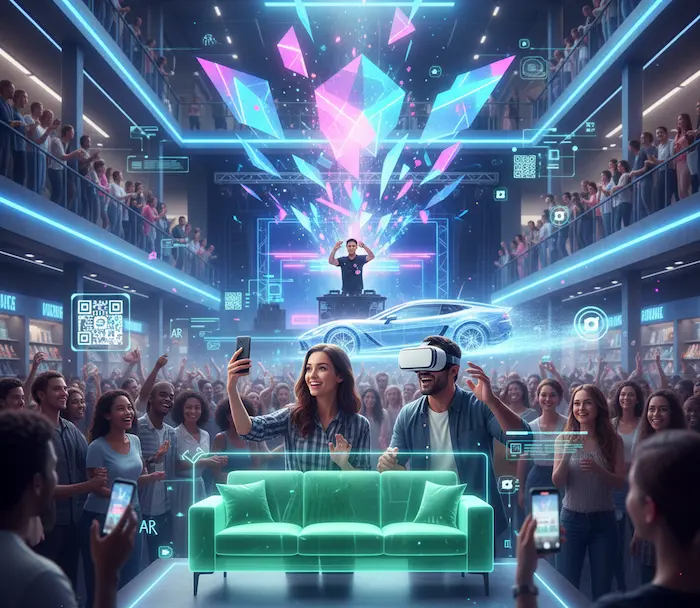
It's about mixing the best of both worlds
Think of it this way. Shopping online is great because you have endless choice, customer reviews, and convenience. But nothing beats touching the fabric, trying on a pair of shoes, or feeling the atmosphere of a place. On the other hand, shopping in a physical store gives us that real-world contact, but we often miss the wealth of information that’s at our fingertips online. Phygital is the attempt to merge these two things. It's like giving the physical world digital superpowers, and giving the digital world a tangible, real-world feel. The goal isn't just to stick another screen in a store, but to make our smartphone a remote control for the reality around us, helping us make better decisions and simply have more fun.
The magic tricks how it actually works
This whole magical blend relies on two key technologies that you've almost certainly already encountered, even if you didn't realize it.
The first is Augmented Reality (AR). This is nothing more than overlaying digital elements onto the real world you see through your phone's camera. The most famous example? Pokémon GO, of course. The game that turned our parks and streets into a game board by placing virtual creatures against the backdrop of real buildings. But AR isn't just for play. When you use the IKEA Place app to see if a new sofa will fit in your living room, that's phygital in its purest form. You see your room on the screen, and in it, a perfectly scaled virtual piece of furniture. The problem of "will this fit?" disappears in a second.
The second technology is Virtual Reality (VR). This takes it a step further. Instead of adding things to the real world, you put on a headset and are completely transported to a digital space. You aren't enhancing reality anymore; you're creating a brand new one. A car dealership could offer you a virtual test drive of their latest model, even if they don't have it in the showroom yet. A travel agency could let you "walk through" a hotel room on the other side of the world before you book it. VR is a powerful tool because it allows us to experience something that is physically impossible or impractical.
Okay, but why are brands so excited about this?
Besides the fact that all of this is just plain "cool," phygital solves real problems and works on our brains in very specific ways.
First, it’s memorable. Our brains are much better at remembering experiences we actively participate in than ones we just passively watch. Seeing an ad for furniture is fleeting. "Placing" a virtual sofa in your own room and walking around it creates a concrete memory. Burger King once ran a campaign where you could "burn" competitors' ads using AR in their app to get a free Whopper. Brilliant, because it turned a simple promotion into an interactive game.
Second, it removes uncertainty and friction. How many times have you bailed on buying clothes online because you weren't sure about the size? Or makeup, because you didn't know how a shade of lipstick would actually look on your face? Apps from brands like Sephora or L'Oréal that use AR to apply makeup to your face in real-time eliminate this problem. This builds trust and confidence in your purchase.
It’s not the future, it’s just the new normal
The best thing about phygital is that when it's done right, it becomes almost invisible. It simply becomes part of the experience. This is no longer some distant, futuristic vision. It's the new normal that we're getting used to every single day. The companies that understand this are no longer thinking in terms of "online strategy" versus "offline strategy." They're thinking about one, seamless customer journey. And the ones who win will be those who can weave digital convenience into our physical reality so cleverly that it feels like the world has simply become a little more helpful and personalized.


