

Email engineering · Digital marketing
The real test happens after the message leaves your editor
A newsletter can have a beautiful, functional footer and still lack the unsubscribe operation its recipient's mail service expects.
- Inspect the delivered messageThe visible template cannot prove that the required headers survived the sending pipeline.
- Separate inspection from removalA link fetch and an intentional unsubscribe need different effects on your list.
- Check who will receive the next campaignA successful-looking response is weaker evidence than the correct subscription actually being removed.
Imagine approving a newsletter after clicking its unsubscribe footer. A preferences page opens, the button works, and the test address disappears from a list. The email looks ready. Yet this test has not answered a separate question: can the recipient leave directly through the controls offered by their mail service?
This is a hypothetical quality-assurance failure, not a report of an incident at PolymathDesk. It matters because the two exits live in different parts of a message. The footer belongs to the content you design. Machine-readable instructions travel in message headers, outside that design.
Google's sender FAQ explicitly says it does not substitute a body link for missing one-click unsubscribe headers. A preferences-page link can remain in the body alongside the header mechanism. Passing the first test therefore does not imply passing the second.
A link checker should not decide who leaves
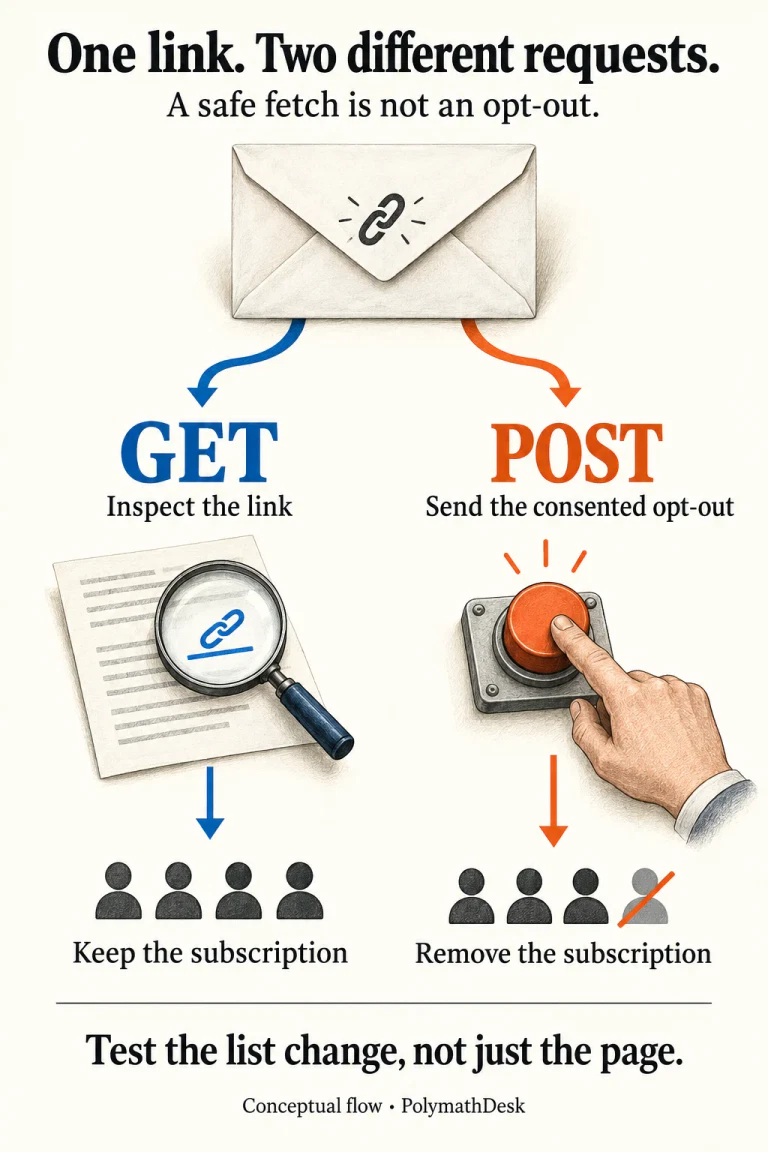
There is a reason this cannot be reduced to “make every visit remove the address.” Software retrieves URLs for purposes other than acting on the reader's wishes. If retrieval itself performs the opt-out, an automated inspection can become an unintended subscription change.
The HTTP standard separates those operations. RFC 9110 defines GET as a safe method: the client requests retrieval, rather than a change of state. Its discussion specifically explains why automated fetching and prefetching depend on this distinction. A URL that looks like an action does not excuse a server from respecting the method.
For an unsubscribe service, the practical design is to let a safe fetch show information or a manual confirmation interface without silently removing the subscriber. The intentional operation has a different path through the handler. This does not claim that every scanner behaves identically, or that writing POST on a request makes its sender trustworthy.
The delivered headers describe the other exit
RFC 8058 specifies an HTTPS POST carrying a fixed value. The URL identifies the recipient and list; an opaque, hard-to-forge component is recommended. A valid DKIM signature must cover both unsubscribe headers. The request cannot depend on cookies or HTTP authorization, and the endpoint must not redirect it. The receiving system must obtain user consent before making the POST.
Here is an illustrative header pair, using a reserved example domain and a dummy token. It is not a live unsubscribe address or a complete signed email.
List-Unsubscribe:
 <https://example.com/u/test-token>
List-Unsubscribe-Post:
 List-Unsubscribe=One-Click
The corresponding form value is List-Unsubscribe=One-Click. With the URL-encoded form type, it is sent in the POST body. Opening the same URL in a browser is a different test.
Start with the original message received by a mailbox you control. Keep its headers, the sending configuration and the test subscription together. A screenshot from a template editor cannot show whether the delivery system added, replaced or signed those fields. Redact the token before sharing the evidence: it is an operational link associated with that subscriber.
One missing topic can change the scope of removal
Amazon SES offers a concrete example of why this inspection belongs at the sending layer. In its managed subscription feature, ListManagementOptions specifies a contact list and can specify a topic. With both supplied, the unsubscribe applies to that topic. Without a topic, it applies to all topics in the list.
SES also documents that this managed feature overrides existing unsubscribe headers. Its automatic header and footer handling requires a single recipient, and the feature uses Easy DKIM rather than messages signed by the sender before submission. Those are product-specific constraints, not universal rules for every email service.
Consider a fictional publisher with “Weekly essays” and “Event notices” inside one contact list. The same attractive footer could accompany two sends: one correctly identifying the weekly topic, another accidentally omitting it. The subscriber's action could then have a broader effect than the publisher intended. The defect is in the send configuration; making the footer clearer cannot repair the missing topic.
This is not an argument for making departure difficult. It is an argument for making the action match its stated scope. Google's subscription guidance calls for identifiable subscription lists and honoring requests within 48 hours. An internal label such as “newsletter” is useful only if the system receiving the request can resolve it to the right membership.
Follow a disposable subscriber into the next audience
The following acceptance test is a proposed workflow, not a claim that a live campaign was tested for this article. Use only an address and subscription you control. Do not paste a customer's token into a public validator or run removal requests against a production subscriber as a convenient shortcut.
- Record the starting membership. Note the contact list and topic, then send one test message through the actual sending path. A draft preview is insufficient.
- Inspect the original received message. Check the two headers, their signature coverage and the intended recipient/list mapping. Do not infer these from the HTML body.
- Exercise safe retrieval separately. On the disposable test subscription, verify that inspecting the link has not changed membership. This isolates a state-changing GET defect.
- Perform the intended opt-out. Use the receiver control if offered, or a developer-controlled protocol test. Record the request method, response and resulting subscription record without exposing its token.
- Check the next audience selection. Confirm exclusion from the intended campaign. If several lists exist, check that the observed scope matches the action offered to the reader.
A hypothetical trace makes the distinction concrete: membership starts active; GET returns a page and membership remains active; the valid opt-out is processed; membership becomes opted out; the next audience selection excludes the address. If the response looks successful but the last two observations fail, the investigation belongs in persistence, routing or audience synchronization—not in the button's color.
That evidence discipline also appears in our discussion of Pinterest clicks versus website visits: an intermediate event does not prove the final outcome. Here the missing outcome is a respected subscription choice, not a session in analytics.
A missing inbox button is a separate diagnosis
Google says that the control beside the sender name depends on automated eligibility checks. Correct headers do not guarantee its appearance. This means “I cannot see the button” and “the endpoint cannot process an unsubscribe” are different observations. Keep the protocol evidence even when the interface does not offer a convenient test.
Provider policies also deserve separate reading. Gmail's FAQ does not accept mailto alone as satisfying its one-click requirement. Yahoo's current bulk-sender guidance accepts mailto while strongly recommending the POST method. Yahoo also calls for a visible body link and requests to be honored within two days. There is no benefit in turning these into a falsely identical rule.
For migration work, include the unsubscribe host in the list of services that must keep working. Our DNS cutover analysis explains why a short TTL alone is not a clean handover guarantee. Moving the main website successfully does not, by itself, establish that a separate mail endpoint still works.
Nor should a working exit be sold as a guarantee of reach. As with browser notification permission, a communication channel remains subject to the recipient and platform. The useful result of this test is narrower and defensible: when this test subscriber asks to leave this list, the sending system actually respects it.
Questions about one-click unsubscribe
Should I remove the footer link?
No. The visible exit and the receiver's machine-readable mechanism serve different paths. Keep the body link easy to find; adding headers is not a reason to hide it.
Does this test prove my next campaign will reach the inbox?
No. It checks a specific opt-out path and its effect. It does not establish sender reputation, content quality or inbox placement.


