

Key takeaways from the Google SynthID analysis
Google SynthID is not a visible label or removable metadata layer. It is an invisible watermarking system designed to embed a detectable signal into AI-generated content at the moment of creation, making synthetic media harder to detach from its origin.
- 1. SynthID embeds provenance into the content itself Unlike visible watermarks or metadata, SynthID places an imperceptible signal inside AI-generated media. For images and video, this means hidden patterns in visual output; for audio and text, the watermark is adapted to the structure of sound or generated language.
- 2. Detection supports trust, but does not prove everything A detected SynthID watermark can help journalists, platforms, researchers, and marketers identify content generated by Google AI systems. However, the absence of a SynthID signal does not prove that content is human-made, because other AI tools may not use the same watermarking system.
- 3. Watermarking is a governance layer, not a complete solution SynthID can make AI content more accountable, but it cannot eliminate misinformation, copyright disputes, or malicious manipulation on its own. It works best as part of a broader provenance system that includes platform policies, verification workflows, disclosure standards, and responsible content governance.
The internet has a new authenticity problem. Not because images can be edited, voices can be cloned, or text can be generated, all of that is already obvious. The real problem is quieter: synthetic content now travels without memory. It can be copied, cropped, compressed, reposted, translated, screen-recorded, stripped of metadata and detached from the place where it was made. By the time it reaches an audience, the usual signals of origin are often gone.
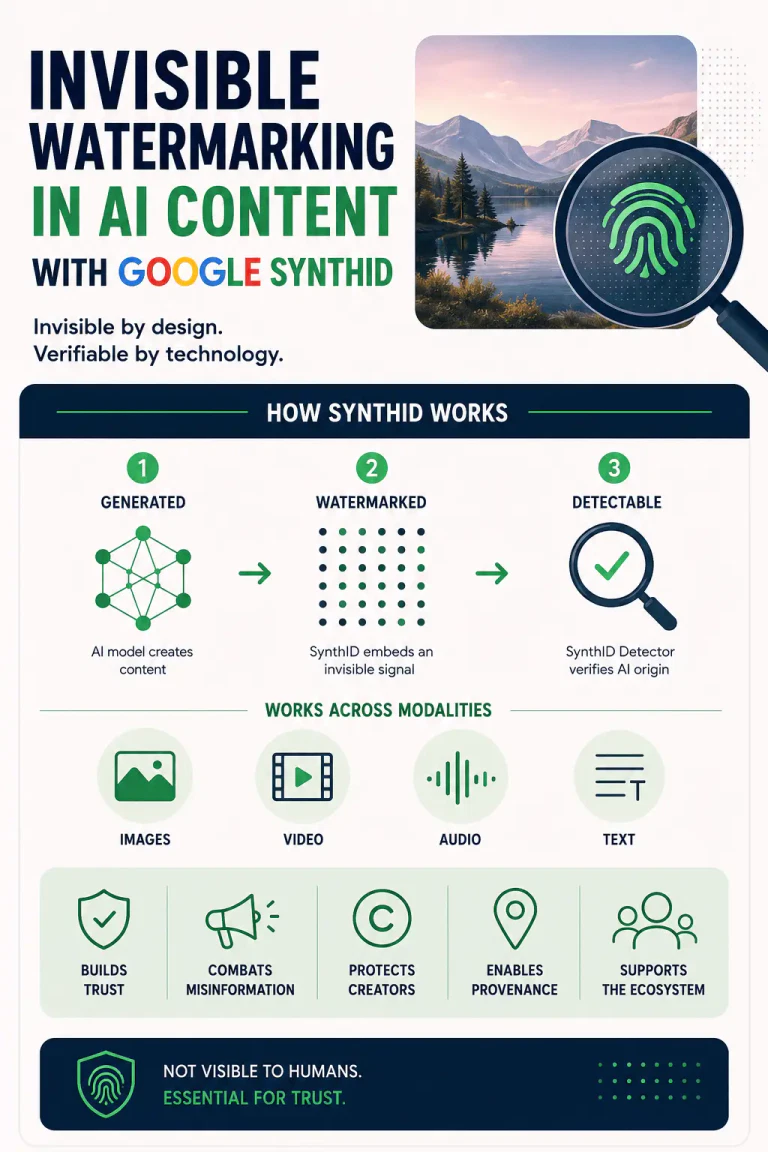
That is where Google SynthID comes in. It is not a visible stamp, not a corner label, and not a piece of metadata waiting to be deleted. SynthID is Google DeepMind’s watermarking technology for AI-generated content. Its purpose is to embed a signal directly into generated media so that, later, a detector can help determine whether the content was created by Google’s AI systems. Google describes SynthID as an invisible digital watermark for AI-generated images, video, audio and text.
The important word is invisible. SynthID is designed not to change how a piece of content looks, sounds or reads to a human. The signal is meant for machines. That makes it more durable than a visible watermark and more useful than metadata, but it also makes the whole system easy to misunderstand. SynthID is not magic. It is not universal proof. It is not a lie detector for the internet. It is one technical layer in a much larger fight over provenance.
Why invisible watermarking matters
Visible labels have a weakness: they are easy to attack. A logo in the corner can be cropped. A caption can be removed. Metadata can disappear during upload, export, screenshotting or platform compression. In ordinary publishing workflows, this happens constantly, even without malicious intent.
Invisible watermarking tries to solve a different problem. Instead of placing a marker around the content, it places a signal inside the content. For images and video, that means embedding an imperceptible pattern into the visual output. For audio, the approach has to respect the listening experience. For text, the watermark must survive in the statistical structure of generated language rather than in pixels or sound waves.
This is why SynthID is interesting. It treats AI provenance not as a label attached after the fact, but as something that should be built into the generation process itself. Google first introduced SynthID for AI-generated images in 2023 through a beta release connected with Imagen on Vertex AI. At that stage, the emphasis was on embedding a digital watermark directly into image pixels while keeping the image visually unchanged.
That decision matters. A watermark added after generation can be forgotten. A watermark embedded during generation becomes part of the output’s structure.
How SynthID works
SynthID does not work in one identical way across every medium. That point is often lost in simplified explanations.
For AI-generated images, SynthID embeds a digital watermark directly into the image. Google says the watermark does not visibly change image quality and is designed to remain detectable even after common modifications such as cropping, filters or lossy compression.
For video, the logic extends across generated frames. Google DeepMind has described SynthID for video as building on its image and audio watermarking methods, embedding an imperceptible watermark without reducing the quality, creativity or speed of generation.
For audio, the problem is different. A watermark cannot be allowed to degrade the listening experience. In its work with Lyria, Google DeepMind described embedding a watermark into AI-generated audio that is inaudible to the human ear. The method involves converting audio into a spectrogram-like representation, where the watermark can be added without becoming perceptible as sound.
For text, SynthID is more subtle still. There are no pixels to mark. Instead, SynthID Text modifies the generation process by slightly influencing token selection in a way that remains natural to readers but can later be detected statistically. Google made SynthID Text available through its Responsible GenAI Toolkit, and the reference implementation is published by Google DeepMind for research and developer use.
So SynthID is best understood as a family of watermarking techniques, not a single trick. The shared principle is the same: the watermark should be imperceptible to people but recoverable by a detector.
What SynthID Detector adds
A watermark only matters if someone can check it. That is the role of SynthID Detector.
In May 2025, Google announced SynthID Detector as a verification portal for identifying AI-generated content made with Google AI. The system can scan uploaded images, audio, video or text for SynthID watermarks and, when a watermark is detected, highlight the portions most likely to contain the signal. Google said the portal was being rolled out first to early testers, including journalists, media professionals and researchers.
This is important because detection cannot remain a private internal feature forever. If watermarking is supposed to help with public trust, then journalists, platforms, fact-checkers and researchers need usable tools. A watermark locked inside a company’s own infrastructure is useful, but limited. A verification workflow begins to turn watermarking into a public accountability layer.
Still, the scope must be kept clear. SynthID Detector is designed to identify content watermarked with SynthID, especially content generated by Google AI tools. It does not prove that every unmarked file is human-made. It does not detect all AI-generated content from all providers. Absence of a SynthID signal is not absence of AI.
That distinction should be repeated often because it prevents a dangerous misunderstanding. Detection is not universal authentication. It is evidence within a defined technical system.
Why SynthID matters for digital marketing
For digital marketing, SynthID matters less as a technical curiosity and more as a sign of where content operations are heading.
AI-generated content is already part of brand workflows: product visuals, ad variations, social media assets, background music, blog drafts, explainer videos, synthetic voiceovers and campaign mockups. The problem is not that AI is used. The problem is that teams often lose track of where AI was used, which model produced what, and whether a final asset can still be explained to clients, regulators, platforms or audiences.
That creates a new operational risk. A brand may publish an AI-generated image without knowing whether it can later prove its origin. A content team may reuse synthetic media across channels without preserving provenance. A platform may need to separate manipulated media from legitimate creative production. A newsroom may need to verify whether an image passed through an AI model before it becomes part of a story.
SynthID does not solve all of that, but it pushes the market toward a more disciplined assumption: AI content needs provenance by design, not as an afterthought.
For agencies and marketing teams, this changes the content governance conversation. It is no longer enough to ask whether a file looks good. The better questions are: where did it come from, what model generated it, what rights apply, can the origin be verified, and what happens if the asset is challenged later?
The copyright and attribution angle
Invisible watermarking is also relevant to copyright, but not in the simplistic sense that it magically proves ownership. It does not.
What it can do is support a chain of evidence. If an AI-generated asset contains a detectable SynthID watermark, that signal may help show that the asset originated from a particular generation ecosystem. Combined with account logs, prompts, project files, contracts, timestamps and platform records, it can become part of a broader provenance record.
That is useful, but limited. A watermark is not a licence. It is not a copyright registration. It does not answer whether training data was lawful, whether the prompt infringed someone’s rights, or whether the final output is protectable in a particular jurisdiction. It simply helps with one narrower question: does this content carry a machine-detectable sign of AI generation from a given system?
For marketing departments, that may still be valuable. In disputes over asset origin, campaign approvals or content misuse, even partial evidence can matter.
The misinformation problem
The strongest public argument for SynthID is misinformation. AI-generated media can now imitate documentary evidence: a political image, a disaster scene, a fake product defect, a synthetic celebrity endorsement, a staged protest, a cloned voice. Once such content spreads, visible disclaimers are often removed and context collapses.
Invisible watermarking gives platforms and investigators another signal. It can help identify whether an image, clip, voice track or text fragment was generated through a watermarked AI system. That can support faster triage, especially during elections, crises, public health emergencies or breaking news events.
But here again, the limitation is essential. SynthID can help detect watermarked AI content. It cannot detect everything synthetic. It cannot stop someone from using an unwatermarked model. It cannot prevent a determined actor from laundering media through multiple transformations. Google itself has repeatedly framed SynthID as an important building block rather than a complete answer.
That phrase, building block, is probably the most accurate description. Content authenticity will not be solved by one technology. It will require watermarking, metadata standards, platform policies, newsroom verification, legal duties, model-level safeguards and user education.
Where SynthID can fail
SynthID is designed to be robust, not invincible.
Common edits may not destroy the watermark. Cropping, compression, filters, frame-rate changes or modest transformations can still leave enough signal for detection, according to Google’s public descriptions. But heavy editing is another matter. Aggressive stylisation, repeated re-generation, adversarial manipulation, substantial compositing, screen capture chains, or conversion through other generative systems may weaken or remove detectable signals.
This does not make SynthID useless. It means it should not be oversold.
In practice, watermarking systems live in an adversarial environment. As soon as detection becomes valuable, removal becomes valuable too. The future will not be a clean state where all AI content is marked and all marks remain intact. It will be a contest between provenance systems and laundering techniques.
For professional use, the right attitude is neither blind trust nor cynicism. SynthID should be treated as one strong signal, not as final proof.
The bigger shift in AI transparency
Google’s broader direction suggests that SynthID is becoming part of a larger provenance stack. The company has expanded SynthID beyond images into video, audio and text, and it has connected verification to tools such as SynthID Detector. Google also says that since SynthID launched in 2023, it has watermarked more than 10 billion images, videos, audio files and texts across its generative media systems.
That number matters less as marketing and more as infrastructure. Watermarking is moving from experiment to default expectation. The more generative media becomes ordinary, the more provenance will become ordinary too.
For brands, publishers and platforms, the lesson is clear: AI disclosure will not remain a voluntary caption at the bottom of a post. It is becoming technical, procedural and eventually regulatory. The organisations that prepare early will have cleaner archives, safer approval workflows and better answers when someone asks: “Where did this content come from?”


