

That approach is no longer enough.
Customers now search in more places and in more ways. They still use Google, but they also watch comparisons on YouTube, check opinions on TikTok, ask voice assistants for local recommendations and use AI tools such as ChatGPT to narrow down their choices. A brand that appears only in traditional search results may be visible in one part of the journey and completely absent in another.
This is why search everywhere optimization has become an important part of modern digital marketing. It does not replace SEO. It expands it. The goal is simple: make the brand easy to find wherever people search, compare, ask and decide.
Why Google-only SEO is becoming too narrow
A typical customer journey is no longer linear. Someone looking for a product, service or expert opinion may move between several platforms before making a decision.
A person buying wireless headphones might search Google for best wireless headphones 2026, then watch a YouTube comparison, then check short TikTok reviews, then ask a voice assistant where to buy them nearby. After that, the same person may ask ChatGPT which model is best for working in an open office.
Each platform answers a different need.
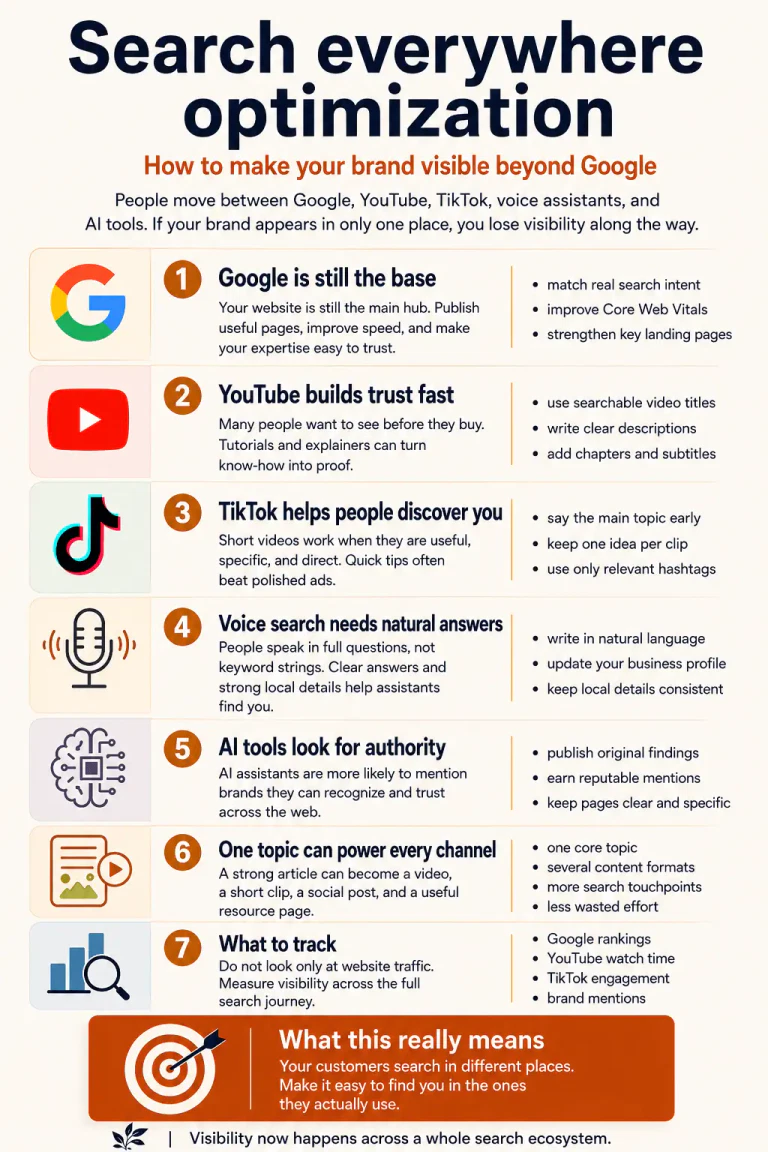
Google is useful for articles, rankings, product pages and local results. YouTube gives visual proof. TikTok provides quick, informal opinions. Voice search gives direct answers, often with local intent. AI assistants summarize information and recommend options based on authority, clarity and repeated brand mentions across the web.
A company that relies only on classic SEO may still get traffic, but it loses visibility at many other decision points. Multi-platform SEO is no longer an extra tactic. For many industries, it is becoming the basic condition of being found.
Google remains the foundation
Google is still the strongest base for online visibility. A company website remains the place where the offer, expertise, contact details, service pages, case studies and educational content should be properly organized.
A strong Google strategy should start with pages that answer real customer questions. A law firm can publish guides about preparing for a court hearing. A dental clinic can explain the cost and process of teeth whitening. An e-commerce brand can create honest product comparisons instead of thin category descriptions.
Good SEO content should not be written only around keywords. It should combine search intent, expert knowledge and clear structure.
The most important elements are:
- useful content based on real questions
- logical headings written in natural language
- fast loading speed and mobile usability
- internal links to related services and articles
- structured data where it genuinely helps
- clear author information and trust signals
- specific examples instead of generic claims
For example, a medical clinic writing about a vaccination schedule should not publish vague advice. It should show who wrote or reviewed the article, refer to reliable sources and explain the topic in a way that is useful for a patient.
Google also supports visibility on other platforms. YouTube videos, reviews, business profiles, social media content and brand mentions can appear in search results. That means good SEO is no longer limited to the website itself. It also depends on the wider digital footprint of the brand.
YouTube SEO turns knowledge into visible proof
YouTube works especially well when customers need to see something before they trust it. This is why it matters for industries such as home renovation, beauty, fitness, education, technology, real estate, medicine, finance and professional services.
A renovation company can publish a video showing how to paint walls without streaks. A software company can record a product walkthrough. A financial advisor can explain the difference between two types of insurance. A clinic can show what a first consultation looks like, without turning the video into aggressive advertising.
This kind of content builds trust because it shows competence in practice.
Effective YouTube SEO includes:
- titles based on phrases people actually search for
- descriptions that explain the topic and include relevant links
- chapters that divide the video into clear sections
- subtitles or transcripts
- thumbnails that are simple and readable
- calls to action that feel natural, not forced
A good YouTube video can also support Google visibility. Video results often appear in Google search, especially for tutorials, comparisons and practical questions. One well-made video can therefore work in two search environments at once.
The key is to avoid treating YouTube as a place only for brand campaigns. It should be treated as a search platform. People go there to solve problems, compare choices and learn before buying.
TikTok SEO works when the content is specific
TikTok has become a search tool for fast answers, short recommendations and informal opinions. This is especially visible among younger users, but the habit is spreading across more groups and industries.
People search TikTok for restaurants, travel tips, cosmetics, books, fitness advice, money tips, product reviews and local services. They often want something less polished than a traditional article and more direct than a company website.
That does not mean every brand should dance, joke or copy trends. For many companies, the best TikTok strategy is simple educational content.
A financial advisor might publish a short video about three mistakes people make when buying car insurance. A coffee brand can show how to recognize freshly roasted beans. A language school can explain phrases that sound unnatural in business emails.
Good TikTok SEO depends on clarity.
The video should begin with the main topic. The caption should include the phrase people may search for. Hashtags should be relevant, not excessive. The video should answer one question, not ten. The style should feel human rather than corporate.
The most important rule is this: TikTok rewards content that feels useful quickly.
Short-form search does not usually replace Google. It often starts the journey. A user discovers a brand on TikTok, then searches its name on Google, visits the website or checks reviews. This is why TikTok should be measured not only by likes, but also by branded searches, direct visits and enquiries.
Voice search needs natural answers
Voice search is different because people speak in full sentences. They do not usually say fragmented keywords. They ask questions.
A typed search may look like this:
cheap hotel Warsaw parking
A spoken query will sound more like this:
find me a cheap hotel in Warsaw with free parking near the city centre
This difference matters for voice search optimization. Content should include clear answers written in a natural way. Local businesses should be especially careful here because voice assistants often return location-based results.
A dentist, hotel, restaurant, mechanic or law office should make sure that basic information is easy to understand and consistent across the web.
Important elements include:
- complete Google Business Profile
- accurate opening hours
- consistent name, address and phone number
- local phrases used naturally
- reviews that mention specific services
- short answers to common customer questions
- clear service pages for each location or offer
A dentist in Wrocław, for example, should not rely only on a generic service page called “Teeth whitening”. A stronger page would clearly mention the service, city, nearby area, process, price range if possible and booking information.
Voice search is not about writing robotic questions and answers. It is about making the website easy for assistants to understand and easy for people to use.
AI search optimization depends on authority
AI assistants do not work like a normal search results page. They do not simply show ten links and let the user decide. They summarize, compare and recommend.
This changes how brands should think about visibility.
If someone asks an AI assistant for the best renewable energy companies in a region, the answer will usually depend on signals of authority. These signals may include industry mentions, articles, reviews, reports, case studies, directories, media coverage and clear information on the company website.
In this environment, brand mentions matter more than many companies realize. A business that is repeatedly described in relevant, trusted places has a better chance of being recognized as a credible entity.
Useful actions for AI search optimization include:
- publishing original reports or market data
- creating case studies with specific results
- earning mentions in industry media
- keeping company descriptions consistent
- using structured data on important pages
- building topical authority through expert content
- making service pages clear and factual
An HR company, for example, can publish a salary report for the IT market. A logistics company can release data on delivery trends. A renewable energy company can publish a guide based on real installation examples. This type of content is much stronger than another generic blog post built around a popular keyword.
AI visibility grows when a brand becomes a source worth citing, mentioning or summarizing.
One strong topic should work across several platforms
Search everywhere optimization does not mean creating completely different content for every channel. That becomes expensive and difficult to manage.
A better approach is to build one strong content idea and adapt it to different formats.
A company can start with a detailed article such as how to reduce energy costs in 2026. That article can become a YouTube tutorial, several TikTok clips, a LinkedIn post, a downloadable checklist, a voice-search-friendly service page and a source for future AI visibility.
The message stays consistent, but the format changes.
This is how one topic can work across the search ecosystem:
- Google gets the long article
- YouTube gets the visual explanation
- TikTok gets short practical tips
- voice search gets concise answers
- AI assistants get clearer brand context and authority signals
- social media gets smaller fragments that bring people back to the main content
This approach also helps avoid content waste. Many companies publish one article and then move on. A better strategy is to extract more value from the same idea by adapting it intelligently.
The goal is not to copy and paste. The goal is to reshape the same expertise for different search behaviours.
Measuring visibility beyond Google
Classic SEO tools are still useful, but they no longer show the full picture. Google Search Console can show impressions, clicks and ranking changes. Google Analytics can show traffic and conversions. But they do not fully explain what happens on YouTube, TikTok, voice search or AI-driven discovery.
A broader measurement system should include:
- Google Search Console for organic search performance
- Google Analytics for website behaviour and conversions
- YouTube Studio for watch time, retention and click-through rate
- TikTok Analytics for views, saves, shares and profile visits
- brand monitoring tools for mentions across the web
- branded search volume to see whether demand is growing
- direct traffic after social or video activity
- lead quality from different channels
A bookstore may notice that Google traffic is stable, but TikTok videos about business books increase direct visits and branded searches. A clinic may see that YouTube videos do not generate immediate bookings, but patients mention them during consultations. A local service company may discover that reviews and Google Business Profile updates influence phone calls more than blog articles.
This is why digital visibility strategy should be measured as an ecosystem, not as a single traffic source.
The brands that win will be easier to find everywhere
Search behaviour has changed. People no longer rely on one search engine, one format or one path to decision. They read, watch, scroll, listen, ask and compare. They move between platforms quickly and expect useful answers wherever they are.
Google still matters. It matters a lot. But it is no longer the whole map.
A modern brand needs a presence across traditional search, video search, short-form content, local voice results and AI-generated answers. This does not mean being everywhere without a plan. It means choosing the platforms that matter for the customer journey and building content that fits each one.
Search everywhere optimization is not about producing more noise. It is about making the brand easier to discover, easier to trust and easier to choose.
The companies that adapt early will have an advantage. They will not depend on one algorithm, one channel or one type of content. They will be visible in more moments of intent, and those moments are where decisions are made.


