

Close reading · Wolf’s Rain
Paradise is a living cycle, not a hidden address
Four conclusions change how the series’ journey, false havens and final rain fit together.
- The wolves detect a relationship before anyone can chart a routeThe Lunar Flower’s scent is useful because wolf, flower and season respond to one another. It is not a coordinate waiting to be decoded.
- Cheza is a participant, not a key-shaped objectShe needs water, answers the pack and changes with the moon. Whoever possesses her body still lacks the conditions that make Paradise possible.
- The oasis fails by ending desire without renewing lifeWarmth and food calm Kiba, but the scene has no future and no return. Its comfort is suspension disguised as fulfilment.
- The finale restores possibility rather than rewarding the travellersRain and the flower return after catastrophic loss, while corruption survives too. Renewal is real precisely because it is unfinished and vulnerable.
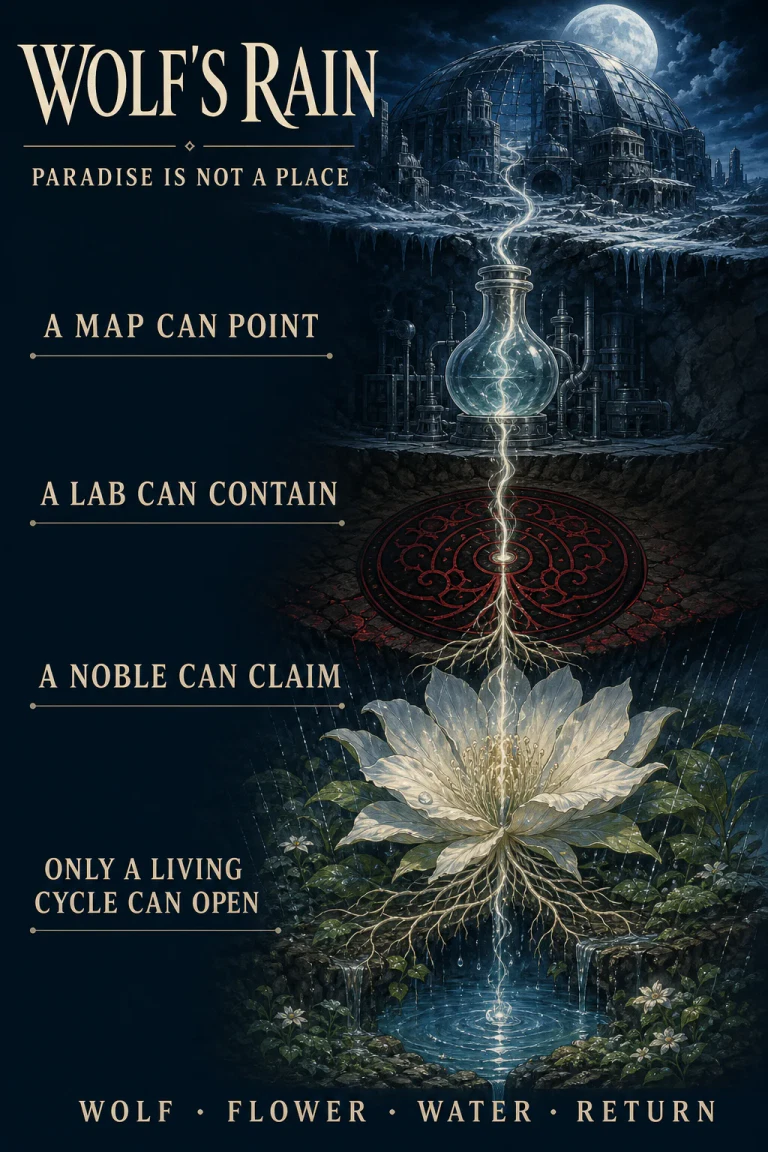
Wolf’s Rain appears to build toward the oldest fantasy promise: cross a ruined world, survive the trials and reach the place that makes suffering meaningful. Yet its most important scenes keep removing the properties a destination ought to have. Paradise cannot be mapped by humans, held in a laboratory, inherited by a noble or manufactured by ritual. Even the series’ most beautiful refuge turns out to be a trap because nothing there can continue.
The stronger reading is ecological rather than geographic. Paradise is the name the story gives to a viable relation among wolves, the Lunar Flower, water, moonlight, death and return. The route exists only while those elements can still answer one another. That is why Kiba can seek it without being able to describe it, why Cheza can guide the pack without functioning like a compass, and why powerful humans repeatedly reproduce Paradise’s appearance while destroying its conditions.
Spoiler boundary: this analysis discusses the television ending and the four concluding OVA episodes. It treats recurring images as evidence about the series’ structure, not as proof of one literal cosmology.
The wolves smell a relation before humans can map a place
The official series premise already establishes an asymmetry. The world is entering an ice age, humans believe wolves are extinct, and the wolves move among them under a human appearance. According to Fuji TV’s official description, only wolves can seek Paradise, while the Lunar Flower’s scent points toward it. The wording matters. A scent is neither a map nor a command. It is a changing trace carried through air and detected by a particular body.
Kiba’s advantage is therefore not secret information. It is sensitivity. He moves because he can register a relation the city has trained itself not to notice. Tsume, Hige and Toboe do not initially share his faith, but their different forms of hunger place them inside the same dying system. The pack is not a council that agrees on a theory. It is a moving sensorium whose disagreements keep testing whether the scent still leads toward life.
No single element can perform Paradise alone
The series distributes agency across bodies and conditions. Remove one relation and the journey loses more than a clue.
This makes Wolf’s Rain different from stories in which a damaged place stores emotion until a character can recover it. The obsolete spaces in Dennō Coil can still be approached as layers of a city. Here, the object of desire becomes less place-like whenever the series explains it. Paradise is not where the relation ends. It is what the relation can still produce.
Cheza cannot open paradise as somebody’s property
Cheza is the clearest test of that argument because nearly every faction treats her body as transferable infrastructure. She was created experimentally from a Lunar Flower, held in a research facility and taken by competing nobles. If Paradise were simply locked, possessing Cheza should be equivalent to possessing the key.
The episodes refuse that equivalence. In episode 7, Cheza responds when she encounters the four wolves after leaving the laboratory. In episode 10, she begins to wilt and the pack must find water. In episode 11, the full moon draws a white path of Lunar Flowers across the landscape. Each scene gives Cheza agency while making that agency conditional. She can answer, weaken and bloom; she cannot abolish dependence.
That distinction also prevents a sentimental simplification. The pack’s care does not make Cheza “theirs” in a kinder form. Their bond works because it stays reciprocal: she gives direction, they give movement and water, and neither side becomes self-sufficient. The series’ beauty comes from treating dependence as a capability rather than a defect.
The oasis fails because comfort has no future
Episode 19, “Oasis Dream,” provides the cleanest counterexample. Separated from the others, Kiba reaches a warm, abundant refuge and meets Mew. Fuji TV’s synopsis describes her telling him that this is Paradise for him; Kiba feels a peace he has not known on the road, while Mew’s sadness quietly contradicts the scene’s promise.
The oasis offers everything exhaustion asks for and nothing life asks next. There is food, warmth and relief from pursuit. There is no pack to answer, no damaged world to re-enter and no consequence that survives the comfort. Kiba is not tempted by obvious evil. He is tempted by a perfect reduction of Paradise to private sensation.

This is more severe than saying escapism is bad. Rest is not condemned; the travellers desperately need it. The problem is a refuge that converts rest into permanent nonparticipation. The circle of sin in Haibane Renmei can be broken only when another person enters the closed logic of self-judgment. Kiba’s oasis fails by removing every other claimant on his future. It is peace with no ecology.
Jaguara reproduces the shape of paradise and destroys its conditions
Lady Jaguara approaches Paradise through the opposite fantasy. Instead of retreating into a private haven, she tries to engineer universal access under her authority. Episode 26 places alchemists, the Book of the Moon, moonstone and concentrated moonlight inside a single ritual apparatus. The official synopsis says the world begins to freeze as Paradise is opened. The machine succeeds at producing an event and fails at producing a world capable of living through it.
The laboratory keeps the flower and loses the field
Cheza can be measured, transported and confined. None of those operations reproduces the wolves’ response, the need for water or the seasonal conditions of blooming.
The ritual concentrates power and freezes relation
Jaguara can align instruments, text and moonlight. Her controlled opening replaces reciprocity with command, turning renewal into a catastrophe staged around one will.
Darcia’s pursuit is more intimate but not more ecological. His grief for Harmona gives Paradise a beloved face, and that makes his claim emotionally legible. It does not make it shareable. The tragedy is not that love contaminates a pure quest; as The Vision of Escaflowne also understands, love can disrupt a machine of destiny. Darcia’s failure is that grief hardens into entitlement. He wants the world’s renewal to validate one private loss.
Four ways the series tests a claim on Paradise
| Claimant | Method | What the scene reveals |
|---|---|---|
| Kiba and the pack | Scent, movement, care | They can participate in the route but cannot control its cost or guarantee arrival. |
| The laboratory | Creation, measurement, containment | It can hold Cheza’s body while missing the relations that let her bloom. |
| Lady Jaguara | Book, moonstone, ritual apparatus | She reproduces an opening event by freezing the living world it was meant to renew. |
| Darcia | Bloodline, grief, personal entitlement | His wound enters the reset as residue rather than becoming the law of a private Paradise. |
The flower returns without restoring the old order
The concluding episodes strip away the last possibility that Paradise is a prize for moral endurance. The pack and Cheza pay for the journey with their lives. Kiba reaches the threshold only after the social unit that made the route possible has been destroyed. If Paradise were a reward, the structure would be perversely empty: the winner arrives alone at a world no one can share.
Instead, rain falls. A Lunar Flower blooms. The imagery returns to a city that resembles the human world we know, with familiar figures crossing it but no explanatory certificate of reincarnation. The ending distributes recognition without giving the viewer a solved genealogy. Something has restarted; nothing guarantees that the new cycle remembers why the old one failed.
Conditions for another attempt
Water, the flower and recognizable lives return to circulation. Paradise becomes the capacity of a damaged world to produce relation again, not a sealed realm outside history.
Purity and guarantee
Memory is uncertain, ownership has vanished and Darcia’s dark residue remains. Renewal does not delete risk.
The dark residue is crucial. It blocks an easy ecological romance in which nature becomes pure once humanity and hierarchy disappear. Paradise is vulnerable from its first frame because the previous world’s violence is already inside the new one. The ending is therefore cyclical without being reassuring. A cycle can renew possibility; it can also repeat domination if its participants fail to recognize dependence.
That is why the series’ melancholy feels different from a story about finding the perfect home. Its rain does not erase grief, and its flower does not close the argument. Like the endings of Mushishi, which often refuse the fantasy of a perfect cure, Wolf’s Rain measures hope by whether life can continue under changed conditions. Continuation is smaller than salvation and harder to own.
Wolf’s Rain leaves paradise open by keeping it impure
The series does not remove humanity from Paradise because every human is uniquely corrupt. It removes human sovereignty from the definition. Laboratories, nobles and grieving lovers all fail when they treat one part of the system as an authorization to rule the whole. Wolves do not succeed because they are morally spotless; they succeed far enough to restart the cycle because their journey remains embodied, collective and dependent.
Paradise, then, is not the world after need. It is a world in which need can still generate response. Cheza wilts and the pack searches for water. Kiba gets lost in comfort and must return to movement. Rain falls after bodies fail. The Lunar Flower blooms again without promising that anyone will deserve what comes next. Wolf’s Rain makes hope beautiful by refusing to make it private.
Questions about paradise in Wolf’s Rain
Is Paradise a physical place in Wolf’s Rain?
The series never reduces it to a stable location. Its imagery supports a physical threshold, but the route depends on living relations among wolves, Cheza, water, moonlight and death. Paradise behaves more like a renewal process than a destination that can be occupied.
Why is Kiba’s oasis not the real Paradise?
It gives Kiba warmth, food and peace, but it severs him from the pack and from any future beyond his own relief. The episode presents comfort without return or renewal, which contradicts the reciprocal structure built around Cheza and the wolves.
Is Cheza human or a Lunar Flower?
Cheza is a flower maiden created experimentally from a Lunar Flower. The series gives her a human-like body and voice while preserving botanical dependence: she reacts to moonlight, wilts and needs water.
Does the ending confirm that every character reincarnates?
No explicit rule is confirmed. Familiar figures and the Lunar Flower recur in a renewed city, but the series leaves memory and identity unresolved. The safest conclusion is that relation and possibility return, not that the viewer receives a complete reincarnation ledger.
Official production and episode materials
Materials checked 29 August 2026
- BONES official work page for staff, broadcast dates and series premise.
- Fuji TV official series page for the definitions of wolves, Paradise and the Lunar Flower.
- Fuji TV episode 7 synopsis for Cheza’s response to the pack.
- Fuji TV episode 10 synopsis for Cheza’s need for water.
- Fuji TV episode 11 synopsis for the full-moon path of Lunar Flowers.
- Fuji TV episode 19 synopsis for Kiba’s oasis and Mew’s warning sadness.
- Fuji TV episode 26 synopsis for Jaguara’s ritual and the freezing world.
The ecological argument is a close reading of the completed series. Official synopses establish the scene-level facts; interpretive claims are identified as analysis rather than production intent.


