

Close reading · Dennō Coil
Obsolete space is where maintenance collides with mourning
The series does not treat corrupted AR as a spooky second world added to an ordinary city. It asks what happens when a system deletes a place before the people attached to it have finished leaving.
- “Obsolete” describes compatibility, not emptinessOld coordinates still hold routes, promises and habits. The platform sees invalid data; a child may still see the last place where a relationship felt reachable.
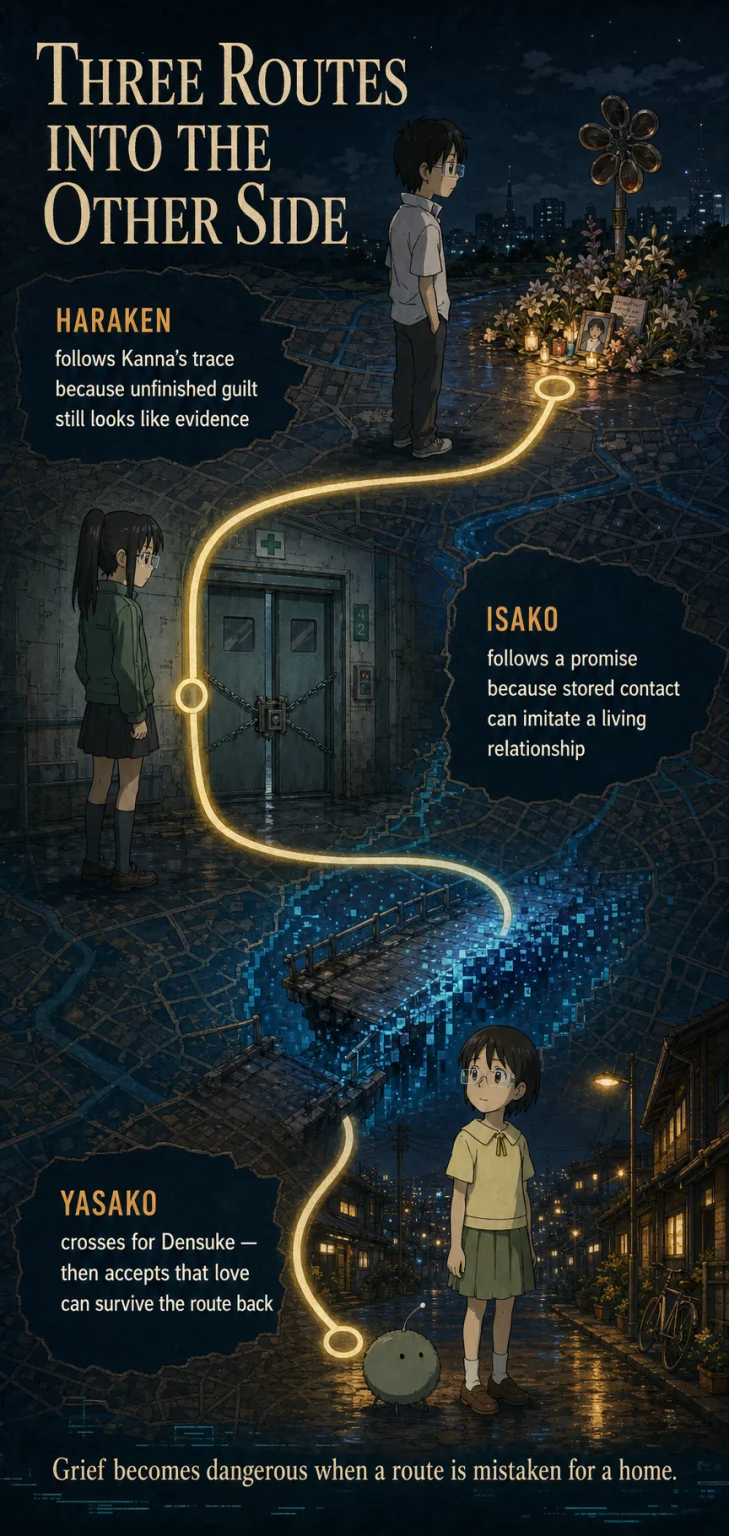
- Grief becomes a navigation problemHaraken, Isako and Yasako enter the other side for different reasons, but each mistakes continued access for a chance to complete what loss interrupted.
- Densuke proves that touch is not the only measure of attachmentYasako cannot feel his fur, yet years of care have made him part of the family’s routines. His digital body does not make the grief imaginary.
- The ending chooses return over perfect recoveryYasako does not solve loss by preserving every trace. She learns that a relationship can remain meaningful without turning its last address into a permanent home.
Dennō Coil is regularly praised for anticipating augmented-reality glasses, location-aware games and children who understand a network better than the adults administering it. That description is accurate, but it makes the series sound like a successful product forecast. Its more durable invention is emotional rather than technical.
Daikoku City contains spaces that the current system no longer recognizes correctly. Searchmaton can format them. Engineers can call them obsolete. Yet children continue to enter them because obsolete space preserves something the updated city has discarded: a route to a dead friend, the apparent voice of a brother, the familiar movement of a pet. The conflict is not “real life versus the internet.” It is between two clocks — software maintenance and mourning — that do not finish at the same speed.
This is a close reading, not a clinical account of grief and not an argument that bereavement should be preserved inside a platform. The series itself shows that old space can injure, deceive and trap. Its sharper question is whether deleting unstable infrastructure also deletes the only form in which a child has learned to approach an absence.
The city calls a place obsolete before its memories expire
In ordinary computing language, obsolete data has lost compatibility with the active system. It may be unreachable, unsupported or scheduled for removal. Dennō Coil gives that administrative label a geography. Old cyber-space does not vanish cleanly when the city updates. It remains misregistered against streets, walls and intersections, producing seams where a person can stand in one location while their glasses insist on another.
That misalignment is frightening because it turns memory into a navigable object. Haraken does not merely remember Kanna. He follows traces near the intersection where she died, gathering fragments as if a better route could convert guilt into evidence. Isako does not simply miss her brother. She pursues access because the network keeps presenting contact as a technical possibility. Yasako’s bond with Densuke is maintained through daily movement even though the body she loves cannot be touched.
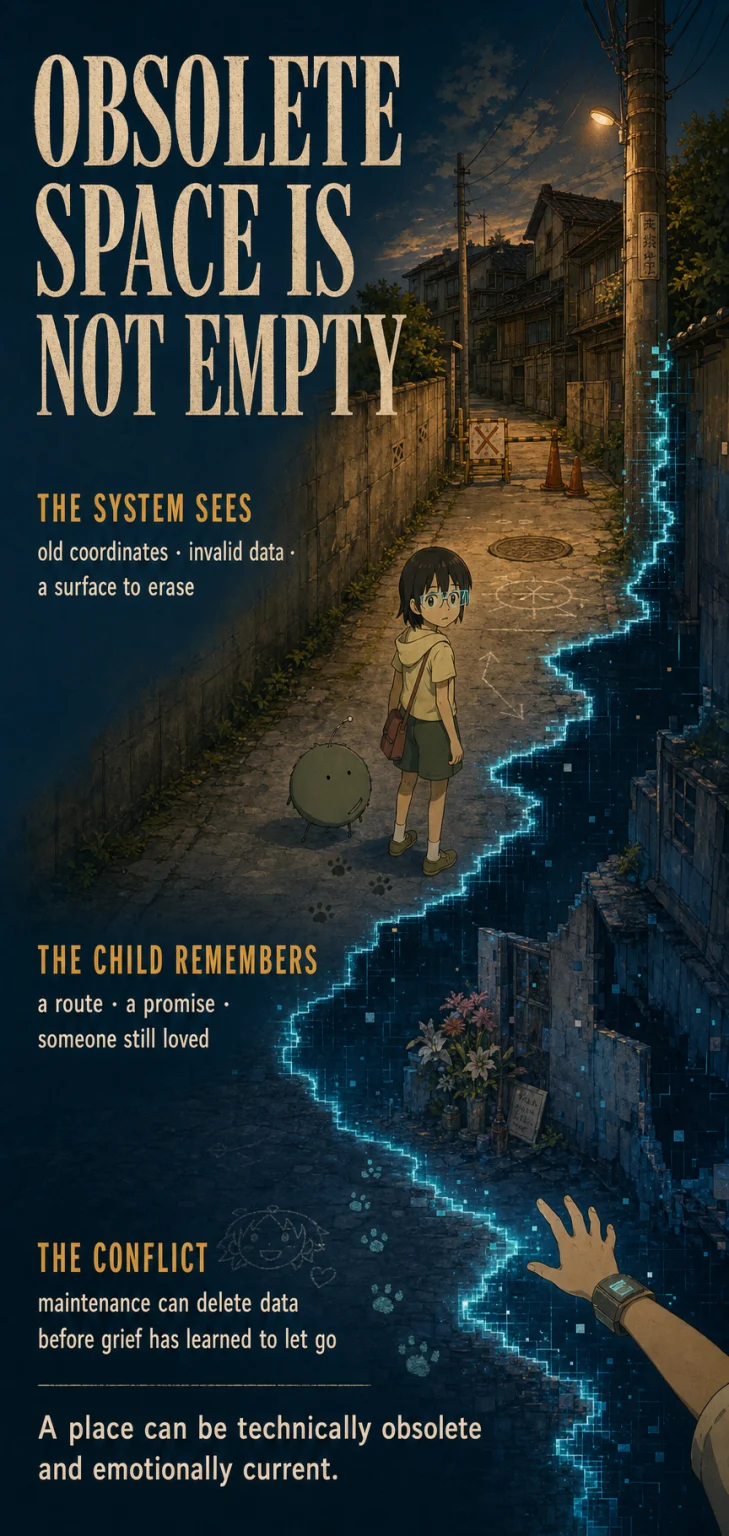
Maintenance clock
Remove the broken layer
Old coordinates create errors, security risks and collisions with the current city. Searchmaton treats instability as a condition to eliminate, not a history to interpret.
Mourning clock
Return until the absence changes meaning
A repeated route can hold guilt, hope and attachment long after it stops producing new information. For the child, revisiting is not a bug; it is unfinished work.
Haraken and Isako confuse access with reversibility in different ways
Haraken’s route begins with responsibility. Kanna died after the two had argued, and the traffic accident fixes his guilt to a physical intersection. The old space around that site behaves like an archive that has lost its index: enough remains to suggest an answer, but never enough to establish what a completed answer would look like. He keeps searching because uncertainty makes stopping feel like abandonment.
Isako’s route begins with a promise. Her techniques appear more controlled, but control hides a deeper dependence: she believes a sequence of access conditions can return her brother. The platform translates bereavement into tasks — find the key, open the passage, reach the correct coordinate. This is precisely why the route is persuasive. It gives grief the shape of work and lets failure mean “not yet” rather than “impossible.”
The two children therefore do not illustrate one generic inability to let go. Haraken treats traces as evidence that might settle guilt. Isako treats access as a contract that might restore a relationship. One searches backward for a fact; the other pushes forward toward a promised meeting. Both can keep moving because the network supplies direction without guaranteeing arrival.
Densuke makes the distance between data and attachment visible
Densuke is the series’ simplest answer to the claim that digital loss is less real. He is software. Yasako cannot touch his fur with her bare hand. Searchmaton can damage him without leaving a wound on the physical street. None of those facts prevents him from occupying the family’s routines: he follows, waits, protects Kyoko and responds to Yasako’s attention.
The emotional fact is not that code secretly becomes biological. It is that care accumulates through reliable address. Yasako knows where Densuke will be, what he will do and how he will answer. When that pattern disappears, the loss is not counterfeit simply because the body was rendered. The series separates the material of a companion from the relationship built around its presence.
The touch gap
A relationship can cross a distance its bodies cannot
Yasako’s body
Can see through the glasses, choose a route and form habits of care.
NO
TOUCH
Densuke’s body
Can answer, follow, protect and disappear when the supporting layer is destroyed.
The distance does not cancel the relationship. It explains why the relationship requires a route — and why losing that route hurts.
Yasako returns because preserving the route is not the same as preserving love
The ending’s crucial movement is not a successful restoration. Yasako crosses toward the other side, encounters what the route still holds and comes back. This distinguishes her from the logic that trapped Isako. If every sign of connection must remain technically reachable, then mourning becomes permanent system administration: no address may be retired because retirement feels like a second death.
Yasako’s return accepts a harder continuity. Densuke can remain part of her life without remaining an active object in the city’s current layer. Memory is no longer treated as a server that must answer on demand. It becomes a relationship whose effects continue in the person who leaves.
↩
Return is the action the other side cannot perform for her
The network can preserve traces and simulate contact. It cannot decide when an encounter has become enough. Yasako’s agency appears in the movement back to a world where Densuke is absent but not meaningless.
The series is not anti-technology; it is against single-owner reality
Mitsuo Iso has described tools as capable of changing human action and generating ideas the unaided mind would not produce. Dennō Coil takes that proposition seriously. The glasses do not merely overlay information; they create new forms of play, investigation, attachment and danger. Children build rules inside the environment rather than remaining passive users.
The failure comes when one layer is granted exclusive authority. Searchmaton is correct that corrupted space can be dangerous. Haraken is correct that the traces around Kanna matter. Isako is correct that a stored voice can carry emotional force. None is correct enough to govern the whole situation alone. The city needs maintenance, but a humane update would recognize that deletion can be technically clean and socially violent at the same time.
| Actor | What the space contains | What that view misses |
|---|---|---|
| Searchmaton | Unsupported and hazardous data | Why a person still returns |
| Haraken | Possible evidence about Kanna | No trace can reverse the argument or accident |
| Isako | A route toward promised contact | Access can simulate continuity without restoring a person |
| Yasako | A last encounter whose meaning can be carried back | Nothing — once return becomes part of the route |
That is why the series has aged better than predictions about any particular headset. Devices change. The conflict remains: platforms constantly decide which places, identities and records are current enough to keep. Dennō Coil asks what a deletion policy owes to the people for whom an outdated address is still the shortest path to someone they loved.
Questions about Dennō Coil and obsolete space
What is obsolete space in Dennō Coil?
It is an older cyber layer that no longer aligns reliably with the current city system. The series uses that technical mismatch as both a real hazard and a place where abandoned routes and memories remain accessible.
Is Densuke alive or only software?
The series does not need to convert Densuke into a biological animal to make the attachment real. He is a cyber pet whose reliable responses and place in family routines create a relationship that can genuinely be lost.
Why does Haraken keep following Kanna’s traces?
His search joins grief to guilt. Because the accident followed an argument, each remaining trace can look like evidence that might finally settle what he owes Kanna, even though no discovery can undo the event.
What does the other side represent?
It works simultaneously as a dangerous network condition, a modern otherworld and a geography of unresolved attachment. The interpretation is strongest when those layers remain together rather than reducing it to a single metaphor.
Production and interpretive sources
Materials checked 27 August 2026
- Bandai Channel — Dennō Coil official series, character and technology guide
- Japan Media Arts Festival — Dennō Coil award page and jury statement
- Ricoh — Mitsuo Iso on tools, externalized information and changed behavior
- Osaka Metropolitan University repository — study of the modern otherworld in Dennō Coil
- Full Frontal — Toshiyuki Inoue on the production and movement language of Dennō Coil


