
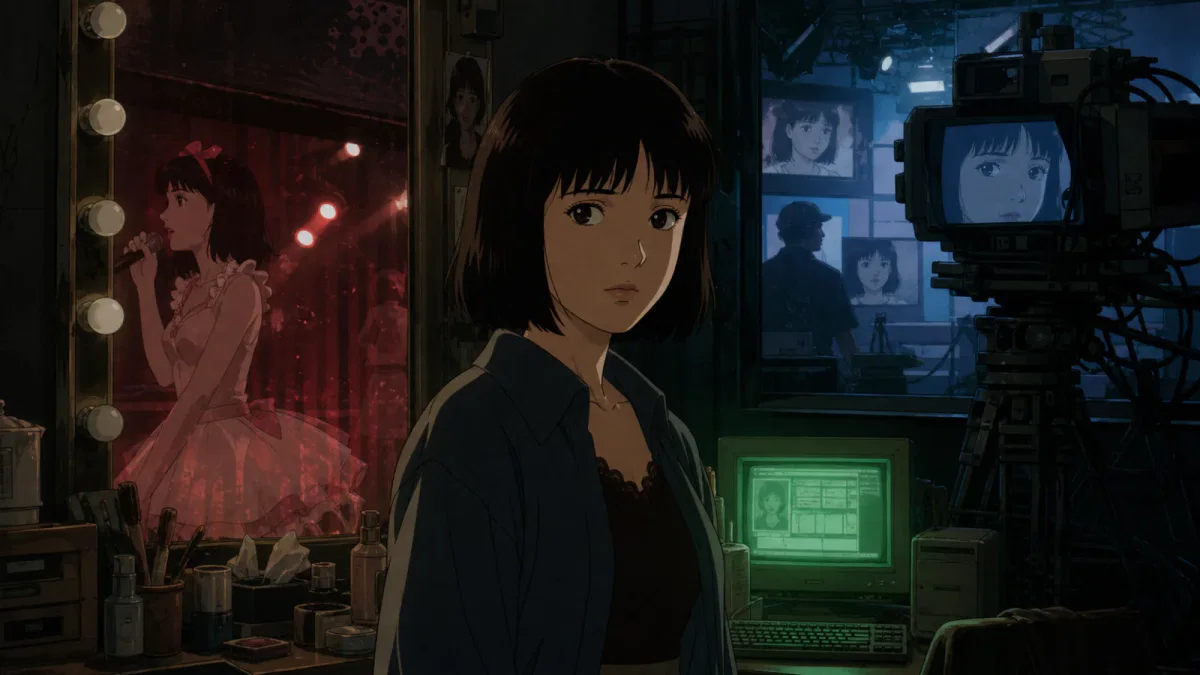
This article contains spoilers for the entire film, including the final confrontation and hospital scene, and discusses stalking and sexual violence. It follows how Mima’s public image becomes something other people try to own, then explains why the last reflection supports recovery without promising that the work of becoming a person is finished.
In his interview with Andrew Osmond, Satoshi Kon warned viewers against turning Perfect Blue into a continuity puzzle with a single answer key. He said the difficulty of separating objective events from subjective experience is the film’s core, and that repeated viewing undertaken only to classify every scene would drain away its effect. That is not permission to call the film random. It is an invitation to track a different kind of order.
Ask who currently has the power to define Mima. The answer changes among a retired idol image, a television production, a counterfeit online diary and Mima herself. Kon’s cuts feel violent because they transfer that power before either Mima or the viewer has time to consent.
The opening turns a career change into a contested identity
Mima’s farewell concert does not simply establish her old job. It shows that an idol is jointly manufactured. The costume, choreography, audience chants, management decisions and fan photography all contribute to a public object that no participant owns alone. When Mima announces that she is leaving CHAM to act, the woman makes a career decision while the image suffers what its audience experiences as a betrayal.
The hallucinated idol Mima is therefore more than suppressed desire. She is a version optimized for recognition: weightless, cheerful, repeatable and untouched by the compromises of adult work. Kon described the tragedy as the gap between the image others see and the person one sees oneself becoming too large. Rumi’s later revelation makes that gap operational. She is not only preserving the old image in memory; she is giving it a body, a diary and an enforcer.
The diary becomes credible by knowing trivial things
Mima’s Room is often praised as a prophetic social-media device, but its most precise horror is less about publicity than continuity. The site does not win Mima’s attention by publishing a spectacular secret. It describes how she holds a cup, what she buys and what train she takes. Those details are small enough to resemble unedited life.
A conventional impostor copies the visible surface. This diary copies sequence. It supplies the connective tissue that memory normally uses to turn isolated moments into a self. As Mima’s working days become discontinuous—one performance cutting into another—the page offers an apparently calm first-person account. Somebody else has begun to remember on her behalf.
In a 2002 interview with Tom Mes, Kon explained that the website had to present a Mima closer to the public image than the real Mima could ever be, and that it had to be made by another character. That production decision exposes the site’s function. Someone has authored a rival with a hidden editorial policy: every change is evidence that the living Mima has become false.

Double Bind industrializes the breakdown it appears to diagnose
The television drama does more than blur fiction and reality. It offers a ready-made explanation for the blur. Mima’s character receives a clinical script about split identity at the same time that the production keeps expanding Mima’s exposure. The diagnosis reaches the audience inside the story before Mima has language for her own experience.
The staged assault is the film’s most severe example of this conversion. Mima chooses to perform the scene as part of becoming a professional actress, a decision Kon defended as hers. Yet consent to the work does not erase the structure around it: a room full of people repeats the event, adjusts bodies and camera positions, and later turns the result into a broadcast image. The sequence can hold both facts at once. Mima exercises agency, and an industry converts that agency into material it controls.
This is why the repeated wake-ups matter. They are not merely clever fake-outs. Each cut demonstrates that production can finish a scene while Mima remains responsible for integrating it. Double Bind has a director who calls “cut,” a script that supplies motivation and a wrap party that declares completion. Mima has no equivalent institution for deciding where the experience ends.
The murders remove the people who helped manufacture the new image
The victims are not random representatives of corruption. The screenwriter, photographer and agent occupy different points in the conversion of Mima from idol to actress. One writes the role, one fixes the body into saleable images and one negotiates access. Their deaths enact the old idol image’s impossible demand that the transformation be reversed after its records already exist.
That pattern also clarifies Me-Mania’s role. He appears to act for the “real Mima,” but he cannot identify her independently. He needs instructions from the diary and recognition from the idol fantasy. His violence is outsourced authorship: he protects a person he has never allowed to change, using a script written by someone else.
The final reflection wins only until the glass breaks
Rumi’s idol Mima seems supernatural because reflective surfaces collaborate with her. Windows and mirrors show the red-costumed figure where an injured adult body should be. The effect makes the public image appear lighter, younger and more real than its bearer. But the illusion depends on the angle. When glass breaks and the reflected costume is exposed as fabric, blood and effort, the image loses its claim to be self-sustaining.
The hospital scene tells us who survived
The chase and the epilogue answer a practical question that the film’s unstable point of view can obscure. Rumi’s attack does not end in her death. Mima intervenes to save her, and the later visit places the two women in different positions: Rumi is receiving care, while Mima arrives as a visitor and then leaves. Reading the hospital as proof that Mima has secretly been the patient requires an additional theory; it is not what that sequence directly presents.
The reflections make that distinction visible. Rumi continues to see the idol image in place of herself. Mima’s last reflection is her present appearance, attached to a woman who can walk away from the hospital and continue her acting career. That contrast gives the recovery reading substantial evidence. It does not require treating Rumi as a monster who must be killed so that Mima can become real.
Mima’s rescue is also an ethical change in the story’s pattern. The stalker and Rumi try to remove a supposedly false woman in order to preserve an ideal one. Mima can stop the attack while preserving the attacker’s life. Our reading is that she refuses the demand that only one version of a person be allowed to exist. The film’s treatment of a violent crisis should not be used as a diagnosis of real people or as a general account of psychiatric illness.
Mima’s last line remains a claim she has to live with
The car mirror repeats a visual device that has already deceived Mima and the audience. Her confident statement can therefore feel reassuring and unsettling at once. A reflection shows an image; it cannot certify a finished inner self. That is a more specific uncertainty than saying that nothing happened or that every scene has equal evidential weight.
Andrew Osmond’s account of Kon’s recorded lectures and written notes, published by the film’s UK distributor, addresses this shot directly. Osmond reports that Kon did not intend the mirror as a revelation that Mima had been the murderer all along. The point was subtler: she had not reached a final, completed authentic self. Kon nevertheless welcomed interpretations that differed from his own. The commentary leaves room for interpretation while giving us a specific account of his intention.
Mima has gained room to choose. A successful career and an assured sentence do not make future self-doubt impossible. In the 2002 interview, Kon described the story as a young woman maturing when her old values break apart. The two ideas can coexist: maturation has occurred, and a person remains unfinished.
The reading developed here is therefore hopeful without making the final frame a certificate of permanent recovery. Mima can resist an image that other people demand she repeat. Rumi’s hospital reflection shows the cost of being unable to release that image. The last car mirror asks us to recognise Mima’s claim to a changing life, rather than demand one more perfect portrait that will never change.
Where the director’s commentary can take the reading further
The current GKIDS physical-edition listing identifies a complete 117 minutes of Kon’s lectures, subtitled in English, among its bonus features. That is a concrete route to more of the director’s thinking if you want to examine the commentary after the film. Check the listed edition’s extras; a digital rental may provide only the feature.
For another Kon story in which an image becomes socially useful, our reading of Paranoia Agent follows how relief helps a rumour acquire force. Serial Experiments Lain approaches identity through shared memory instead.


