

Close reading · Paranoia Agent
Shōnen Bat becomes real because relief makes him useful
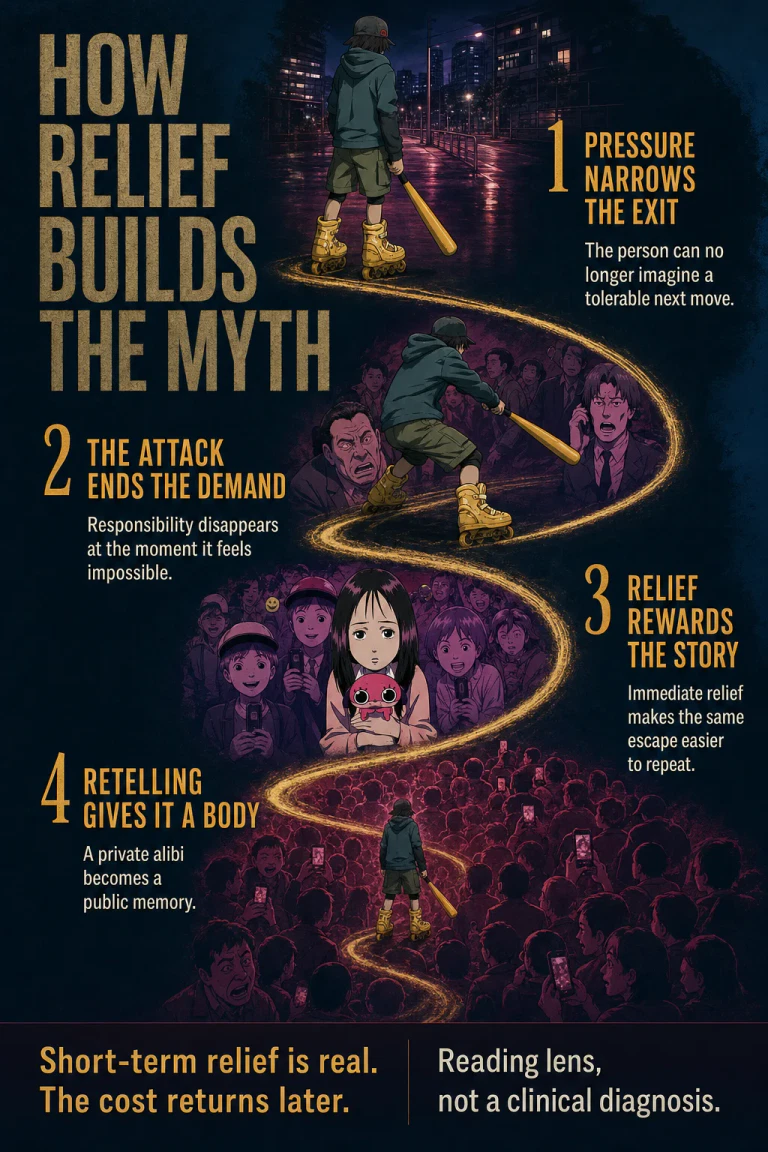
Tokyo does not first agree on what Shōnen Bat is. It learns what he does: he arrives when a person can no longer bear the next decision, and the attack makes that decision disappear.
- The reward comes after the blowEach attack interrupts a demand that has become intolerable. The victim pays a visible cost, but also receives immediate relief from choosing, confessing or continuing.
- Belief is less important than functionA rumor can organize behavior before everyone accepts it literally. Shōnen Bat gives strangers one repeatable explanation for why responsibility suddenly stopped.
- Maromi and the bat offer opposite forms of the same escapeOne softens attention until the demand is forgotten; the other ends the demand through impact. Both preserve the story that nothing has to change.
- The finale removes the reward, not merely the monsterWhen Tsukiko accepts the event she had rewritten, the escape script loses its job. The series resolves responsibility before it resolves spectacle.
Paranoia Agent is often described as a story about mass hysteria, urban anxiety or a rumor that takes physical form. All three descriptions are true, but they begin too late. They explain how Shōnen Bat moves through Tokyo after the city has started talking about him. They do not explain why the story is so easy to reuse.
The series supplies a sharper mechanism. Before the attack, a person faces a demand that has narrowed into an impossible next move. After the attack, that demand is suspended. The wound is real, but so is the relief. Shōnen Bat spreads because he turns avoidance into an event with a witness, a bruise and a socially recognizable cause.
This is a close reading, not a diagnosis of the characters and not a claim that a television series models a psychiatric disorder. The useful comparison is behavioral: laboratory research shows that relief following the omission of an expected threat can function as a reward, while work on experiential avoidance shows why short-term escape may coexist with longer-term costs. Satoshi Kon transforms that modest mechanism into a civic myth.
The attack arrives after the decision space has collapsed
Tsukiko Sagi does not begin the series by searching for a supernatural attacker. She is a designer whose successful Maromi character has made the company demand another hit. Her creative block is also an accountability crisis: colleagues wait for an answer that she cannot produce, and the public image of effortless cuteness makes the pressure harder to admit. The first Shōnen Bat story gives that pressure an external author.
The pattern repeats with different content. Yūichi Taira cannot tolerate the collapse of a school identity built on admiration. Harumi Chōno has organized daily life around a partition that is failing. Masami Hirukawa discovers that authority, debt and private appetite cannot remain separate. The cases are not interchangeable portraits of “stress.” In each one, the attack occurs when maintaining the current self-story has become more expensive than being removed from the scene.
The episode sequence
Four different lives reach the same mechanical edge
01 · TSUKIKO
Produce the next success
Creative uncertainty becomes a deadline that others interpret as failure.
02 · YŪICHI
Remain the admired boy
A rumor makes ordinary ambiguity feel like the loss of a complete identity.
03 · HARUMI
Keep two lives sealed
The boundary that made daily functioning possible can no longer hold.
04 · MASAMI
Preserve public authority
Debt and misconduct make the respectable self impossible to maintain.
The content changes. The timing does not: Shōnen Bat enters when another action would force the person to revise the story they live inside.
That timing matters more than whether every victim consciously invites the attack. A mechanism can reward behavior without being planned. The person need not think, “I want to be hit.” The relevant sequence is smaller: intolerable demand, interruption, relief. Once the city can narrate that sequence as Shōnen Bat, the next crisis already has a form available.
Relief is the reward that teaches the myth to return
Experimental work on threat avoidance helps identify what the series gets right. Relief is not just the neutral absence of fear. In controlled studies, successfully avoiding an expected threat can produce a positively valued state, and the size of that relief can strengthen subsequent avoidance. A person may therefore repeat an escape not because the danger was imaginary, but because the immediate transition from threat to safety is rewarding.
Paranoia Agent turns that transition into narrative architecture. The attacks hurt, attract police attention and create new problems, yet they also stop the clock at the exact moment when the previous problem required an answer. The series refuses the easy moral that victims simply choose cowardice. It shows why avoidance can remain compelling even when its later cost is obvious.
01
The pain is not the reward
The reinforcing event is the change in state: a demand disappears. Keeping that distinction prevents the analysis from romanticizing harm or claiming that victims consciously seek it.
A rumor can be useful before it is believed
The detectives initially treat Shōnen Bat as an ordinary offender whose description can be stabilized through testimony. But testimony does not merely record the figure. It distributes him. The bent bat, golden skates and elementary-school silhouette become a compact package that strangers can recognize, fear and reuse. The story’s portability matters more than forensic consistency.
Literal question
Did this person see the same attacker?
This matters to the investigation, but it cannot explain why the description keeps entering new crises.
≠
Functional question
What became unnecessary after the attack?
This reveals the repeated payoff: the obligation, confession or choice that no longer has to happen now.
Research on social memory makes the next step less mystical without making it less disturbing. Recollection is not sealed inside individuals. Conversation can align memories, propagate errors and make negative information especially durable inside a group. Rumor studies likewise show that anxiety and informational gaps shape what gets transmitted. The series exaggerates these processes into a body that can strike, but its social logic is recognizable: repetition standardizes a useful account.
How a private alibi acquires public agency
The city remembers a reusable sequence, not one stable eyewitness report
Private crisisA person cannot preserve the current self-story and still take the next action.
→
Public accountThe attack converts a conflicted choice into something that happened to the person.
→
Shared imageryBat, skates and child silhouette compress the account into portable signs.
→
Available escapeThe next crisis inherits a story whose consequences the city already recognizes.
This comparison does not prove that collective-memory experiments explain a fictional entity. It clarifies the series’ distinction between a story being factually settled and a story becoming behaviorally available.
Maromi and Shōnen Bat sell opposite versions of the same escape
Maromi appears to be Shōnen Bat’s opposite: soft where he is hard, passive where he is kinetic, commercial where he is criminal. Yet the series repeatedly places them in the same functional position. Maromi asks the overwhelmed person to relax, forget and accept a world in which the demand no longer presses. Shōnen Bat removes the person from that demand through impact.
Episode 10 makes this pairing especially precise by moving into an animation studio that cannot deliver its own episode. The production process becomes a chain of delayed responsibilities, soothing reassurances and transferred blame. The result is not a generic satire about overwork. It is a demonstration that the machinery creating comforting images can itself depend on the same evasions the comfort is sold to manage.
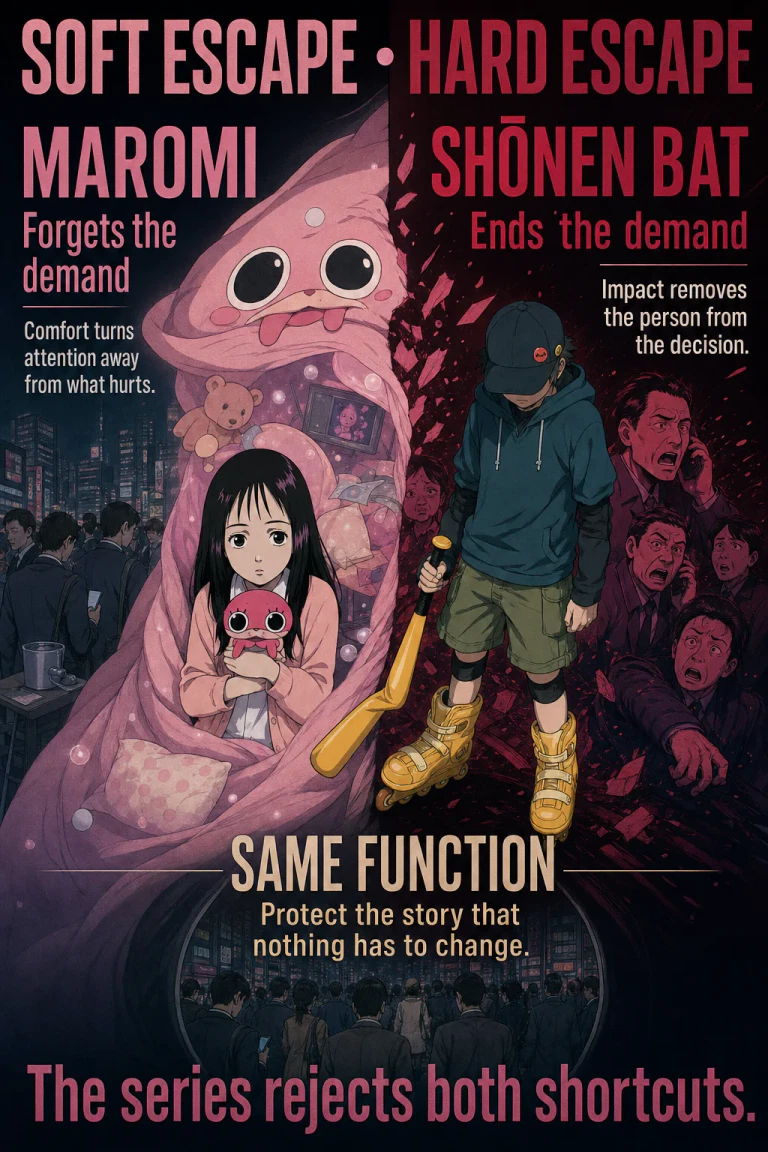
The pairing also explains why product success and urban panic can grow together. Maromi gives private exhaustion a mass-produced language of innocence. Shōnen Bat gives the same exhaustion a public language of victimhood. Neither language is automatically false. The problem is what each one makes unnecessary: naming the demand, accepting the loss and choosing what must change next.
The finale works because Tsukiko accepts a cost that relief had hidden
The story finally returns to the death of Tsukiko’s dog, also named Maromi. As a child, she displaced responsibility for that loss into the first Shōnen Bat story. The point is not that one lie mechanically causes every later event. It is that the original story demonstrates the exact service the myth will provide at scale: convert an unbearable admission into an external attack.
Tsukiko’s decisive act is therefore not defeating a stronger monster. She acknowledges what happened without demanding that the acknowledgment erase grief. That change removes the myth’s reward. The past remains painful, but it no longer needs an attacker to make responsibility survivable.
02
Acceptance is not the same as comfort
The ending does not promise that truth feels better immediately. It shows that responsibility can be carried without turning pain into an alibi. That is why the final recognition changes the system rather than merely winning a fight.
This reading also preserves an important limit. Experiential avoidance is a broad psychological construct, not a verdict on Tsukiko, Harumi or any viewer. Longitudinal studies associate persistent avoidance with worse emotional outcomes, but the size and independence of that relationship vary once researchers account for rumination, worry and existing symptoms. Kon’s achievement is not clinical accuracy. It is causal clarity: he makes the immediate payoff of escape visible before showing the cost of a city organized around it.
Questions about the relief behind Shōnen Bat
Is Shōnen Bat real in Paranoia Agent?
The series deliberately lets physical attack, invented testimony and collective manifestation overlap. This analysis does not need a single ontological answer. Shōnen Bat becomes causally real when the shared story changes what people expect, report and do.
Why do the victims feel relief after an attack?
The attack interrupts a responsibility that has become intolerable. The injury creates new costs, but it also postpones a decision, confession or performance. That immediate change of state is the reward analyzed here.
What is the connection between Maromi and Shōnen Bat?
They use opposite sensory strategies but perform a similar function. Maromi offers soft forgetting; Shōnen Bat offers violent interruption. Both become shortcuts around revising the story that produced the crisis.
Is this article claiming the anime depicts a mental illness?
No. It uses research on relief, avoidance and social memory as interpretive lenses. The characters are not clinical cases, and the article does not offer diagnosis or treatment advice.
Episode, production and research sources
Materials checked 25 August 2026
- Crunchyroll series page for Paranoia Agent — official availability and series identity.
- Crunchyroll News on Paranoia Agent — production context and Kon’s reuse of ideas that did not fit earlier films.
- Midnight Eye interview with Satoshi Kon — the director’s account of the series’ construction and themes.
- What a relief! The pleasure of threat avoidance — experimental evidence that successful avoidance can produce positively reinforcing relief.
- Experiential avoidance and persistence of emotional disorders — longitudinal evidence and limits relevant to avoidance as a process.
- Experiential avoidance, rumination and worry — evidence that the construct overlaps with other processes and should not be treated as a total explanation.
- Social transmission of memory — experimental review of how group recall can align accurate and false memories.


