
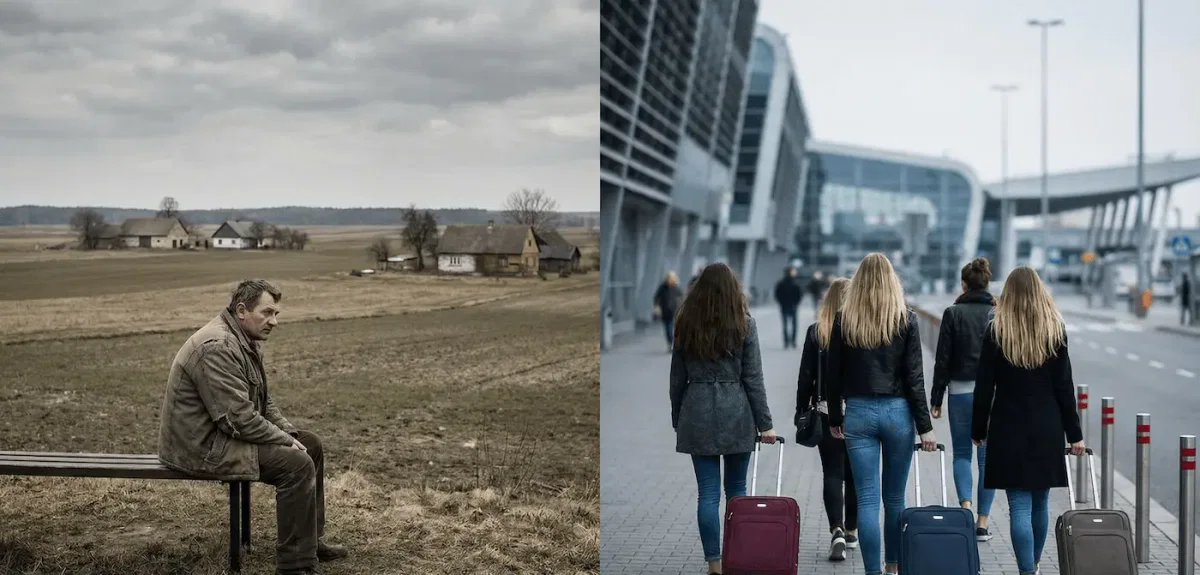
📉 Key Takeaways from the Demographic Analysis
Official statistics often hide the full picture. Here are 3 hard truths about the Polish population that you won't see in the standard reports:
- 1. The 2-3 Million Gap ("Womb Drain"): Residency-based stats are misleading. In the key age groups for starting families (20-39 years), millions of women are simply missing. They have emigrated permanently and aren't coming back. The apparent surplus of women in Poland is driven by seniors over 60, masking a serious demographic gap among younger people.
- 2. Poland is just a "Pit Stop" (The Ukrainian Myth): The hope that Ukrainian refugees would fix the demographic issues hasn't played out. Poland is losing out to Germany, where wages and benefits are higher. Many Ukrainian women view Poland as a transit point rather than a destination, and the number of Polish-Ukrainian marriages remains very low (1.8%).
- 3. Geography of Loneliness & Cultural Fracture: Polish society is splitting. Young men are leaning right politically, while young women lean left. We are seeing "bachelor reserves" in rural areas with up to 150 men for every 100 women, while big cities draw women away. Unable to bridge this gap, many men are choosing a path of "holy peace" - effectively withdrawing from the dating market entirely.
The fundamental error in diagnosing the state of Polish demography stems from a cognitive bias rooted in the definition of the population and the reliance on residency registration (meldunek), a concept that is largely dead in the 21st century. GUS operates using the category of de jure (registered) population. This leads to a situation where millions of people who have been physically absent from the country for years still figure in the registers as residents of specific municipalities.
The definition of a "resident," while theoretically intended to correct this error, is insufficient in practice. The population of Poland includes citizens who are temporarily abroad (even for more than 12 months) provided they have not reported their permanent departure. In Polish administrative culture, completing the deregistration formality upon emigration is a rarity; most emigrants keep their Polish registration "just in case" or due to bureaucratic inertia. GUS estimates from 2023 mentioned 1.56 million people staying temporarily abroad, but this figure is widely considered by demographers to be drastically underestimated.
The statistical office "does not see" entire families who have left Poland and severed ties with the country, taking no benefits but also not deregistering. Before Brexit, the British Office for National Statistics (ONS) estimated the number of Poles in the UK at over a million, while Polish data was much more conservative. This discrepancy reveals a massive dynamic that the ossified Polish statistical system cannot capture in real-time. Consequently, state policy designs public services (schools, hospitals) for a population that exists only on paper.
The 2-3 million gap - where did the women go?
In independent analyses of the mating market, the figure of "2-3 million missing women" frequently appears. While official GUS data does not confirm such a gigantic gap directly, a deep dive into age and migration structures supports the thesis of a "demographic shadow" of this magnitude. Several overlapping phenomena contribute to this:
- Unregistered permanent emigration - women of working age (20–40 years) constitute a significant portion of this "invisible" emigration. Unlike male economic migration, which is often cyclical or trade-based, female emigration tends to be more settlement-oriented and integrative. Polish women, statistically better educated than Polish men, enter relationships with foreigners (British, German, Italian) faster and rarely decide to return. They disappear from the Polish "market" definitively, even if they still figure in the PESEL system as single women living in provincial towns,
- Male excess mortality vs. age structure - Polish statistics are misleading when looking at the overall feminization ratio of 107 (107 women per 100 men). This surplus is generated almost exclusively by age groups over 60, where women live on average 8 years longer than men. In the cohorts key for reproduction and the marriage market (20–39 years), we are dealing with a deficit of women, which, combined with their higher mobility, creates a structural gap,
- Urban drainage and "double selection" - young women migrate in two stages. The first stage is the drainage from the Polish provinces to large cities (Warsaw, Kraków, Wrocław), where feminization rates are artificially inflated (reaching 115–120). The second stage is migration from Polish metropolises to global metropolises (London, Berlin). Men from the provinces do not have access to women from the first stage (because they left for university), and men from Warsaw lose partners to Western markets.
If we sum up these cohorts "lost" in statistics, supplement them with women who were never born due to the demographic slump of the 1990s, and those who left and did not return, the estimate of a deficit of 2–3 million women in relation to the needs of generational replacement and market equilibrium becomes terrifyingly real.
Brain drain as "womb drain"
Modern research on gender roles in emigration indicates a fundamental paradigm shift: from the "accompanying person" model to the "independent conqueror" model. In the past, women often emigrated passively. Today, they are the initiators of departure, motivated not only by economics but also by a desire to escape the conservative cultural patterns prevailing in Poland.
Studies conducted on Polish female emigrants in Europe and the USA show that they adapt to new, egalitarian cultural models much faster and deeper than men. A Polish woman in the West appreciates work-life balance, a partnership model of relationships, and the lack of pressure to be a "Polish Mother" (Matka Polka). Returning to the country is perceived as a regression not only economic but also social. These women, by disappearing de facto from the Polish population registry, create a gap that cannot be filled by simple social transfers like the "800+" child benefit. This is not just a "brain drain" but primarily a "womb drain" the loss of reproductive potential that is non-renewable.
Poland as a "pit stop" - the Ukrainian reality check
The outbreak of full-scale war in Ukraine in 2022 triggered a wave of unjustified demographic optimism in Poland. The prevailing narrative in media and political cabinets was that the influx of millions of women and children would naturally fill the Polish demographic gap, provide hands for work, and revive the marriage market. Analysis of hard data from 2023–2025 brutally verifies these hopes, exposing Poland as an unattractive destination country.
Poland is increasingly treated by Ukrainian women as a transit country a kind of "pit stop" on the way to richer Western European countries, primarily Germany. The data is unambiguous:
| Indicator | Poland (Situation 2024/25) | Germany (Situation 2024/25) | Migration Trend |
| Refugees (temporary protection) | ~975,000 | ~1.12 million | Mass outflow PL to DE |
| Dynamics (y/y) | Permit decrease of 23.9% | Increase in registrations | Secondary migration |
| Key Motivators | Geographic/linguistic proximity | Higher benefits, better wages | Economic rationalism |
This phenomenon is confirmed by Eurostat reports: Germany has overtaken Poland in the number of refugees hosted by over 150,000 people, and this difference is constantly growing. Ukrainian women make rational economic decisions. In the face of a prolonged conflict, sentiments and proximity to the border give way to calculations regarding their children's future. The German social system (Bürgergeld), better healthcare, and higher earnings are magnets with which the Polish state struggling with inflation and a housing crisis cannot compete.
The myth of the "wife from the East"
Among a section of Polish society, especially single men, a myth functioned that the influx of Ukrainian women would solve their matrimonial problems. It was expected that "traditional" women from the East would seek stability alongside Polish men. Statistical reality is quite different and points to the marginal nature of this phenomenon.
- Micro scale in a sea of needs - in 2024, a record number of Polish-Ukrainian marriages was recorded 2,556. However, on a national scale, where approx. 136,000 marriages are concluded annually, this constitutes only 1.8% of all unions. Considering the refugee population of one million, this is a drop in the ocean,
- national endogamy - a key, yet silenced fact is that in the same period, the number of marriages concluded between two citizens of Ukraine in Poland (Ukrainian man + Ukrainian woman) exceeded the number of mixed marriages, reaching 2,627. This proves that the Ukrainian diaspora in Poland is solidifying, becoming socially self-sufficient, and "closing" within its own circle. Ukrainian women are not looking for Poles they are looking for Ukrainians staying in Poland or bringing partners from home.
Status mismatch and disappointment
Why are Ukrainian women "not interested in Poles"? The answer lies in the social structure of both groups. There is a deep mismatch on the mating market.
- Refugee profile - women who came to Poland after 2022 are largely residents of large Ukrainian cities (Kyiv, Kharkiv), holding higher education degrees. These are aspiring, urbanized, and modern women,
- Polish "Seeker" profile - The greatest deficit of women occurs in the Polish countryside and small towns, among men with vocational or secondary education. For an educated woman from Kyiv, the prospect of a relationship with a farmer or blue-collar worker from the Polish provinces is not a social advancement, but a degradation.
The "pit stop" theory finds its social justification here. Ukrainian women treat Poland instrumentally, and Polish men as unattractive partners. They aim either for men from their own cultural circle or for partners from Western Europe who can offer a higher standard of living.
The gender war - polarization and "holy peace"
Poland is experiencing one of the deepest political and axiological fractures in Europe running along gender lines. The young generation of Poles (Gen Z and younger Millennials) is not a monolith they are two hostile tribes living in separate information bubbles and professing contradictory values.
- Young men (18–30) turn to the right - this group massively supports Konfederacja and national-conservative parties. Polls indicate support reaching 62% in some studies. This is a defensive reaction to perceived systemic discrimination against men, the pressure to be a "traditional provider" while losing patriarchal privileges, and the lack of any political offer from the Left, which focuses on women's and minority rights. The young man feels besieged by "gender ideology" and accused of all the world's evils, so he seeks refuge in narratives of strength, the free market, and tradition,
- young women (18–30) turn to the left - Polish women of the same age are decisively turning towards The Left (Lewica) and the Civic Coalition (KO). Their political identity was formed by the "Black Protests," the fight for reproductive rights, and educational emancipation. For a young, liberal Polish woman, a peer voting for Konfederacja (which she identifies with authoritarianism and contempt for women) is "unfit for a relationship" for fundamental reasons. This is an insurmountable barrier at the level of values.
The "holy peace" strategy
In response to the rising requirements of women who expect partners to have not only financial stability but also fluency in the language of psychotherapy ("needs," "boundaries," "space"), while often lacking acceptance for traditional male weaknesses Polish men are increasingly choosing a strategy of total withdrawal. Psychology describes this as an escape into "holy peace" (święty spokój).
This is a form of "Italian strike" in male-female relationships. The man calculates that the emotional and financial costs of entering a relationship with a demanding (in his feeling) partner outweigh the potential gains. He therefore chooses:
- passivity - avoiding initiative, not flirting, waiting for a move from the other side (which rarely happens),
- virtual escape - video games, pornography, internet communities, which offer gratification without the risk of rejection and without the need to meet exorbitant standards,
- minimalism - focusing on a career or, conversely, living along the line of least resistance, just so no one wants anything from him.
The patron saint of the contemporary Polish single male has become "Holy Peace" a state of no demands, no criticism, and no necessity to constantly prove one's worth. This psychological withdrawal is just as destructive for demography as the physical emigration of women.
Geography of loneliness - the 150 men anomaly
Territorial analysis reveals drastic, deepening disparities in the distribution of women and men on the map of Poland. The country is divided into feminized metropolitan centers and masculinized, depopulating peripheries.
- Cities magnets for women - in the largest Polish agglomerations (Warsaw, Poznań, Wrocław, Kraków), feminization rates break records. There are on average 112–120 women for every 100 men. Even after adjusting for the overrepresentation of female seniors, the female advantage is clear in student and early-career groups. Cities offer women a labor market in the service and administration sectors, anonymity, a liberal environment, and access to education. A woman from a small town, once she leaves for studies in Warsaw, almost never returns,
- rural areas bachelor reserves - the situation is the opposite in rural areas. A permanent surplus of men dominates there. Young men more often stay on farms or take up jobs in local industry/crafts. Vocational education ties them to the local labor market, while general education pushes women to cities. As a result, entire municipalities arise where finding a female partner is statistically impossible.
Extreme municipalities - Where there are no wives
GUS data from 2023/2024 allows for the identification of critical points on the map of Poland, municipalities with the highest masculinization, which are becoming demographic deserts.
- In some rural municipalities (e.g., in Podlaskie or Warmińsko-Mazurskie voivodeships), the feminization ratio in reproductive age groups drops to 67–80 women per 100 men. This means that every third, and sometimes every second man has no physical possibility of finding a partner in his area,
- extreme examples include small villages like Szczudły or Święćk-Strumiany, where masculinization rates of 150 men per 100 women are noted,
- This phenomenon leads to social pathologies - a plague of loneliness, alcoholism, suicides among men, and the total disappearance of family life.
Apocalypse 2035 - systemic consequences
Forecasts by the Polish Economic Institute (PIE) are ruthless. By 2035, the Polish labor market will physically lose 2.1 million workers, which constitutes about 12.6% of the current workforce. This is a loss that cannot be filled by immigration.
Pension system catastrophe
The Polish pension system (ZUS), based on intergenerational solidarity, is heading towards mathematical insolvency.
- Currently, the replacement rate is approx. 54%,
- ZUS forecasts for 2040–2060 are catastrophic, the replacement rate will fall to 25–30%. This means future retirees will receive benefits on the verge of the subsistence minimum,
- for women, the situation is even worse due to the lower retirement age (60 vs 65) and career gaps. The system will condemn single, childless women to systemic poverty.
Healthcare collapse - who will hold the hand?
Poland already has one of the lowest ratios of doctors and nurses in the EU. The demographic crisis will hit this sector with double force.
- The average age of a nurse in Poland exceeds 53 years. Within a decade, most will retire,
- reports indicate that by 2035, tens of thousands of nurses will be missing. There are physically no young women to enter the profession, and those who exist often choose emigration,
- the system faces paralysis of hospitals and care homes due to a simple lack of human hands.


