
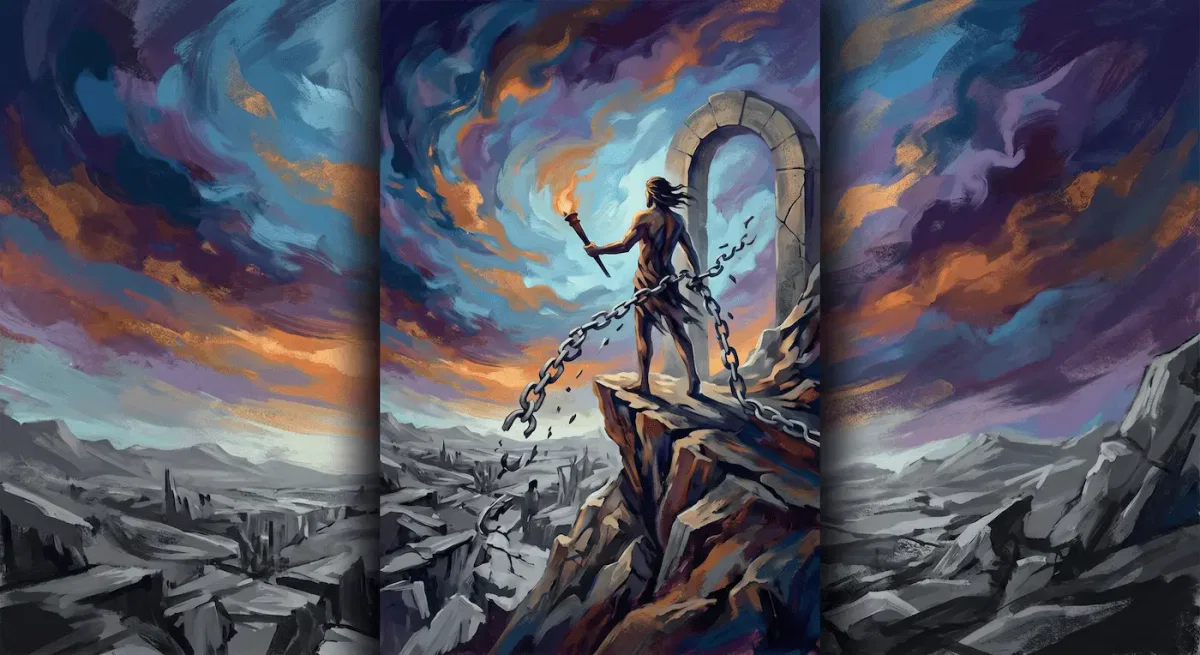
Key takeaways from the Nietzschean Philosophy analysis
Friedrich Nietzsche's philosophy is profoundly misunderstood. Rather than promoting physical violence or nationalism, his work diagnoses the collapse of Western ethics and offers a framework for overcoming cultural nihilism:
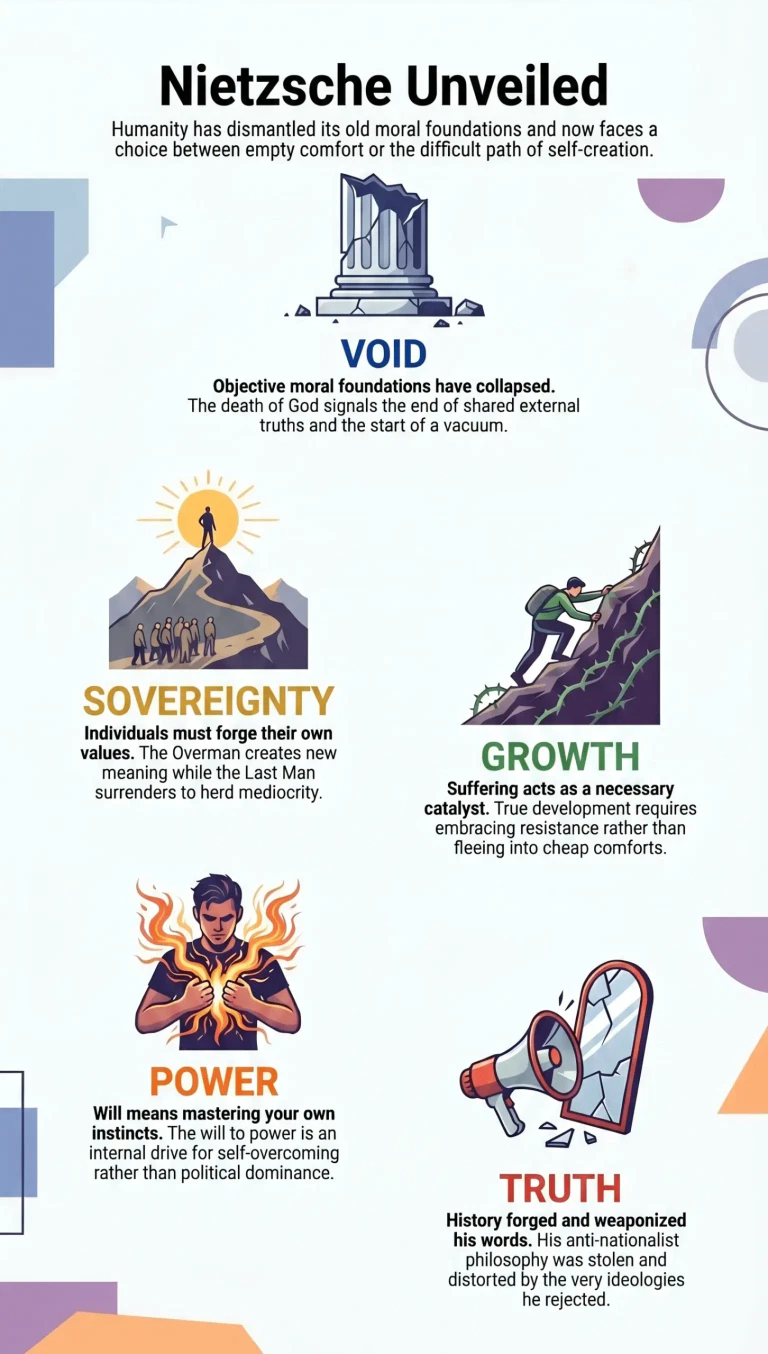
- 1. The moral void and the "Last Man" The "death of God" is a diagnosis of collapsing objective ethics, exposing modern humanism as mere secularized Christian dogma. This collapse breeds nihilism and produces the "last man"—an individual who flees from suffering into cheap, meaningless comfort.
- 2. Zarathustra vs. the "Cold Monster" Unlike the historical Jesus, who escaped physical existence through hypersensitivity, Zarathustra embodies evolutionary maturity by unconditionally affirming matter. This journey requires spiritual and intellectual "war" (agon), standing in direct opposition to the nation-state, which Nietzsche despised as a "cold monster."
- 3. The tragedy of historical forgery The association of Nietzsche's deeply individualistic, anti-nationalist philosophy with the Third Reich was an act of unprecedented forgery. His sister, Elisabeth Förster-Nietzsche, deliberately flattened and weaponized his notes to serve fascist ideologies he openly rejected.
The famous declaration about the death of God remains the most misunderstood sentence in the history of modern Western thought. We reject religious dogmas today with a smile of intellectual superiority, yet we fall into a hysterical panic when anyone questions our secular human rights. We pride ourselves on scientific rationalism, yet spend our lives searching for political saviors. Is this not the ultimate proof of our disorientation? Nietzsche, announcing the demise of the absolute guarantor of truth through the mouth of the Madman in "The Gay Science," was not celebrating the triumph of the Enlightenment. He was performing a brutal, cold autopsy of European culture. A culture that deliberately cut off the branch it was sitting on. The Enlightenment killed the divine authority using scientific tools, but failed to grasp the consequences of its act. The death of the deity marks the end of an objective teleological order. It is no cause for joy, but the harbinger of an existential earthquake.
This event operates on a cosmic scale, though to the crowd in the marketplace, it seems merely an anecdote. The crowd of atheists mocked by the Madman takes the lack of a creator for granted, failing to understand they have just wiped away the horizon of phenomena. Nietzsche knew that stripping the world of a metaphysical organizing principle destroys the reason for good and evil in their previous understanding. We demand absolute social justice based on an evolution driven by the survival of the fittest. Where is the logical consistency here? If the universe is merely blind will and colliding atoms, our moral outrage is as pointless as the wind. We reject this fact. Modern man rejects inconvenient facts. We seek solace in illusions.
The ethical systems we inherit rest on a Judeo-Christian foundation. Principles of inherent dignity, compassion for the weak, and unconditional altruism derived directly from the theological premise that all humans stand equal before the face of a creator. When we remove this concept from the structure, the entire edifice begins to shake. European ethics is a historical construct, not a law of gravity. The designer disappears, so the hard reason to respect weakness vanishes. Most people have no idea they are playing a game whose rules expired long ago. Morality hangs in a vacuum. It waits for the final collapse.
Christian morality without Christ
Modern secular humanism is merely the shadow of a dead god. Nietzsche notes that rejecting theology did not alter the mechanisms of valuation. Progressive, leftist, or liberal ideologies are essentially secularized forms of Christianity. Only the vocabulary was changed. Instead of sin, we have social exclusion; instead of salvation, we have the utopia of a classless welfare state. The mechanism remains identical: glorifying weakness and condemning vital strength. We passionately fight for the rights of the oppressed but hate individuals who dare to rise above mediocrity. Does that not sound familiar? When Christianity promised heaven on earth for the meek, it operated according to an internal religious logic. Secularization transferred this claim to tax offices and politics. Shadows of the old cult fall on modern institutions. Hypocrisy hardly gets bigger than this.
This state of affairs leads to a deep internal fracture in the modern individual. We tell ourselves we are the masters of our own fate, while deep down we operate on herd mentality. This is ressentiment, the poison with which the weak infect the strong. Because the masses cannot achieve greatness, they establish a value system where greatness becomes evil. Pride, ambition, and arrogance get classified as vices, while passivity and docility gain the status of civic virtues. Outstanding individuals thus begin to feel ashamed of their own capabilities. We dwarf ourselves by choice. Instinct undergoes permanent degeneration. Surviving in a herd requires putting predators to sleep.
Shedding religious dogma without establishing new values leads straight into the arms of cheap cynicism. People start treating ethics as a set of optional consumer preferences. Since there is no longer a final judgment for our actions, justice reduces to avoiding legal sanctions. We spend our lives calculating profits and losses, completely forgetting dignity. Such a society cannot spark any great form within itself. It lives day to day, slowly eating away the capital accumulated by previous generations. The disintegration of social bonds occurs silently. Everything is permitted, so nothing matters. It is a zero-sum equation.
The last man and the triumph of nihilism
The direct consequence of this phenomenon is the onset of the epoch of nihilism. This is a state of total depletion of society's vital energy, where the highest values devalue themselves. When the transcendent goal ceases to exist, life reduces to biological vegetation. Instead of seeking greatness, man begins seeking exclusively comfort. We create increasingly complex anesthetic systems, from pharmacology to digital entertainment, just to avoid feeling the weight of existence. We issue trigger warnings for every potential emotional threat, sterilizing our environment. Is this supposed to be our evolutionary peak? Avoiding suffering becomes the only binding cultural imperative. Escaping pain is the ultimate capitulation. Society loses its capacity for resistance.
In response to this void, Nietzsche draws the terrifyingly accurate silhouette of the "last man." This is an individual reconciled with their monstrous smallness, bypassing all risk. The last men invented happiness, they say, and blink. They have given up passions that could lead to a fall, but thereby surrendered the possibility of rising upward. They settle for a little pleasure for the day and a little pleasure for the night, managing their health with mechanical precision. No one wants to rule anymore, no one wants to obey; both attitudes require effort. This type represents mass mediocrity that has declared itself the pinnacle of civilization. It is the end of human self-overcoming. History halts in bland satisfaction.
The attempt to break out of this state of paralysis does not rely on turning back time and naively returning to the faith of our fathers. A return is impossible because the foundations of trust have been destroyed. The solution is active nihilism, which means using the destructive force of doubt to clear the ground. Instead of crying over the void, one must accept it as an empty canvas. If there are no external meanings, we must generate them ourselves, from our own drives and our own strength. This requires a fortitude possessed only by outstanding individuals. Taking on the burden of sovereignty is an act of ultimate heroism. One must forge new tables of values based on the pure affirmation of existence. The weak will perish in this trial. The strong will build a new state of mind.
| Ethos Foundations | Slave (Herd) Mentality | Life Affirmation (Overman) |
| Source of Authority | External: God, state, social norms, ideologies. | Internal: personal legislation, will to power. |
| Approach to Suffering | Treated as absolute evil; must be eliminated or escaped. | Treated as a necessary catalyst for development and the growth of personal power. |
| Goal of Existence | Security, equality, maximizing comfort, lack of tension. | Self-overcoming, expanding capabilities, creative risk. |
| Origin of Values | Ressentiment and envy toward the strong; praising docility. | Nobility, respect for one's own fitness; fierce loyalty to the earth. |
Radical responsibility and eternal recurrence
The necessity of making daily choices in a world devoid of objective foundations is a brutal verification of maturity. When we remove the fear of hell and the promise of paradise, we are left with naked physiology and the time in which we must act. The will to power becomes the main engine of action, understood not as a vulgar desire to murder the weak, but as the fundamental energy of self-overcoming. It is the force that compels us to abandon comfortable habits in favor of demanding tasks. Every individual possesses their measure of the will to power, but not everyone can channel it. We dissipate this energy on trivial disputes in cyberspace, losing the potential for greatness. We waste vital forces on illusions. Rebuilding requires iron discipline.
The true test of this new value is the concept of eternal recurrence. Imagine having to live your life, in exactly the same form, with all its pains, humiliations, and moments of triumph, an infinite number of times. No discounts, no possibility of escaping to a better "afterlife" upon dying. Does such a vision crush you, or does it trigger ecstasy? For the weak, it is a hellish vision, proof of ultimate meaninglessness. For the strong individual who entirely affirms their choices, it is the heaviest challenge bringing the highest joy. Amor fati (love of fate) means total acceptance of the physical world in its brutal and irreversible form. Life must be shaped so that one wants its eternal repetition. Every moment carries an ultimate weight. There are no dress rehearsals.
Jesus of Nazareth vs. Zarathustra. Anatomy of maturity
Naive idealist and escaping friction
The figure of Jesus of Nazareth receives one of the most complex and non-obvious analyses in the history of modern psychology of religion from Nietzsche. In his work "The Antichrist," the German thinker strips away layers of theological dogma to reach the very core of the Savior's personality. The historical Nazarene was not a political rebel, an angry judge, or an agitator. He was a specific psychological type, based on extreme, almost morbid hypersensitivity. This hypersensitivity made every contact with brutal, physical reality painful to him. He could not put up resistance, defend himself against evil, or feel hatred, because defense requires generating aggression, and aggression breeds physiological discomfort. We focus on historical martyrdom, forgetting that failing to resist is a symptom of deep decadence. Is refusing a fight truly a manifestation of supreme strength? For the philosopher, it was an act of pure escape. Refusing to fight stems from a lack of vitality. It is weakness dressed up as virtue.
His gospel did not relate to facts, but to internal emotional states. It demanded the total rejection of the sensory world. Jesus lived in the absolute, eternal present of his psychological state, where time, state, law, or science did not exist. The heavenly domain was for him a state of the heart, which could be achieved immediately if one rejected external stimuli. He was, as Nietzsche bluntly writes, an "idiot" in the Dostoyevskian sense of the word: a pure, abstracted symbol. He rejected any organization. The concepts of guilt, punishment, and anger did not exist in his vocabulary at all. Accepting the death sentence and showing complete lack of rebellion on the cross were the logical finale of a life that refused participation in physical reality. Rejecting matter led to the annihilation of matter. Death was his only asylum. He accepted it as liberation.
The hatred of dogmatists and falsifying the truth
This extraordinary and pure, albeit decadent, phenomenon was immediately brutally hijacked and distorted by his own followers. The main culprit is Paul of Tarsus. Jesus' disciples could not reconcile themselves with the shameful death of their master on the cross. Their own ressentiment and desire for revenge against Roman executioners and Jewish priests required creating an armed ideology. They took a defenseless pacifist and turned him into an instrument of cosmic punishment. Since the master did not take revenge during his lifetime, they invented that he would return as the ultimate, angry judge at the end of times. We apply such historical manipulations to this day, fabricating biographies of past heroes for the needs of political campaigns, proving that fraud has deep traditions. Guilt, punishment, the promise of resurrection, and paradise after death are all fabrications aimed at exercising power over the souls of the faithful. The Church was born out of hatred. The truth about the Savior was buried.
According to Nietzsche, the crucifixion became the central point of the new doctrine not because it carried good news, but because it provoked fear. Instead of taking responsibility for their own mistakes and fixing them through hard work on earth, Christians shifted their entire burden onto the shoulders of a single victim. The concept of redeeming others' sins through the blood of the innocent is the most dangerous act of rejecting personal responsibility. Through this, the believer remains perpetually guilty and always dependent on a priestly institution that holds monopolies on forgiveness. A pure idea of internal love was turned into an oppressive mechanism of exercising power, resting on the condemnation of human physiology and vitality. Christianity is a crime against psychology. It appropriated fear as a method of surveillance.
If the Savior had reached old age
The most revolutionary revision of this figure, however, appears in "Thus Spoke Zarathustra." In the chapter dealing with voluntary death, Nietzsche drops a sentence that alters the perspective of all Western culture: "He died too early; he himself would have disavowed his doctrine had he attained to my age!". This precise observation holds the key to understanding the Nietzschean ideal of man. Jesus, in the eyes of the philosopher, was essentially a psychological youth. He knew the tears, the melancholy of a conquered nation, and the hatred of the rigorous guardians of morality. This pressure destroyed him prematurely, provoking a longing to disappear. We lock ourselves in sterile offices, avoiding all confrontation in the name of preserving peace. Is this not an echo of the same youthful escape? Immaturity seeks simple solutions in rejecting resistance. He hated resistance, so he desired death. His stance is the quintessence of a lack of resilience.
Nietzsche spins a brilliant evolutionary hypothesis: what would have happened if this incredibly noble idealist had not died on the cross? What if he had survived the storms of youth, remained in the harsh desert, and built immunity to the hardships of existence? The author believes that a man of such exceptional depth would eventually have to mature. Over time, he would have verified his rejection of the world. "Noble enough was he to disavow!" Zarathustra says. This assumption strips Jesus of the divine absolute, rendering him a being subject to the laws of human development. He would have realized over time that renouncing the body and physical tension is a dead end. He was noble enough to admit a mistake, but he was not given the time. His death sealed his youthful error. The rest is grim manipulation.
| Stages of Psychological Evolution | Youthful Type (Historical Jesus) | Mature Type (Zarathustra) |
| Approach to Reality | Escaping matter, rejecting physical resistance, focusing on the interior. | Affirming earthly phenomena, verifying ideas in clashes with brutal matter. |
| Relation to Pain | Extreme hypersensitivity, lack of self-defense instinct. | Physiological resilience, treating friction as a source of the will to power. |
| Emotional Expression | Tears, melancholy, extreme seriousness, withdrawn submission. | Laughter, distance to oneself, dancing, joyful spiritual agon. |
| Approach to Death | Escape and capitulation to an incomprehensible world. | A conscious, voluntary act concluding a fulfilled life at the right time. |
Zarathustra as an adult liberator
Maturity, according to Nietzsche, has nothing to do with capitulating to convention. In the figure of Zarathustra, the threads of an upgraded, fully formed savior converge, standing before people after years of silence on the mountain. What would the mature Nazarene have learned? Zarathustra provides a clear answer: he would have learned "to live, and love the earth, and laughter also!". This is a radical redirection of perspective. Rejecting the idea of an afterlife forces the individual to engage in the here and now. Affirming the earth means accepting human physiology, one's own body, one's own drives, and the hard laws of nature. We proudly demonstrate contempt for physical strength, treating the body like a machine to transport the head, yet without the body, no spirituality exists. The mature liberator does not flee from matter. He shapes matter according to his own will. He understands that anything else is a betrayal of life.
Laughter is, for Zarathustra, the ultimate testament to wisdom. Someone who cannot laugh at their own ideals is doomed to dangerous fanaticism. Maturity can admit the imperfection of the universe and still joyfully cooperate with it. Zarathustra is the herald of the overman, an individual who shatters passivity and humility. He expects no reward, fears no punishment. He acts out of a surplus of his own vital energy, shaping phenomena like raw material in the hands of an artist. The revaluation of old concepts begins with rejecting fear. The overman descends into noisy marketplaces to find the few ready for the burden of freedom. He challenges mediocrity. Only adulthood can bear the responsibility of existence. The rest seek shelter in the crowd.
The garden of will and a bloodless war. Pacifism revalued
The cultivation of biological nature
Zarathustra stands before the world not just as a prophet of destruction, but primarily as a rigorous gardener. The concept of cultivating nature is the core of the Nietzschean effort. Today, we pay homage to the romantic delusion, believing that man is inherently completely good, and only bad structures corrupt him. Meanwhile, human drives are like a brutal wilderness, heavy and full of contradictory vectors of force. If we leave the garden to its own devices, it gets overgrown with the weeds of primitive whims. We spend millions returning to a "natural lifestyle," convincing ourselves that raw means healthier. This is a symptom of massive naivety. Human nature demands hard cultivation and pruning. Nature inherently spawns purposeless chaos. The exceptional human must be bred. They need the corset of a strong form.
This process requires a cruel selection of internal desires. The thinker rejects a naive return to an animalistic state. Instead, he postulates producing a "second nature" through discipline. This requires eliminating emotions that poison the system: self-pity, envy rationalized as a demand for equality, and guilt that blocks agency. In exchange, one must fertilize instincts conducive to power: decisiveness, pride, and the capacity for sustained labor. Such cultivation of the body and mind is a merciless process, excluding comfort and complacency. Forging oneself is the work of an artisan and an artist simultaneously. The earth waits for a human who can impose a shape upon it. We are raw material for processing. It is up to us whether we end up as rubble.
Warriors of knowledge and spiritualized enmity
The most manipulated concept in Nietzsche's output remains the issue of struggle, laid out in the chapter "On War and Warriors." When the thinker postulates the love of peace only as a break between new wars, the crowd sees barracks, rifles, and charging infantry. Yet the context leaves no doubt. It is an instruction manual for a spiritual agon, a sharp clash of ideas. It is about fighting for self-knowledge and deconstructing falsehoods. When we reduce the concept of aggression exclusively to the use of physical force, we castrate society from the creative dynamics of ideological conflicts, and then we act surprised when systems stagnate. Aggression is necessary for us to transcend existing forms. Real war is the process of challenging our own ignorance and social illusions. Warriors of knowledge fight for the quality of their own interpretations. The intellect is the ultimate battlefield. The victor is the one who invents a better world.
Zarathustra commands his disciples not to be ashamed of the dark aspects of their character: envy, hatred, the desire to dominate. Repressing these forces breeds neuroses and a false humility in which hidden resentment destroys the organism. If we accept our internal destruction, we can channel it. Envy toward a wiser rival can be transformed into fuel forcing us to work intensely on our own competencies. Sublimation is a powerful tool of transformation. An enemy in such a spiritualized struggle becomes a necessity, an opponent sharpening the blade of our arguments. Friendship requires resistance, not mindless nodding. Conflict, properly used, spawns new value. Avoiding tension is suicide. It signals a loss of vital instincts.
Discovering this internal tension redefines the concept of pacifism. Rejecting the bloody, military militarism of butcher machines as a manifestation of national stupidity, Nietzsche designs a space of sharp dispute. The true creator avoids the crowd, the state, and the barracks. He shuns bloodshed, viewing it as a waste of vitality for barren, bureaucratic interests. His strength lies in the striking precision of the word. This spiritualized pacifism does not mean sitting idly waiting for a settlement; it means constant tension of thought, rejecting intellectual compromises, and striking at the fundamental dogmas of the era. Fighting without a sword, Zarathustra knocks old deities and concepts off their pedestals. He overthrows the load-bearing structures of old civilizations. He smashes the tables of values with his own wrath. That is the most devastating war possible.
The shadow of the state as the new idol
The diagnosis in the chapter "On the New Idol" is one of the shortest and most powerful blows to the structure of modern reality. When the objective God finally fell, the place he vacated in the psyche of the crowd was immediately occupied by the bureaucratized State. Nietzsche calls it "the coldest of all cold monsters," which lies by claiming it represents the people. We sell the lion's share of our income, our freedom, and our privacy to administrative apparatuses in exchange for an illusory guarantee of absolute security. Is there a better definition of voluntary slavery? The state creates the illusion of being a moral guide, promising everything but offering man no authentic meaning beyond satisfying consumption needs. It wants a monopoly on disposing of the fate of individuals. It pulls the strings, producing submissive laborers. It kills originality with sterile administration. It trades blood for dead ink.
For an individual desiring authentic self-determination, the modern state is a natural enemy. Instead of stimulating the development of excellence, it reduces everyone to a common denominator. Where this deceitful monster ends, there, as Zarathustra writes, begins the man who is not superfluous. All vitality, high-flying culture, and art have always formed on the fringes of power structures or outright in opposition to them. The nation-state exploits the natural energy of the crowd for senseless games over territory. This is a vulgar phenomenon that equates military success with cultural success, confusing concepts. Culture dies in the embrace of bureaucrats. It develops only outside the corset of laws.
The good European above the tribal trench
This critique is inextricably linked to the rejection of nationalism. In an era of awakening tribal pride fever in Europe, especially in Bismarck's newly united Germany, Nietzsche disgustedly distanced himself from his compatriots. He considered nationalist hubris and pan-German frenzy a symptom of a loss of culture and mental degeneration. We waste time proving the superiority of one border-invented territory over another, forgetting that the brightest minds freely drew from the entire continent's heritage. The borders of the mind do not overlap with military maps. Nationalism serves only dynastic families and financial interests, not the development of a great human. Rejecting German chauvinism, the philosopher postulated adopting the identity of a "good European." Obsolete nations had to be destroyed. Only this would enable the emergence of a new intellectual race.
The idea of a good European is a synthesizing and transnational concept. Instead of locking oneself in local trenches, the outstanding individual should freely dispose of the heritage of various traditions, purposefully crossing cultural currents. Nietzsche not only rejected the German anti-Semitism of his time but sharply condemned it as an abomination, considering the Jews an extremely valuable and intelligent element of future European fusion. These free spirits, homeless in states but deeply embedded in European vitality, were to become the leaven from which the human of the future could grow. Instead of fighting foreigners, one must integrate their strength into one's own process of sublimation. The intellectual elite needs an open continent to test the limits of a new will to power. Chauvinism is the refuge of tiny people. The aristocracy of the spirit desires open space.
A crime against the text. How did the Nazis steal vitality?
The sister and the birth of a falsified archive
How is it possible that the thought of a thinker openly despising German militarism, anti-Semitism, and obedience to the state became the official gospel of Adolf Hitler's regime a few decades later? The anatomy of this lie strikes with brutal cynicism, and one of the leading roles in this process was played by the philosopher's sister, Elisabeth Förster-Nietzsche. Elisabeth, married at the time to Bernhard Förster, a leading anti-Semitic agitator, was on a collision course with her brother's views from the start. We demand spectacular conspiracy theories from history with precisely thought-out roles, whereas most tragedies stem from mundane greed and a lack of intellectual flair. When Nietzsche's mind sank into the final darkness of dementia in 1889, his sister took custody of his literary body. She created the Nietzsche Archive in Weimar, an institution that soon morphed into a profitable commercial enterprise. Vanity seized control over genius. Truth became exclusively a commodity.
The myth that Elisabeth cynically and consciously created a manual for the Nazis out of her brother's writings misses the chronology of events. She published "The Will to Power" in 1901, two decades before the NSDAP emerged from the shadows of history. Her interferences did not consist of brutally implanting racist tumors into the text. On the contrary, she often softened and removed those manuscript fragments that struck too aggressively and contemptuously at the emerging German chauvinism or stigmatized the flaws of "deformed" mass cultures. Fearing the loss of profitable conservative readers, she smoothed out her brother's explosive thoughts, commercializing his notes into an amorphous aphoristic mass. She covered up his compromising assessments regarding herself and her husband. She hid private letters in which her brother embarrassedly cut ties with the "unpleasant anti-Semitic party" to which she was connected. Instead of forging a fascist manifesto, she created a chaotic selection of thoughts devoid of rigor. Her main offense was ignorance. Ideologues took advantage of an open door.
The biological reduction of the overman
When Nazi ideologues led by Alfred Bäumler took the floor, they received a text that was highly flawed, chopped up, and susceptible to interpretive manipulations. We quickly learn to ignore facts that thwart our own political plans, fabricating slick quotes from great thinkers to justify our lowest instincts. This fraud is the foundation of propaganda. The Nazis had to perform breakneck intellectual gymnastics to mask Nietzsche's overtly pro-Jewish, internationalist views. They did this by excising all psychological nuances from the text and entirely ignoring the thinker's epistemology. They performed a shameless biological reduction. They skinned philosophy of its depth. They left only catchy slogans.
The concept of the "overman," which functioned in Nietzsche as an abstract, murderously difficult goal of psychological self-improvement for an individual struggling with internal chaos, was vulgarly translated into the biology of race. The Aryan image of masters who crush neighboring nations with sheer force had absolutely nothing to do with the aristocratic solitude of an outstanding aesthete who renounces physical violence against those smaller than himself. The "will to power," a principle of self-creation and breaking old paradigms of art, morphed into a desire to murder people in gas chambers. Concepts lost their original meaning entirely and began serving the most brutal nationalist state in history, a state that, in Zarathustra's view, was the greatest threat to cultural vitality. Zarathustra taught overcoming the crowd. National socialism turned the crowd into a god.
| Nietzschean category | Original meaning | Nazi falsification |
| Overman (Übermensch) | A goal of individual, internal self-overcoming; a state of spiritual maturity. | A collective term ("Master race"); a biological ethnic category based on descent. |
| Will to Power | Sublimation of instincts, creative formation of one's own life and values. | Territorial expansion, physical brutality, the right to destroy alleged "subhumans." |
| War | Intellectual agon, a clash of ideas leading to the destruction of dogmas. | Physical armed conflict, barracks militarism, ruthless annihilation of political opponents. |
| Attitude toward Jews | Admiration for vitality and intellect, recognizing them as a desired element of the European elite. | The basis for extreme, state-sponsored anti-Semitism (which the thinker sincerely despised). |
The absurdity of anti-Semitic appropriation
The irony of fate strikes with full brutality when we realize the absurd contradiction between the original and the state interpretation. Nietzsche officially called anti-Semitism stupidity and repeatedly postulated mixing German blood with Jewish blood to rid Germans of their natural, beer-soaked sluggishness. He radically cut ties with circles propagating racist prejudice. How selectively must historical meat grinders operate, given that soldiers on the front lines of World War I were handed copies of "Thus Spoke Zarathustra" in their backpacks, a book by a thinker who demanded abandoning the fatherland for a new Europe? Truth fell victim to systemic ignorance. The outstanding individualist was posthumously harnessed to the chariot of the most collectivist terror the modern world has seen. His contempt for the herd became a tool of the herd. This is the ultimate and most terrifying defeat of independent thought.


