

Key takeaways from the Return-to-Office analysis
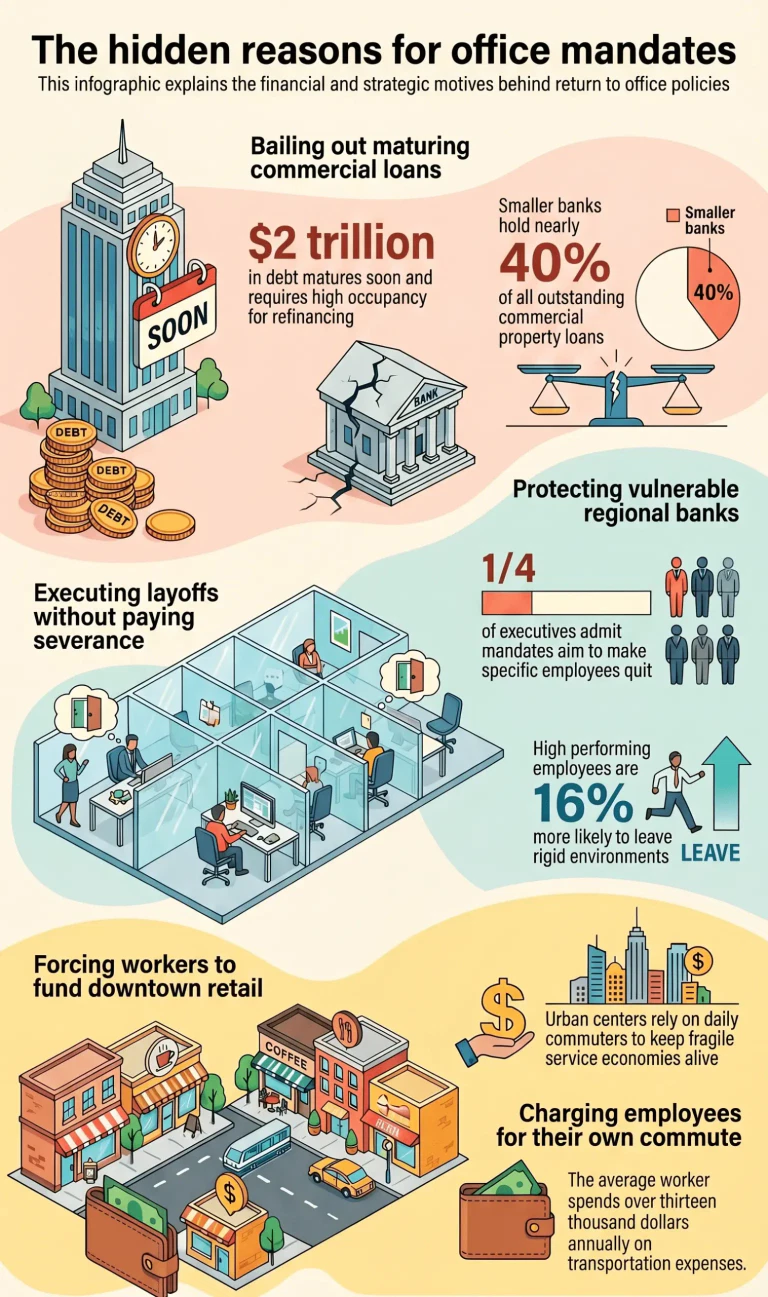
The corporate push for mandatory office attendance has nothing to do with productivity or culture. It is a multi-trillion-dollar financial defense mechanism designed to protect collapsing commercial real estate, execute stealth layoffs, and subsidize failing urban economies:
- 1. Bailing out a $2 trillion commercial debt crisis Between 2024 and 2026, up to $2 trillion in commercial real estate debt is maturing. Empty offices cause property valuations to plummet, threatening regional banks with catastrophic defaults. RTO mandates artificially inflate building occupancy to justify valuations and secure critical refinancing.
- 2. Weaponizing mandates for "stealth layoffs" Corporations are using inflexible attendance policies as a covert tool to force voluntary resignations, effectively cutting bloated payrolls without paying mandatory severance. However, this cynical "quiet firing" tactic severely backfires by driving away the highest-performing employees to direct competitors.
- 3. The forced "commuter tax" subsidizing urban decay Modern downtowns rely heavily on captive commuters to sustain retail and tax bases. By eliminating the commute, workers saved 55 minutes a day and thousands of dollars annually. RTO mandates force employees to sacrifice their time and money (on gas, parking, and lunches) to artificially prop up a fragile, outdated urban planning model.
The corporate narrative surrounding the modern workplace has been carefully sanitized and heavily curated for public consumption over the past few years. Executives dominate business media networks, enthusiastically praising the undeniable magic of spontaneous watercooler conversations and the irreplaceable value of in-person brainstorming sessions. Behind this carefully constructed public relations facade, however, lies a completely different reality. The aggressive push for return to office mandates has become the primary weapon in a high-stakes financial operation designed to protect corporate balance sheets and mask systemic vulnerabilities.
To understand this phenomenon, one must look far beyond the generic corporate memos citing company culture and collaborative synergy. When leadership demands that workers commute five days a week, they are not examining granular productivity metrics or team efficiency reports. They are staring directly at the terrifying collapse of commercial real estate valuations that currently threaten to destabilize regional banking systems and institutional portfolios alike. Office buildings represent massive sunk costs, anchored by inflexible ten-year leases and intricately woven into complex financial derivatives that require physical occupancy to maintain their perceived market value.
Simultaneously, the strategic implementation of rigid physical attendance policies serves a secondary, equally cynical purpose for human resources departments across the globe. During a period of economic uncertainty and post-pandemic bloat, enforcing strict workplace attendance policies acts as a highly effective, covert mechanism for headcount reduction. This specific strategy allows multinational corporations to shed thousands of high-paid employees without the devastating public relations fallout of mass layoffs, and significantly, without paying a single dollar in mandatory severance packages.
Furthermore, this physical relocation of human capital sustains an entirely artificial, localized ecosystem that many municipalities desperately rely upon. The modern metropolis has become highly addicted to the daily, predictable influx of suburban commuters. The local tax bases, retail infrastructure, and service economies require workers to engage in a forced daily commuter routine just to survive. Workers are essentially taxed through their own time, compelled to purchase expensive fuel, overpriced specialty coffee, and downtown lunches just to keep the surrounding municipal economy from entering a terminal decline.
This comprehensive report systematically deconstructs the corporate myths surrounding the modern workplace by analyzing massive datasets collected between 2020 and 2025. By evaluating these hard numbers, we can clearly see the underlying financial mechanics currently at play in the global market. The insistence on returning to the physical office has absolutely nothing to do with how well employees perform their jobs. It is, fundamentally, a brutal, multi-trillion-dollar corporate financial game designed to maintain the urban economic status quo at the direct expense of the modern worker.
The productivity lie
The most pervasive and aggressively defended myth utilized by corporate boards today is that remote setups fundamentally destroy worker output and stifle innovation. Executives repeatedly claim during earnings calls that physical proximity is the only viable way to ensure deep cognitive focus and drive competitive advantage. However, hard analytical data from the years 2020 through 2025 thoroughly destroys this carefully crafted narrative. The evidence overwhelmingly indicates that remote work productivity either directly matches or significantly exceeds the output generated in traditional, densely packed office environments.
The grand illusion of office efficiency is perhaps best exposed by measuring the actual time spent executing meaningful work tasks. Extensive research tracking employee behavior indicates that the average office worker is only genuinely productive for a staggering two hours and 53 minutes per day. The vast majority of the traditional eight-hour shift is entirely consumed by a myriad of environmental time sinks. An estimated 6 hours and 33 minutes are lost weekly to in-office distractions alone, costing large organizations massive amounts of lost potential and delayed deliverables. In stark contrast, flexible working arrangements allow employees to seamlessly optimize their peak cognitive hours without the constant, draining disruption of performative desk presence.
The reality of office time
To truly understand the reality of corporate output, we must deeply examine large-scale institutional research that tracks performance over extended periods. Studies conducted by the Stanford Institute for Economic Policy Research (SIEPR), utilizing comprehensive tracking mechanisms across multiple years, revealed that employees operating under a hybrid work model are just as productive as their full-time office counterparts. Furthermore, teams that have the autonomy to choose their own office days consistently outperform teams that are subjected to arbitrary, top-down attendance mandates.
While some studies found that fully remote work exhibited a slight 10% dip in raw productivity in certain highly specific operational modes, this metric is highly misleading when viewed in total isolation. Fully distributed teams generate massive, compounding cost reductions for their parent firms that easily eclipse this minor friction. The staggering savings derived from reduced real estate footprints and the unique ability to leverage a much cheaper global hiring pool far outweigh any minor operational delays. When organizations actively invest in asynchronous digital collaboration tools, they actually observe a 40% surge in distributed team performance metrics.
Consider the hard telemetry data generated by large technology firms that properly measured digital output rather than mere physical attendance. Software engineers who were placed on structured hybrid schedules consistently wrote 8% more deployable code than those who were forced into the office on a full-time basis. Additionally, massive analytical data from Prodoscore, which rigorously evaluated over 105 million data points from 30,000 corporate users, discovered a definitive 5% increase in baseline output during the initial work-from-home era. The data clearly illustrates that employee output metrics improve dramatically when workers are freed from the artificial constraints of the physical office.
| Productivity Metric | Remote / Hybrid Impact | In-Office Baseline |
| Daily Productive Time | Increased by 10+ minutes | 2 hours 53 minutes |
| Engineering Output | +8% more code generated | Baseline |
| Distraction Time | 50% find it easier to avoid | 6.5 hours lost weekly |
| Employee Engagement | 31% highly engaged | 19% highly engaged |
| Financial Value Add | $3,900 to $13,800 per worker | Baseline |
The concept of multitasking, often highly praised in fast-paced corporate environments, is another major productivity killer that is heavily exacerbated by modern open-plan offices. Cognitive researchers have repeatedly noted that human beings physically cannot focus on multiple complex things at once; they merely engage in rapid, inefficient task-switching. In a standard office environment, it takes just 12 minutes on average before an employee is physically interrupted by a colleague. Reclaiming deep focus after such an interruption takes over 23 minutes. Therefore, a forced in-person work environment inherently fragments attention, completely destroying the deep work states required for modern knowledge tasks.
The inflation argument
Despite this overwhelming mountain of empirical evidence, powerful financial figures continue to push a highly contradictory, anti-data narrative to the public. BlackRock CEO Larry Fink famously went on national television to boldly claim that getting employees back into the physical office would result in rising productivity that would somehow naturally offset macroeconomic inflationary pressures. This massive assertion was made without a single shred of statistical backing, surveys, or peer-reviewed studies. It was a pure ideological push designed to justify a deeply unpopular corporate governance strategy to weary shareholders.
In reality, the National Bureau of Economic Research (NBER) comprehensively proved the exact opposite of Fink's widely broadcast claims. Their detailed economic studies showed that remote work actually acts as a powerful force that decreases core inflation. Because modern employees highly value the extreme flexibility of working from home, they are statistically willing to accept lower baseline wages to secure it. This socio-economic phenomenon directly resulted in a 2% decrease in wage growth over a two-year period, specifically concentrated in high-paying white-collar sectors. By organically reducing wage growth, remote work adoption directly limits consumer spending pressure, acting as a powerful, natural deflationary mechanism.
The underlying contradiction here is absolutely stunning to anyone paying attention. Leaders at major investment firms have unfettered access to the best economic data on the planet, employing armies of analysts who mathematically know that remote workers save employers up to $18,000 per year in real estate and utility costs. Yet, they persist in pushing a provably false narrative to the working public. This extreme cognitive dissonance points to a much darker hidden motive. The relentless push for mandatory office attendance is not about maximizing labor efficiency; it is about protecting a fragile asset class that underpins their entire financial empire.
The real estate time bomb
If the global data decisively proves that remote workers are more productive, significantly cheaper to employ, and much less prone to clinical burnout, why are corporate boards of directors using extreme force to drag them back to cubicles? The uncomfortable answer lies buried deep within the highly leveraged balance sheets of the world's largest financial institutions. The corporate world is currently sitting atop a catastrophic commercial real estate crisis that threatens to trigger a systemic financial meltdown mirroring the devastation of 2008.
Between the critical years of 2024 and 2026, an estimated $1.4 trillion to $2.0 trillion in commercial real estate loans are scheduled to reach their final maturity dates. These are not simple, traditional residential mortgages; these are massive, highly complex financial instruments tied to sprawling suburban office parks and towering downtown glass skyscrapers. When these specific loans were originally originated a decade ago, global interest rates were near zero, and physical building valuations were at all-time historic highs. Today, the fundamental landscape for commercial property investments is entirely broken.
Trillions in maturing debt
When a massive commercial loan finally matures, the corporate borrower cannot simply pay it off with cash on hand; they must immediately refinance it. However, the current restrictive economic environment makes this standard procedure nearly impossible to execute. Interest rates have surged significantly across the board, radically altering the math. If a borrower attempts to secure new financing today, their monthly debt service costs could easily jump by a staggering 50%, with rates hovering in the 6% range. Concurrently, because remote work has physically emptied these buildings, the actual market value of these physical assets has plummeted. This creates a lethal commercial debt spiral for highly leveraged property owners.
If these expensive buildings remain physically empty, strict financial appraisers are legally forced to officially lower their valuations on the books. When a building's appraised value drops below the total value of the loan attached to it, the borrower is effectively underwater, holding a toxic asset. At this critical juncture, many commercial landlords will simply choose to default, walking away and handing the keys back to the lending bank. To urgently prevent this cascade of strategic defaults, corporations must physically occupy the space. A populated, bustling building allows a desperate landlord to justify a slightly higher valuation, which in turn allows them to secure life-saving refinancing. Therefore, strict RTO enforcement policies are essentially a multi-billion dollar lifeline thrown to drowning commercial landlords.
Regional banks face collapse
The terrifying fallout of empty office buildings extends far beyond the immediate landlords and property management firms. Financial institutions, particularly vulnerable mid-sized and regional banks, currently hold approximately 38% of all outstanding commercial real estate loans in the United States. Unlike massive, globally systemic entities that boast highly diversified business models and deep capital reserves, regional banks are dangerously over-leveraged in this specific property sector. If a sudden wave of commercial defaults hits the open market, it will directly threaten the fundamental solvency of these smaller financial lending institutions.
Federal regulators and banking oversight agencies are acutely aware of this looming systemic risk. Throughout late 2023 and 2024, nearly all surveyed banks dramatically tightened their commercial real estate lending standards—an incredibly rare occurrence to see outside of a formally declared economic recession. Panicked lenders are currently desperately extending loan terms and modifying strict covenants just to prevent immediate foreclosures, a highly risky practice known quietly in the financial industry as "extend and pretend". But this artificial, regulatory delay cannot last forever. Without millions of workers physically returning to their desks to justify the rent, the regional banking sector faces catastrophic, localized losses that could easily ripple through the broader global economy.
Institutional investor pressure
The immense pressure to force workers back into these buildings is heavily coordinated by major institutional investors operating behind the scenes. Asset management giants like BlackRock and Vanguard hold immense, often unchecked sway over corporate America through their massive equity holdings. BlackRock, for instance, has massive, direct exposure to commercial real estate ventures globally. When highly hyped property investments like WeWork spectacularly collapsed, massive funds managed by BlackRock and similar entities stood to lose millions in capital. To fiercely protect their diversified portfolios, these shadow regulators exert intense, quiet pressure on the public companies they invest in, demanding strict corporate real estate utilization at all costs.
We can see this exact mechanic playing out clearly with the recent decisions made by Amazon. In early 2025, Amazon announced a draconian, uncompromising five-day return mandate for all corporate staff. While CEO Andy Jassy publicly claimed it was for collaborative innovation and cultural alignment, the hidden financial reality is glaringly obvious. There are currently $4.5 billion in commercial mortgage-backed securities (CMBS) loans tied directly to office properties actively tenanted by Amazon across major tech hubs. If Amazon successfully abandoned these massive offices, the fragile CMBS market would face severe, immediate distress. By fiercely forcing employees back to Seattle, San Francisco, and New York, Amazon is single-handedly stabilizing the office space market in those metropolitan hubs, rescuing the underlying debt.
| Commercial Real Estate Risk Metrics | 2024-2026 Data Points | Systemic Market Implication |
| Total Maturing CRE Debt | $1.4 Trillion to $2.0 Trillion | Massive refinancing gridlock |
| Regional Bank Vulnerability | 38% of all outstanding CRE loans | Potential bank insolvencies |
| Amazon-linked CMBS Loans | $4.5 Billion at direct risk | Mandates stabilize valuations |
| Manhattan Office Availability | Peaked at a dangerous 18% | Forces "doom loop" political fears |
| Average Interest Rate Impact | ~50% increase in debt service | Destroys landlord profitability |
Major financial players are no longer even bothering to hide their aggressive actions. BlackRock itself officially ordered its 1,000 senior managing directors to urgently return to the office five days a week, abandoning their previous hybrid flexibility. JP Morgan’s Jamie Dimon blasted remote work in leaked audio and forced aggressive, punitive attendance policies across the entire banking division. These seasoned leaders are acutely aware that their massive balance sheets are artificially propped up by the perceived, subjective value of physical office space. They are currently fighting a desperate, rearguard battle to maintain the grand illusion of necessity. The massive commercial property bailout is happening in plain sight, funded entirely by the stolen time, energy, and forced commutes of the modern workforce.
Stealth layoffs and attrition
While desperately protecting physical real estate valuations is the primary macro-economic driver for these policies, executives have also discovered a highly lucrative, secondary micro-economic benefit to these mandates. Implementing a draconian, inflexible attendance policy is statistically the most effective method of rapid headcount reduction available in the modern corporate era. In the cynical playbook of corporate human resources, aggressive in-office requirements have become entirely synonymous with stealth layoffs.
Following the aggressive, highly optimistic over-hiring of the pandemic years, tech giants and Fortune 500 companies suddenly found themselves bloated with highly paid, fully remote staff. Traditional, announced layoffs are inherently expensive; they require massive severance packages, trigger highly negative press cycles, and severely damage the remaining corporate culture. However, a strict attendance mandate brilliantly circumvents all of these painful issues. By suddenly demanding that employees return to an office—often hundreds of miles from where they were explicitly hired to live—corporations knowingly force a wave of voluntary resignations, entirely bypassing the need for expensive employee severance payouts.
The quiet firing mechanism
This phenomenon is not a fringe conspiracy theory whispered among disgruntled employees; it is a thoroughly documented, openly utilized corporate strategy. A comprehensive, anonymous study conducted by BambooHR revealed that a shocking 25% of C-suite executives and 18% of HR leaders explicitly admitted they implemented mandates hoping that specific employees would simply quit. This highly calculated tactic, often referred to as "quiet firing," allows a business to rapidly shrink its overall workforce organically. The PR department can simultaneously release glowing statements claiming they are "rebuilding foundational team culture," while the finance department quietly celebrates the massive, immediate reduction in annual payroll expenses.
The modern workforce is entirely aware of this cynical manipulation from the top down. Broad industry surveys indicate that a staggering 72% of US employees strongly suspect these mandates are a deliberate, bad-faith trap designed solely to drive voluntary attrition without the heavy cost of severance. When nearly three-quarters of a workforce firmly believes a core policy is a weaponized HR tactic, any genuine, authentic attempt at building company culture is already dead on arrival. Instead of fostering organic collaboration, these heavy-handed policies create a highly toxic environment centered entirely on self-preservation and malicious compliance, leading directly to the widespread phenomenon of coffee badging behavior.
Workers actively engage in "coffee badging" by maliciously swiping their ID cards at the office turnstile early in the morning, grabbing a complimentary coffee to ensure they are physically seen by middle management, and promptly leaving to finish their actual work in a quiet, productive home environment. Nearly 46% of surveyed workers openly admit to engaging in this exact practice. It is the ultimate, undeniable symptom of a fundamentally broken corporate directive. Employees are merely fulfilling the physical requirement to prop up the real estate metrics, but the promised "magic of in-person collaboration" remains completely, entirely absent. The tracked workplace attendance metrics are artificially inflated, masking the underlying cultural rot.
The catastrophic brain drain
While stealth layoffs successfully and rapidly reduce raw payroll numbers, they are a remarkably blunt, uncontrollable, and highly dangerous instrument. When a company cynically uses a blanket policy to force attrition, they absolutely do not get to choose who walks out the door. Data unequivocally shows that the employees who quickly resign are almost always the exact high-performers the company desperately needs to keep. Exceptional employees, who inherently possess the most leverage and options in a tight labor market, are 16% more likely to have a remarkably low intent to stay when suddenly faced with a rigid mandate. This blindly triggers a catastrophic, highly destructive corporate talent drain.
Rigorous academic research from the University of Chicago targeting major tech firms like Microsoft, SpaceX, and Apple absolutely confirms this disastrous, unintended outcome. The comprehensive study found that strict mandates specifically drive senior, highly experienced employees away at the absolute highest rates. Furthermore, these veteran engineers and battle-tested managers do not leave the tech industry; they immediately defect to direct, large-scale competitors. The resulting human capital cost is utterly staggering to the bottom line. Companies instantly lose irreplaceable operational knowledge, forfeit years of highly specialized training, and essentially hand their best intellectual property directly to their fiercest rivals. The immediate, short-term savings on severance are very quickly eclipsed by the long-term, structural damage to organizational innovation capacity.
| The Attrition Impact of Mandates | Statistical Reality | Strategic Consequence |
| Overall Industry Talent Loss | 80% of companies lost talent | Severe operational disruption |
| Strict Policy Turnover Rate | 13% higher than flexible peers | Constant recruitment costs |
| Executive "Quiet Firing" Intent | 25% hoped staff would quit | Destroys leadership trust |
| High Performer Flight Risk | 16% more likely to leave | Loss of top-tier output |
| Employee Policy Dissatisfaction | 91% (Amazon case study) | Strikes, walkouts, low morale |
Real-world RTO failures
We can clearly observe the catastrophic, deeply embarrassing failure of these policies in real-time across the corporate landscape. Dell Technologies rolled out an aggressive, highly invasive tracking system, meticulously monitoring badge swipes and publicly declaring that remote workers were entirely ineligible for future promotions. The result was disastrous for their internal culture. Nearly 50% of employees bravely chose to remain remote, explicitly stating they valued their daily flexibility over any potential career advancement at the company. Dell effectively created a bitter, resentful two-tier workforce, signaling profound distrust and practically guaranteeing a continuous employee retention crisis for years to come.
Similarly, banking behemoth JPMorgan Chase implemented a rigid, unforgiving five-day requirement without any flexibility for individual circumstances or commuting difficulties. The internal backlash was immediate and fierce, resulting in protest petitions signed by thousands of frustrated employees. When CEO Jamie Dimon publicly and callously dismissed these valid concerns, he deeply alienated his core workforce, an incredibly strange move considering the bank had just posted record net incomes of $58.5 billion under the previous, highly successful hybrid arrangements. These isolated executives are willingly torching employee goodwill and long-term stability just to achieve short-term, artificial reductions in headcount and fiercely protect their commercial asset investments.
Economy of fake movement
If we aggressively zoom out from the isolated balance sheet of the individual corporation, the bizarre insistence on physical office attendance reveals an even larger, much more insidious macroeconomic dependency. Entire municipal ecosystems have been meticulously constructed over decades around the daily, highly predictable migration of suburban workers into dense urban centers. Modern cities are structurally addicted to this massive economy of fake movement. The current system desperately requires millions of people to engage in hours of senseless, unproductive travel every single week simply to stimulate highly localized consumption.
Before the pandemic shattered the illusion, this highly inefficient system was entirely unquestioned by the masses. The average American commuter spends a staggering $13,318 annually on transportation, making it the second-largest household expenditure immediately after housing itself. When workers are forced to commute daily, they burn massive amounts of gasoline, incur rapid vehicle depreciation and maintenance costs, and pay exorbitant, daily fees for downtown parking and crumbling public transit. This enforced physical mobility acts as a massive, invisible tax directly levied on the workforce. By simply eliminating the commute, remote workers saved an average of 55 minutes a day and reclaimed billions of dollars in personal transportation expenditures that they could redirect to their actual families.
The daily commuter tax
However, when empowered workers stop commuting, the surrounding, highly fragile urban infrastructure immediately starves. Downtown central business districts were explicitly, carefully designed to extract maximum wealth from a captive audience of office workers. The local artisanal coffee shops, the overpriced lunchtime salad bars, and the corner dry cleaners simply cannot survive without a guaranteed, massive daily footfall. The American worker currently spends an average of $191 per month dining out, with a massive, highly disproportionate portion of that budget allocated to quick, mandatory weekday lunches near the office. The exploding global coffee market, highly valued at over $138 billion with 73% of adults drinking it daily, relies heavily on the desperate, caffeinated mid-morning routines of exhausted commuters.
When this forced, artificial consumption suddenly stops, major cities face the terrifying, highly publicized prospect of the urban doom loop. A deeply concerning study published by Cushman & Wakefield highlighted this exact vulnerability, noting that in the 15 major cities actively studied, an average of 70% of the entire real estate base in downtown areas was heavily allocated to single-use office space. This extreme, historically unprecedented lack of real estate diversity means that when the offices empty out, the entire surrounding district immediately dies. Retailers quickly go bankrupt, legacy restaurants shutter their doors, and the streets become abandoned, dangerous zones.
| The Cost of the Commuter Economy | Direct Financial Impact | Macro-Economic Effect |
| Annual Transport Spend | $13,318 per household | 17% of total household budget |
| Dining Out Expenditure | $191 per person / month | Sustains downtown restaurants |
| Time Tax on Workers | 55 minutes lost daily | Reduces personal well-being |
| Downtown Real Estate Mix | 70% allocated to offices | Extreme vulnerability to vacancy |
| Global Coffee Market | $138.37 Billion | Reliant on morning transit routines |
The municipal governments and city planners are absolutely panicking. Empty commercial buildings and permanently shuttered retail stores lead directly to a massive, irreversible collapse in commercial property tax revenues and highly vital local sales taxes. Without this critical, consistent funding, desperate cities are forced to severely cut vital public services, which inevitably leads to higher crime rates and a drastically lower quality of life, further driving high-income residents and profitable businesses away. To halt this catastrophic downward spiral, frantic mayors and city planners are applying intense, highly coordinated political pressure on corporate leaders to reinstate mandatory physical attendance immediately.
Subsidizing urban failure
The loud, desperate demand for workers to return is, therefore, a direct demand for them to personally subsidize the catastrophic failure of modern urban planning. Instead of bravely reimagining downtowns as vibrant, mixed-use spaces with diverse residential zoning, cultural hubs, and sustainable green spaces, the entrenched establishment is trying to use brute force to return to the profitable 2019 status quo. They are demanding that the average, hardworking employee sacrifice an hour of precious sleep, endure highly stressful traffic conditions, and spend $25 a day on mediocre coffee and lunch just to keep the local retail economy artificially afloat.
It is an archaic economy built entirely, unashamedly on friction. If an experienced employee can easily complete their specialized tasks from a quiet suburban home office with zero commute and demonstrably higher efficiency, enforcing a mandatory commute is a deliberate act of economic sabotage against that worker. The worker's lost time, mounting stress, and hard-earned money are systematically harvested to quietly pay the commercial landlord, bail out the regional bank, and appease the municipal tax collector. The corporate attendance mandate is nothing more than a highly coordinated mechanism to silently transfer wealth from the employee's pocket back into the bloated, failing ecosystem of corporate real estate and urban dependency.
The ultimate facade
The loud, highly publicized debate over exactly where work should be performed has been intentionally manipulated from the very beginning. Corporate leaders will undoubtedly continue to flood the financial media with vague, entirely unquantifiable anecdotes about mentorship, synergy, and company culture. They will continue to hire expensive PR firms to craft inspiring memos about the vibrant energy of a bustling office. But the hard, unyielding statistical realities deeply embedded in the global economy tell a much different story of cold, calculated financial preservation. The data is utterly irrefutable: distributed work models are highly productive, incredibly cost-effective, and deeply preferred by the elite talent that actually drives global innovation.
The relentless, highly coordinated campaign to reverse this societal progress is a desperate defense mechanism. It is a frantic attempt to quietly defuse a trillion-dollar commercial debt bomb before it completely destroys the regional banking system. It is a highly calculated strategy to successfully execute mass layoffs without paying a dime in severance. And it is a coordinated, political effort to sustain an outdated, highly fragile urban model that relies entirely on the forced daily consumption of millions of exhausted commuters.
The physical office, in its current rigidly mandated form, is no longer a genuine center of productivity or innovation. It is merely a financial instrument. Every single employee swiping a badge at 8:45 AM is not there to collaborate; they are there to physically underwrite the collapsing value of the concrete beneath their feet. The forced return to the office is the greatest, most audacious stealth bailout in modern economic history, and the everyday worker is the one quietly paying the terrible price.


